Green Hydrogen Market Revenue, Trends, and Strategic Insights by 2035
Table of Contents
ToggleGreen Hydrogen Market Size
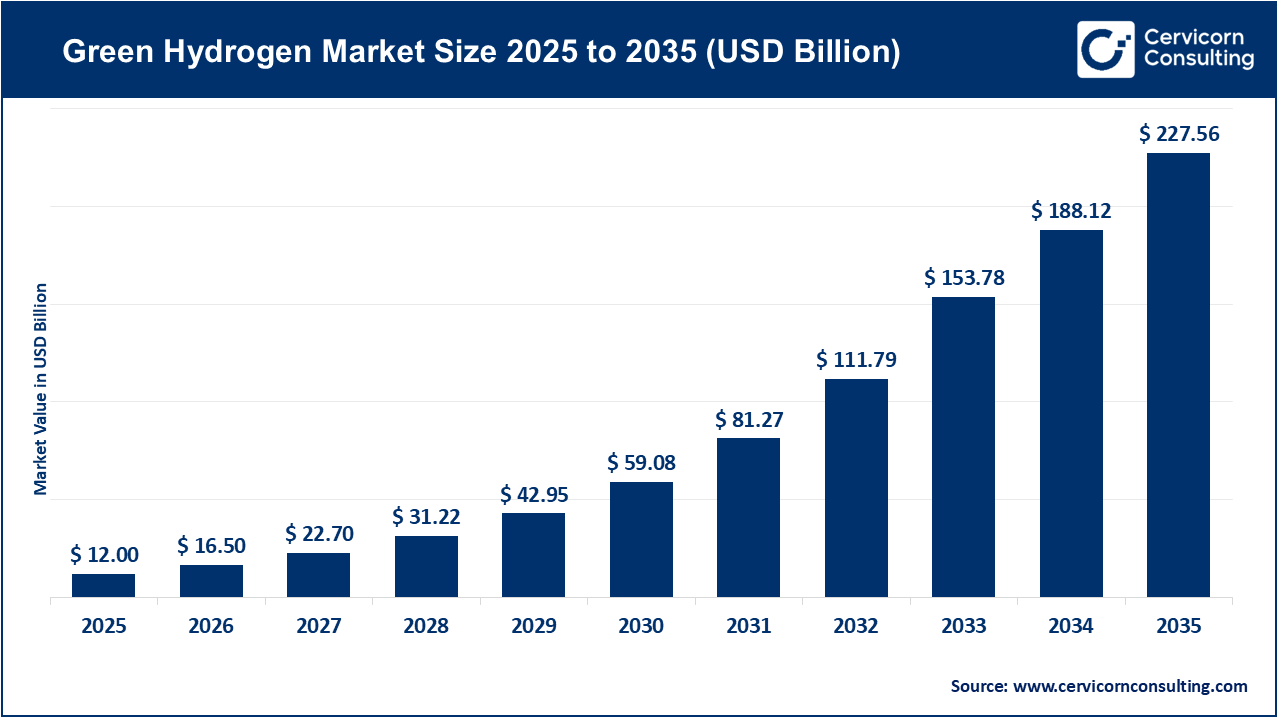
The global green hydrogen market was valued at approximately USD 12 billion in 2025 and is projected to reach around USD 227.56 billion by 2035, expanding at a CAGR of nearly 34.21%.
What is the Green Hydrogen Market?
The green hydrogen market refers to the global industry involved in the production, storage, transportation, distribution, and utilization of hydrogen generated using renewable energy sources such as solar, wind, and hydropower. Green hydrogen is produced through electrolysis, a process in which water is split into hydrogen and oxygen using renewable electricity, resulting in minimal or zero greenhouse gas emissions.
Unlike gray hydrogen, which is produced using natural gas and emits carbon dioxide, green hydrogen is considered a clean fuel that can support long-term sustainability goals. The market encompasses electrolyzer manufacturers, renewable energy developers, hydrogen infrastructure providers, industrial gas companies, fuel cell manufacturers, and transportation solution providers.
The growing adoption of hydrogen across industrial processes, mobility solutions, energy storage systems, and grid balancing applications is accelerating market expansion worldwide. Countries such as Germany, Japan, China, Australia, India, the United States, and Saudi Arabia are investing heavily in hydrogen ecosystems to establish leadership in the future energy economy.
Why is Green Hydrogen Important?
Green hydrogen is gaining global attention because it can decarbonize sectors that are difficult to electrify directly. Heavy industries including steel manufacturing, chemicals, fertilizers, shipping, and aviation require high-energy-density fuels that electricity alone cannot efficiently provide. Green hydrogen offers a clean alternative capable of replacing fossil fuels in these sectors.
Another major advantage of green hydrogen is its ability to store renewable energy for long durations. Since solar and wind power generation can fluctuate due to weather conditions, hydrogen serves as an effective energy storage medium that can stabilize electricity grids and improve energy security.
Green hydrogen also supports the transition toward sustainable transportation. Hydrogen fuel cells are increasingly being used in buses, trucks, trains, ships, and industrial vehicles because they provide faster refueling times and longer operating ranges compared to battery-electric systems.
Additionally, the hydrogen economy is expected to create millions of jobs globally across renewable energy development, electrolyzer manufacturing, infrastructure construction, logistics, engineering, and research activities. Nations investing early in green hydrogen are positioning themselves to become future exporters of clean energy.
Green Hydrogen Market Growth Factors
The green hydrogen market is experiencing remarkable growth due to several interconnected factors, including increasing global commitments toward carbon neutrality, rising investments in renewable energy infrastructure, rapid technological advancements in electrolyzers, declining costs of solar and wind power generation, growing demand for clean industrial feedstocks, expanding adoption of hydrogen-powered transportation systems, supportive government subsidies and tax incentives, large-scale hydrogen production projects, increasing collaborations between energy companies and governments, rising focus on energy security and diversification, development of hydrogen refueling infrastructure, expansion of international hydrogen trade corridors, and growing corporate sustainability initiatives aimed at reducing greenhouse gas emissions across industrial value chains.
Get a Free Sample: https://www.cervicornconsulting.com/sample/2352
Leading Companies in the Green Hydrogen Market
| Company | Specialization | Key Focus Areas | Notable Features | 2025 Revenue | Market Share | Global Presence |
|---|---|---|---|---|---|---|
| Air Liquide | Industrial gases and hydrogen solutions | Hydrogen production, storage, mobility infrastructure | Strong global hydrogen fueling network and industrial partnerships | Over €27 billion annual revenue | Significant global hydrogen supplier | Operations across 70+ countries |
| Linde plc | Industrial gases and engineering | Green hydrogen production, liquefaction, clean mobility | Large-scale hydrogen infrastructure expertise | Around $34 billion sales in 2025 | One of the largest hydrogen market participants | Extensive operations worldwide |
| Hydrogenics Corporation | Hydrogen generation and fuel cell technologies | Electrolyzers and fuel cell systems | Strong expertise in PEM electrolyzers | Integrated under Cummins clean energy division | Important technology provider | North America, Europe, Asia |
| ITM Power | PEM electrolyzer manufacturing | Green hydrogen production systems | Large-scale electrolyzer projects | Approximately £26 million revenue in 2025 | Growing electrolyzer market participant | Europe-focused with international expansion |
| Nel ASA | Electrolyzers and hydrogen fueling stations | Renewable hydrogen infrastructure | Pioneer in alkaline and PEM electrolyzers | Expanding commercial hydrogen portfolio | Major hydrogen technology supplier | Presence across Europe, North America, and Asia |
Leading Trends Shaping the Green Hydrogen Market and Their Impact
Expansion of Large-Scale Electrolyzer Projects
One of the most significant trends in the market is the development of gigawatt-scale electrolyzer facilities. Governments and private investors are funding massive green hydrogen plants powered by solar and wind energy. These projects are expected to reduce production costs significantly through economies of scale while increasing hydrogen availability for industrial and transportation applications.
Integration with Renewable Energy Systems
Green hydrogen is increasingly being integrated with renewable power plants to improve energy storage and grid flexibility. Excess solar and wind energy can be converted into hydrogen during periods of low electricity demand and used later for power generation or industrial consumption. This trend is improving renewable energy utilization rates while enhancing grid reliability.
Growth of Hydrogen Mobility
Hydrogen-powered transportation is expanding rapidly, particularly in heavy-duty vehicles such as trucks, buses, trains, and marine vessels. Countries are investing in hydrogen refueling stations and fuel cell infrastructure to accelerate clean mobility adoption. This trend is reducing emissions in transportation sectors where battery-electric systems face limitations.
Development of International Hydrogen Trade
Nations with abundant renewable resources, such as Australia, Saudi Arabia, Chile, and the United Arab Emirates, are developing hydrogen export strategies. Global hydrogen trade corridors are emerging as countries seek to import clean hydrogen to support industrial decarbonization and energy security goals.
Technological Advancements in Electrolyzers
Continuous innovation in electrolyzer technologies is improving efficiency and lowering production costs. Proton Exchange Membrane (PEM), alkaline, and solid oxide electrolyzers are becoming more commercially viable, enabling wider adoption of green hydrogen across industrial sectors.
Hydrogen Hubs and Industrial Clusters
Several countries are establishing hydrogen hubs where production, storage, transportation, and industrial utilization are integrated into a unified ecosystem. These clusters improve supply chain efficiency and accelerate commercialization efforts.
Successful Examples of Green Hydrogen Projects Around the World
NEOM Green Hydrogen Project – Saudi Arabia
Saudi Arabia’s NEOM project is among the world’s largest green hydrogen initiatives. Powered entirely by renewable energy, the project aims to produce green hydrogen and green ammonia for export markets. It demonstrates how large-scale renewable resources can support clean fuel production while diversifying national economies beyond oil dependency.
HyDeal Ambition – Europe
The HyDeal Ambition initiative seeks to deliver affordable green hydrogen across Europe by integrating solar energy generation, electrolyzer deployment, and industrial hydrogen demand. The project highlights Europe’s commitment to building a competitive hydrogen economy.
Fukushima Hydrogen Energy Research Field – Japan
Japan has positioned itself as a global hydrogen leader through projects such as the Fukushima Hydrogen Energy Research Field. The facility uses renewable energy to produce hydrogen and supports Japan’s long-term vision of becoming a hydrogen-based society.
Asian Renewable Energy Hub – Australia
Australia is investing heavily in green hydrogen exports through projects such as the Asian Renewable Energy Hub. The initiative combines large-scale wind and solar generation with hydrogen production aimed at Asian export markets.
Hydrogen Valley Projects – South Africa
South Africa is developing hydrogen valley initiatives to leverage its renewable energy resources and platinum reserves, which are essential for fuel cell manufacturing. These projects aim to create industrial growth while supporting clean energy adoption.
India’s National Green Hydrogen Mission
India is rapidly expanding its hydrogen ambitions through major investments in renewable energy and domestic electrolyzer manufacturing. The country aims to become a global hub for green hydrogen production and exports while reducing dependence on fossil fuel imports.
Global Regional Analysis of the Green Hydrogen Market
North America
North America is becoming a major player in the green hydrogen market due to strong policy support, advanced industrial infrastructure, and growing investments in clean energy technologies. The United States is witnessing substantial growth in hydrogen hubs, renewable hydrogen projects, and industrial decarbonization initiatives.
The U.S. government has introduced incentives under the Inflation Reduction Act, including tax credits for clean hydrogen production. These measures are attracting billions of dollars in investments from industrial gas companies, energy developers, and technology providers.
Canada is also emerging as an important green hydrogen producer because of its abundant renewable energy resources and strong government support for clean fuel development. Several Canadian provinces are investing in hydrogen export facilities and fuel cell technologies.
Europe
Europe currently represents one of the most advanced green hydrogen markets globally. The European Union has established ambitious hydrogen strategies aimed at reducing greenhouse gas emissions and enhancing energy independence.
Germany leads the European hydrogen economy through large-scale investments in electrolyzers, hydrogen pipelines, and industrial decarbonization projects. France, the Netherlands, Spain, and Denmark are also actively investing in renewable hydrogen ecosystems.
The European Green Deal and REPowerEU initiatives are accelerating hydrogen infrastructure deployment while encouraging cross-border hydrogen trade. Europe is focusing heavily on replacing natural gas with renewable hydrogen across industrial sectors.
Asia-Pacific
The Asia-Pacific region is expected to witness the fastest growth in the green hydrogen market due to rapid industrialization, rising energy demand, and strong government support for clean energy technologies.
China is investing heavily in hydrogen fuel cell vehicles, renewable hydrogen production, and industrial hydrogen applications. The country is rapidly expanding electrolyzer manufacturing capacity and hydrogen transportation infrastructure.
Japan and South Korea are pioneers in hydrogen mobility and fuel cell deployment. Both nations are developing hydrogen import partnerships to secure future clean energy supplies.
India is emerging as a major green hydrogen market through its National Green Hydrogen Mission, which promotes domestic production, export development, and industrial adoption. The country aims to reduce fossil fuel imports while strengthening renewable energy integration.
Australia is leveraging its abundant solar and wind resources to become a leading exporter of green hydrogen and ammonia to Asian markets.
Middle East and Africa
The Middle East is rapidly becoming a global green hydrogen production hub due to abundant renewable energy resources and strategic export capabilities. Countries such as Saudi Arabia, the UAE, and Oman are investing in large-scale hydrogen and ammonia projects aimed at international markets.
Africa also holds strong long-term potential because of its solar energy resources and growing interest in sustainable industrial development. South Africa, Egypt, and Morocco are actively pursuing green hydrogen investment opportunities.
Latin America
Latin America is gaining attention as an emerging green hydrogen production region. Countries including Chile and Brazil are developing hydrogen export strategies supported by strong renewable energy potential.
Chile, in particular, has become a prominent green hydrogen destination due to its world-class solar and wind resources. The government is actively supporting hydrogen investments to position the country as a major global exporter.
Government Initiatives and Policies Shaping the Market
Governments worldwide are playing a crucial role in accelerating the green hydrogen market through subsidies, mandates, tax incentives, funding programs, and infrastructure investments.
The European Union’s Hydrogen Strategy aims to install significant electrolyzer capacity and integrate hydrogen into industrial and transportation sectors. The REPowerEU plan further strengthens investments in renewable hydrogen to reduce dependence on imported fossil fuels.
The United States introduced hydrogen production tax credits under the Inflation Reduction Act, encouraging private investment in clean hydrogen facilities and hydrogen hubs.
India’s National Green Hydrogen Mission supports domestic manufacturing, renewable integration, research activities, and export development. The initiative is expected to accelerate large-scale hydrogen adoption across industrial sectors.
Japan and South Korea have implemented hydrogen roadmaps focused on fuel cell vehicles, hydrogen imports, and infrastructure development.
China’s hydrogen strategy includes fuel cell vehicle expansion, industrial hydrogen adoption, and large-scale renewable energy integration.
Australia is supporting hydrogen export infrastructure and international partnerships to strengthen its role in the global hydrogen trade market.
Saudi Arabia and the UAE are investing heavily in hydrogen megaprojects to diversify their economies and establish leadership in future clean energy exports.
The increasing alignment between climate policies, renewable energy investments, and industrial decarbonization goals is expected to drive long-term growth in the global green hydrogen market.
To Get Detailed Overview, Contact Us: https://www.cervicornconsulting.com/contact-us
Read Report: Artificial Intelligence (AI) in Drug Discovery Market Revenue, Trends, and Strategic Insights by 2035