Hydrogen Blending Market Revenue, Trends, and Strategic Insights by 2035
Hydrogen Blending Market Size
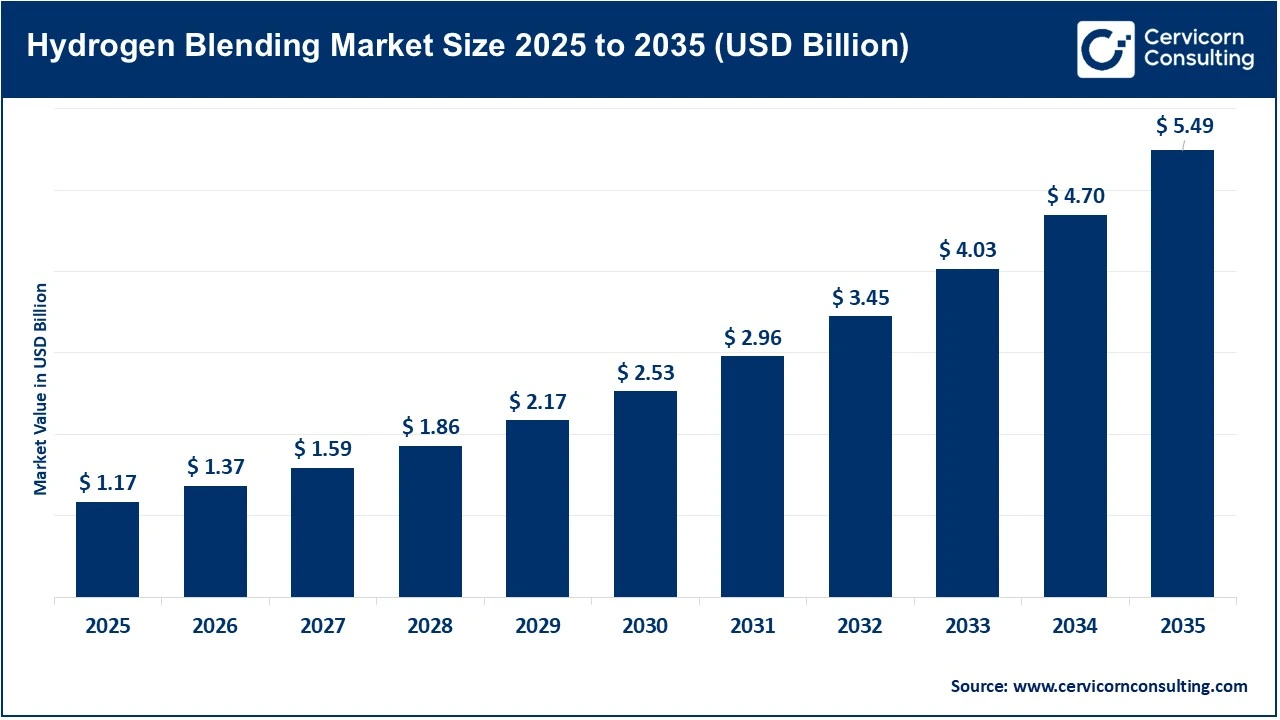
The global hydrogen blending market was valued at approximately USD 1.17 billion in 2025 and is projected to reach nearly USD 5.49 billion by 2035, growing at a CAGR of 16.8%.
What is the Hydrogen Blending Market?
The hydrogen blending market refers to the integration of hydrogen gas into existing natural gas infrastructure, including transmission pipelines, distribution networks, storage facilities, and end-use applications. Hydrogen blending involves mixing a certain percentage of hydrogen with natural gas to reduce carbon emissions while utilizing existing energy infrastructure. This approach serves as a transitional pathway toward a full hydrogen economy by enabling utilities, industrial operators, and governments to decarbonize energy systems without requiring immediate large-scale infrastructure replacement.
Hydrogen blending projects typically involve blending ratios ranging from 5% to 20%, depending on pipeline compatibility, regulatory standards, and end-user requirements. The market encompasses hydrogen production technologies, blending equipment, gas transmission systems, monitoring technologies, storage facilities, and related engineering services.
Why is the Hydrogen Blending Market Important?
Hydrogen blending is gaining strategic importance because it provides a practical and cost-effective route to reducing greenhouse gas emissions from natural gas consumption. As countries pursue net-zero targets, replacing fossil fuels entirely remains challenging due to infrastructure limitations and economic constraints. Hydrogen blending allows energy providers to lower carbon intensity while leveraging existing gas networks.
The market is particularly important for:
- Supporting decarbonization goals.
- Enhancing energy security through diversified energy sources.
- Facilitating renewable energy integration.
- Reducing dependency on imported fossil fuels.
- Creating a scalable pathway toward a hydrogen-based economy.
- Extending the useful life of existing gas infrastructure.
- Enabling industrial sectors to meet sustainability targets.
Hydrogen blending is also viewed as a critical bridge technology that helps governments and utilities gain operational experience with hydrogen before transitioning to dedicated hydrogen infrastructure.
Hydrogen Blending Market Growth Factors
The hydrogen blending market is experiencing substantial growth due to increasing global commitments toward carbon neutrality, rising investments in green hydrogen production, growing deployment of renewable energy projects, supportive government regulations promoting clean energy adoption, modernization of natural gas infrastructure, increasing industrial demand for low-carbon fuels, technological advancements in hydrogen transportation and storage systems, expansion of hydrogen pilot projects across Europe, Asia-Pacific, and North America, growing concerns regarding energy security following geopolitical disruptions, favorable funding mechanisms from international agencies, declining renewable electricity costs that support green hydrogen production, increasing collaboration between utility companies and hydrogen technology providers, and the emergence of national hydrogen strategies that encourage blending initiatives as an intermediate step toward large-scale hydrogen economies.
Major Companies Driving the Hydrogen Blending Market
The hydrogen blending market is heavily influenced by major gas transmission system operators and energy infrastructure companies that are actively testing and deploying hydrogen blending technologies.
| Company | Specialization | Key Focus Areas | Notable Features | 2025 Revenue | Estimated Market Share* | Global Presence |
|---|---|---|---|---|---|---|
| Snam | Gas infrastructure and transmission | Hydrogen backbone development, blending projects, storage | Operator of Europe’s largest gas networks and SoutH2 Corridor participant | €3.89 Billion | 12-15% | Italy, Europe, International partnerships |
| National Gas | UK gas transmission infrastructure | Hydrogen-ready network development, FutureGrid testing | UK’s national gas transmission operator | Private company (not publicly disclosed) | 8-10% | United Kingdom |
| Enagás | Gas transmission and energy infrastructure | Hydrogen corridors, H2Med project, blending initiatives | Leading hydrogen infrastructure developer in Spain | €960.4 Million | 7-9% | Spain, Europe, Latin America |
| Fluxys | Natural gas transmission and LNG infrastructure | Hydrogen transport networks, cross-border connectivity | Extensive European gas infrastructure | Private company (not publicly disclosed) | 6-8% | Belgium, Germany, Switzerland, Europe |
| Gasunie | Gas transportation and storage | Hydrogen transport backbone, hydrogen valleys | Pioneer in Dutch hydrogen ecosystem | State-owned enterprise | 8-10% | Netherlands, Germany, Northern Europe |
Snam
Snam is among the most influential players in the European hydrogen blending landscape. The company is investing heavily in hydrogen-ready infrastructure and plans to establish a comprehensive hydrogen backbone connecting Southern and Northern Europe. Snam reported total revenues of approximately €3.885 billion in 2025 and has allocated significant investments toward hydrogen transport projects. The company’s involvement in the SoutH2 Corridor positions it as a critical enabler of future hydrogen imports and distribution across Europe.
National Gas
National Gas operates the UK’s national gas transmission system and plays a central role in hydrogen blending initiatives. Through projects such as FutureGrid, the company is evaluating how hydrogen can safely be integrated into Britain’s gas infrastructure while maintaining system reliability.
Enagás
Enagás is actively developing hydrogen infrastructure across Spain and Europe. The company is a key participant in the H2Med corridor, which aims to connect hydrogen production centers with major demand hubs. Enagás generated approximately €960.4 million in revenue during 2025.
Fluxys
Fluxys is leveraging its extensive gas transmission and LNG infrastructure to facilitate hydrogen transportation and blending. The company focuses on cross-border hydrogen connectivity across Europe and participates in several EU-funded hydrogen initiatives.
Gasunie
Gasunie is a leader in hydrogen infrastructure development in Northern Europe. The company supports hydrogen valleys, industrial clusters, and transmission projects aimed at integrating hydrogen into existing gas networks while preparing for future dedicated hydrogen pipelines.
Leading Trends in the Hydrogen Blending Market and Their Impact
1. Green Hydrogen Expansion
Rapid growth in renewable-powered electrolysis projects is increasing the availability of green hydrogen for blending applications.
Impact
- Lower carbon emissions.
- Increased renewable energy utilization.
- Reduced dependence on fossil fuels.
2. Hydrogen Backbone Development
European infrastructure operators are constructing hydrogen corridors capable of transporting large hydrogen volumes.
Impact
- Improved cross-border energy trade.
- Creation of regional hydrogen markets.
- Enhanced energy security.
3. Digital Pipeline Monitoring
Advanced sensors and AI-based monitoring systems are improving hydrogen blending operations.
Impact
- Enhanced safety.
- Reduced leakage risks.
- Improved operational efficiency.
4. Increasing Hydrogen Blending Ratios
Many pilot projects are progressing beyond 5% blending toward 20% hydrogen content.
Impact
- Greater carbon reduction.
- Improved commercial viability.
- Faster hydrogen adoption.
5. Industrial Decarbonization
Heavy industries are increasingly adopting hydrogen-blended gas supplies.
Impact
- Reduced industrial emissions.
- Compliance with ESG goals.
- Increased demand for hydrogen infrastructure.
6. Renewable Energy Storage Integration
Hydrogen is increasingly used as a storage medium for excess renewable electricity.
Impact
- Improved grid flexibility.
- Better renewable energy utilization.
- Enhanced energy resilience.
Successful Hydrogen Blending Market Examples Around the World
HyDeploy Project – United Kingdom
The HyDeploy project successfully demonstrated blending up to 20% hydrogen into a public gas network serving residential and commercial customers. The project proved that hydrogen blending could be implemented without requiring modifications to existing appliances.
Key Achievements
- Safe operation at 20% hydrogen blend.
- Regulatory validation.
- Strong consumer acceptance.
FutureGrid Project – United Kingdom
Led by National Gas, FutureGrid is testing hydrogen transportation through the UK’s gas transmission infrastructure.
Key Achievements
- Full-scale pipeline testing.
- Hydrogen network readiness evaluation.
- Development of future hydrogen regulations.
GRHYD Project – France
The GRHYD project demonstrated hydrogen blending for residential heating and transportation applications.
Key Achievements
- Integration of renewable hydrogen.
- Multi-sector application testing.
- Real-world performance validation.
HyNet Project – United Kingdom
HyNet combines hydrogen production, blending, and carbon capture technologies.
Key Achievements
- Regional industrial decarbonization.
- Low-carbon hydrogen production.
- Large-scale infrastructure deployment.
Hydrogen Valley Projects – Netherlands
Several Dutch hydrogen valleys supported by Gasunie are integrating hydrogen production, storage, and distribution systems.
Key Achievements
- Industrial cluster decarbonization.
- Renewable energy integration.
- Commercial-scale hydrogen deployment.
H2Med Corridor – Spain, Portugal, France
The H2Med project, supported by Enagás and European partners, aims to establish a major hydrogen transmission corridor.
Key Achievements
- Cross-border hydrogen infrastructure.
- European market integration.
- Long-term hydrogen trade support.
Global Regional Analysis
North America
North America is emerging as a significant hydrogen blending market driven by strong investments in clean energy and hydrogen infrastructure.
Key Drivers
- Decarbonization initiatives.
- Growing renewable energy capacity.
- Industrial hydrogen demand.
Government Initiatives and Policies
United States
- Inflation Reduction Act (IRA) incentives for clean hydrogen production.
- Department of Energy Hydrogen Shot Initiative.
- Regional Clean Hydrogen Hub Program.
- Federal funding for hydrogen infrastructure development.
Canada
- National Hydrogen Strategy.
- Provincial support programs.
- Investments in green hydrogen export projects.
Market Outlook
North America is expected to witness strong growth as utilities increasingly test hydrogen blending across natural gas networks.
Europe
Europe currently leads the global hydrogen blending market due to aggressive climate targets and extensive gas infrastructure.
Key Drivers
- European Green Deal.
- REPowerEU strategy.
- Strong hydrogen funding mechanisms.
Government Initiatives and Policies
European Union
- Hydrogen Strategy for a Climate-Neutral Europe.
- Trans-European Energy Networks (TEN-E).
- Projects of Common Interest (PCI) funding.
- Renewable Energy Directive (RED III).
Germany
- National Hydrogen Strategy.
- Hydrogen Core Network development.
- Industrial decarbonization incentives.
Italy
- Hydrogen Valley programs.
- Support for SoutH2 Corridor.
- National Recovery and Resilience Plan investments.
Spain
- Hydrogen Roadmap.
- H2Med infrastructure support.
- Renewable hydrogen incentives.
Market Outlook
Europe is expected to remain the largest hydrogen blending market due to extensive pilot programs and large-scale hydrogen corridor investments.
Asia-Pacific
Asia-Pacific is rapidly emerging as a major hydrogen blending market fueled by industrial growth and energy transition goals.
Key Drivers
- Rising energy demand.
- Industrial decarbonization.
- Government hydrogen strategies.
Government Initiatives and Policies
Japan
- Basic Hydrogen Strategy.
- Hydrogen Society Roadmap.
- Large-scale hydrogen import programs.
South Korea
- Hydrogen Economy Roadmap.
- Hydrogen City initiatives.
- Hydrogen infrastructure subsidies.
China
- National Hydrogen Development Plan.
- Provincial hydrogen pilot programs.
- Renewable hydrogen deployment targets.
Australia
- National Hydrogen Strategy.
- Hydrogen export initiatives.
- Renewable hydrogen hub investments.
Market Outlook
Asia-Pacific is expected to become one of the fastest-growing regions due to expanding hydrogen investments and strong government backing.
Latin America
Latin America possesses significant renewable energy resources that support hydrogen production and blending opportunities.
Government Initiatives and Policies
Chile
- National Green Hydrogen Strategy.
- Export-focused hydrogen projects.
- Renewable energy integration programs.
Brazil
- Hydrogen regulatory framework development.
- Renewable hydrogen investment incentives.
- Industrial decarbonization initiatives.
Market Outlook
The region is expected to emerge as an important green hydrogen production hub supplying domestic and international markets.
Middle East & Africa
The Middle East and Africa are increasingly investing in hydrogen as part of economic diversification strategies.
Government Initiatives and Policies
Saudi Arabia
- Vision 2030 hydrogen initiatives.
- NEOM green hydrogen project.
- Renewable energy expansion.
United Arab Emirates
- National Hydrogen Strategy.
- Hydrogen production and export investments.
- Low-carbon energy transition programs.
South Africa
- Hydrogen Society Roadmap.
- Green hydrogen corridor development.
- Industrial decarbonization support.
Market Outlook
The region is expected to become a major hydrogen exporter while gradually incorporating hydrogen blending into domestic energy systems.
To Get Detailed Overview, Contact Us: https://www.cervicornconsulting.com/contact-us
Read Report: CO2 Separation Membrane Market Revenue, Trends, and Strategic Insights by 2035