Artificial Intelligence (AI) in Drug Discovery Market Revenue, Trends, and Strategic Insights by 2035
Artificial Intelligence (AI) in Drug Discovery Market Size
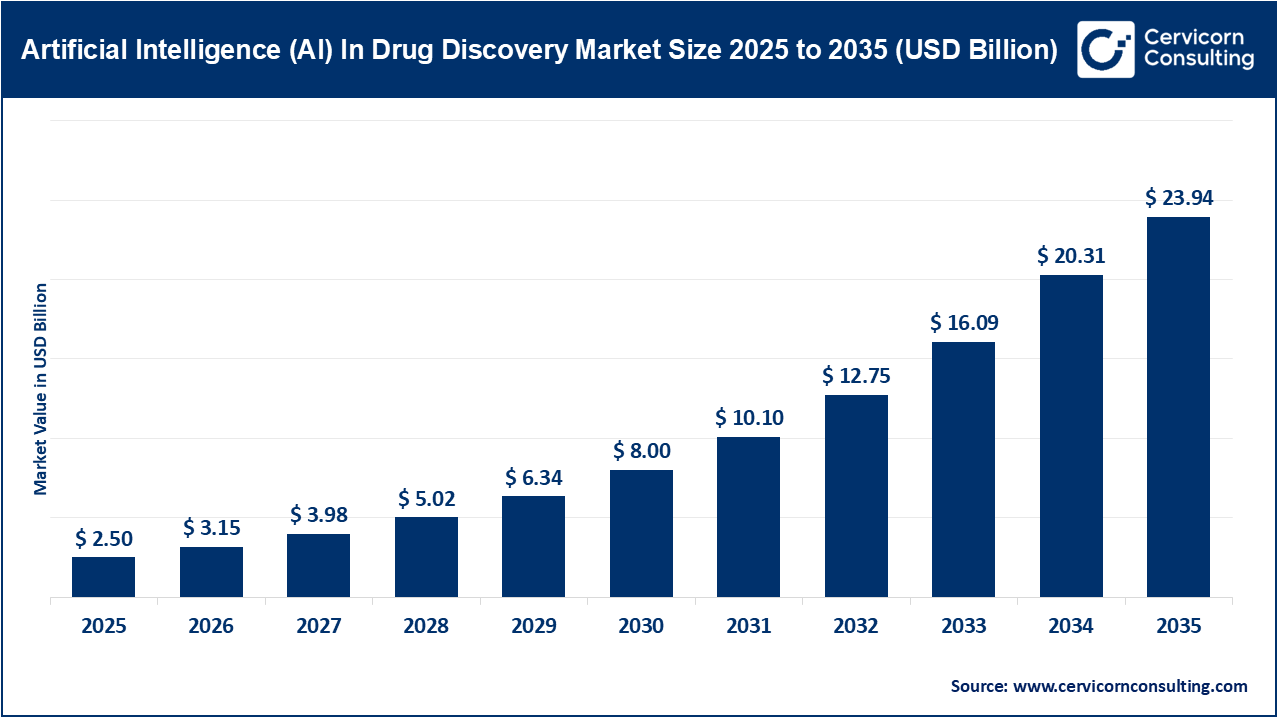
The global artificial intelligence (AI) in drug discovery market was valued at approximately USD 2.50 billion in 2025 and is projected to reach around USD 23.94 billion by 2035, expanding at a CAGR of nearly 26.49%. This growth reflects increasing adoption across pharmaceutical companies, biotech firms, and research institutions seeking faster, more efficient innovation.
What is Artificial Intelligence (AI) in Drug Discovery Market?
The Artificial Intelligence (AI) in drug discovery market refers to the use of advanced computational technologies—such as machine learning, deep learning, natural language processing, and predictive analytics—to accelerate and enhance the process of discovering, designing, and developing new pharmaceutical drugs. Traditionally, drug discovery has been a time-consuming and expensive process, often taking more than a decade and costing over USD 2 billion to bring a single drug to market.
AI transforms this process by analyzing vast datasets that include genomic sequences, chemical structures, clinical trial data, and patient records. It enables researchers to identify potential drug targets, predict molecular behavior, optimize compounds, and even repurpose existing drugs for new therapeutic uses. AI-based platforms can screen millions of compounds in a fraction of the time required by conventional laboratory methods, dramatically reducing development timelines and costs.
Why is Artificial Intelligence (AI) in Drug Discovery Market Important?
AI plays a critical role in modern healthcare innovation, particularly in drug discovery, where inefficiencies have historically limited progress. One of the most significant advantages of AI is its ability to process and interpret complex biological and chemical data at scale. This capability allows scientists to uncover patterns and relationships that would otherwise remain hidden.
The importance of AI in drug discovery can be summarized in several key aspects:
- Accelerated Drug Development: AI reduces the time required to identify viable drug candidates, enabling faster progression from discovery to clinical trials.
- Cost Efficiency: By automating data analysis and reducing failed experiments, AI significantly lowers R&D expenses.
- Precision Medicine: AI facilitates targeted therapies by analyzing patient-specific data, improving treatment outcomes.
- Drug Repurposing: AI identifies new applications for existing drugs, reducing risk and development time.
- Improved Success Rates: Predictive modeling enhances the likelihood of clinical trial success by identifying potential failures early.
Given the rising prevalence of chronic diseases such as cancer, cardiovascular disorders, and neurodegenerative conditions, the demand for innovative therapies is growing. AI provides a scalable solution to meet this demand, making it a cornerstone of the future pharmaceutical ecosystem.
Get a Free Sample: https://www.cervicornconsulting.com/sample/2525
Artificial Intelligence (AI) in Drug Discovery Market Growth Factors
The growth of the artificial intelligence (AI) in drug discovery market is driven by multiple interconnected factors, including the increasing demand for cost-effective drug development processes, the rising prevalence of chronic and complex diseases, and the growing number of clinical trials focused on drug repurposing. Advancements in computing power, cloud infrastructure, and big data analytics have significantly enhanced the capabilities of AI platforms, enabling faster and more accurate data processing. Additionally, the shift toward precision medicine and personalized therapies is encouraging pharmaceutical companies to adopt AI-driven solutions for targeted drug development. Strong investments from venture capital firms, strategic collaborations between technology providers and pharmaceutical companies, and the expansion of AI startups are further accelerating market growth. Moreover, the ability of AI to reduce drug discovery timelines from over a decade to just a few years, while lowering costs substantially, continues to drive widespread adoption across the global healthcare industry.
Key Companies in the Artificial Intelligence (AI) in Drug Discovery Market
Below is a structured overview of major companies operating in this space:
| Company | Specialization | Key Focus Areas | Notable Features | 2024 Revenue* | Market Share* | Global Presence |
|---|---|---|---|---|---|---|
| IBM | AI platforms & cloud computing | Drug discovery analytics, genomics, clinical data integration | Watson AI for healthcare, strong enterprise AI capabilities | ~$61B | Moderate | Global (North America, Europe, Asia) |
| Atomwise Inc. | AI-driven drug discovery | Structure-based drug design, molecule screening | AtomNet platform for deep learning drug discovery | Private | Niche | US, partnerships worldwide |
| BenevolentAI | AI-enabled biomedical research | Target identification, disease modeling | Knowledge graph-based AI platform | ~$100M+ (est.) | Emerging | Europe, US |
| Berg Health (BPGbio) | AI-driven clinical research | Precision medicine, biomarker discovery | Interrogative Biology platform | Private | Niche | US, global collaborations |
| BioSymetrics, Inc. | AI for healthcare analytics | Drug repurposing, clinical insights | Augusta AI platform integrating clinical datasets | Private | Niche | North America, Europe |
*Note: Revenues and shares are approximate/indicative where public data is limited for private firms.
These companies are shaping the competitive landscape by leveraging proprietary AI platforms, forming partnerships with pharmaceutical giants, and focusing on specialized therapeutic areas.
Leading Trends and Their Impact
1. Drug Repurposing Using AI
AI is increasingly used to identify new therapeutic uses for existing drugs. This approach reduces development time and risk since safety profiles are already established. It also accelerates response to emerging health crises.
Impact: Faster market entry and reduced costs.
2. Integration of Generative AI
Generative AI models are being used to design novel molecules and predict their biological activity. These models can simulate millions of chemical combinations.
Impact: Enhanced innovation and discovery of previously unknown drug candidates.
3. Cloud-Based AI Platforms
Cloud computing enables scalable data processing and collaboration among global research teams.
Impact: Improved accessibility and reduced infrastructure costs.
4. Precision Medicine and Genomics
AI is driving personalized medicine by analyzing genetic data to tailor treatments.
Impact: Better patient outcomes and targeted therapies.
5. Strategic Collaborations
Partnerships between tech companies and pharmaceutical firms are increasing, such as collaborations involving AI labs and biotech companies.
Impact: Accelerated innovation and shared expertise.
Successful Examples of AI in Drug Discovery Around the World
1. Recursion Pharmaceuticals (USA)
Recursion uses AI and automation to analyze biological data and identify drug candidates. It has successfully developed AI-generated molecules for rare diseases and oncology.
2. Insilico Medicine (USA/Hong Kong)
Insilico Medicine developed a fibrosis drug candidate using AI in record time, demonstrating the potential of generative AI in drug design.
3. DeepMind’s AlphaFold (UK)
DeepMind revolutionized protein structure prediction with AlphaFold, enabling researchers to understand protein folding and accelerate drug discovery.
4. Exscientia (UK)
Exscientia created the first AI-designed drug to enter clinical trials, significantly reducing development timelines.
5. Takeda Pharmaceutical (Japan)
Takeda has leveraged AI to develop treatments for diseases like psoriasis, highlighting the growing adoption in Asia.
These examples demonstrate how AI is transitioning from theoretical potential to real-world impact, with increasing success in clinical applications.
Global Regional Analysis Including Government Initiatives and Policies
North America
North America dominates the AI in drug discovery market, accounting for over 50% of global revenue share. The region benefits from:
- Strong R&D investments
- Presence of leading pharmaceutical and AI companies
- Advanced healthcare infrastructure
Government Initiatives:
- U.S. FDA promoting AI integration in drug development
- NIH funding for AI-based biomedical research
- Public-private partnerships to accelerate innovation
Europe
Europe is a key market driven by innovation and regulatory support.
Key Countries: UK, Germany, France
Government Policies:
- EU AI strategy promoting ethical AI use
- Funding programs for digital health and biotech
- Support for startups like BenevolentAI
Asia-Pacific
Asia-Pacific is the fastest-growing region due to increasing investments and expanding healthcare infrastructure.
Key Countries: China, Japan, India, South Korea
Government Initiatives:
- China’s AI development plan focusing on healthcare innovation
- Japan’s investment in AI-driven drug discovery
- India’s push for digital health and biotech startups
Latin America
Emerging adoption driven by improving healthcare systems and growing interest in AI technologies.
Challenges: Limited infrastructure and funding
Middle East & Africa
Gradual growth supported by government investments in healthcare digitization.
Key Initiatives:
- UAE and Saudi Arabia investing in AI healthcare ecosystems
- Expansion of research collaborations
Market Dynamics and Future Outlook
The artificial intelligence (AI) in drug discovery market is poised for exponential growth, driven by technological advancements and increasing healthcare demands. While challenges such as data quality, regulatory concerns, and high initial investment remain, the long-term benefits far outweigh these barriers.
AI is expected to become an integral part of the pharmaceutical value chain, from early-stage research to post-market surveillance. As more companies adopt AI-driven platforms and governments continue to support innovation, the market will witness significant transformation in the coming years.
To Get Detailed Overview, Contact Us: https://www.cervicornconsulting.com/contact-us
Read Report: HVAC System Market Revenue, Trends, and Strategic Insights by 2035