AI in Steel Market Revenue, Trends, and Strategic Insights by 2035
AI in Steel Market Size
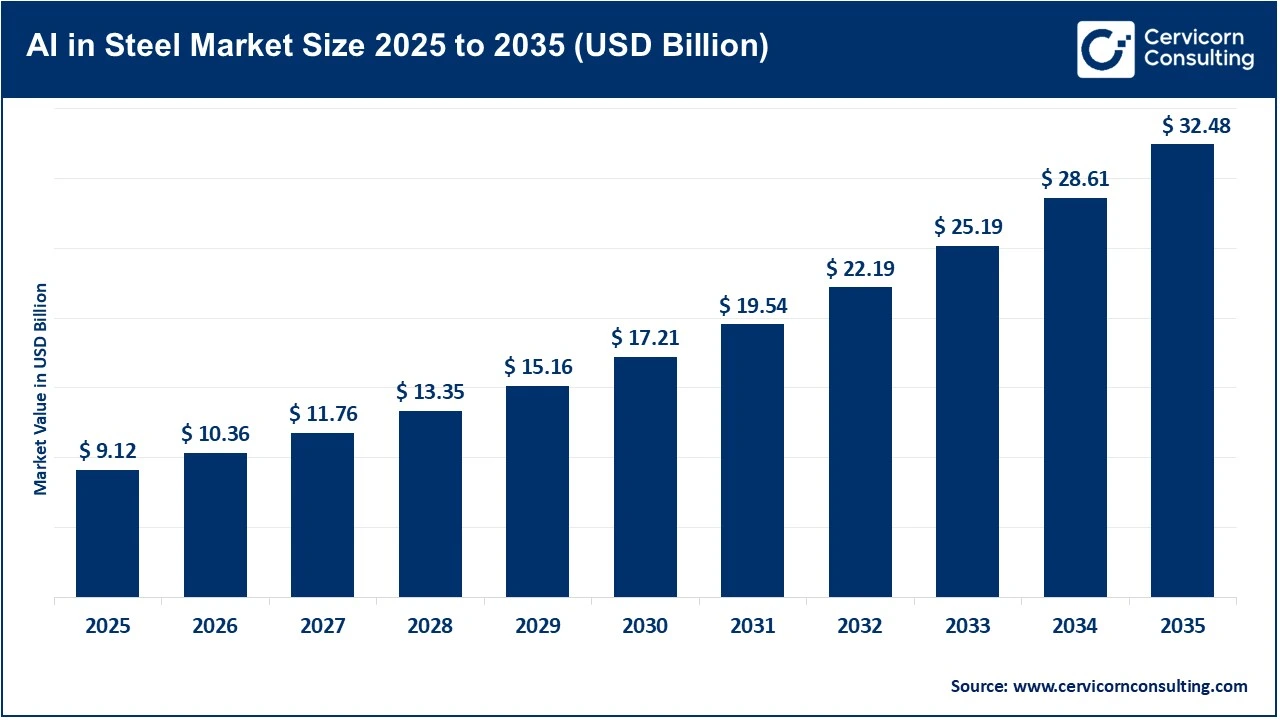
The global AI in steel market was valued at approximately USD 9.12 billion in 2025 and is projected to reach around USD 32.48 billion by 2035, expanding at a CAGR of nearly 13.5%.
What is AI in Steel Market?
The AI in steel market refers to the integration and deployment of artificial intelligence technologies across steel manufacturing operations, supply chains, quality management systems, and industrial automation processes. AI solutions in the steel sector include machine learning algorithms, intelligent sensors, robotics, predictive analytics software, computer vision systems, digital twins, and cloud-based industrial platforms.
These technologies are designed to optimize production efficiency, reduce operational costs, improve workplace safety, and enhance product quality. AI systems analyze massive volumes of real-time operational data generated during steel manufacturing processes to identify inefficiencies, predict equipment failures, automate quality inspections, and improve resource utilization.
AI applications in the steel industry include:
- Predictive maintenance of heavy machinery and furnaces
- Automated defect detection in steel sheets and coils
- Energy consumption optimization
- Intelligent production scheduling
- Process automation in rolling mills
- Supply chain optimization
- Workforce safety monitoring
- Emission control and sustainability management
- Demand forecasting and inventory planning
The market covers AI software providers, industrial automation companies, cloud platform vendors, robotics manufacturers, and digital transformation service providers serving steel producers worldwide.
Get a Free Sample: https://www.cervicornconsulting.com/sample/2959
Why AI in Steel Market is Important?
AI is becoming critically important for the steel industry because manufacturers must simultaneously increase production efficiency, reduce operational costs, improve sustainability, and comply with strict environmental regulations. Traditional steel manufacturing methods often involve high energy consumption, equipment downtime, inconsistent product quality, and labor-intensive operations. AI technologies address these challenges by enabling real-time monitoring, predictive decision-making, and intelligent process automation.
One of the most important benefits of AI in steel manufacturing is predictive maintenance. Steel plants operate massive machinery under extreme conditions, and unexpected failures can result in costly production disruptions. AI-powered predictive maintenance systems analyze sensor data to identify potential equipment issues before failures occur, reducing downtime and maintenance costs.
AI also improves product quality through advanced computer vision systems capable of detecting microscopic defects in steel surfaces during production. This helps manufacturers reduce waste, improve customer satisfaction, and maintain consistent quality standards.
Sustainability is another major factor driving AI adoption. Steel production contributes significantly to global carbon emissions. AI-driven energy optimization systems help manufacturers reduce fuel consumption, lower emissions, and improve energy efficiency. As governments impose stricter environmental regulations, AI becomes an essential tool for achieving sustainability goals.
In addition, AI enhances worker safety by monitoring hazardous industrial environments, identifying risks, and automating dangerous tasks. Smart factories powered by AI can improve operational transparency, enable remote monitoring, and support faster decision-making.
AI in Steel Market Growth Factors
The growth of the AI in steel market is being driven by the increasing adoption of Industry 4.0 technologies, rising demand for operational efficiency, growing focus on predictive maintenance, and expanding investments in industrial automation. Steel manufacturers worldwide are investing heavily in AI-based digital transformation initiatives to reduce production costs, optimize resource utilization, and improve product quality. The rising need for sustainable manufacturing and carbon emission reduction is also accelerating the adoption of AI-driven energy management systems across steel plants.
Furthermore, growing competition in the global steel industry is encouraging companies to deploy intelligent analytics and automation technologies to improve productivity and maintain profitability. Advancements in cloud computing, edge analytics, industrial IoT, and machine learning algorithms are further supporting market expansion by enabling real-time monitoring and data-driven decision-making. Government initiatives promoting smart manufacturing, industrial digitization, and green steel production are also contributing significantly to the market’s long-term growth.
Leading Companies in the AI in Steel Market
| Company | Specialization | Key Focus Areas | Notable Features | 2025 Revenue | Market Share | Global Presence |
|---|---|---|---|---|---|---|
| Siemens | Industrial automation and digitalization | Smart manufacturing, digital twins, AI analytics | Strong Industry 4.0 ecosystem and AI-enabled industrial platforms | Approx. USD 85 billion | Strong global industrial automation share | Europe, Asia Pacific, North America, Middle East |
| ABB | Robotics and industrial automation | Intelligent robotics, predictive maintenance, process automation | Advanced AI-powered robotics and energy optimization solutions | Approx. USD 33 billion | Major player in industrial AI automation | Global operations across more than 100 countries |
| Honeywell | Industrial software and process automation | Smart plants, AI analytics, operational optimization | AI-driven industrial control systems and predictive analytics | Approx. USD 39 billion | Significant presence in industrial AI systems | North America, Europe, Asia Pacific |
| Rockwell Automation | Manufacturing automation and smart factory systems | Industrial IoT, AI-enabled manufacturing execution systems | Advanced factory automation and real-time analytics | Approx. USD 9 billion | Strong position in factory automation | North America, Europe, Asia Pacific, Latin America |
| Schneider Electric | Energy management and industrial automation | Smart energy systems, industrial AI platforms, sustainability solutions | AI-driven energy efficiency and digital transformation tools | Approx. USD 42 billion | Leading energy automation provider | Global operations across industrial regions |
Leading Trends in the AI in Steel Market and Their Impact
1. Predictive Maintenance and Asset Optimization
Predictive maintenance is one of the most widely adopted AI applications in steel manufacturing. Steel plants operate highly complex equipment, including blast furnaces, rolling mills, conveyors, and cooling systems. AI algorithms analyze operational data from sensors and connected devices to predict machinery failures before they occur.
This trend is significantly reducing maintenance costs, minimizing downtime, and improving overall equipment effectiveness. Companies implementing predictive maintenance systems are achieving better plant reliability and longer equipment life cycles.
2. Digital Twins in Steel Manufacturing
Digital twin technology is gaining momentum in the steel industry. A digital twin is a virtual representation of a physical manufacturing process or facility. AI-enabled digital twins allow manufacturers to simulate plant operations, optimize production workflows, and identify process inefficiencies.
The impact of this trend includes improved operational visibility, faster decision-making, reduced production risks, and better resource utilization. Steel producers are increasingly using digital twins to improve furnace efficiency and optimize energy consumption.
3. AI-Powered Quality Inspection
Computer vision and machine learning technologies are transforming steel quality inspection processes. Traditional inspection methods often rely on manual monitoring, which can be inconsistent and time-consuming.
AI-powered inspection systems use high-resolution cameras and image recognition algorithms to detect surface defects, cracks, thickness variations, and structural inconsistencies in real time. This trend is helping manufacturers reduce product defects, improve consistency, and increase customer satisfaction.
4. Energy Optimization and Green Steel Production
Sustainability is becoming a major focus area for the global steel industry. AI is playing a critical role in optimizing energy usage and reducing carbon emissions during steel production.
AI systems monitor fuel consumption, furnace temperatures, and production parameters to improve energy efficiency. Manufacturers are increasingly adopting AI-driven solutions to support green steel initiatives and meet global climate targets.
This trend is expected to have a long-term impact on the industry by enabling lower operational costs and improved environmental performance.
5. Integration of Industrial IoT and Edge Computing
Industrial IoT devices generate massive volumes of operational data within steel plants. AI combined with edge computing enables real-time processing of this data close to the source.
This trend improves operational responsiveness, reduces latency, and supports real-time decision-making. Smart sensors connected to AI platforms are enhancing monitoring capabilities across production facilities.
6. Autonomous Robotics and Smart Automation
Robotics and AI-driven automation systems are increasingly being used for hazardous and repetitive tasks in steel plants. Autonomous robots can perform material handling, welding, inspection, and maintenance activities with higher precision and improved safety.
The impact of this trend includes improved worker safety, increased productivity, reduced labor dependency, and more efficient manufacturing operations.
Successful Examples of AI in Steel Market Around the World
ArcelorMittal
ArcelorMittal has implemented AI-powered predictive maintenance and smart manufacturing systems across several production facilities. The company uses AI algorithms to monitor blast furnace performance, optimize raw material consumption, and improve production efficiency.
AI-driven analytics have helped the company reduce equipment downtime and improve energy efficiency, supporting its sustainability goals.
Tata Steel
Tata Steel has adopted AI technologies for quality inspection, process optimization, and supply chain management. The company utilizes machine learning models to improve steel quality consistency and optimize manufacturing operations.
AI-based defect detection systems help identify surface irregularities during production, reducing waste and enhancing product reliability.
POSCO
South Korean steel producer POSCO is recognized for its smart factory initiatives. The company uses AI, industrial IoT, and robotics to automate production processes and improve operational efficiency.
POSCO has implemented AI-driven systems for predictive maintenance and intelligent process control, resulting in reduced operational costs and improved plant productivity.
Nippon Steel Corporation
Nippon Steel has integrated AI technologies into blast furnace operations and process optimization systems. The company uses AI models to improve temperature control, optimize fuel efficiency, and enhance steel quality.
AI adoption has enabled Nippon Steel to improve operational precision and support environmentally sustainable manufacturing practices.
China Baowu Steel Group
China Baowu Steel Group has invested heavily in AI-powered smart manufacturing solutions. The company uses AI and big data analytics to optimize production scheduling, energy management, and logistics operations.
Its smart factory initiatives have contributed to improved operational efficiency and enhanced competitiveness in the global steel market.
Global Regional Analysis of AI in Steel Market
North America
North America represents a significant market for AI adoption in the steel industry due to the strong presence of industrial automation companies, advanced manufacturing infrastructure, and growing investments in digital transformation.
The United States is leading regional adoption as steel manufacturers increasingly implement AI-powered predictive maintenance, robotics, and industrial IoT systems. Companies are focusing on improving productivity and reducing operational costs through intelligent automation.
Government Initiatives and Policies
The U.S. government is promoting advanced manufacturing technologies through initiatives supporting Industry 4.0, smart factories, and industrial modernization. Funding programs focused on clean energy and sustainable manufacturing are encouraging steel companies to adopt AI-driven energy optimization systems.
Environmental regulations related to carbon emissions are also pushing manufacturers to invest in AI technologies that improve energy efficiency and support decarbonization efforts.
Canada is also supporting industrial digitalization through innovation programs and investments in advanced manufacturing research.
Europe
Europe is one of the leading regions in the AI in steel market due to strong industrial automation capabilities, sustainability regulations, and widespread Industry 4.0 adoption.
Countries such as Germany, France, Italy, and the United Kingdom are investing heavily in smart manufacturing technologies. European steel manufacturers are focusing on reducing carbon emissions and improving operational efficiency through AI-powered solutions.
Germany remains a major hub for industrial AI innovation, supported by the country’s advanced engineering and manufacturing ecosystem.
Government Initiatives and Policies
The European Union’s Green Deal and carbon neutrality targets are significantly influencing the adoption of AI technologies in steel manufacturing. Policies aimed at reducing industrial emissions are encouraging steel producers to invest in AI-driven energy optimization and emission monitoring systems.
European governments are also supporting research and development initiatives related to digital manufacturing, robotics, and AI integration.
Programs promoting industrial sustainability and smart factories are accelerating the deployment of intelligent manufacturing systems across the region.
Asia Pacific
Asia Pacific dominates the global steel industry and is expected to remain the largest market for AI adoption in steel manufacturing. The region includes major steel-producing countries such as China, India, Japan, and South Korea.
Rapid industrialization, large-scale manufacturing operations, and increasing investments in automation technologies are driving market growth. Steel manufacturers in Asia Pacific are adopting AI to improve efficiency, reduce energy consumption, and maintain global competitiveness.
China is leading the region due to its extensive steel production capacity and strong focus on industrial digitalization. Japan and South Korea are also major contributors due to their advanced robotics and automation capabilities.
Government Initiatives and Policies
China’s “Made in China 2025” initiative strongly supports smart manufacturing, robotics, and AI adoption in industrial sectors, including steel manufacturing. The government is encouraging companies to modernize production facilities using digital technologies.
India is promoting industrial modernization through initiatives such as “Digital India” and “Make in India,” which encourage the adoption of advanced manufacturing technologies.
Japan’s Society 5.0 strategy supports AI integration, industrial automation, and smart factory development. South Korea is also investing heavily in AI and industrial robotics through government-backed innovation programs.
Latin America
Latin America is gradually adopting AI technologies in steel manufacturing as companies seek to improve operational efficiency and remain competitive in global markets.
Brazil and Mexico are among the key regional markets due to their growing industrial sectors and steel production capabilities. Manufacturers are investing in automation systems, predictive maintenance, and energy optimization technologies.
Government Initiatives and Policies
Governments across Latin America are supporting industrial modernization and digital transformation initiatives aimed at improving manufacturing productivity.
Several countries are encouraging foreign investments in industrial automation and smart manufacturing infrastructure. Sustainability initiatives related to energy efficiency and emission reduction are also contributing to AI adoption in steel manufacturing.
Middle East and Africa
The Middle East and Africa region is experiencing growing adoption of AI technologies in the steel industry due to increasing investments in industrial diversification and infrastructure development.
Countries such as Saudi Arabia and the United Arab Emirates are investing in smart manufacturing technologies as part of broader economic diversification strategies.
Steel manufacturers in the region are increasingly implementing AI-driven automation systems to improve efficiency and reduce operational costs.
Government Initiatives and Policies
Saudi Arabia’s Vision 2030 program is supporting industrial modernization, digital transformation, and advanced manufacturing initiatives. The UAE is also promoting AI adoption through national AI strategies and smart industry programs.
Governments across the region are encouraging investments in Industry 4.0 technologies, including AI, robotics, and industrial automation, to strengthen manufacturing competitiveness and reduce dependency on traditional industries.
Future Outlook of AI in Steel Market
The future of the AI in steel market appears highly promising as manufacturers continue to prioritize automation, sustainability, and digital transformation. AI technologies are expected to become increasingly integrated into every stage of steel production, from raw material procurement to finished product delivery.
Advancements in machine learning, generative AI, industrial robotics, and real-time analytics will further improve production efficiency and operational intelligence. The growing emphasis on carbon neutrality and green steel production will continue to drive investments in AI-powered energy optimization systems.
Cloud computing, digital twins, and edge analytics are expected to play an increasingly important role in enabling connected and intelligent steel manufacturing ecosystems. In addition, partnerships between steel producers and technology companies will accelerate innovation and support the development of smarter and more sustainable production facilities.
As global competition intensifies, AI adoption will become essential for steel manufacturers seeking to improve profitability, maintain product quality, and achieve long-term operational resilience in a rapidly evolving industrial landscape.
To Get Detailed Overview, Contact Us: https://www.cervicornconsulting.com/contact-us
Read Report: Green Hydrogen Market Revenue, Trends, and Strategic Insights by 2035