South Korea Humanoid Robot Market Revenue, Trends, and Strategic Insights by 2035
Table of Contents
ToggleSouth Korea Humanoid Robot Market Size
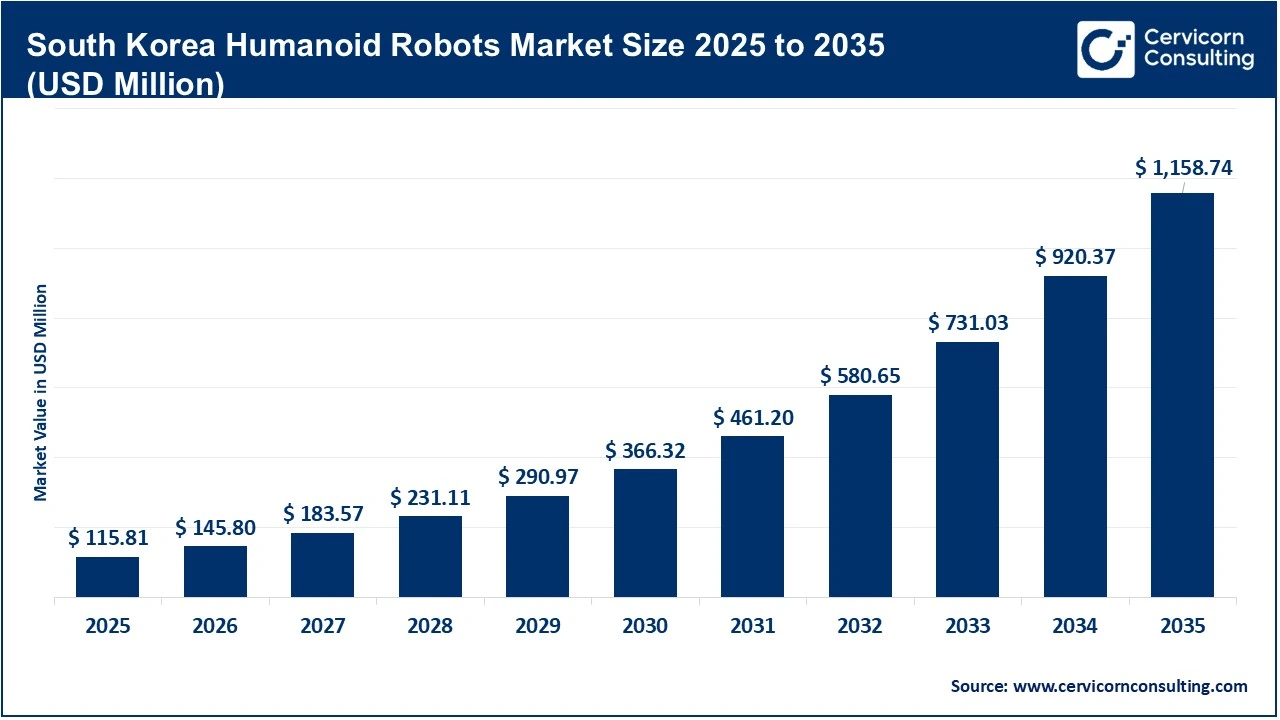
The South Korea humanoid robot market was valued at approximately USD 115.81 million in 2025 and is projected to reach nearly USD 1158.74 million by 2035, growing at a CAGR of 26%.
South Korea Humanoid Robot Market Growth Factors
The growth of the South Korea humanoid robot market is driven by a combination of demographic, technological, industrial, and policy-related factors. Rapid population aging and declining birth rates are creating labor shortages across manufacturing, healthcare, logistics, and service industries, increasing demand for intelligent robotic assistance. Strong government investments in AI, robotics, and smart manufacturing initiatives are accelerating research, development, and commercialization efforts. Advances in artificial intelligence, machine vision, sensors, edge computing, and battery technologies are significantly improving humanoid robot capabilities and reducing operational limitations. South Korea’s globally competitive electronics and semiconductor industries provide a strong technological foundation for humanoid robot production.
Increasing adoption of Industry 4.0 practices, smart factories, and digital transformation strategies is further driving demand for advanced robotic systems. Rising investments from major corporations, venture capital firms, and research institutions are supporting innovation and market expansion. Additionally, growing demand for service robots in healthcare, retail, hospitality, education, and public administration is creating new opportunities for humanoid robot deployment throughout the country.
What is the South Korea Humanoid Robot Market?
The South Korea humanoid robot market encompasses the development, manufacturing, deployment, and commercialization of robots designed with human-like physical structures and intelligent capabilities. These robots typically feature arms, legs, sensors, cameras, AI processors, and communication systems that enable them to interact with people and perform tasks in human-centric environments.
Humanoid robots are designed to undertake activities such as:
- Material handling and assembly operations
- Customer service and reception functions
- Elderly care and healthcare assistance
- Warehouse and logistics operations
- Educational support and training
- Security and surveillance activities
- Research and development applications
Unlike conventional industrial robots that operate in fixed environments, humanoid robots can adapt to dynamic surroundings and collaborate directly with humans. Their ability to navigate existing workplaces without major infrastructure modifications makes them particularly attractive for future automation strategies.
Get a Free Sample: https://www.cervicornconsulting.com/sample/2984
Why the South Korea Humanoid Robot Market is Important
Addressing Workforce Challenges
South Korea faces one of the world’s lowest birth rates and rapidly aging demographics. Humanoid robots can help address workforce shortages by performing repetitive, hazardous, or physically demanding tasks.
Enhancing Industrial Productivity
Manufacturers are increasingly adopting advanced robotics to improve efficiency, reduce costs, and maintain global competitiveness. Humanoid robots provide flexible automation capabilities suitable for evolving production requirements.
Supporting Economic Growth
The humanoid robot industry contributes to economic expansion by creating new business opportunities in AI, software, electronics, sensors, semiconductor technologies, and robotic services.
Strengthening Technological Leadership
South Korea aims to maintain its position as a global technology leader. Investment in humanoid robotics supports innovation across multiple industries while enhancing national competitiveness.
Improving Healthcare and Elderly Care
As the aging population grows, humanoid robots can assist healthcare professionals, support elderly care facilities, and improve quality of life for senior citizens.
Major Companies Operating in the South Korea Humanoid Robot Market
Company Comparison Table
| Company | Specialization | Key Focus Areas | Notable Features | Estimated 2025 Revenue | Estimated Market Share |
|---|---|---|---|---|---|
| Rainbow Robotics | Humanoid and collaborative robotics | Humanoid robots, mobility systems, AI robotics | Developer of HUBO technology and advanced humanoid platforms | USD 120–150 Million | 12–15% |
| LG Electronics | AI-driven service robots | Hospitality, logistics, customer interaction robots | Integration of AI, IoT, and smart ecosystem capabilities | USD 60–65 Billion (Corporate Revenue) | 10–12% |
| Samsung Electronics | AI, semiconductors, robotics R&D | Home robots, intelligent assistants, humanoid robotics research | Advanced AI chips and ecosystem integration | USD 180–220 Billion (Corporate Revenue) | 15–18% |
| HD Hyundai Robotics | Industrial automation and robotics | Manufacturing automation and industrial humanoid systems | Strong industrial deployment expertise | USD 350–450 Million | 8–10% |
| Doosan Robotics | Collaborative and intelligent robots | Service robots, industrial automation, AI robotics | Global collaborative robot leadership | USD 100–150 Million | 10–12% |
Rainbow Robotics
Specialization
Rainbow Robotics specializes in humanoid robots, collaborative robots, autonomous mobility systems, and advanced robotic platforms.
Key Focus Areas
- Humanoid robot development
- AI-powered robotic systems
- Mobility and navigation technologies
- Research and educational robotics
- Industrial automation
Notable Features
Rainbow Robotics is widely known for its connection to HUBO, one of the world’s most recognized humanoid robot platforms developed from Korean robotics research initiatives. The company continues to advance humanoid mobility, manipulation capabilities, and AI integration.
Market Position
The company has become one of South Korea’s leading humanoid robot innovators and has attracted significant industry attention through strategic investments and technology partnerships.
LG Electronics
Specialization
LG Electronics focuses on AI-enabled service robots, smart automation solutions, and customer interaction technologies.
Key Focus Areas
- Hospitality robots
- Customer service automation
- Smart building robotics
- Healthcare support systems
- AI-powered interaction technologies
Notable Features
LG leverages its expertise in artificial intelligence, consumer electronics, IoT ecosystems, and smart devices to develop intelligent robots capable of interacting naturally with users.
Market Position
LG’s strong global presence and extensive technological ecosystem position the company as an influential participant in South Korea’s expanding humanoid robotics landscape.
Samsung Electronics
Specialization
Samsung Electronics focuses on AI, semiconductor technologies, robotics research, and intelligent automation systems.
Key Focus Areas
- Home robotics
- Personal assistant robots
- AI processors
- Edge computing
- Smart home integration
Notable Features
Samsung’s strengths in semiconductor manufacturing, AI research, and consumer electronics provide a powerful foundation for next-generation humanoid robot development.
Market Position
The company continues to invest heavily in robotics innovation and has demonstrated multiple AI-enabled robotic concepts designed for home and commercial environments.
HD Hyundai Robotics
Specialization
HD Hyundai Robotics specializes in industrial robotics, automation systems, and smart manufacturing solutions.
Key Focus Areas
- Industrial automation
- Smart factories
- Robotic manufacturing systems
- Autonomous operations
- Human-robot collaboration
Notable Features
The company has extensive expertise in industrial automation and is leveraging its manufacturing capabilities to expand into more intelligent and adaptive robotic systems.
Market Position
HD Hyundai Robotics plays a critical role in supporting South Korea’s industrial transformation through advanced robotic solutions.
Doosan Robotics
Specialization
Doosan Robotics is recognized for collaborative robots and intelligent automation technologies.
Key Focus Areas
- Collaborative robotics
- AI-powered automation
- Service robotics
- Manufacturing support systems
- Human-robot interaction
Notable Features
The company has gained international recognition for developing user-friendly robotic platforms that safely operate alongside human workers.
Market Position
Doosan Robotics continues to expand its global footprint while investing in advanced robotic technologies relevant to humanoid applications.
Leading Trends in the South Korea Humanoid Robot Market and Their Impact
Artificial Intelligence Integration
AI is transforming humanoid robots from programmed machines into adaptive systems capable of learning, decision-making, and natural interaction.
Impact
- Improved autonomy
- Enhanced task execution
- Better customer interaction
- Increased workplace productivity
Generative AI and Large Language Models
Humanoid robots are increasingly incorporating advanced language models that allow them to communicate naturally with humans.
Impact
- More intuitive interactions
- Better customer service experiences
- Enhanced educational and healthcare applications
Human-Robot Collaboration
Organizations are adopting collaborative robots that work alongside employees rather than replacing them.
Impact
- Higher operational efficiency
- Improved workplace safety
- Reduced labor shortages
Advanced Mobility Technologies
Developments in actuators, sensors, and control systems are improving robot movement and stability.
Impact
- Expanded deployment environments
- Greater task flexibility
- Increased commercial viability
Smart Factory Adoption
South Korea’s manufacturing sector continues to embrace Industry 4.0 technologies.
Impact
- Increased demand for intelligent robots
- Enhanced production efficiency
- Improved quality control
Healthcare Robotics Expansion
Hospitals and elderly care facilities are exploring humanoid robots for assistance and patient engagement.
Impact
- Better healthcare accessibility
- Reduced caregiver burden
- Enhanced patient support services
Semiconductor-Driven Innovation
South Korea’s semiconductor leadership is enabling the development of more powerful robotic processors.
Impact
- Faster AI computations
- Improved energy efficiency
- Enhanced robot intelligence
Successful Examples of South Korea Humanoid Robot Market Around the World
HUBO Humanoid Robot
HUBO remains one of South Korea’s most recognized humanoid robot achievements. The platform demonstrated advanced mobility, manipulation, and autonomous capabilities that attracted global attention and established South Korea as a leader in humanoid robotics research.
Rainbow Robotics’ Advanced Humanoid Platforms
Rainbow Robotics has developed sophisticated humanoid technologies that have been showcased internationally, highlighting South Korea’s expertise in robotic mobility and AI integration.
LG Service Robots
LG’s service robots have been deployed in hotels, airports, hospitals, and commercial facilities across multiple countries, demonstrating practical humanoid-inspired applications in customer-facing environments.
Samsung Robotics Innovations
Samsung’s robotic concepts and AI-powered assistant technologies have influenced global discussions around the future of personal robotics and intelligent home automation.
Doosan Collaborative Robots
Doosan Robotics has successfully expanded into North America, Europe, and Asia-Pacific markets, proving South Korea’s capability to compete globally in advanced robotics solutions.
Korean Smart Manufacturing Facilities
South Korea’s highly automated manufacturing facilities serve as global examples of successful robot integration, combining AI, automation, and industrial robotics to achieve world-class productivity levels.
Government Initiatives and Policies Shaping the South Korea Humanoid Robot Market
National Robotics Strategy
The South Korean government has identified robotics as a strategic industry for national growth and technological competitiveness. Multiple national roadmaps support robotics innovation, commercialization, and deployment.
Key Objectives
- Accelerate robotics R&D
- Strengthen domestic manufacturing
- Promote commercialization
- Increase global competitiveness
K-Robot Industry Promotion Policies
The government continues to invest in robotics through industry promotion programs that encourage innovation, startup growth, and technology adoption.
Impact
- Increased private-sector investment
- Enhanced research collaboration
- Faster technology commercialization
AI National Strategy
South Korea’s broader AI strategy provides significant support for humanoid robotics development through investments in machine learning, data infrastructure, and intelligent systems.
Impact
- Improved robot intelligence
- Enhanced AI capabilities
- Greater automation adoption
Smart Factory Expansion Programs
Government-led smart manufacturing initiatives encourage businesses to deploy advanced robotics and automation technologies.
Impact
- Higher industrial robot adoption
- Increased demand for intelligent robotic systems
- Improved manufacturing competitiveness
Research and Development Funding
Government agencies provide substantial funding to universities, research institutes, and private companies working on robotics innovation.
Impact
- Accelerated technological advancement
- Stronger innovation ecosystem
- Development of next-generation humanoid robots
Human Capital Development Programs
South Korea is investing in robotics education, engineering training, and workforce development to ensure sufficient talent availability.
Impact
- Expanded robotics expertise
- Stronger research capabilities
- Sustainable industry growth
Regulatory Support for Robotics Deployment
Government agencies are working to create regulatory frameworks that support safe deployment of autonomous and intelligent robotic systems.
Impact
- Faster commercialization
- Improved public acceptance
- Greater investor confidence
Public-Private Partnerships
Collaboration between government organizations, universities, and private companies is accelerating humanoid robotics innovation.
Impact
- Faster technology transfer
- Stronger commercialization pathways
- Increased global competitiveness
The combination of advanced technological capabilities, strong corporate participation, supportive government policies, and growing demand across industries positions South Korea as one of the world’s most promising markets for humanoid robots, with significant opportunities for innovation, commercialization, and global leadership throughout the coming decade.
To Get Detailed Overview, Contact Us: https://www.cervicornconsulting.com/contact-us
Read Report: Fuel Cell Market Revenue, Trends, and Strategic Insights by 2035