Active Electronic Components Market Revenue, Trends, and Strategic Insights by 2035
Table of Contents
ToggleActive Electronic Components Market Size
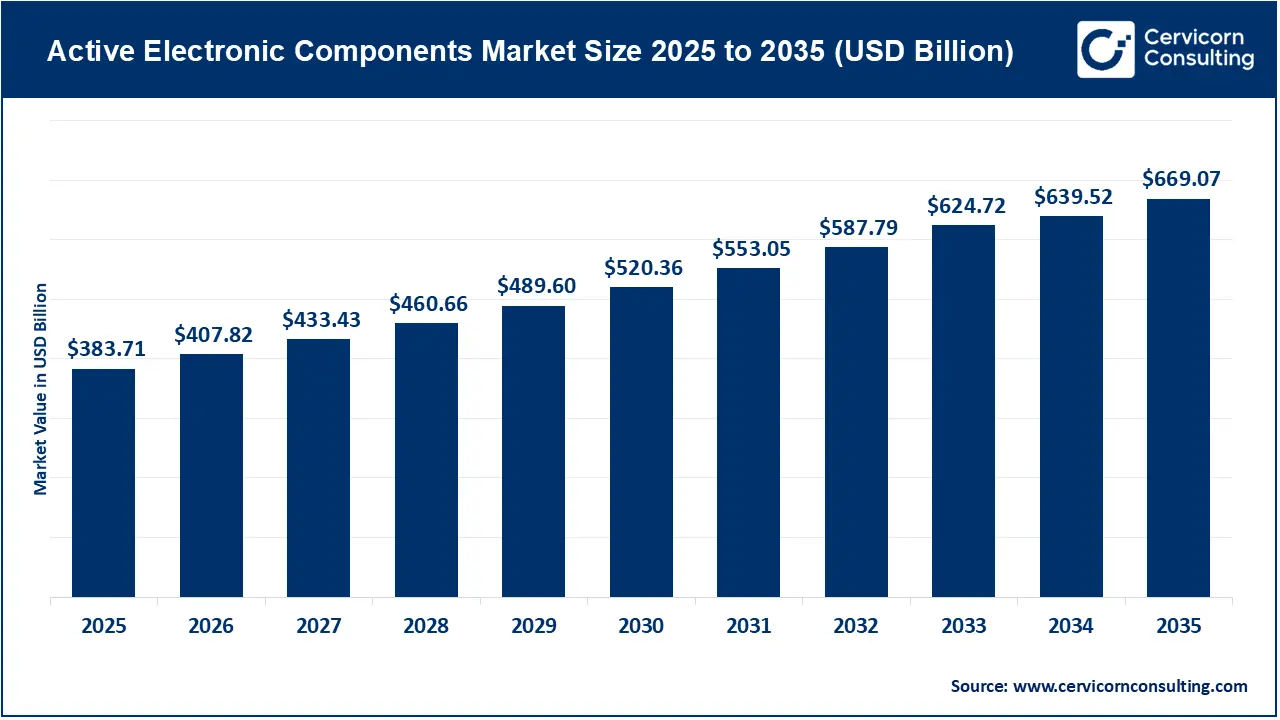
The global active electronic components market was valued at approximately USD 383.71 billion in 2025 and is projected to reach nearly USD 669.07 billion by 2035, growing at a CAGR of 5.72%.
What is the Active Electronic Components Market?
The active electronic components market encompasses the manufacturing, development, and commercialization of electronic devices that require electrical power to perform specific functions within circuits. These components include:
- Semiconductors
- Integrated Circuits (ICs)
- Microprocessors
- Microcontrollers
- Power Transistors
- Diodes
- Sensors
- Memory Chips
- Amplifiers
- Power Management ICs
These components are widely utilized in various applications, including:
- Consumer electronics
- Automotive electronics
- Healthcare equipment
- Industrial automation
- Aerospace and defense
- Telecommunications
- Data centers
- Renewable energy systems
Modern electronic products rely heavily on active components to provide intelligence, connectivity, signal processing, and energy efficiency.
Why the Active Electronic Components Market is Important
The active electronic components market plays a vital role in enabling technological innovation and economic growth worldwide. Every digital device, from smartphones and laptops to advanced medical equipment and autonomous vehicles, depends on active electronic components for operation.
The market’s importance stems from several factors:
Foundation of Digital Transformation
Active components enable computing, networking, communication, and automation technologies that power the digital economy.
Essential for Artificial Intelligence
AI processors, graphics processing units (GPUs), and neural processing units (NPUs) depend on advanced semiconductor technologies to perform complex computations.
Driving Automotive Innovation
Modern vehicles contain hundreds of electronic components that support safety systems, infotainment, battery management, and autonomous driving capabilities.
Supporting Renewable Energy
Solar inverters, wind energy systems, and energy storage solutions rely on power semiconductors and control systems for efficient operation.
Enhancing Industrial Productivity
Factories increasingly deploy smart sensors, programmable controllers, and industrial robots powered by active electronic components.
Enabling Global Connectivity
5G infrastructure, satellite communication systems, and cloud computing platforms depend heavily on high-performance semiconductors and networking chips.
Get a Free Sample: https://www.cervicornconsulting.com/sample/2553
Active Electronic Components Market Growth Factors
The active electronic components market is experiencing robust growth due to the rapid expansion of consumer electronics, increasing deployment of 5G networks, rising adoption of electric and autonomous vehicles, growing investments in semiconductor fabrication facilities, widespread implementation of industrial automation technologies, expanding Internet of Things (IoT) ecosystems, increasing demand for cloud computing and hyperscale data centers, advancements in artificial intelligence and machine learning hardware, government support for domestic semiconductor manufacturing, growing utilization of renewable energy systems requiring power electronics, rising healthcare digitization, increasing defense modernization programs, and continuous technological innovation aimed at improving processing power, energy efficiency, and connectivity across industries.
Leading Trends Shaping the Active Electronic Components Market
1. Artificial Intelligence Semiconductor Boom
AI is transforming semiconductor design and demand patterns across the electronics industry.
Impact on the Market
- Increased demand for AI accelerators
- Higher investments in advanced chip manufacturing
- Expansion of edge AI computing
- Growth in machine learning processors
Industries ranging from healthcare to finance increasingly require specialized chips capable of handling AI workloads efficiently.
2. Rapid Expansion of Electric Vehicles
Electric vehicles require significantly more semiconductors than traditional internal combustion engine vehicles.
Impact on the Market
- Growing demand for power semiconductors
- Increased adoption of battery management systems
- Expansion of automotive-grade microcontrollers
- Growth in advanced driver assistance systems (ADAS)
The automotive sector has become one of the largest consumers of active electronic components globally.
3. Growth of 5G Infrastructure
Telecommunication providers are accelerating 5G deployments worldwide.
Impact on the Market
- Increased demand for RF semiconductors
- Expansion of networking processors
- Higher investments in communication chips
- Growth in wireless connectivity solutions
5G technology requires advanced active components capable of supporting ultra-fast data transmission.
4. Industrial Automation and Industry 4.0
Manufacturers are increasingly implementing smart factory technologies.
Impact on the Market
- Rising demand for industrial sensors
- Increased use of programmable logic controllers
- Growth in robotics systems
- Expansion of industrial communication networks
Factories now rely on intelligent electronic systems to improve productivity and operational efficiency.
5. Edge Computing Development
Data processing is moving closer to the source of information generation.
Impact on the Market
- Growth in embedded processors
- Increased deployment of edge AI chips
- Rising demand for low-power semiconductors
- Expansion of IoT-enabled devices
Edge computing reduces latency and improves real-time decision-making capabilities.
6. Sustainability and Energy Efficiency
Governments and businesses are focusing on reducing energy consumption.
Impact on the Market
- Development of energy-efficient chips
- Increased demand for power management ICs
- Growth in renewable energy applications
- Expansion of smart grid infrastructure
Energy-efficient electronics have become a major competitive advantage for manufacturers.
Competitive Landscape of the Active Electronic Components Market
Major Industry Participants
The market is highly competitive and dominated by global semiconductor manufacturers investing heavily in research and development, advanced manufacturing facilities, AI technologies, automotive electronics, and next-generation communication solutions.
| Company | Specialization | Key Focus Areas | Notable Features | 2025 Revenue (Approx.) | Market Share | Global Presence |
|---|---|---|---|---|---|---|
| Advanced Micro Devices (AMD) | High-performance computing and graphics processors | AI processors, CPUs, GPUs, Data Centers | Ryzen and EPYC processor families | USD 30+ Billion | Significant in CPUs and AI accelerators | North America, Europe, Asia-Pacific, Middle East |
| Analog Devices, Inc. | Analog and mixed-signal semiconductors | Industrial automation, healthcare, automotive | Precision sensing and signal processing solutions | USD 10+ Billion | Leading analog semiconductor supplier | Operations in over 30 countries |
| Broadcom Inc. | Connectivity and infrastructure semiconductors | Networking, broadband, wireless communication | Enterprise networking and data center solutions | USD 50+ Billion | Major communication chip supplier | Global operations across Americas, Europe, and Asia |
| Infineon Technologies AG | Power semiconductors and automotive electronics | EVs, renewable energy, industrial power systems | Leadership in power electronics | USD 20+ Billion | Strong automotive semiconductor position | Europe, Asia-Pacific, North America |
| Intel Corporation | Microprocessors and semiconductor manufacturing | AI, PCs, data centers, foundry services | Advanced semiconductor manufacturing capabilities | USD 55+ Billion | One of the world’s largest chipmakers | Presence in more than 100 countries |
Successful Examples of the Active Electronic Components Market Around the World
Tesla’s Electric Vehicle Ecosystem
Tesla vehicles utilize thousands of active electronic components including:
- Power semiconductors
- Microcontrollers
- Battery management ICs
- AI processing chips
The company demonstrates how active components drive innovation in transportation.
NVIDIA AI Data Centers
Modern AI data centers depend on advanced processors and networking chips for machine learning workloads.
Benefits include:
- Faster AI model training
- Improved cloud computing efficiency
- Enhanced big data analytics
These facilities represent one of the fastest-growing applications for active electronic components.
Samsung Consumer Electronics
Samsung integrates advanced semiconductors into smartphones, televisions, memory devices, and smart appliances.
Results include:
- Enhanced device performance
- Improved energy efficiency
- Seamless connectivity experiences
Samsung showcases large-scale integration of active electronic components across product categories.
Siemens Smart Manufacturing Systems
Industrial automation systems developed by Siemens rely on:
- Industrial processors
- Sensors
- Power management devices
- Communication modules
These technologies improve productivity and support Industry 4.0 initiatives.
Huawei 5G Network Infrastructure
5G base stations require highly sophisticated semiconductors and communication components.
Benefits include:
- Ultra-low latency
- Faster mobile broadband
- Increased IoT connectivity
This demonstrates the critical role of active components in telecommunications infrastructure.
Global Regional Analysis of the Active Electronic Components Market
North America
North America remains a global innovation hub for semiconductor development and advanced electronics manufacturing.
Key Market Drivers
- Strong AI investments
- Expanding cloud computing infrastructure
- Growth of electric vehicle production
- Significant defense electronics spending
Government Initiatives and Policies
United States CHIPS and Science Act
The U.S. government introduced substantial funding programs aimed at strengthening domestic semiconductor manufacturing and reducing dependence on overseas supply chains.
Key objectives include:
- Expanding fabrication capacity
- Supporting R&D activities
- Creating high-tech jobs
- Enhancing national security
Regional Outlook
The region is expected to maintain leadership in AI processors, advanced computing, and semiconductor innovation.
Europe
Europe continues to strengthen its position in automotive electronics, industrial automation, and power semiconductor technologies.
Key Market Drivers
- Growth of electric mobility
- Industrial digitalization
- Renewable energy expansion
- Smart manufacturing adoption
Government Initiatives and Policies
European Chips Act
The European Union launched strategic initiatives to increase semiconductor production capacity and improve supply chain resilience.
Key focus areas include:
- Semiconductor investments
- Advanced manufacturing facilities
- Research collaborations
- Technology sovereignty
Regional Outlook
Europe is likely to remain a leader in automotive semiconductors and industrial power electronics.
Asia-Pacific
Asia-Pacific dominates global electronics manufacturing and semiconductor production.
Key Market Drivers
- Large-scale electronics manufacturing
- Rapid urbanization
- Rising consumer electronics demand
- Strong semiconductor ecosystem
Government Initiatives and Policies
China’s Semiconductor Self-Sufficiency Strategy
China continues investing heavily in domestic chip production and semiconductor innovation.
South Korea Semiconductor Development Programs
Government-backed investments support memory chips, AI processors, and advanced semiconductor technologies.
Japan Semiconductor Revitalization Policies
Japan is promoting strategic partnerships and manufacturing investments to strengthen domestic semiconductor capabilities.
India’s Semiconductor Mission
India has introduced incentives and production-linked schemes aimed at attracting semiconductor manufacturing and packaging facilities.
Regional Outlook
Asia-Pacific is expected to remain the largest regional market due to its extensive manufacturing base and growing domestic consumption.
Latin America
Latin America is gradually increasing its participation in electronics manufacturing and digital infrastructure development.
Key Market Drivers
- Telecommunications expansion
- Rising smartphone adoption
- Industrial modernization
- Growing renewable energy projects
Government Initiatives and Policies
Governments across Brazil, Mexico, and Chile are supporting digital transformation and manufacturing modernization through investment incentives and technology development programs.
Regional Outlook
The region offers significant opportunities for component suppliers targeting emerging technology markets.
Middle East and Africa
The Middle East and Africa region is witnessing increasing demand for advanced electronic technologies.
Key Market Drivers
- Smart city projects
- Renewable energy investments
- Telecommunications infrastructure development
- Industrial diversification strategies
Government Initiatives and Policies
Saudi Vision 2030
Saudi Arabia is investing heavily in technology infrastructure, smart cities, and industrial diversification.
UAE Digital Economy Programs
The UAE is promoting semiconductor-related innovation, AI adoption, and advanced manufacturing initiatives.
Regional Outlook
Growing technology investments are expected to increase demand for active electronic components across multiple sectors.
Future Opportunities in the Active Electronic Components Market
Several emerging opportunities are expected to accelerate market expansion:
- Artificial intelligence hardware
- Quantum computing systems
- Autonomous vehicles
- Smart healthcare devices
- Advanced robotics
- Edge computing infrastructure
- Renewable energy electronics
- Smart grids
- Aerospace electronics
- Next-generation communication networks
As governments and industries continue investing in digital transformation, active electronic components will remain central to innovation across virtually every sector of the global economy.
To Get Detailed Overview, Contact Us: https://www.cervicornconsulting.com/contact-us
Read Report: Stroke Diagnostic and Therapeutic Market Revenue, Trends, and Strategic Insights by 2035