Ammonia Market Revenue, Trends, and Strategic Insights by 2035
Table of Contents
ToggleAmmonia Market Size
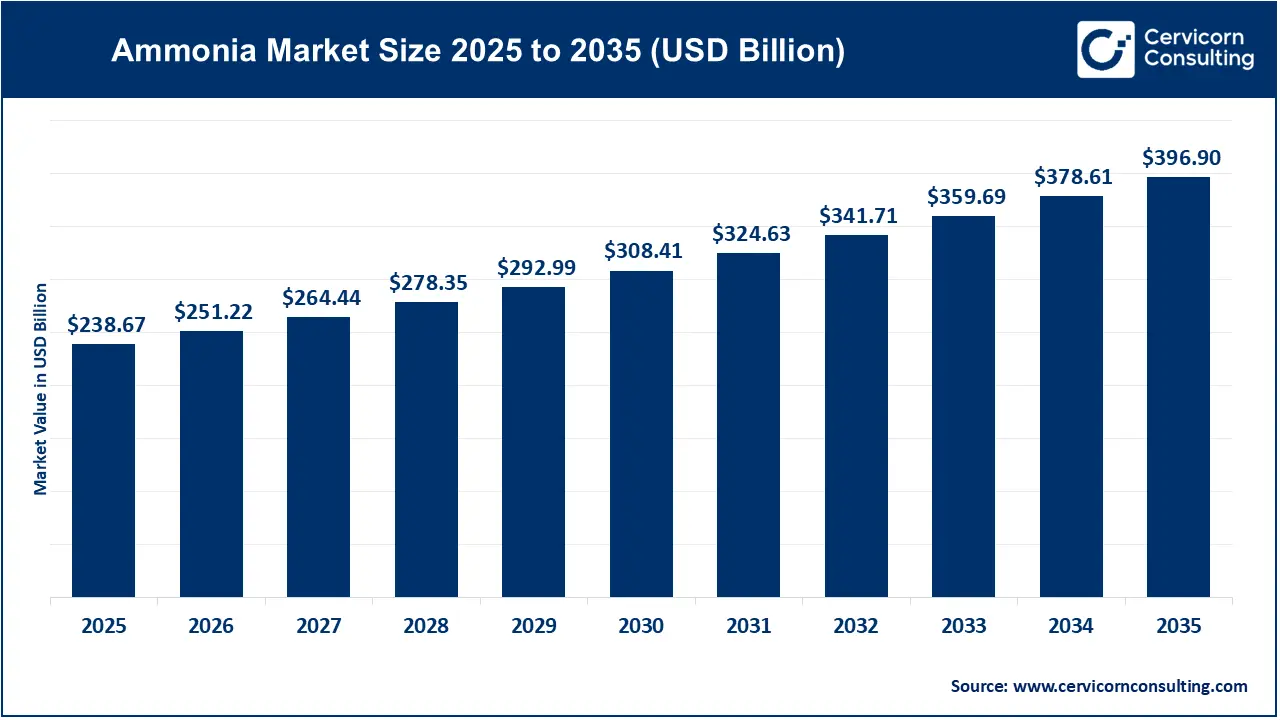
The global ammonia market was valued at approximately USD 238.67 billion in 2025 and is projected to reach nearly USD 396.90 billion by 2035, growing at a CAGR of 5.22%.
Ammonia Market Growth Factors
The ammonia market is experiencing significant growth due to rising global demand for agricultural fertilizers, increasing adoption of green ammonia as a clean energy carrier, expanding industrial applications in chemicals and refrigeration, growing investments in hydrogen infrastructure, and supportive government policies promoting decarbonization. The transition toward sustainable agriculture, rising food demand from a growing global population, and the need to improve crop yields continue to drive ammonia consumption in the fertilizer sector. Simultaneously, the emergence of ammonia as a potential hydrogen storage and transportation medium is creating new opportunities across the energy industry.
Technological advancements in carbon capture, utilization, and storage (CCUS), renewable-powered ammonia production, and low-emission manufacturing processes are further accelerating market expansion. Increasing investments from governments and private companies in green hydrogen projects are also contributing to the long-term growth prospects of the global ammonia market.
What is the Ammonia Market?
The ammonia market encompasses the global production, distribution, trade, and utilization of ammonia (NH₃), a nitrogen-rich chemical compound widely used across agriculture, chemicals, energy, pharmaceuticals, refrigeration, and industrial manufacturing sectors. Ammonia is primarily produced through the Haber-Bosch process, which combines nitrogen from the atmosphere with hydrogen derived mainly from natural gas.
Historically, ammonia has been used predominantly for fertilizer production, accounting for the majority of global consumption. However, recent developments in clean energy technologies have expanded ammonia’s role beyond agriculture. Today, ammonia is increasingly recognized as a potential carbon-free fuel, hydrogen carrier, and energy storage medium capable of supporting global decarbonization goals.
The market includes conventional ammonia, blue ammonia produced with carbon capture technologies, and green ammonia manufactured using renewable energy-powered electrolysis. As industries pursue net-zero emissions strategies, ammonia is becoming a critical component of future energy systems.
Get a Free Sample: https://www.cervicornconsulting.com/sample/2554
Why is the Ammonia Market Important?
Ammonia plays a vital role in supporting food security, industrial development, and the global energy transition.
Agricultural Importance
Nearly half of the world’s food production relies on nitrogen fertilizers derived from ammonia. Modern agricultural systems depend on ammonia-based fertilizers such as:
- Urea
- Ammonium nitrate
- Ammonium sulfate
- Diammonium phosphate (DAP)
These fertilizers help increase crop yields and improve agricultural productivity.
Industrial Importance
Ammonia serves as a key feedstock in the production of:
- Nitric acid
- Explosives
- Plastics
- Synthetic fibers
- Cleaning products
- Refrigerants
Numerous manufacturing industries depend on ammonia-based chemical processes.
Energy Transition Importance
Green ammonia has emerged as a promising solution for:
- Hydrogen transportation
- Long-duration energy storage
- Carbon-free shipping fuels
- Power generation
- Industrial decarbonization
Many governments and energy companies are investing heavily in ammonia infrastructure to support future clean energy ecosystems.
Leading Trends Shaping the Ammonia Market
Rise of Green Ammonia Production
Green ammonia is becoming one of the most transformative developments in the industry. Produced using renewable electricity and water electrolysis, green ammonia eliminates carbon emissions associated with conventional production.
Impact:
- Reduced carbon footprint
- Increased renewable energy utilization
- New export opportunities for renewable-rich countries
- Support for net-zero targets
Countries including Australia, Saudi Arabia, Japan, and Germany are actively investing in large-scale green ammonia facilities.
Growing Use of Ammonia as a Hydrogen Carrier
Hydrogen transportation remains challenging due to storage limitations and high costs. Ammonia provides an efficient alternative because it can be liquefied and transported using existing infrastructure.
Impact:
- Lower hydrogen transportation costs
- Expansion of international hydrogen trade
- Improved energy security
- Increased infrastructure investments
Decarbonization Through Blue Ammonia
Blue ammonia production combines traditional ammonia manufacturing with carbon capture technologies.
Impact:
- Lower industrial emissions
- Faster transition toward cleaner production
- Increased investment in carbon capture projects
- Reduced environmental impact
Ammonia-Powered Shipping
The maritime industry is exploring ammonia as a low-carbon fuel alternative to conventional marine fuels.
Impact:
- Reduced shipping emissions
- Compliance with International Maritime Organization (IMO) regulations
- Growing demand from shipbuilders and fleet operators
Digitalization and Process Optimization
Manufacturers are increasingly deploying:
- Artificial intelligence
- Advanced analytics
- Predictive maintenance
- Smart plant management systems
Impact:
- Improved operational efficiency
- Lower production costs
- Reduced downtime
- Enhanced plant safety
Competitive Landscape of the Ammonia Market
Acron
| Category | Details |
|---|---|
| Specialization | Nitrogen fertilizers and ammonia production |
| Key Focus Areas | Ammonia, urea, ammonium nitrate |
| Notable Features | Integrated fertilizer manufacturing operations |
| 2025 Revenue | Estimated above USD 3 billion |
| Market Share | Significant presence in Eastern Europe and CIS markets |
| Global Presence | Europe, Asia, Latin America, Africa |
Acron is among the world’s leading fertilizer producers with extensive ammonia production capabilities. The company continues investing in efficiency improvements and export expansion.
Asahi Kasei Corp
| Category | Details |
|---|---|
| Specialization | Chemicals, advanced materials, and ammonia technologies |
| Key Focus Areas | Green ammonia technologies and electrolyzers |
| Notable Features | Strong innovation and sustainability focus |
| 2025 Revenue | Estimated above USD 18 billion |
| Market Share | Growing presence in clean ammonia technologies |
| Global Presence | Asia-Pacific, Europe, North America |
Asahi Kasei is leveraging its expertise in hydrogen and electrolysis technologies to support the development of sustainable ammonia production systems.
BASF SE
| Category | Details |
|---|---|
| Specialization | Chemicals and industrial solutions |
| Key Focus Areas | Ammonia production, catalyst technologies, low-carbon chemicals |
| Notable Features | Pioneer of the Haber-Bosch process |
| 2025 Revenue | Estimated above USD 75 billion |
| Market Share | Major global chemical producer |
| Global Presence | More than 90 countries |
BASF continues to invest in low-emission ammonia production and advanced catalyst technologies that improve process efficiency.
CF Industries Holdings, Inc.
| Category | Details |
|---|---|
| Specialization | Nitrogen fertilizers and ammonia production |
| Key Focus Areas | Blue ammonia, carbon capture, fertilizer manufacturing |
| Notable Features | One of the world’s largest ammonia producers |
| 2025 Revenue | Estimated above USD 6 billion |
| Market Share | Major share in North American ammonia market |
| Global Presence | North America, Europe, Asia-Pacific |
CF Industries is leading several blue ammonia initiatives and has become a key player in the clean ammonia transition.
Koch Fertilizers, LLC
| Category | Details |
|---|---|
| Specialization | Fertilizers and ammonia manufacturing |
| Key Focus Areas | Agricultural ammonia supply and logistics |
| Notable Features | Extensive distribution network |
| 2025 Revenue | Estimated above USD 5 billion |
| Market Share | Significant North American presence |
| Global Presence | North America and international export markets |
Koch Fertilizers benefits from strong logistics infrastructure and integrated production facilities that support large-scale ammonia distribution.
Successful Examples of the Ammonia Market Around the World
NEOM Green Hydrogen Project – Saudi Arabia
One of the world’s largest green ammonia projects is being developed in Saudi Arabia’s NEOM region. The facility aims to produce green hydrogen and convert it into ammonia for export to international markets.
Key Achievements:
- Large-scale renewable energy integration
- Export-focused green ammonia production
- Global clean energy supply chain development
Yara Green Ammonia Initiatives – Norway
Yara has launched several projects focused on producing low-carbon and green ammonia.
Key Achievements:
- Reduced carbon emissions
- Sustainable fertilizer production
- Advancement of clean maritime fuel applications
CF Industries Blue Ammonia Facilities – United States
CF Industries has invested heavily in carbon capture technologies for ammonia production.
Key Achievements:
- Large-scale blue ammonia production
- Significant emission reductions
- Commercial-scale deployment
Japan’s Ammonia Co-Firing Programs
Japan is pioneering ammonia use in power generation through co-firing projects in thermal power plants.
Key Achievements:
- Reduced coal dependency
- Lower greenhouse gas emissions
- Enhanced energy diversification
Australia’s Renewable Ammonia Projects
Australia is emerging as a major green ammonia exporter due to abundant renewable resources.
Key Achievements:
- Renewable energy utilization
- Export-oriented infrastructure
- Hydrogen economy development
Global Regional Analysis
North America
North America remains one of the largest ammonia-producing regions globally, supported by abundant natural gas resources and strong agricultural demand.
Market Drivers
- Large fertilizer consumption
- Extensive agricultural production
- Natural gas availability
- Clean ammonia investments
Government Initiatives and Policies
United States
Key policy initiatives include:
- Inflation Reduction Act incentives for clean hydrogen
- Hydrogen production tax credits
- Carbon capture and storage support programs
- Department of Energy hydrogen hub initiatives
These policies are encouraging investments in blue and green ammonia facilities.
Canada
Government efforts focus on:
- Hydrogen strategy implementation
- Clean fuel regulations
- Net-zero emissions targets
- Renewable energy investments
Canada is positioning itself as a future exporter of low-carbon ammonia.
Europe
Europe is leading the global transition toward sustainable ammonia production through ambitious climate policies.
Market Drivers
- Decarbonization goals
- Green hydrogen investments
- Carbon pricing mechanisms
- Industrial sustainability requirements
Government Initiatives and Policies
European Union
Key policy frameworks include:
- European Green Deal
- Fit for 55 package
- REPowerEU strategy
- Hydrogen Bank initiatives
These programs support renewable hydrogen and green ammonia production.
Germany
Germany is investing heavily in:
- Green hydrogen imports
- Ammonia terminal infrastructure
- Industrial decarbonization projects
Netherlands
The Netherlands is becoming a major ammonia import and distribution hub for Europe through investments in port infrastructure.
Asia-Pacific
Asia-Pacific represents the largest ammonia-consuming region globally due to intensive agricultural activities and rapid industrialization.
Market Drivers
- Population growth
- Food security requirements
- Expanding industrial sectors
- Increasing energy demand
Government Initiatives and Policies
China
China is promoting:
- Green hydrogen deployment
- Industrial emission reductions
- Energy diversification
- Renewable energy expansion
The country remains one of the largest ammonia producers and consumers globally.
Japan
Japan’s policies emphasize:
- Ammonia-powered electricity generation
- Hydrogen economy development
- Carbon neutrality goals
Government-backed projects are accelerating ammonia adoption in energy applications.
India
India is actively supporting ammonia market development through:
- National Green Hydrogen Mission
- Fertilizer self-sufficiency initiatives
- Renewable energy investments
- Industrial decarbonization programs
The country is expected to become a major producer and consumer of green ammonia.
Australia
Australia’s strategy focuses on:
- Green ammonia exports
- Renewable hydrogen development
- International energy partnerships
The government is funding large-scale renewable energy projects supporting ammonia production.
Latin America
Latin America is witnessing increasing investments in ammonia production, particularly in countries with strong agricultural sectors.
Market Drivers
- Agricultural expansion
- Fertilizer demand growth
- Renewable energy potential
- Export opportunities
Government Initiatives and Policies
Brazil
Brazil supports ammonia development through:
- Agricultural modernization programs
- Fertilizer security strategies
- Renewable energy incentives
The country seeks to reduce fertilizer import dependence.
Chile
Chile’s hydrogen strategy includes:
- Green ammonia exports
- Renewable energy investments
- International partnerships
Its abundant solar resources make it an attractive location for green ammonia production.
Middle East and Africa
The Middle East is rapidly emerging as a global hub for blue and green ammonia production.
Market Drivers
- Abundant energy resources
- Strategic export locations
- Hydrogen economy investments
- Industrial diversification
Government Initiatives and Policies
Saudi Arabia
Saudi Arabia’s Vision 2030 supports:
- Green hydrogen projects
- Clean energy exports
- Industrial diversification
- Carbon reduction initiatives
The NEOM project exemplifies the country’s ammonia ambitions.
United Arab Emirates
The UAE is promoting:
- Hydrogen roadmaps
- Renewable energy investments
- Low-carbon industrial development
South Africa
South Africa is exploring green ammonia opportunities through:
- Renewable energy deployment
- Hydrogen valley initiatives
- Industrial decarbonization strategies
As governments worldwide accelerate clean energy adoption and industries seek low-carbon alternatives, ammonia is evolving from a traditional fertilizer feedstock into a strategic component of the global energy transition, creating substantial opportunities across agriculture, chemicals, transportation, and power generation sectors.
To Get Detailed Overview, Contact Us: https://www.cervicornconsulting.com/contact-us
Read Report: Public Safety and Security Market Revenue, Trends, and Strategic Insights by 2035