Unmanned Aerial Vehicle (UAV) Market Revenue, Trends, and Strategic Insights by 2035
Table of Contents
ToggleUnmanned Aerial Vehicle (UAV) Market Size
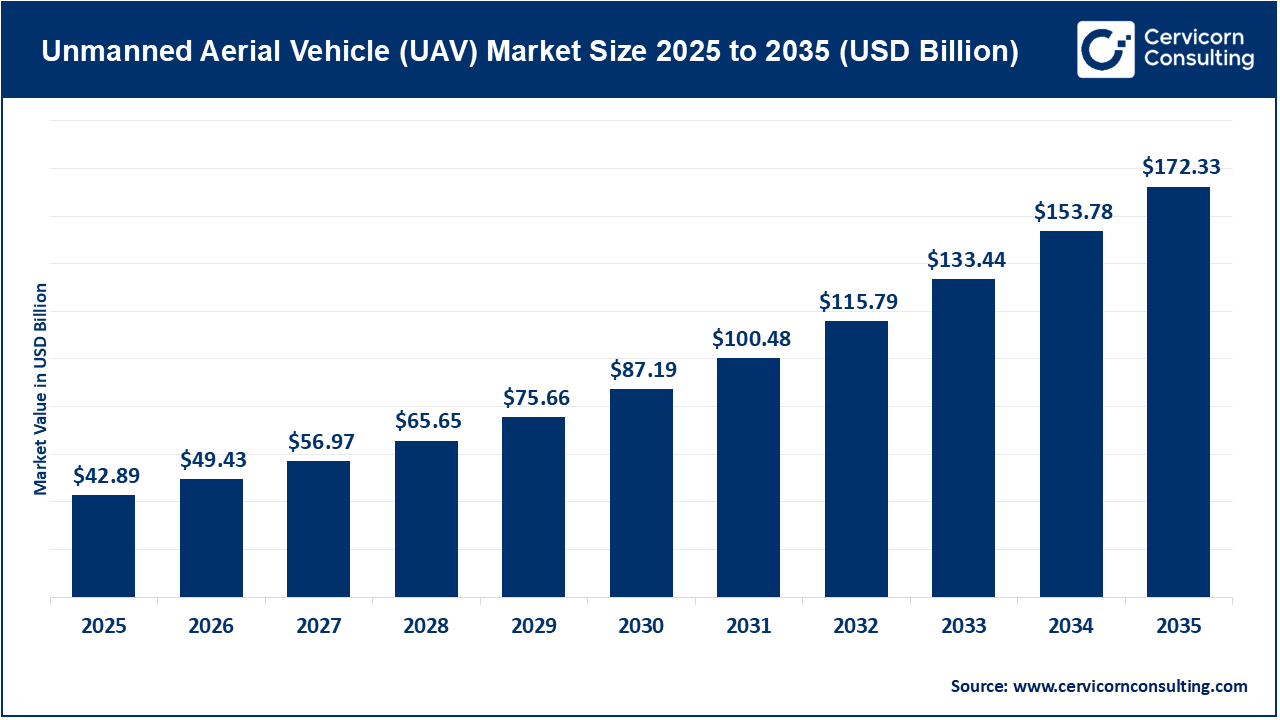
The global unmanned aerial vehicle (UAV) market was valued at approximately USD 42.89 billion in 2025 and is projected to reach nearly USD 172.33 billion by 2035, expanding at a compound annual growth rate (CAGR) of about 14.92% between 2026 and 2035.
What is the Unmanned Aerial Vehicle (UAV) Market?
The Unmanned Aerial Vehicle (UAV) market refers to the global industry involved in the design, manufacturing, deployment, operation, and maintenance of drones and autonomous aerial systems used across commercial, military, governmental, and consumer applications. UAVs are aircraft that operate without an onboard human pilot and are controlled either remotely or through autonomous flight systems powered by artificial intelligence (AI), machine learning, sensors, GPS, and advanced communication technologies. The market encompasses fixed-wing drones, rotary-wing drones, hybrid UAVs, and specialized aerial platforms designed for surveillance, mapping, logistics, agriculture, infrastructure inspection, disaster response, environmental monitoring, and defense operations. As industries increasingly adopt automation and data-driven decision-making, UAVs have emerged as critical tools for improving operational efficiency, safety, and real-time intelligence gathering.
Why is the Unmanned Aerial Vehicle (UAV) Market Important?
The UAV market has become a strategic pillar of modern digital transformation because drones provide rapid, cost-effective, and highly accurate aerial data collection capabilities. Governments rely on UAVs for border security, military reconnaissance, and emergency response operations, while commercial enterprises utilize them for precision agriculture, construction monitoring, mining surveys, and infrastructure inspections. UAVs significantly reduce human exposure to hazardous environments and enable access to remote or difficult-to-reach locations. Furthermore, advancements in autonomous navigation, edge computing, AI-powered analytics, and beyond-visual-line-of-sight (BVLOS) operations are expanding the scope of drone applications worldwide. The growing importance of smart cities, environmental sustainability initiatives, and real-time logistics networks is further accelerating demand for advanced UAV systems across both developed and emerging economies.
Unmanned Aerial Vehicle (UAV) Market Growth Factors
The growth of the unmanned aerial vehicle (UAV) market is driven by increasing defense modernization programs, rising demand for aerial surveillance and intelligence gathering, expanding commercial drone applications across agriculture, logistics, construction, and energy sectors, rapid advancements in artificial intelligence and autonomous navigation technologies, growing investments in smart city infrastructure, increasing adoption of drone-based inspection and monitoring services, favorable regulatory developments supporting beyond-visual-line-of-sight operations, rising demand for precision agriculture solutions, expanding disaster management and emergency response applications, increasing use of drones in environmental monitoring, declining costs of sensors and drone components, growing venture capital investments in drone startups, expanding e-commerce delivery initiatives, and the integration of 5G connectivity, cloud computing, and advanced analytics platforms that enhance operational efficiency and real-time decision-making capabilities.
Get a Free Sample: https://www.cervicornconsulting.com/sample/2671
Key Companies Operating in the UAV Market
Company Analysis
| Company | Specialization | Key Focus Areas | Notable Features | 2025 Revenue* | Estimated Market Share | Global Presence |
|---|---|---|---|---|---|---|
| AeroVironment Inc. | Defense UAVs and tactical drone systems | Military reconnaissance, loitering munitions, surveillance | Strong defense contracts and battlefield UAV solutions | Approx. USD 850 Million | 4–6% | North America, Europe, Middle East, Asia-Pacific |
| Parrot Drones | Commercial and enterprise drones | Mapping, inspection, surveying, public safety | Advanced imaging and open-source drone ecosystem | Approx. USD 150 Million | 1–2% | Europe, North America, Asia-Pacific |
| PrecisionHawk | Drone analytics and aerial intelligence | Agriculture, energy, infrastructure inspections | AI-powered aerial analytics and data solutions | Approx. USD 120 Million | <1% | North America, Latin America, Europe |
| 3D Robotics | Enterprise drone software solutions | Construction, engineering, mapping | Drone fleet management and data integration platforms | Approx. USD 70 Million | <1% | North America, Europe |
| Airbus SAS | Defense and industrial UAV systems | Military surveillance, border monitoring, aerospace innovation | Large-scale aerospace expertise and autonomous flight technologies | Approx. USD 75 Billion (total company revenue) | 3–5% UAV segment share | Global operations across more than 100 countries |
Major Market Trends and Their Impact
1. Artificial Intelligence-Powered Autonomous Drones
AI integration is transforming UAV operations by enabling autonomous navigation, object recognition, obstacle avoidance, and predictive analytics. Advanced machine learning algorithms allow drones to process data in real time, reducing the need for human intervention and improving mission efficiency.
Impact:
- Increased operational autonomy
- Enhanced mission accuracy
- Reduced labor costs
- Faster decision-making capabilities
2. Beyond Visual Line of Sight (BVLOS) Operations
Regulatory agencies worldwide are increasingly approving BVLOS drone operations, allowing drones to travel long distances without direct visual supervision.
Impact:
- Expanded delivery networks
- Large-scale infrastructure inspections
- Enhanced agricultural monitoring
- Growth of drone-as-a-service business models
3. Drone Delivery and Logistics Expansion
Retailers, logistics companies, and healthcare providers are investing heavily in drone delivery systems for last-mile transportation.
Impact:
- Faster deliveries
- Reduced transportation costs
- Improved rural accessibility
- Enhanced medical supply distribution
4. Integration of 5G Connectivity
The rollout of 5G networks enables real-time communication between drones, operators, and cloud platforms.
Impact:
- Low-latency data transmission
- Improved autonomous capabilities
- Enhanced remote operations
- Better fleet coordination
5. Drone Swarm Technology
Military and commercial sectors are increasingly exploring coordinated drone swarms capable of performing complex missions collaboratively.
Impact:
- Improved defense capabilities
- Enhanced search-and-rescue operations
- Increased operational scalability
- Greater mission redundancy
6. Sustainability and Environmental Monitoring
Governments and environmental agencies are deploying UAVs to monitor climate change, biodiversity, and natural resources.
Impact:
- Better environmental protection
- Enhanced disaster preparedness
- Improved carbon monitoring
- Efficient wildlife conservation
Successful Examples of UAV Deployment Around the World
Agricultural Drones in the United States
The United States has become a global leader in precision agriculture through widespread deployment of UAVs for crop monitoring, irrigation management, soil analysis, and pesticide application. Farmers utilize drone-generated data to improve yields and reduce resource consumption.
Key Outcomes
- Increased agricultural productivity
- Reduced water usage
- Optimized fertilizer application
- Lower operational costs
Medical Drone Delivery in Rwanda
Rwanda pioneered drone-based healthcare logistics through national drone delivery programs serving remote communities. UAVs transport blood supplies, vaccines, and emergency medical products to rural healthcare facilities.
Key Outcomes
- Faster emergency response
- Improved healthcare accessibility
- Reduced transportation delays
- Enhanced public health outcomes
Infrastructure Inspection in Europe
Energy providers and utility companies across Europe use UAVs to inspect power lines, wind turbines, solar farms, and transportation infrastructure.
Key Outcomes
- Reduced inspection costs
- Improved worker safety
- Faster maintenance cycles
- Enhanced asset management
Mining Operations in Australia
Australian mining companies deploy UAVs for surveying, mapping, stockpile measurement, and environmental monitoring.
Key Outcomes
- Improved operational efficiency
- Better resource management
- Enhanced safety compliance
- Reduced survey times
Defense Surveillance in the Middle East
Several Middle Eastern countries have significantly expanded UAV deployment for border security, surveillance, and intelligence gathering.
Key Outcomes
- Improved national security
- Enhanced border monitoring
- Real-time intelligence collection
- Reduced operational risks
Global Regional Analysis
North America
North America remains one of the largest UAV markets globally due to strong defense spending, technological innovation, and supportive regulatory frameworks.
Key Growth Drivers
- High military expenditure
- Advanced drone manufacturing ecosystem
- Growing commercial drone adoption
- Strong venture capital investments
Government Initiatives and Policies
The Federal Aviation Administration (FAA) has expanded drone integration programs through initiatives supporting BVLOS operations, drone corridors, and commercial UAV certification. The U.S. Department of Defense continues investing heavily in next-generation autonomous systems and tactical drones.
Canada has also introduced drone regulations supporting commercial applications in infrastructure, agriculture, and environmental monitoring while maintaining strong safety standards.
Europe
Europe has emerged as a major UAV innovation hub driven by aerospace expertise, sustainability goals, and harmonized drone regulations.
Key Growth Drivers
- Advanced aerospace manufacturing
- Smart city initiatives
- Industrial inspection demand
- Environmental monitoring programs
Government Initiatives and Policies
The European Union Aviation Safety Agency (EASA) has implemented unified drone regulations across member states, creating a standardized framework for commercial drone operations. European governments actively support UAV research through aerospace innovation programs and digital transformation initiatives.
Several countries including Germany, France, and the United Kingdom are investing in autonomous aerial mobility projects and defense UAV modernization programs.
Asia-Pacific
Asia-Pacific is expected to experience the fastest growth in the UAV market due to rapid industrialization, increasing defense budgets, and expanding commercial drone adoption.
Key Growth Drivers
- Large-scale agricultural applications
- Growing logistics sector
- Defense modernization initiatives
- Expanding manufacturing capabilities
Government Initiatives and Policies
China continues to strengthen its leadership position through substantial investments in drone manufacturing, AI technologies, and aerospace innovation. Government policies support domestic UAV production and export expansion.
India has introduced drone-focused initiatives including the Drone Rules framework, Production-Linked Incentive (PLI) programs, and digital agriculture missions that encourage UAV deployment across multiple industries.
Japan and South Korea are investing in autonomous mobility technologies, drone delivery systems, and smart infrastructure projects.
Latin America
Latin America is increasingly adopting UAV technology for agriculture, mining, environmental monitoring, and public safety applications.
Key Growth Drivers
- Precision farming adoption
- Mining industry expansion
- Infrastructure development
- Environmental conservation efforts
Government Initiatives and Policies
Brazil has established regulatory frameworks supporting commercial drone operations and agricultural applications. Several countries in the region are developing drone policies to facilitate innovation while ensuring safety and compliance.
Public-private partnerships are promoting UAV adoption in disaster management and environmental protection initiatives.
Middle East and Africa
The Middle East and Africa region is witnessing substantial growth driven by security requirements, infrastructure development, and healthcare logistics applications.
Key Growth Drivers
- Border surveillance demand
- Smart city projects
- Oil and gas inspections
- Medical delivery services
Government Initiatives and Policies
Countries such as the UAE and Saudi Arabia have launched ambitious smart city and autonomous mobility programs incorporating UAV technologies into urban planning and public services.
African governments are increasingly supporting drone-enabled healthcare delivery networks, agricultural modernization projects, and environmental monitoring initiatives. Regulatory authorities across the continent are developing frameworks that balance innovation with safety requirements.
Emerging Opportunities in the UAV Market
The next phase of UAV market growth will be shaped by autonomous cargo drones, urban air mobility solutions, drone traffic management systems, AI-enabled swarm operations, hydrogen-powered UAVs, and advanced edge-computing capabilities. The convergence of artificial intelligence, robotics, 5G networks, satellite connectivity, and cloud analytics will unlock new commercial opportunities across transportation, public safety, defense, environmental monitoring, and industrial automation sectors.
As governments continue modernizing aviation regulations and organizations seek more efficient ways to collect and analyze aerial data, UAVs are expected to become indispensable assets across nearly every major industry, reinforcing their role as one of the most transformative technologies of the digital era.
To Get Detailed Overview, Contact Us: https://www.cervicornconsulting.com/contact-us
Read Report: Point of Care Molecular Diagnostics Market Revenue, Trends, and Strategic Insights by 2035