AI Agents in Healthcare Market Revenue, Trends, and Strategic Insights by 2035
Table of Contents
ToggleAI Agents in Healthcare Market Size
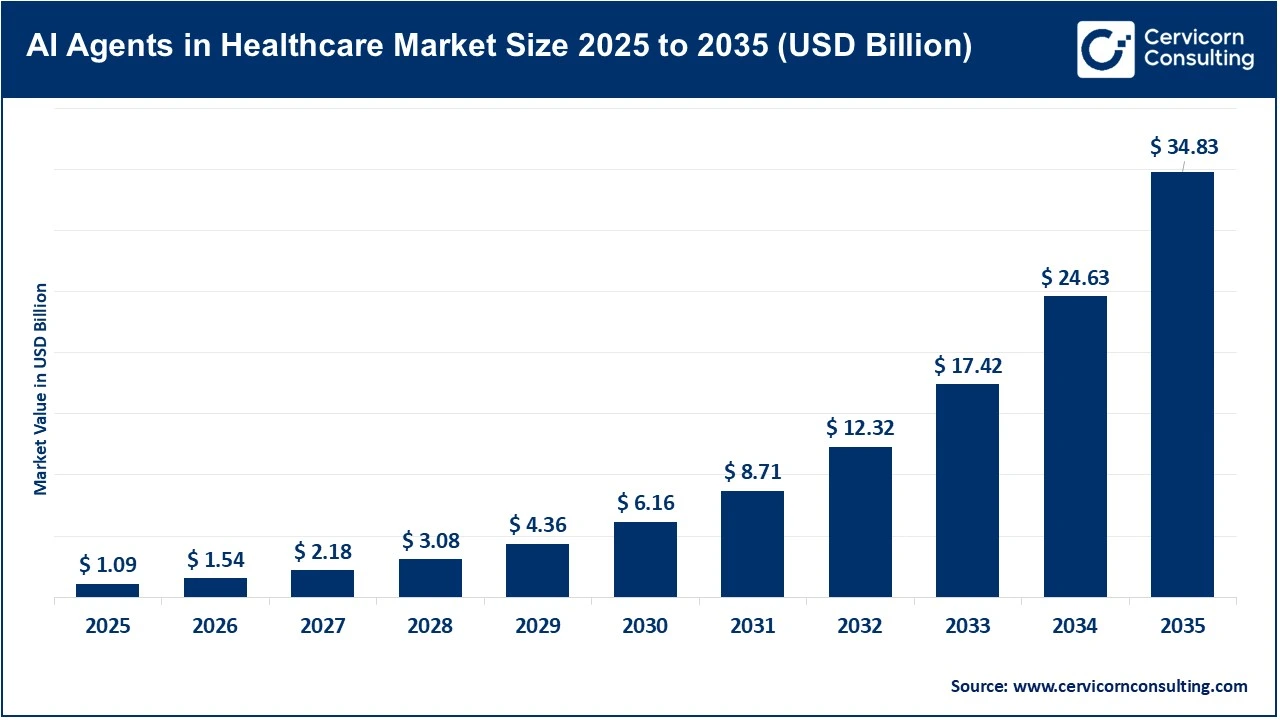
The global AI agents in healthcare market was valued at approximately USD 1.09 billion in 2025 and is projected to reach nearly USD 34.83 billion by 2035, expanding at a compound annual growth rate (CAGR) of about 41.4% between 2026 and 2035.
What is the AI Agents in Healthcare Market?
The AI agents in healthcare market refers to the ecosystem of technologies, software platforms, services, and solutions that utilize autonomous or semi-autonomous AI systems to support healthcare operations, diagnostics, treatment planning, patient monitoring, administrative workflows, and research activities. These AI agents leverage machine learning, natural language processing (NLP), generative AI, predictive analytics, and large language models (LLMs) to analyze vast amounts of healthcare data and provide actionable insights.
Healthcare AI agents can function as virtual assistants, clinical decision-support systems, patient engagement platforms, medical coding assistants, diagnostic tools, drug discovery agents, and remote monitoring solutions. Their ability to continuously learn and improve enables healthcare providers to deliver more accurate, efficient, and personalized care.
AI Agents in Healthcare Market Growth Factors
The growth of the AI agents in healthcare market is being driven by increasing healthcare data generation, rising demand for personalized medicine, growing shortages of healthcare professionals, expanding adoption of electronic health records (EHRs), rapid advancements in generative AI and machine learning technologies, increasing investments in digital health infrastructure, growing demand for remote patient monitoring solutions, rising prevalence of chronic diseases, increasing healthcare expenditure, favorable government initiatives promoting AI integration in healthcare, expanding use of AI in drug discovery and clinical trials, growing focus on reducing administrative burdens and operational costs, improved cloud computing capabilities, enhanced interoperability of healthcare systems, and increasing acceptance of AI-powered virtual assistants and decision-support systems among healthcare providers and patients worldwide.
Why is AI Agents in Healthcare Important?
AI agents are becoming critical because healthcare systems worldwide face unprecedented challenges. Aging populations, rising chronic disease burdens, workforce shortages, and escalating healthcare costs require innovative solutions capable of improving efficiency and outcomes.
Some of the key benefits include:
Enhanced Clinical Decision-Making
AI agents can analyze millions of patient records, research publications, imaging scans, and treatment outcomes to provide clinicians with evidence-based recommendations.
Improved Patient Outcomes
Predictive AI models help identify health risks earlier, enabling timely interventions and preventive care strategies.
Reduced Administrative Burden
Healthcare providers spend substantial time on documentation, coding, scheduling, and billing. AI agents automate these repetitive tasks, allowing clinicians to focus on patient care.
Faster Drug Discovery
AI agents significantly reduce the time required to identify drug candidates, analyze molecular interactions, and optimize clinical trial designs.
Personalized Medicine
AI-driven systems analyze genetic, lifestyle, and clinical data to develop individualized treatment plans for patients.
Better Patient Engagement
Virtual healthcare assistants provide 24/7 support, appointment scheduling, medication reminders, symptom assessments, and health education.
Get a Free Sample: https://www.cervicornconsulting.com/sample/2971
Key Companies Shaping the AI Agents in Healthcare Market
The competitive landscape is dominated by major technology companies that are leveraging cloud computing, AI infrastructure, healthcare analytics, and generative AI capabilities to expand their healthcare offerings.
| Company | Specialization | Key Focus Areas | Notable Features | 2025 Revenue | Estimated Market Share* | Global Presence |
|---|---|---|---|---|---|---|
| Oracle | Healthcare information systems and cloud infrastructure | EHR integration, healthcare analytics, AI-driven workflows | Oracle Health platform, clinical AI tools | Approximately USD 57.4 Billion | 8-10% | North America, Europe, Asia-Pacific, Middle East |
| Microsoft | Generative AI, cloud computing, healthcare solutions | Clinical documentation, Copilot healthcare solutions, predictive analytics | Azure AI, Nuance healthcare solutions, Copilot | Approximately USD 281.7 Billion | 20-22% | Global |
| IBM | AI-driven healthcare analytics and enterprise solutions | Clinical decision support, population health management | watsonx AI ecosystem | Estimated USD 65+ Billion corporate revenue | 10-12% | Global |
| AI infrastructure and healthcare data analytics | Medical imaging, generative AI, healthcare search | Gemini AI, Vertex AI, Med-PaLM technologies | Approximately USD 402.8 Billion (Alphabet) | 18-20% | Global | |
| Amazon Web Services | Cloud infrastructure and healthcare AI services | Medical transcription, predictive analytics, healthcare cloud | Amazon HealthLake, Bedrock AI, Comprehend Medical | AWS annualized revenue exceeds USD 100 Billion range through cloud operations | 15-18% | Global |
Leading Trends in the AI Agents in Healthcare Market and Their Impact
1. Generative AI-Powered Clinical Assistants
Generative AI agents are transforming clinician workflows by automatically generating medical notes, summarizing patient histories, and creating treatment recommendations.
Impact:
- Reduced physician burnout
- Improved documentation accuracy
- Enhanced patient interaction time
- Faster clinical workflows
2. AI-Driven Medical Imaging
Advanced AI agents are being integrated into radiology, pathology, and diagnostic imaging platforms.
Impact:
- Faster image interpretation
- Improved diagnostic accuracy
- Early disease detection
- Reduced workload for radiologists
3. Autonomous Patient Engagement Agents
Healthcare organizations are increasingly deploying conversational AI agents to interact with patients.
Impact:
- Improved patient satisfaction
- Better medication adherence
- Reduced hospital readmissions
- Enhanced access to healthcare information
4. AI in Drug Discovery
Pharmaceutical companies are using AI agents to identify molecular targets, simulate drug interactions, and optimize clinical trials.
Impact:
- Reduced R&D costs
- Faster drug development
- Improved clinical trial success rates
- Increased innovation
5. Predictive Healthcare Analytics
AI agents analyze patient histories, genetic information, and population health data to predict disease risks.
Impact:
- Preventive healthcare strategies
- Reduced hospitalization rates
- Better chronic disease management
- Improved healthcare resource allocation
6. AI-Powered Remote Patient Monitoring
Wearable devices and connected healthcare systems increasingly utilize AI agents to continuously monitor patient health.
Impact:
- Real-time health monitoring
- Early intervention capabilities
- Reduced emergency admissions
- Improved management of chronic conditions
7. Multi-Agent Healthcare Ecosystems
Healthcare providers are beginning to implement collaborative AI systems where multiple AI agents coordinate across departments.
Impact:
- Integrated care delivery
- Enhanced operational efficiency
- Improved patient outcomes
- Better resource utilization
Successful Examples of AI Agents in Healthcare Around the World
Microsoft and Nuance DAX Copilot
Microsoft’s healthcare-focused AI assistant automatically generates clinical documentation during patient consultations. Physicians can focus on patient interactions while AI handles note-taking and administrative tasks.
Results:
- Significant reduction in documentation time
- Improved clinician productivity
- Reduced burnout levels
Google’s Med-PaLM
Google developed Med-PaLM, a healthcare-specific large language model designed to answer medical questions and support clinical decision-making.
Applications:
- Medical knowledge retrieval
- Clinical reasoning assistance
- Healthcare education
Oracle Health Clinical AI Agent
Oracle integrates AI into healthcare workflows to streamline documentation, patient record management, and clinical recommendations.
Benefits:
- Workflow optimization
- Reduced administrative workload
- Enhanced interoperability
Amazon HealthLake
AWS HealthLake uses AI and machine learning to organize healthcare data and generate insights from clinical records.
Applications:
- Population health analytics
- Predictive healthcare
- Healthcare data interoperability
IBM Watsonx for Healthcare
IBM has expanded healthcare AI capabilities through watsonx, enabling organizations to develop domain-specific healthcare AI applications.
Applications:
- Clinical decision support
- Research analytics
- Healthcare automation
Babylon Health Virtual Agents
AI-driven virtual healthcare assistants provide symptom assessments and patient triage services.
Impact:
- Improved healthcare accessibility
- Faster patient assessments
- Reduced burden on primary care systems
Global Regional Analysis of the AI Agents in Healthcare Market
North America
North America remains the largest market for healthcare AI agents due to advanced healthcare infrastructure, substantial AI investments, widespread EHR adoption, and strong regulatory support.
Key Growth Drivers
- High healthcare spending
- Advanced digital health ecosystem
- Strong presence of leading technology companies
- Growing physician shortages
Government Initiatives and Policies
The United States government continues supporting AI innovation through initiatives from agencies such as the U.S. Department of Health and Human Services (HHS), National Institutes of Health (NIH), and FDA.
Key developments include:
- AI regulatory frameworks for healthcare applications
- Funding for healthcare AI research
- Expansion of interoperability standards
- Support for precision medicine programs
Canada is also investing heavily in AI healthcare innovation through national AI strategies and healthcare digitization programs.
Europe
Europe is rapidly emerging as a significant AI healthcare market driven by digital health transformation and strong regulatory governance.
Key Growth Drivers
- Aging population
- Rising chronic disease prevalence
- Government-backed digital health initiatives
- Strong healthcare infrastructure
Government Initiatives and Policies
The European Union’s AI Act is creating structured governance frameworks for AI deployment across healthcare sectors.
Major initiatives include:
- European Health Data Space (EHDS)
- AI innovation funding programs
- Cross-border healthcare data sharing
- Digital health transformation strategies
Countries such as Germany, France, the United Kingdom, and the Netherlands are leading AI adoption in healthcare.
Asia-Pacific
Asia-Pacific is expected to witness the fastest growth during the forecast period due to increasing healthcare digitization, large patient populations, and government investments in AI technologies.
Key Growth Drivers
- Expanding healthcare infrastructure
- Rising healthcare expenditures
- Growing demand for telemedicine
- Increasing smartphone and internet penetration
Government Initiatives and Policies
China
China’s national AI development strategy prioritizes healthcare AI innovation through substantial public and private investments.
Japan
Japan is deploying AI solutions to address healthcare workforce shortages and support its aging population.
India
India’s National Digital Health Mission and AI-focused healthcare programs are accelerating digital healthcare adoption and AI integration.
Singapore
Singapore’s Smart Nation initiative promotes AI adoption across healthcare institutions through funding and innovation programs.
Latin America
Latin America is gradually adopting AI healthcare solutions as governments focus on improving healthcare access and efficiency.
Key Growth Drivers
- Expanding telehealth services
- Healthcare modernization efforts
- Increasing digital health investments
Government Initiatives
Countries such as Brazil, Mexico, and Chile are implementing digital health strategies that encourage AI deployment in healthcare delivery and public health management.
Middle East & Africa
The Middle East and Africa region is experiencing growing adoption of AI healthcare technologies, particularly in Gulf Cooperation Council (GCC) countries.
Key Growth Drivers
- Smart healthcare initiatives
- Healthcare infrastructure investments
- Government-led digital transformation programs
Government Initiatives and Policies
Saudi Arabia
Vision 2030 emphasizes healthcare modernization through AI and digital technologies.
United Arab Emirates
National AI strategies support healthcare innovation, predictive analytics, and smart hospital development.
South Africa
Digital health initiatives are creating opportunities for AI-driven healthcare solutions, particularly in remote and underserved communities.
Future Outlook
The AI agents in healthcare market is entering a phase of rapid expansion as generative AI, multimodal AI systems, cloud computing, and healthcare interoperability continue to evolve. Increasing collaboration between technology providers, healthcare organizations, pharmaceutical companies, and governments is expected to accelerate adoption globally. As AI agents become more autonomous, explainable, and clinically validated, they will play an increasingly central role in improving healthcare delivery, enhancing patient outcomes, reducing costs, and addressing workforce challenges across healthcare systems worldwide.
To Get Detailed Overview, Contact Us: https://www.cervicornconsulting.com/contact-us
Read Report: Carbon Farming Market Revenue, Trends, and Strategic Insights by 2035
Read About:
- Why Are Investors and Aesthetic Clinics Betting Billions on the Medical Aesthetics Market?
- Why Is the IVF Services Market Growing So Rapidly? Key Trends, Market Size, and Business Opportunities Through 2035
-
Why Is the Nuclear Materials Market Growing So Rapidly? Key Trends, Opportunities, and Market Forecast Through 2035