Next-Generation Lithium-ion Battery Market Revenue, Trends, and Strategic Insights by 2035
Next-Generation Lithium-ion Battery Market Size
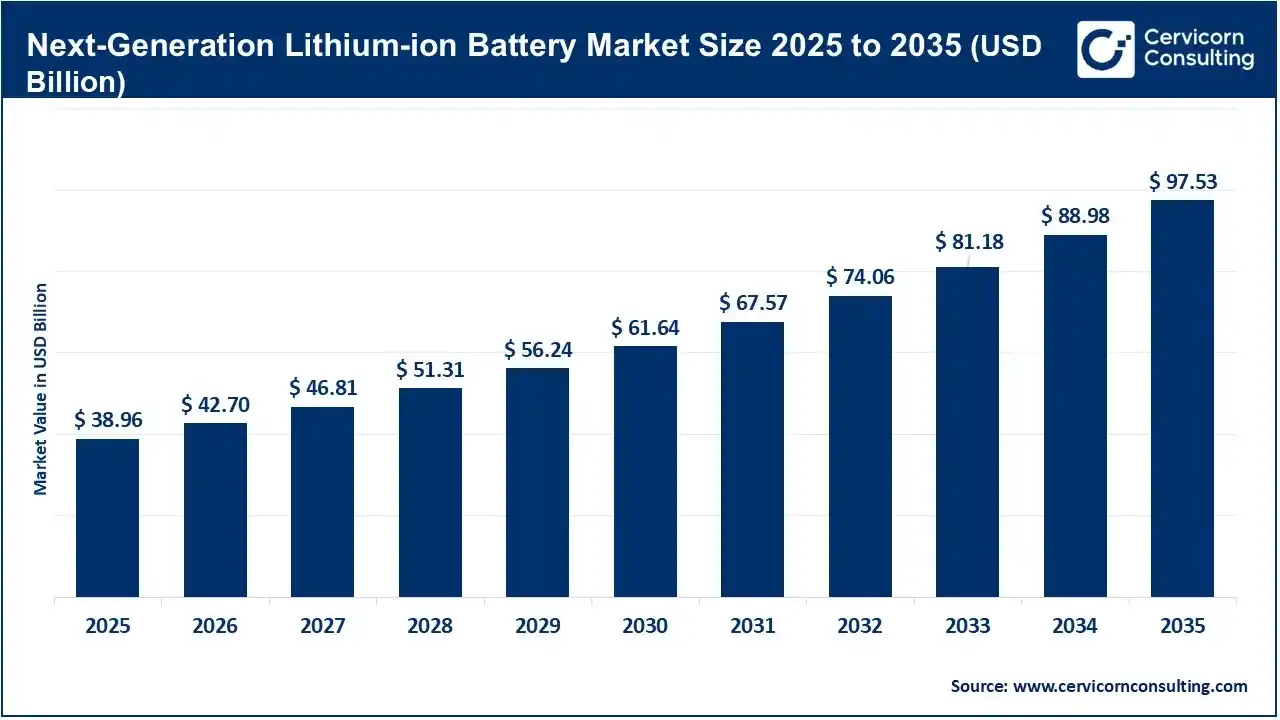
The global next-generation lithium-ion battery market was valued at USD 38.96 billion in 2025 and is projected to reach USD 97.53 billion by 2035, expanding at a 9.6% CAGR from 2026 to 2035.
Next-Generation Lithium-ion Battery Market Growth Factors
The next-generation lithium-ion battery market growth factors include the rapid electrification of transportation, increasing demand for longer EV driving ranges, expansion of renewable-energy storage, growing deployment of grid-scale battery energy storage systems, demand for faster charging, advances in silicon and silicon-carbon anodes, high-nickel cathodes, advanced electrolytes, improved cell architectures, AI-enabled battery-management systems, declining battery costs, increasing investment in domestic battery manufacturing, and government incentives supporting localized battery supply chains.
Global EV battery deployment reached approximately 1.2 TWh in 2025, while the increasing adoption of 1,000-volt vehicle platforms and charging technologies capable of significantly reducing charging times is encouraging manufacturers to develop higher-performance cells. Silicon is particularly attractive because its theoretical specific capacity is substantially higher than graphite, although commercial deployment requires solutions to its volume-expansion and degradation challenges.
At the same time, energy-storage demand is creating another major growth engine because LFP chemistry combines relatively low cost, long cycle life, and strong thermal stability. Battery manufacturers are also investing in recycling, circular supply chains, high-voltage cells, dry-electrode manufacturing, lithium-metal technologies, and solid-state architectures, allowing the industry to improve performance without completely abandoning the established lithium-ion manufacturing ecosystem.
Get a Free Sample: https://www.cervicornconsulting.com/sample/3023
What Is the Next-Generation Lithium-ion Battery Market?
The next-generation lithium-ion battery market encompasses advanced lithium-ion batteries that improve upon conventional Li-ion technologies through innovations in materials, cell architecture, manufacturing processes, charging systems, and battery-management technologies.
Rather than representing one single battery chemistry, the market includes several technological pathways. These include silicon and silicon-carbon anodes, high-nickel cathodes, advanced LFP formulations, high-voltage cells, lithium-metal enhancements, advanced electrolytes, semi-solid batteries, solid-state designs, improved separators, cell-to-pack architectures, and intelligent battery-management systems.
Silicon-based anodes are particularly important because silicon can theoretically store substantially more lithium than graphite. However, silicon expands considerably during charging and discharging, creating mechanical stress and degradation. Consequently, commercial developers are working on silicon-carbon composites, nanostructuring, protective coatings, binders, electrolyte additives, and prelithiation techniques.
The market also includes improvements to established LFP and NMC technologies. LFP is increasingly important because of its cost, safety, durability, and lower dependence on nickel and cobalt, while NMC remains attractive for applications where high energy density and driving range are priorities.
Why Is the Next-Generation Lithium-ion Battery Market Important?
The market is strategically important because batteries have become foundational infrastructure for electric mobility, renewable energy, grid modernization, consumer electronics, industrial equipment, data centers, telecommunications, marine applications, aerospace, and defense.
For EV manufacturers, battery performance directly affects vehicle range, acceleration, charging time, weight, and overall vehicle cost. A higher-energy-density battery can potentially deliver longer range without requiring a proportionally larger battery pack.
For energy systems, next-generation batteries can improve the ability to store electricity generated by solar and wind projects and release it when demand increases. Longer cycle life and improved thermal management can reduce operating costs and improve reliability.
The technology is also important from an industrial-policy perspective. Battery supply chains involve lithium, graphite, nickel, cobalt, manganese, cathode and anode materials, electrolytes, manufacturing equipment, recycling, and specialized engineering. Governments therefore increasingly view battery manufacturing as a strategic industry linked to energy security, automotive competitiveness, and clean-energy objectives.
Leading Companies in the Next-Generation Lithium-ion Battery Market
| Company | Specialization | Key Focus Areas | Notable Features | 2025 Revenue | Market Share* | Global Presence |
|---|---|---|---|---|---|---|
| CATL | EV batteries, ESS, advanced Li-ion | LFP, high-energy cells, fast charging, lithium-metal, recycling | Qilin platform, advanced LFP, sodium-ion and next-generation battery R&D | RMB 423.7B | 39.2% EV power-battery installations | China, Europe, Asia, North America and other international markets |
| BYD Company Limited | EVs and battery manufacturing | LFP, Blade Battery, EV platforms, energy storage | Blade Battery architecture and vertical integration | RMB 804.0B | 16.4% EV battery installations | China, Europe, Latin America, Asia-Pacific and other markets |
| LG Energy Solution Ltd. | EV and ESS batteries | LFP, NMC, high-nickel, 46-series cylindrical, solid-state | Large global manufacturing footprint and broad OEM relationships | KRW 23.67T | ~9% EV battery installations* | South Korea, North America, Europe and Asia |
| Panasonic Energy Co., Ltd. | Cylindrical automotive batteries | 4680, high-nickel, silicon-anode technologies | Major cylindrical battery supplier with strong automotive partnerships | ¥873.2B Energy segment* | ~3–4% EV battery installations* | Japan, North America and international markets |
| Samsung SDI Co., Ltd. | EV, ESS and consumer batteries | High-nickel, LFP, 46-series, all-solid-state | Gen 6 batteries and solid-state development | KRW 13.27T | ~3% EV battery installations* | South Korea, Europe, North America and Asia |
*Market-share figures are best interpreted as global EV battery installation shares/proxies, rather than a separately reported share of the narrower next-generation lithium-ion battery market, because companies generally do not disclose revenue specifically for this market definition.
CATL reported RMB 423.7 billion in 2025 revenue, lithium battery sales of 661 GWh, and a 39.2% global power-battery share, maintaining the leading position for the ninth consecutive year. BYD reported approximately RMB 804 billion in 2025 revenue, supported by its EV and battery businesses.
LG Energy Solution reported KRW 23.67 trillion in 2025 consolidated revenue. Its strategy increasingly emphasizes LFP, high-voltage mid-nickel, LMR prismatic cells, 46-series cylindrical batteries, ESS, dry-electrode technology, all-solid-state batteries, and sodium batteries.
Panasonic Holdings reported ¥873.2 billion in FY2025 Energy segment sales, which includes more than automotive batteries alone and therefore should not be interpreted as Panasonic Energy’s standalone next-generation battery revenue. Samsung SDI reported KRW 13.27 trillion in 2025 annual revenue, with its battery business generating KRW 3.62 trillion in the fourth quarter and the company advancing NCA and LFP ESS products, 46-series cells, and all-solid-state battery validation.
Leading Trends and Their Impact
1. Silicon-Carbon Anodes
Silicon-carbon anodes are becoming one of the most important development pathways because they can increase energy density while retaining much of the existing lithium-ion manufacturing ecosystem. The primary obstacle is silicon’s significant volume expansion during cycling.
The impact is potentially substantial: higher energy density can increase EV range, reduce battery weight, and improve the performance of compact devices. Manufacturers are therefore working on composite structures, coatings, binders, prelithiation and electrolyte optimization.
2. LFP’s Expanding Role
LFP has moved from being a cost-focused chemistry to becoming one of the central technologies in mass-market EVs and energy storage. It represented 38.3% of the next-generation lithium-ion battery market in 2025 and accounted for more than 90% of global stationary-storage installations according to Cervicorn Consulting’s market assessment.
Its impact is strongest in applications where safety, durability and affordability are more important than maximum energy density.
3. Faster-Charging Batteries
Charging speed is becoming a major competitive differentiator. Battery companies are developing high-voltage architectures, improved electrolytes, optimized electrodes, thermal-management systems and advanced charging algorithms.
For EV consumers, faster charging can reduce one of the principal barriers to EV adoption. For commercial fleets, faster charging can increase vehicle utilization and reduce downtime.
4. Large-Format and 46-Series Cylindrical Cells
Large cylindrical formats such as 46-series cells are attracting investment because they can potentially reduce the number of cells required in a pack while improving manufacturing efficiency.
LG Energy Solution, Samsung SDI and other major manufacturers are expanding their cylindrical-cell strategies, while Panasonic continues to focus heavily on cylindrical automotive batteries.
5. Solid-State and Semi-Solid Development
Solid-state batteries are one of the industry’s most closely watched technologies. They seek to replace conventional liquid electrolytes with solid materials, potentially enabling higher energy density and improved safety.
However, solid-state technology remains technically challenging because of manufacturing yield, interface stability, materials compatibility and cost. As a result, commercialization is likely to progress through staged validation rather than an immediate industry-wide replacement of conventional lithium-ion batteries.
Japan’s updated battery strategy targets full-scale commercialization of all-solid-state batteries around 2030.
6. AI-Enabled Battery Management
Artificial intelligence is increasingly being applied to battery monitoring, state-of-charge estimation, degradation prediction, thermal management and charging optimization.
The impact extends beyond the battery cell itself. Better software can help manufacturers extract greater usable capacity, identify abnormal behavior earlier, extend battery life and optimize charging according to operating conditions.
7. Battery Recycling and Circular Supply Chains
As the installed battery base grows, recycling is becoming an increasingly important part of the next-generation battery ecosystem.
The EU is establishing particularly stringent requirements around battery recycling and critical-material recovery. Its framework targets 65% recycling efficiency for lithium-based batteries by the end of 2025 and 70% by 2030, alongside material-recovery targets for lithium, cobalt, nickel and copper.
This trend could reduce dependence on newly mined materials while creating new sources of lithium, nickel, cobalt and other battery inputs.
Successful Examples of Next-Generation Lithium-ion Battery Market Development Around the World
CATL’s High-Performance Battery Ecosystem — China
CATL provides one of the clearest examples of how next-generation battery development is moving from individual cell innovation toward an integrated technology ecosystem.
The company combines advanced LFP, high-energy-density cells, fast-charging technologies, energy-storage products, battery recycling and international manufacturing. In 2025, CATL sold 661 GWh of lithium batteries and reached 39.2% of global power-battery installations. Its global production capacity reached 772 GWh.
BYD Blade Battery — China
BYD’s Blade Battery demonstrates how cell chemistry and pack architecture can be combined to address safety, packaging and cost. The company’s vertically integrated approach connects battery manufacturing with EV design, power electronics and vehicle production.
This strategy has helped BYD expand battery-powered passenger vehicles, commercial vehicles and stationary energy-storage solutions across international markets.
Panasonic’s Cylindrical Battery Strategy — Japan and North America
Panasonic Energy’s cylindrical-cell strategy demonstrates another pathway toward next-generation lithium-ion technology. The company has focused on high-energy-density cylindrical batteries and partnerships with automotive manufacturers while expanding production capabilities in North America.
This approach is particularly relevant to EV platforms that prioritize high energy density, manufacturing efficiency and standardized cell formats.
LG Energy Solution’s North American Expansion
LG Energy Solution has used localization to strengthen its position in North America. Its 2025 strategy included LFP production in North America, 46-series cylindrical cells, ESS expansion and development of all-solid-state and sodium batteries. The company ended 2025 with an ESS order backlog of approximately 140 GWh.
Samsung SDI’s Solid-State Development — South Korea
Samsung SDI is pursuing high-performance lithium-ion batteries alongside next-generation solid-state technology. Its 2025 activities included 46-series orders, NCA and LFP ESS batteries and collaboration with BMW for all-solid-state battery validation.
These examples demonstrate that successful market development is not dependent on a single technology. Instead, leading companies are simultaneously improving conventional lithium-ion chemistries while preparing for silicon-rich, lithium-metal, semi-solid and solid-state platforms.
Global Regional Analysis Including Government Initiatives and Policies
Asia-Pacific
Asia-Pacific is the dominant regional market, accounting for 52.1% of global next-generation lithium-ion battery market revenue in 2025. The regional market was valued at approximately USD 20.30 billion and is forecast to reach around USD 50.81 billion by 2035. China, Japan, South Korea and India form the region’s major technology, manufacturing and demand centers.
China has the strongest manufacturing ecosystem. Its scale across cathode materials, anodes, electrolytes, cells and battery packs creates major cost and commercialization advantages. The country is also investing heavily in advanced batteries, including solid-state technologies.
Japan is emphasizing technological leadership and domestic manufacturing. In 2026, Japan revised its Battery Industry Strategy into the Battery and Power Industry Strategy, targeting a domestic manufacturing base of 150 GWh annually from 2030 into the mid-2030s, a tripling of global battery-related sales by Japanese companies between 2025 and 2035, and full-scale commercialization of all-solid-state batteries around 2030.
South Korea is similarly focused on maintaining leadership in advanced batteries through R&D, international partnerships, manufacturing investment and development of next-generation chemistries.
India is emerging as an important market because of EV adoption, renewable-energy deployment and domestic battery-manufacturing initiatives. Its production-linked incentive program targets 50 GWh of advanced chemistry cell manufacturing capacity, supporting greater localization of the battery value chain.
North America
The North American next-generation lithium-ion battery market was valued at approximately USD 9.08 billion in 2025 and is projected to reach USD 22.72 billion by 2035. The United States represents the dominant market, supported by EV manufacturing, grid-scale storage, battery R&D and efforts to localize supply chains.
The U.S. policy environment has historically provided strong incentives for domestic battery manufacturing. The 45X Advanced Manufacturing Production Credit, created under the Inflation Reduction Act, covers qualifying battery components, electrode active materials and critical minerals produced in the United States.
This policy framework has encouraged investment in battery plants, component manufacturing and domestic critical-mineral processing. At the same time, changing EV policy and tax-credit rules create uncertainty for manufacturers planning long-term capacity investments.
Canada is strengthening the region’s upstream and midstream ecosystem through critical-mineral resources and battery manufacturing projects. Its lithium, nickel, cobalt and graphite resources provide a foundation for developing more localized supply chains.
Europe
Europe’s next-generation lithium-ion battery market was valued at approximately USD 8.22 billion in 2025 and is projected to reach USD 20.58 billion by 2035. Germany, the UK, France, Italy, Hungary and Poland are among the major markets and production centers.
European policy places particularly strong emphasis on sustainability and circularity. The EU Batteries Regulation introduces carbon-footprint requirements, performance information, recycled-content requirements, due-diligence obligations and progressively stronger recycling targets.
The EU is also introducing the European battery passport, with the passport becoming mandatory for relevant battery categories placed on the EU market from February 18, 2027 under the current implementation timeline.
These policies are influencing battery manufacturers to improve not only energy density and cost but also traceability, carbon intensity, recyclability and responsible sourcing.
Latin America
Latin America represents a smaller but increasingly attractive market. Brazil is the principal regional market, supported by rising EV adoption, renewable-energy development and automotive manufacturing.
Brazil’s growing EV market is creating opportunities for LFP batteries because cost, durability and safety are important factors in mass-market electrification. Mexico also benefits from its established automotive manufacturing ecosystem and proximity to the U.S. supply chain.
The region’s major long-term opportunity extends beyond battery consumption. Countries such as Chile and Argentina possess significant lithium resources, creating opportunities for mining, refining, cathode materials and battery supply-chain integration.
Middle East and Africa
The Middle East and Africa remain emerging markets for next-generation lithium-ion batteries, with opportunities concentrated around renewable-energy storage, electric mobility, industrial electrification and critical-mineral development.
The LAMEA market was valued at approximately USD 1.36 billion in 2025 and is projected to reach around USD 3.41 billion by 2035.
The Middle East is particularly relevant for utility-scale energy storage because countries are investing heavily in solar power and grid modernization. Saudi Arabia and the UAE are developing renewable-energy and electrification projects that can increase demand for large-scale battery storage.
Africa offers a different opportunity through its mineral resources and emerging EV and renewable-energy markets. Morocco, South Africa and Egypt are among the countries positioned to participate in battery-related manufacturing and supply chains.
Market Outlook
The next-generation lithium-ion battery industry is increasingly becoming a competition between energy density, cost, safety, charging speed, manufacturing scalability and supply-chain resilience. LFP is strengthening its position in cost-sensitive EVs and energy storage, while NMC and high-nickel technologies remain relevant where maximum energy density is required. Silicon-carbon anodes are moving closer to broader commercialization, while solid-state and lithium-metal technologies represent longer-term opportunities.
For battery manufacturers, automakers, material suppliers, energy-storage developers and investors, the strongest opportunities are likely to emerge where advanced materials, scalable manufacturing, intelligent battery management, recycling and localized supply chains converge. Government policy will remain equally important because battery competitiveness increasingly depends not only on cell chemistry but also on access to capital, critical minerals, manufacturing incentives, environmental compliance and regional industrial strategies.
To Get Detailed Overview, Contact Us: https://www.cervicornconsulting.com/contact-us
Read Report: Personal Radiation Detector Market Revenue, Trends, and Strategic Insights by 2035