Plant Growth Regulator Market Outlook: Crop-Specific Applications, Formulation Innovation, Field Validation, and Commercial Adoption
Plant Growth Regulator Market: 6 Decisions Companies Should Make to Improve Product Differentiation, Market Access, and Commercial Returns
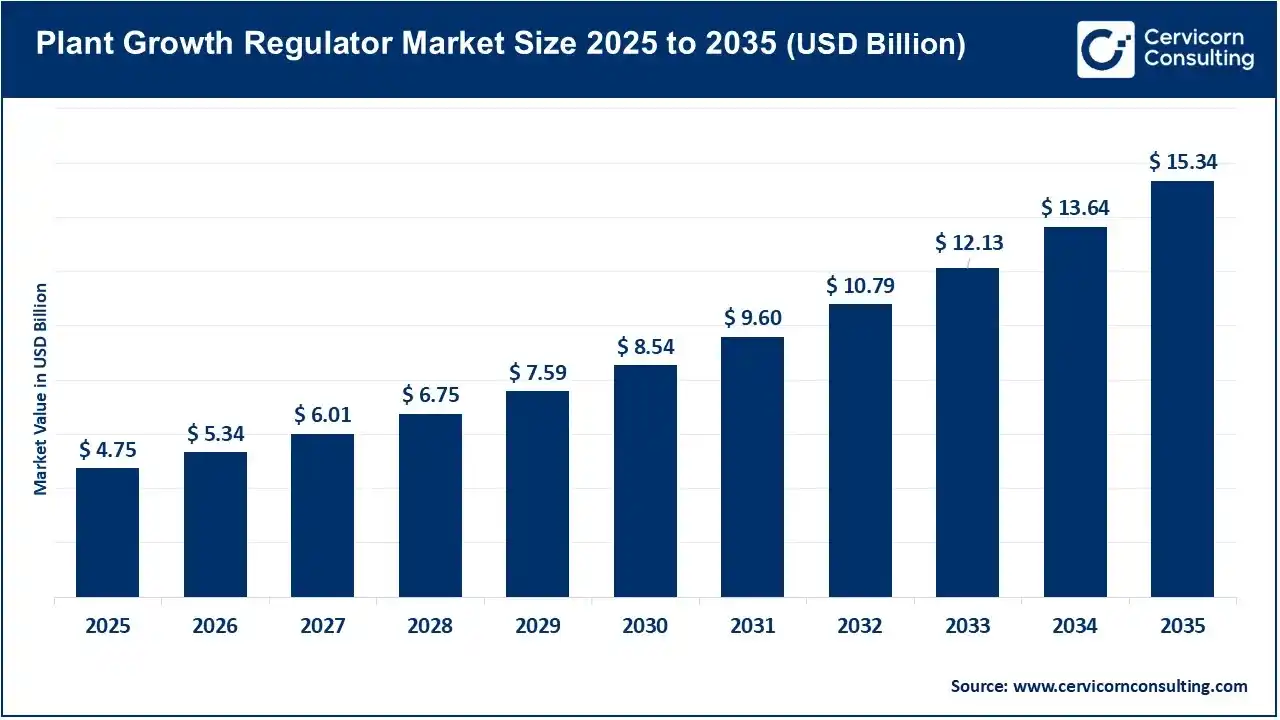
The global plant growth regulator market was valued at USD 4.75 billion in 2025 and is projected to reach approximately USD 15.34 billion by 2035, growing at a compound annual growth rate (CAGR) of 12.5% from 2026 to 2035. Asia-Pacific accounted for an estimated 38% of global market revenue in 2025, while fruits and vegetables represented approximately 39% of demand by crop type. These estimates indicate substantial commercial potential, but market growth alone does not guarantee profitability for manufacturers, formulation developers, and agricultural input distributors.
Plant growth regulators (PGRs) influence specific physiological processes, including root development, cell division, flowering, fruit setting, ripening, and plant height. Their commercial value depends on how effectively they address crop-specific production challenges and improve outcomes that matter to growers, such as marketable yield, produce quality, harvest timing, and crop consistency.
For companies operating in this market, the strategic challenge is to identify the most commercially attractive applications, establish reliable product performance, and build distribution models that support repeat purchases. The following six decisions can help businesses translate market growth into more sustainable commercial opportunities.
1. Which Crop Segments Offer the Strongest Commercial Opportunities?
Product development and market expansion should begin with crop-level economics rather than the overall size of the agricultural inputs market. Different crops have different production cycles, physiological requirements, price structures, and tolerance for additional input costs. Consequently, the same plant growth regulator may deliver very different commercial value across applications.
Fruits and vegetables offer opportunities where improved fruit setting, size, uniformity, colour, and maturity can influence the proportion of produce meeting market specifications. Export-oriented horticulture and premium fresh-produce supply chains may provide attractive opportunities when measurable quality improvements justify the additional cost of treatment.
Cereals and grains present a different value proposition. Here, companies may need to demonstrate improvements in plant architecture, lodging resistance, crop establishment, or yield stability. Oilseeds and pulses require their own assessment of flowering, pod development, and stress-related crop losses.
Companies should prioritize applications according to the economic value of the outcome, not simply the number of potential users.
Before entering a new crop segment, decision-makers should assess:
- Addressable demand: Cultivated area, crop production intensity, existing PGR adoption, and the number of growers who can realistically access the product.
- Value per application: The potential financial benefit from improved marketable yield, produce quality, or reduced crop losses.
- Adoption barriers: Farmer awareness, application complexity, input affordability, and access to agronomic advice.
- Competitive intensity: Existing alternatives, established brands, generic formulations, and the availability of substitutes.
A useful commercial approach is to select a limited number of crop–problem combinations for initial market development. Companies can validate product performance and willingness to pay before expanding into adjacent crops.
Get a Free Sample: https://www.cervicornconsulting.com/sample/3073
2. Should Companies Compete Through Active Ingredients or Application-Specific Solutions?
Plant growth regulators include auxins, gibberellins, cytokinins, ethylene-releasing compounds, abscisic acid, and other regulators. Each group influences different physiological processes, making product selection and positioning important determinants of commercial success.
However, competing primarily on the basis of an active ingredient can expose manufacturers to price pressure, particularly when comparable formulations are available from multiple suppliers. A more defensible strategy is to connect the product to a clearly defined crop-management objective.
For example, an auxin-based solution may be positioned around a validated rooting or fruit-setting application, while a gibberellin-based product may address a specific fruit-development or flowering requirement where permitted and supported by evidence. Growth retardants can serve applications where controlling excessive vegetative growth is commercially important.
These examples are not universal recommendations. Efficacy depends on crop species, variety, environmental conditions, dose, application timing, and applicable product approvals.
Companies should determine whether their competitive advantage will come from formulation quality, crop-specific efficacy, ease of application, technical support, or a combination of these factors.
The investment decision should consider three questions:
- Can the product demonstrate a measurable advantage over existing alternatives?
- Is that advantage sufficiently valuable for growers to pay for it?
- Can the company maintain consistent performance across relevant growing conditions?
The objective should be to sell a validated crop outcome rather than rely exclusively on an ingredient-based value proposition.
3. Which Formulation Technologies Deserve Investment?
Formulation decisions influence product stability, storage requirements, transport costs, application convenience, and compatibility with existing farm equipment. A formulation that performs well under controlled conditions may still struggle commercially if it is difficult to handle or requires significant changes to established farming practices.
Liquid formulations benefit from their compatibility with many conventional spraying operations. Powders and granules may offer advantages in storage, handling, or dosing, depending on their composition and intended use. Water-soluble formulations can be relevant to fertigation and other precision application systems when the product is suitable for those methods.
More advanced approaches, including encapsulation, controlled-release systems, and bio-based formulations, may offer opportunities to improve delivery or product differentiation. However, these technologies should not automatically receive investment simply because they are innovative.
Companies should evaluate formulation projects against practical commercial criteria:
- Stability: Shelf life under realistic temperature, humidity, and transport conditions.
- Application performance: Solubility, dispersion, dosing accuracy, and compatibility with intended equipment.
- Manufacturing economics: Production cost, scalability, packaging requirements, and quality-control complexity.
- Field efficacy: Consistency across crop varieties, seasons, and relevant environmental conditions.
- Commercial acceptance: Whether the additional benefits justify a price premium for distributors and growers.
A premium formulation should advance only when its incremental benefits can be demonstrated against its development and production costs. In markets where affordability is a major barrier, improving an existing formulation may create more value than introducing a technically sophisticated but expensive alternative.
4. How Should Companies Prove Product Performance Before Scaling?
Plant growth regulators operate within narrow biological and application windows. Results can vary with plant growth stage, weather, soil conditions, crop variety, dose, and application method. This variability creates a commercial challenge: growers need confidence that a product will perform under their own operating conditions.
Laboratory findings and isolated demonstrations may support product development, but they are not sufficient substitutes for appropriately designed field validation.
Companies should build a structured testing programme that compares treated and untreated plots and, where appropriate, established competing products. Trials should cover representative crop varieties, locations, and growing conditions. The selected measures should reflect the product’s intended commercial benefit rather than rely solely on visible vegetative growth.
Relevant performance indicators may include:
- Marketable yield per hectare rather than total biomass alone.
- Fruit size, grade distribution, quality, or uniformity where relevant.
- Flowering, fruit-setting, or maturity consistency.
- Lodging incidence or other crop-specific production risks.
- Cost of treatment relative to the incremental value generated.
- Repeatability of results across locations and seasons.
Commercial validation should also include correct application protocols, product handling instructions, and clear explanations of conditions under which results may vary.
For manufacturers, distributors, and agronomy teams, the key question is not merely whether a treatment produces a biological response. It is whether the response generates a sufficiently reliable economic benefit to encourage repeat use.
5. Which Markets Should Companies Enter First?
The geographic distribution of agricultural production does not necessarily match the commercial attractiveness of a plant growth regulator. Countries differ in crop mix, farmer purchasing power, product registration requirements, distribution infrastructure, and familiarity with PGR applications.
Asia-Pacific is a significant opportunity within the global market, supported by extensive agricultural activity and demand for improved crop productivity. However, companies should avoid treating the region as a single homogeneous market. Crop economics, farming practices, and route-to-market requirements can vary substantially between countries and even between agricultural regions within a country.
India illustrates the importance of this distinction. Horticulture, commercial crop production, and the need to improve input efficiency can create opportunities for crop-specific solutions. Nevertheless, successful market entry may depend on affordable pack sizes, local-language application guidance, reliable distributor relationships, and demonstrations that show tangible benefits under regional growing conditions.
A company evaluating geographic expansion should examine:
- Market attractiveness: Relevant crop area, likely adoption, product demand, and potential revenue per treated hectare.
- Regulatory feasibility: Registration status, permitted uses, labelling requirements, and the time and cost involved in obtaining approvals.
- Route to market: Distributor coverage, retailer access, agronomy support, and availability of demonstration farms.
- Competitive positioning: Local and international competitors, prevailing prices, and the strength of existing customer relationships.
- Economic viability: Expected margins after registration, logistics, channel incentives, technical support, and customer acquisition costs.
Companies should compare a small number of priority markets using the same criteria. This helps distinguish markets with large theoretical demand from those that can generate profitable sales within a realistic timeframe.
6. How Can Companies Improve Farmer Adoption and Repeat Purchases?
A technically effective product does not automatically become a commercially successful one. Adoption depends on whether growers understand the application, trust the expected outcome, can afford the treatment, and have access to reliable advice.
This is particularly important for plant growth regulators because incorrect timing, excessive or insufficient dosing, and unsuitable application conditions can undermine performance. An unsatisfactory experience may affect future purchases even when the underlying product is technically sound.
Companies should therefore treat agronomic support as part of the commercial offering rather than as a separate promotional activity.
Practical measures include:
- Developing crop-specific application guides with clear timing, dose, and handling instructions consistent with approved labels.
- Conducting demonstration trials that compare treatment costs with measurable crop outcomes.
- Training distributors and retailers to explain appropriate applications and limitations.
- Offering pack sizes and distribution arrangements suited to target customer economics.
- Tracking repeat purchases, product complaints, application errors, and performance differences across regions.
- Collecting structured feedback to guide formulation improvements and identify new crop applications.
Digital tools can strengthen these efforts when they provide practical value. Weather information, crop-stage monitoring, and field-level records may help agronomy teams communicate suitable application windows, provided recommendations are supported by validated protocols and local conditions.
Commercial performance should be measured through indicators such as repeat-purchase rates, treated-area expansion, distributor productivity, customer retention, and contribution margins—not only initial sales volumes.
For companies with limited resources, improving the success rate of existing customers may be more economical than continuously acquiring new customers through broad promotional campaigns.
What Should Plant Growth Regulator Companies Prioritize Next?
The plant growth regulator market offers opportunities across crop types, active ingredients, formulations, and geographies. However, investment decisions should reflect the commercial realities of each application rather than market growth forecasts alone.
Companies can strengthen their position by concentrating on three priorities:
First, focus product development on clearly defined crop problems. Select applications where a measurable improvement in crop performance can justify the cost of treatment.
Second, make field evidence and application reliability central to differentiation. Consistent results, appropriate formulation choices, and effective agronomic support can help distinguish a product from competing alternatives.
Third, allocate resources to markets where adoption and profitability are achievable. Evaluate regulatory requirements, distribution capabilities, farmer economics, and competitive intensity before committing to large-scale expansion.
The companies best positioned to capture long-term value will be those that connect product innovation with crop-specific evidence, practical application support, and commercially viable distribution models. As demand for agricultural productivity solutions evolves, the ability to demonstrate repeatable value at the farm level will remain a critical factor in building durable market share.
To Get Detailed Overview, Contact Us: https://www.cervicornconsulting.com/contact-us