Distributed Database Middleware Market Outlook: Data Consistency, Cloud Integration, Real-Time Performance, and Scalable Data Architecture
Distributed Database Middleware Market: 6 Decisions Companies Should Make to Improve Data Consistency, Scalability, and System Performance
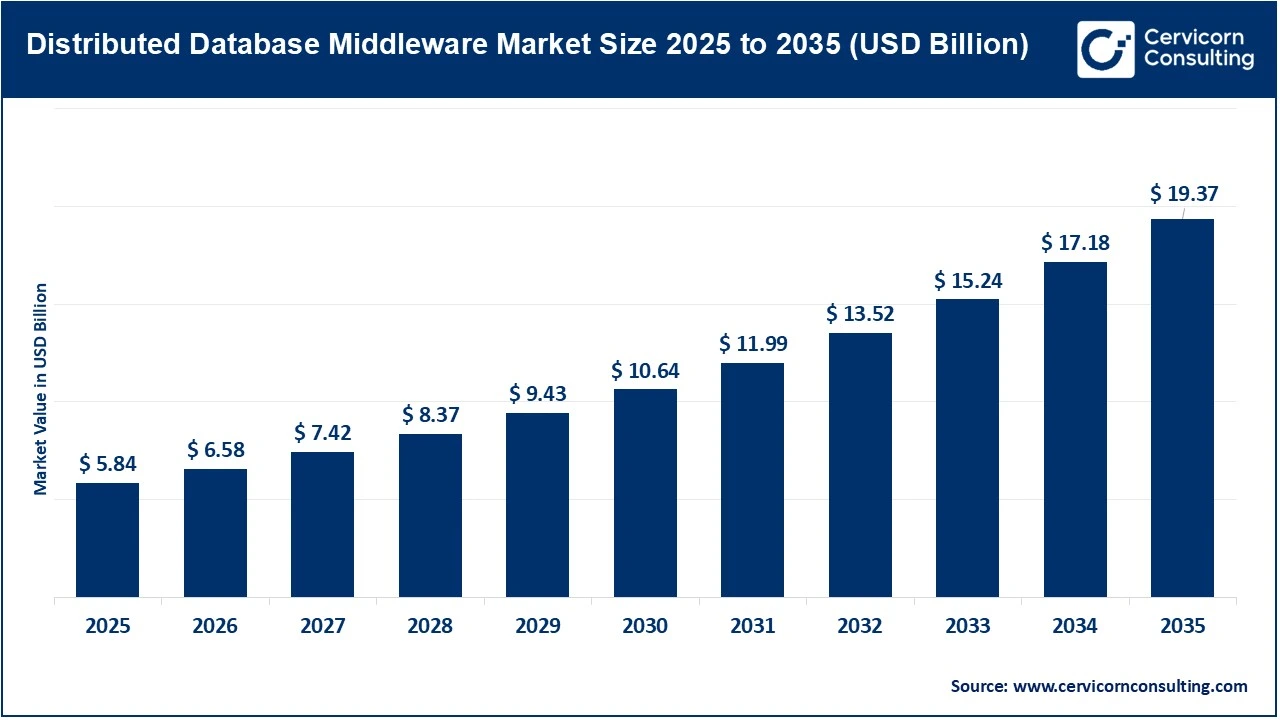
The global distributed database middleware market was valued at USD 5.84 billion in 2025 and is projected to reach approximately USD 19.37 billion by 2035, growing at a compound annual growth rate (CAGR) of 12.8% from 2026 to 2035. Growth is being driven by rising enterprise data volumes, cloud-native application development, multi-cloud adoption, and the need for real-time access to data across geographically distributed systems.
For enterprises, the business challenge is no longer simply storing more data. It is ensuring that applications can access accurate, consistent, and available information across multiple databases, cloud platforms, and operating locations without creating unnecessary complexity or cost.
Distributed database middleware helps address this challenge through capabilities such as data integration, replication, synchronization, distributed query processing, transaction coordination, and load balancing. However, selecting the right solution requires more than comparing technical features. Companies must evaluate their application requirements, operational risks, deployment strategies, and long-term infrastructure costs.
The following six decisions can help technology leaders prioritize investments and identify where distributed database middleware can deliver measurable business value.
1. Should the Company Modernize Its Existing Database Architecture or Build a Distributed Environment?
The first decision is whether the existing database infrastructure can support future application requirements or whether a more distributed architecture is necessary.
Traditional centralized databases may remain suitable for applications with predictable workloads, limited geographic requirements, and manageable data volumes. However, businesses operating digital banking platforms, global e-commerce systems, connected industrial equipment, and real-time analytics applications may require data access across multiple locations and infrastructure environments.
Distributed database middleware can connect existing databases, coordinate data exchange, and support gradual modernization without requiring every legacy system to be replaced simultaneously.
What companies should evaluate:
- Current database performance during peak workloads.
- Application latency and geographic data-access requirements.
- The cost and risk of migrating legacy databases.
- Dependencies between applications and existing data structures.
- The business consequences of database outages or synchronization delays.
Strategic implication: Companies should avoid adopting distributed architectures simply because they are technologically advanced. Investment is more defensible when the existing infrastructure creates measurable constraints on performance, availability, scalability, or expansion into new markets.
Get a Free Sample: https://www.cervicornconsulting.com/sample/2966
2. Which Middleware Capabilities Should Be Prioritized?
Distributed database middleware includes several capability categories, and each addresses a different operational problem. Selecting a platform without identifying the primary requirement can increase implementation costs while leaving important performance issues unresolved.
Data integration middleware connects information across different databases and applications. Data replication middleware maintains copies of information across systems. Transaction processing middleware coordinates operations that may involve multiple data sources, while cloud database middleware supports connectivity across cloud-based environments.
Data synchronization, distributed query processing, database sharding management, and load balancing become increasingly important as applications grow more complex.
What companies should evaluate:
- Whether the priority is integration, replication, transaction management, or query performance.
- The required consistency model and acceptable synchronization delay.
- Compatibility with existing database engines and application frameworks.
- Support for automated failover, monitoring, and recovery.
- The ability to scale individual workloads without unnecessary infrastructure expansion.
Strategic implication: Technology teams should establish a ranked list of required capabilities before evaluating vendors. This helps prevent overinvestment in broad platforms when a focused middleware solution may meet the immediate requirement more efficiently.
3. Should the Deployment Strategy Be On-Premises, Cloud-Based, or Hybrid?
Deployment decisions influence security, performance, regulatory compliance, operational flexibility, and total cost of ownership.
On-premises middleware can provide greater direct control over infrastructure and data handling. Cloud-based solutions may reduce infrastructure management requirements and support faster scaling. Hybrid deployments can help companies modernize selected workloads while retaining sensitive or business-critical systems within existing environments.
The appropriate choice depends on the company’s data governance obligations, infrastructure maturity, application architecture, and internal operational capabilities.
What companies should evaluate:
- Data residency, privacy, and industry-specific compliance requirements.
- Existing investments in private infrastructure and public cloud services.
- The cost of data transfer, storage, software licensing, and ongoing maintenance.
- Network latency and the location of applications and users.
- Portability across cloud providers and the risk of vendor lock-in.
Strategic implication: Enterprises should compare deployment models using a common total-cost-of-ownership framework. A lower initial software cost may not translate into lower long-term expenditure if data movement, integration, monitoring, and specialized administration remain expensive.
4. How Should Companies Balance Data Consistency, Availability, and Performance?
Distributed systems must manage the possibility that different database nodes temporarily hold different versions of information. This creates important trade-offs between immediate consistency, service availability, latency, and recovery behavior.
For financial transactions, inventory management, and other applications where conflicting records can create direct business losses, stronger consistency controls may be essential. Applications such as content delivery, product recommendations, or some analytical workloads may tolerate short synchronization delays when this improves responsiveness or availability.
Middleware selection should therefore be based on application-level consequences rather than a single universal performance target.
What companies should evaluate:
- The maximum acceptable delay before replicated data becomes consistent.
- The impact of stale or conflicting records on customers and operations.
- Recovery objectives following network interruptions or regional outages.
- Transaction integrity across multiple database systems.
- Performance under peak demand, node failures, and network partition scenarios.
Strategic implication: Companies should define service-level objectives for latency, consistency, availability, and recovery before procurement. These requirements can then be translated into measurable acceptance tests and vendor evaluation criteria.
5. How Can the Middleware Architecture Support AI, Analytics, and Real-Time Applications?
Artificial intelligence, connected devices, digital commerce, and operational analytics are increasing the need to access information distributed across operational databases, cloud platforms, and enterprise applications.
Middleware can help consolidate access to distributed data without necessarily consolidating all underlying storage. It can also support data movement, synchronization, and integration processes that make information available to analytical and AI workloads.
However, distributed database middleware should not be treated as a complete data governance or AI infrastructure solution. Data quality, access permissions, metadata management, lineage, and workload-specific processing requirements must also be addressed.
What companies should evaluate:
- Whether operational data can reach analytical applications within the required time.
- Integration with existing data warehouses, lakehouses, and streaming platforms.
- The quality and consistency of information supplied to AI systems.
- Access controls, auditability, and protection of sensitive data.
- Whether additional data movement creates unnecessary latency or cost.
Strategic implication: Companies should prioritize middleware investments around clearly defined use cases, such as real-time fraud detection, inventory visibility, connected-factory monitoring, or customer personalization. This creates a measurable basis for evaluating business impact rather than relying on general AI-readiness claims.
6. Which Vendor and Commercial Model Offers the Best Long-Term Value?
The final decision concerns vendor selection and the commercial structure of the investment. Distributed database middleware can involve licensing fees, consumption-based pricing, infrastructure expenses, implementation services, and ongoing support costs.
Established enterprise software providers may offer broad integration capabilities and support for existing enterprise environments. Specialized database vendors may provide advantages in particular distributed database architectures, developer workflows, or performance requirements. The best choice depends on workload fit and operational economics rather than brand recognition alone.
What companies should evaluate:
- Compatibility with current and planned database platforms.
- Licensing terms, consumption charges, and scaling costs.
- Availability of technical support and implementation expertise.
- Migration complexity and the cost of switching vendors.
- Security updates, product roadmaps, and long-term platform support.
- Performance benchmarks using representative enterprise workloads.
Strategic implication: Procurement teams should use a weighted evaluation framework that combines technical performance, security, interoperability, operational effort, and five-year ownership costs. Proof-of-concept testing should use realistic data volumes and failure scenarios instead of relying exclusively on vendor demonstrations.
What These Decisions Mean for Market Participants
The growth of distributed database middleware creates different opportunities and priorities for vendors, enterprise buyers, and technology service providers.
For middleware vendors: Differentiation will depend on interoperability, reliable data synchronization, manageable deployment complexity, and demonstrable performance under real-world workloads. Vendors should identify the industries and application types where their capabilities solve the most expensive customer problems.
For cloud providers and database companies: Integration across heterogeneous environments, migration support, workload portability, and operational observability can influence adoption. Buyers increasingly need solutions that work within existing infrastructure rather than requiring complete platform replacement.
For enterprise technology leaders: Investment priorities should be linked to measurable improvements in application availability, transaction reliability, data accessibility, operational efficiency, and infrastructure utilization.
For systems integrators and IT service providers: Opportunities may arise from legacy modernization, middleware implementation, cloud migration, database interoperability, and ongoing performance optimization. Successful engagements will require expertise in both database architecture and business-critical application requirements.
Conclusion
The distributed database middleware market is expanding as enterprises manage increasingly complex data environments and demand faster, more reliable access to information. Yet market growth alone does not establish which technology or vendor a company should choose.
The strongest investment decisions begin with a clear assessment of existing architecture, required middleware capabilities, deployment constraints, consistency requirements, future application workloads, and long-term ownership costs.
Companies that evaluate these six areas systematically can make more informed technology investments, reduce integration risk, and build distributed data architectures that support business growth without introducing unnecessary operational complexity.
To Get Detailed Overview, Contact Us: https://www.cervicornconsulting.com/contact-us