AI in Transportation Market Revenue, Trends, and Strategic Insights by 2035
Table of Contents
ToggleAI in Transportation Market Size
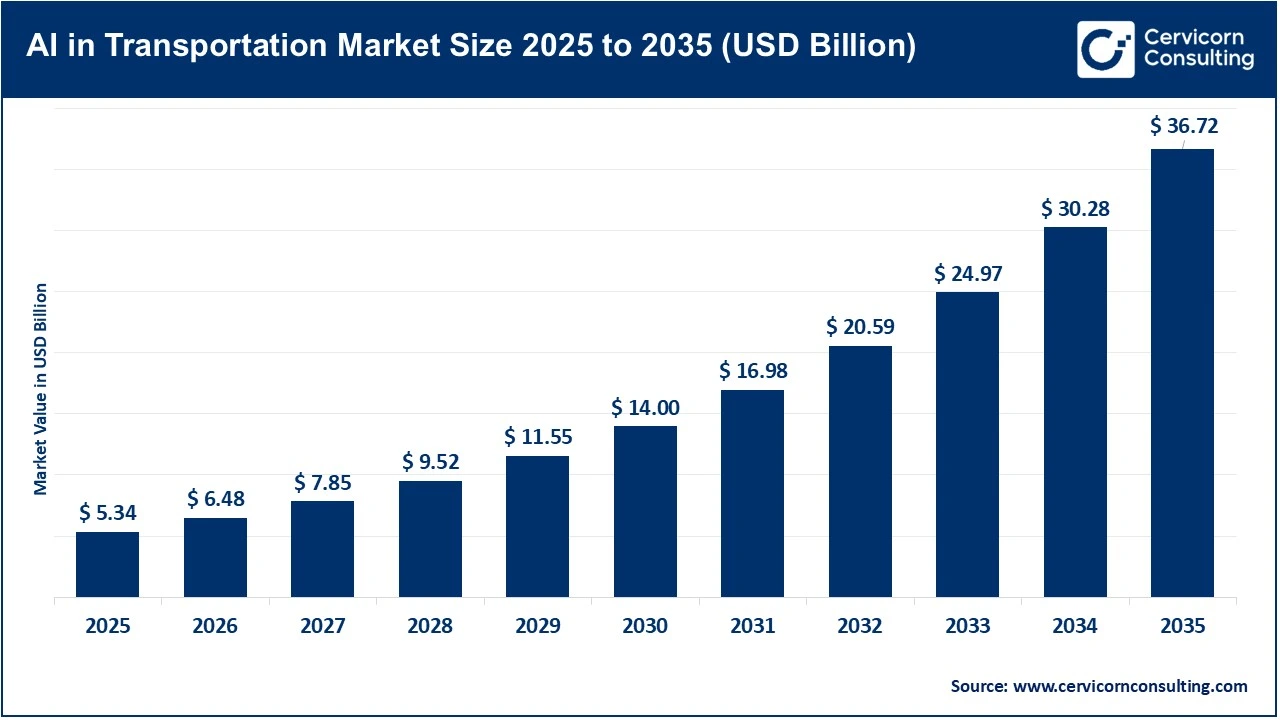
The global AI in transportation market was valued at approximately USD 5.34 billion in 2025 and is projected to reach nearly USD 36.72 billion by 2035, growing at a CAGR of 21.3%.
What is the AI in Transportation Market?
The AI in transportation market refers to the ecosystem of technologies, software platforms, hardware solutions, and services that leverage artificial intelligence to improve transportation systems, vehicles, logistics networks, traffic management, and mobility services. AI technologies such as machine learning, deep learning, computer vision, natural language processing, predictive analytics, and edge computing are increasingly integrated into transportation infrastructure to enhance operational efficiency, safety, sustainability, and customer experience. The market encompasses autonomous vehicles, intelligent traffic management systems, predictive maintenance platforms, fleet optimization software, smart public transportation solutions, and AI-powered logistics applications.
As transportation systems become more connected and data-driven, AI serves as the foundation for real-time decision-making, route optimization, vehicle automation, and infrastructure management. Governments, automotive manufacturers, logistics providers, technology companies, and urban planners are investing heavily in AI-enabled transportation solutions to address growing challenges related to congestion, emissions, safety, and operational costs.
AI in Transportation Market Growth Factors
The AI in transportation market is experiencing rapid expansion due to the increasing adoption of autonomous and connected vehicles, growing investments in smart city infrastructure, rising demand for efficient logistics and supply chain management, advancements in machine learning and computer vision technologies, increasing concerns regarding road safety, expanding deployment of intelligent traffic management systems, growing use of predictive maintenance solutions, rising urbanization and traffic congestion worldwide, favorable government initiatives supporting smart mobility, increasing availability of real-time transportation data, expansion of electric vehicle ecosystems, demand for reduced operational costs across transportation networks, and continuous technological innovations by major technology providers and automotive manufacturers.
Get a Free Sample: https://www.cervicornconsulting.com/sample/2968
Why is AI in Transportation Important?
Enhanced Safety
Human error contributes to the majority of road accidents globally. AI-powered driver assistance systems, collision detection technologies, and autonomous driving capabilities help reduce accidents and improve road safety.
Improved Traffic Management
AI enables transportation authorities to monitor traffic patterns in real time, optimize signal timings, and reduce congestion through intelligent traffic management systems.
Increased Operational Efficiency
Transportation operators utilize AI to optimize routes, reduce fuel consumption, improve fleet utilization, and streamline logistics operations.
Sustainability Benefits
AI-driven transportation systems contribute to lower emissions through optimized traffic flow, efficient route planning, and support for electric and autonomous vehicles.
Better Customer Experience
Passengers benefit from intelligent navigation systems, predictive arrival times, personalized mobility services, and enhanced transportation reliability.
Cost Reduction
Organizations leverage AI to minimize maintenance expenses, reduce downtime, optimize workforce deployment, and improve asset utilization.
Major Companies Driving the AI in Transportation Market
Company Analysis
| Company | Specialization | Key Focus Areas | Notable Features | 2025 Revenue | Estimated AI Transportation Market Share | Global Presence |
|---|---|---|---|---|---|---|
| Tesla, Inc. | Autonomous Driving & EV AI | Full Self-Driving, Autopilot, Neural Networks | Real-world AI training using billions of driving miles | USD 94.8 Billion | Significant in autonomous driving AI | North America, Europe, Asia-Pacific |
| NVIDIA Corporation | AI Computing Platforms | Autonomous Vehicle Chips, AI Infrastructure | DRIVE Platform, High-performance GPUs | USD 130.5 Billion | Leading AI hardware provider | Global Operations Across 50+ Countries |
| Intel Corporation | Transportation Semiconductors | Mobileye, ADAS, Autonomous Driving | Computer Vision & Safety Systems | USD 52.9 Billion | Major ADAS Supplier | Global Presence in Automotive Markets |
| Alphabet Inc. | Autonomous Mobility | Waymo, AI Mapping, Mobility Services | Robotaxi Operations & Advanced AI | Parent Company Revenue Exceeds USD 350 Billion* | Strong Position in Autonomous Mobility | Global Technology Network |
| Microsoft Corporation | Cloud AI Transportation Solutions | Azure Mobility Services, Digital Twins | AI Analytics & Transportation Cloud | USD 281.7 Billion | Strong Enterprise Transportation AI Presence | Global Cloud Infrastructure |
*Approximate recent corporate revenue levels based on publicly reported financial data.
Leading Trends in the AI in Transportation Market and Their Impact
1. Autonomous Vehicle Development
Autonomous vehicles represent one of the most transformative trends in transportation. AI systems continuously process data from cameras, lidar, radar, GPS, and sensors to make driving decisions in real time.
Impact:
- Reduced accident rates
- Improved traffic efficiency
- Lower transportation costs
- Increased accessibility for elderly and disabled populations
2. AI-Powered Traffic Management Systems
Cities worldwide are deploying intelligent transportation systems capable of analyzing traffic conditions and optimizing road usage.
Impact:
- Reduced congestion
- Lower fuel consumption
- Improved emergency response times
- Enhanced urban mobility planning
3. Predictive Maintenance
Transportation operators increasingly rely on AI algorithms to predict equipment failures before they occur.
Impact:
- Reduced downtime
- Lower maintenance costs
- Extended asset lifespan
- Increased operational reliability
4. Smart Logistics and Fleet Optimization
AI-powered logistics solutions optimize delivery routes, vehicle scheduling, cargo management, and warehouse operations.
Impact:
- Faster deliveries
- Reduced transportation costs
- Improved customer satisfaction
- Better supply chain visibility
5. Connected Vehicle Ecosystems
Vehicles are becoming intelligent nodes within broader transportation networks.
Impact:
- Real-time communication between vehicles
- Enhanced road safety
- Efficient traffic coordination
- Improved navigation accuracy
6. Digital Twins in Transportation
Digital twin technology enables transportation operators to simulate and optimize infrastructure performance.
Impact:
- Better planning decisions
- Infrastructure optimization
- Reduced project risks
- Improved transportation resilience
7. AI-Powered Public Transportation
Transit agencies are leveraging AI for scheduling, demand forecasting, passenger analytics, and service optimization.
Impact:
- Higher passenger satisfaction
- Reduced operational expenses
- Increased transit efficiency
- Better resource allocation
Successful Examples of AI in Transportation Around the World
Waymo Robotaxi Services – United States
Waymo, owned by Alphabet, operates one of the world’s most advanced autonomous ride-hailing services. Its AI-powered vehicles navigate complex urban environments using advanced machine learning algorithms and sensor fusion technologies.
Key Achievements
- Millions of autonomous driving miles
- Commercial robotaxi operations
- Advanced perception and decision-making systems
Tesla Full Self-Driving Platform – Global
Tesla utilizes AI-driven neural networks trained on extensive real-world driving data collected from its vehicle fleet.
Key Achievements
- Continuous over-the-air software updates
- Advanced driver assistance capabilities
- Large-scale AI training infrastructure
Singapore Smart Traffic Management System
Singapore has implemented AI-enabled transportation systems to manage urban mobility efficiently.
Key Achievements
- Real-time traffic optimization
- Intelligent congestion management
- Smart mobility planning
Deutsche Bahn Predictive Maintenance – Germany
Germany’s railway operator utilizes AI to predict equipment failures and optimize maintenance schedules.
Key Achievements
- Reduced service disruptions
- Improved rail network reliability
- Lower maintenance expenditures
China’s Intelligent Transportation Networks
China has invested heavily in AI-powered traffic monitoring, smart highways, autonomous vehicle testing zones, and intelligent logistics systems.
Key Achievements
- Large-scale smart city integration
- Extensive AI-powered surveillance and traffic management
- Advanced autonomous driving pilots
Port of Rotterdam Smart Logistics System – Netherlands
The Port of Rotterdam employs AI to optimize shipping operations, cargo movement, and port logistics.
Key Achievements
- Enhanced cargo efficiency
- Reduced waiting times
- Improved supply chain coordination
Global Regional Analysis of the AI in Transportation Market
North America
North America remains the largest and most technologically advanced AI in transportation market.
Market Drivers
- Strong presence of technology leaders
- High investment in autonomous vehicles
- Advanced transportation infrastructure
- Favorable innovation ecosystem
Government Initiatives and Policies
The United States government supports autonomous vehicle testing, smart transportation research, and infrastructure modernization through various federal and state-level programs. Investments in connected infrastructure and intelligent transportation systems continue to accelerate market growth.
Canada is also promoting smart mobility initiatives, autonomous vehicle testing programs, and AI innovation through public-private partnerships.
Key Countries
- United States
- Canada
Europe
Europe is a major market driven by sustainability goals, smart mobility initiatives, and stringent transportation safety regulations.
Market Drivers
- Strong environmental regulations
- Smart city development programs
- Advanced automotive industry
- Focus on intelligent mobility
Government Initiatives and Policies
The European Union supports AI-driven transportation through digital mobility strategies, connected vehicle initiatives, and smart infrastructure investments. The region’s Green Deal and sustainable transportation objectives encourage adoption of intelligent transportation technologies.
Key Countries
- Germany
- France
- United Kingdom
- Netherlands
- Sweden
Asia-Pacific
Asia-Pacific is expected to witness the fastest growth in the AI in transportation market.
Market Drivers
- Rapid urbanization
- Growing vehicle ownership
- Expanding smart city projects
- Government investment in AI technologies
Government Initiatives and Policies
China’s national AI strategy promotes autonomous vehicles, smart transportation infrastructure, and intelligent logistics systems. Significant investments support the development of AI-powered transportation ecosystems.
Japan actively supports autonomous mobility innovation and connected vehicle technologies through collaborative industry programs.
South Korea continues investing in smart transportation corridors and autonomous driving infrastructure.
India’s Smart Cities Mission and intelligent transportation initiatives are accelerating AI adoption across urban mobility systems.
Key Countries
- China
- Japan
- South Korea
- India
- Singapore
Latin America
The region is gradually adopting AI-powered transportation solutions, particularly in urban mobility and logistics.
Market Drivers
- Growing urban populations
- Need for traffic optimization
- Expanding e-commerce logistics
Government Initiatives and Policies
Several governments are implementing smart city programs and intelligent transportation projects aimed at reducing congestion and improving public transportation efficiency.
Key Countries
- Brazil
- Mexico
- Chile
- Colombia
Middle East and Africa
The Middle East is emerging as a significant market for AI-driven transportation innovation.
Market Drivers
- Smart city developments
- Infrastructure modernization
- Digital transformation initiatives
Government Initiatives and Policies
The UAE’s smart mobility strategies encourage autonomous transportation deployment, AI-driven traffic management, and intelligent public transit systems.
Saudi Arabia’s Vision 2030 supports smart infrastructure development, autonomous mobility solutions, and AI integration across transportation networks.
African nations are increasingly adopting AI-powered transportation technologies to improve logistics efficiency and urban mobility.
Key Countries
- United Arab Emirates
- Saudi Arabia
- South Africa
- Egypt
Competitive Landscape and Future Outlook
The competitive landscape of the AI in transportation market is characterized by collaboration among technology companies, automotive manufacturers, cloud service providers, transportation operators, and government agencies. Companies such as Tesla, Inc., NVIDIA Corporation, Intel Corporation, Alphabet Inc., and Microsoft Corporation continue investing heavily in artificial intelligence, autonomous systems, edge computing, cloud infrastructure, and transportation analytics. As governments prioritize smart mobility, sustainability, and transportation safety, AI adoption is expected to accelerate across roadways, railways, aviation, maritime logistics, and public transit networks, creating substantial growth opportunities throughout the coming decade.
To Get Detailed Overview, Contact Us: https://www.cervicornconsulting.com/contact-us
Read Report: Healthcare IT Market Revenue, Trends, and Strategic Insights by 2035