Where are the biggest growth opportunities in data center IT as AI scales?
Data Center IT Market: How AI and High-Density Computing Are Reshaping Infrastructure Demand
Artificial intelligence is changing what data centers need from their IT infrastructure.
The shift is no longer limited to adding more servers. AI training, inference, generative AI, high-performance computing, cloud applications, and data-intensive workloads are increasing requirements for accelerated computing, high-speed networking, large-scale storage, and intelligent infrastructure management.
This is creating a fundamental question for data center operators and technology companies: how should IT infrastructure evolve as workloads become more computationally intensive and data volumes continue to expand?
The answer is increasingly visible across the data center IT market.
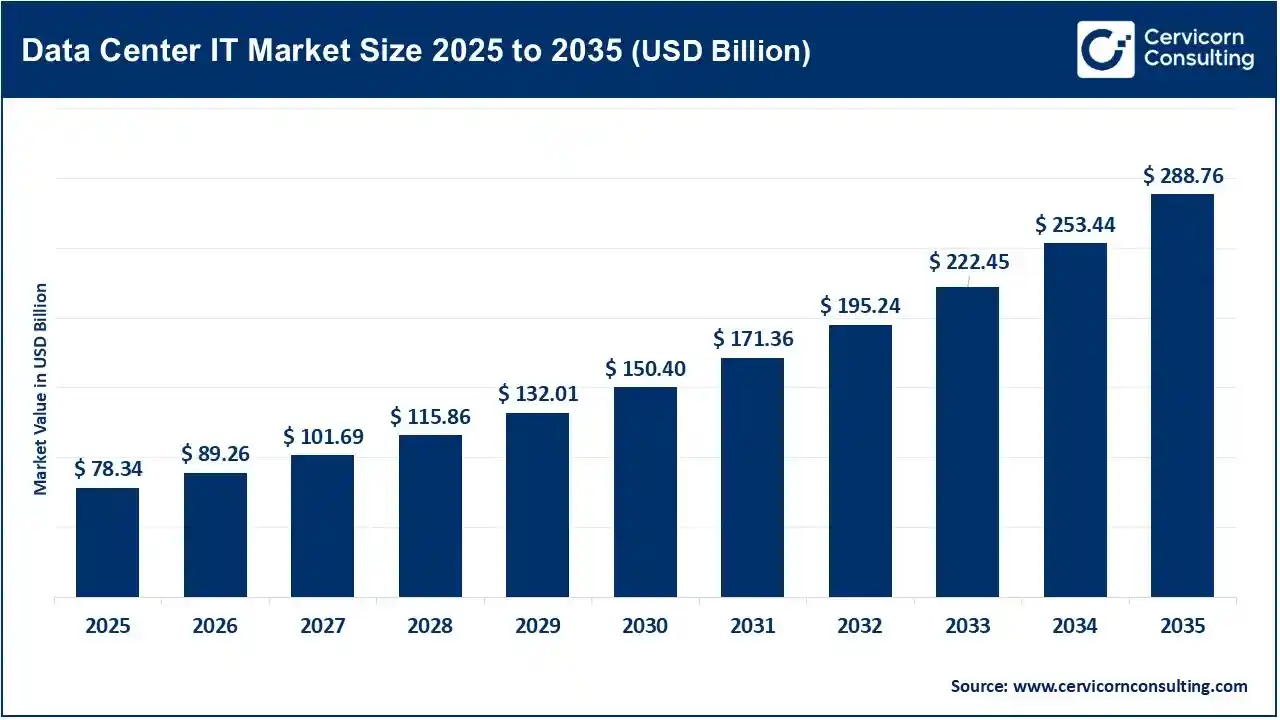
The global data center IT market was valued at USD 78.34 billion in 2025 and is projected to reach USD 288.76 billion by 2035, expanding at a 13.9% CAGR from 2026 to 2035.
But the opportunity is not distributed evenly across every technology category, data center type, or geography.
AI is changing the data center IT equation
Traditional enterprise workloads required substantial computing, storage, and networking capacity, but AI introduces a different infrastructure profile.
AI model training and inference require high-performance servers, GPUs, accelerators, high-bandwidth memory, and faster interconnects. As organizations deploy generative AI and machine learning applications, infrastructure must increasingly support larger computational workloads while moving massive volumes of data between processors and storage systems.
The impact is already reflected in electricity demand. According to the data cited by Cervicorn Consulting, electricity consumption by AI-focused data centers increased 50% in 2025, compared with 17% growth in overall data center electricity consumption.
AI-focused data centers are also expected to triple their electricity consumption between 2025 and 2030, reinforcing the need for accelerated computing, high-density servers, and specialized IT infrastructure.
This creates an important distinction between simply expanding data center capacity and building infrastructure specifically designed for AI workloads.
For IT vendors, this means opportunities are emerging across servers, accelerators, storage, networking, management software, and infrastructure optimization technologies.
Get a Free Sample: https://www.cervicornconsulting.com/sample/3046
More data does not simply mean more storage
Data growth is another structural factor affecting data center IT requirements.
Connected devices, enterprise applications, industrial systems, video platforms, analytics, cloud applications, and digital services are generating increasingly large datasets. Data centers therefore need additional computing and storage capacity while also improving how information moves through infrastructure.
Global data center electricity consumption reached approximately 415 TWh in 2024, equivalent to around 1.5% of worldwide electricity consumption, according to the information referenced on the market page. Data center electricity consumption has also grown at roughly 12% annually since 2017.
At the same time, accelerated-server capacity grew four times faster than total server capacity between 2015 and 2024.
The implication is significant: infrastructure growth is increasingly being shaped by workload intensity rather than simply by the number of servers deployed.
Servers remain the largest component, but software is becoming increasingly important
Servers accounted for 38.7% of the data center IT market in 2025, making them the largest component segment.
Storage systems represented 19.4%, while networking equipment accounted for 18.6%. Data center management software represented 8.9%, followed by security solutions at 6.1% and IT infrastructure management solutions at 5.2%.
The dominance of servers reflects their central role in cloud applications, databases, virtualization, analytics, enterprise workloads, and AI.
However, the increasing complexity of modern infrastructure is also creating demand for software-based management.
Data center operators are increasingly dealing with hybrid environments, hyperscale deployments, distributed infrastructure, AI workloads, automated provisioning, predictive maintenance, and increasingly complex resource allocation.
This is creating opportunities for data center management software incorporating automation, AI-based monitoring, predictive analytics, workload orchestration, digital twins, and energy-management capabilities.
In other words, the next phase of data center modernization is not only about more compute. It is also about better control of compute.
Hyperscale infrastructure continues to shape IT demand
Hyperscale data centers represented 36.8% of the data center IT market in 2025, the largest share among data center types.
Their scale makes them particularly important for AI and cloud infrastructure. Large cloud providers, technology companies, internet platforms, and digital service providers require standardized architectures capable of supporting enormous computing and networking workloads.
AI is strengthening this requirement further.
Large-scale AI training and inference require substantial quantities of compute, storage, and networking infrastructure. As AI clusters become larger, high-performance servers, accelerators, high-speed interconnects, and infrastructure-management technologies become increasingly important.
Colocation data centers represented 22.7% of the market, supported by enterprises seeking scalable infrastructure, connectivity, reduced capital requirements, and access to established data-center ecosystems.
At the other end of the infrastructure spectrum, edge data centers are emerging around workloads where latency matters.
AI inference, IoT, autonomous systems, 5G services, real-time analytics, and content delivery are encouraging organizations to process data closer to users and connected devices.
This creates a different IT requirement: compact servers, storage, networking equipment, remote management, and highly automated systems capable of operating across geographically distributed locations.
The enterprise modernization opportunity extends beyond technology companies
IT and telecommunications represented 29.6% of the data center IT market in 2025, making it the largest end-user segment.
The sector includes cloud providers, telecom operators, internet companies, hosting providers, and technology enterprises with extensive computing and networking requirements.
But demand is spreading across other industries.
BFSI accounted for 16.8%, healthcare for 9.2%, government and defense for 9.7%, retail and e-commerce for 7.8%, and manufacturing for 7.1%.
Financial institutions, for example, are increasingly using cloud infrastructure, real-time payments, fraud detection, cybersecurity systems, analytics, and AI.
Healthcare organizations are handling increasingly data-intensive applications, while manufacturers are integrating connected systems, analytics, automation, and digital platforms.
This means data center IT demand is increasingly linked to the digital transformation strategies of individual industries rather than being confined to traditional technology companies.
North America remains the largest regional market
North America accounted for 39.8% of global data center IT revenue in 2025.
The regional market was valued at USD 31.18 billion in 2025 and is forecast to reach USD 114.93 billion by 2035.
The region benefits from mature cloud infrastructure, hyperscale operators, AI investment, enterprise digitalization, and a large installed base of data centers.
In 2025, supply across CBRE’s eight primary North American data-center markets increased 36% year over year to 9,432 MW, while net absorption reached 2,497.6 MW, up 38%. Vacancy declined to 1.4%.
These conditions are important for IT infrastructure suppliers because new data-center capacity ultimately creates additional requirements for servers, storage, networking, security, and management systems.
Asia-Pacific is becoming increasingly important for future infrastructure demand
Asia-Pacific accounted for 28.7% of the data center IT market in 2025, with the regional market valued at USD 22.48 billion.
The market is projected to reach approximately USD 82.87 billion by 2035.
China, Japan, India, Australia, Singapore, South Korea, and Southeast Asia represent major demand centers, while Malaysia, Indonesia, and Thailand are emerging as important deployment locations.
APAC’s operational data-center capacity reached 13.8 GW in 2025, while its development pipeline reached 19.4 GW, including 3.7 GW under construction and 15.7 GW planned.
India is particularly relevant to the regional expansion story.
India had approximately 1.3 GW of operational data-center capacity in the first half of 2025, placing it among APAC’s five largest markets. Mumbai’s operational IT load increased 42% during 2025, from 542 MW to 768 MW, while another 323 MW was under construction and 998 MW was planned at the end of 2025.
For IT infrastructure vendors, this translates into potential demand across computing, storage, networking, accelerated infrastructure, and management technologies as new capacity comes online.
Europe is balancing AI demand with infrastructure constraints
Europe represented 22.4% of the global data center IT market in 2025.
The European market was valued at USD 17.55 billion and is projected to surpass USD 64.68 billion by 2035.
AI adoption, cloud expansion, enterprise digitalization, and data-sovereignty requirements are supporting infrastructure investment.
At the same time, power and land constraints are encouraging data center development to expand beyond traditional hubs.
The established FLAPD markets—Frankfurt, London, Amsterdam, Paris, and Dublin—remain important, while Milan, Madrid, Helsinki, Oslo, and Warsaw are gaining attention.
This geographic diversification matters for IT suppliers because new locations can create demand for infrastructure architectures adapted to different power, connectivity, workload, and deployment conditions.
The biggest opportunity may be at the intersection of AI, networking, and infrastructure management
The data center IT market is moving toward a more interconnected infrastructure model.
AI requires powerful servers.
Those servers require high-speed networking.
Large AI datasets require high-performance storage.
Increasing infrastructure complexity requires sophisticated management software.
And higher rack densities require data centers to coordinate IT infrastructure with power and cooling systems.
This creates opportunities across several interconnected technology areas rather than within isolated equipment categories.
AI-optimized servers are becoming increasingly important as organizations deploy GPUs, specialized accelerators, high-bandwidth memory, and advanced interconnects.
High-speed networking is becoming critical as AI clusters grow and large datasets need to move rapidly between processors and storage.
Edge computing is opening opportunities for compact, distributed infrastructure designed for low-latency applications.
Meanwhile, data center management software can help operators improve resource utilization, automate provisioning, monitor infrastructure, and manage increasingly complex environments.
What could limit the pace of infrastructure modernization?
The expansion opportunity comes with several practical constraints.
Advanced servers, GPUs, accelerators, storage systems, and networking equipment require significant capital investment. Hardware supply constraints can also create procurement delays when demand for processors, memory, accelerators, and networking equipment rises rapidly.
Another issue is technological obsolescence.
The rapid evolution of processors, accelerators, storage architectures, and networking technologies can shorten infrastructure refresh cycles. Organizations therefore need to balance current performance requirements against future technology developments.
Rising power density adds another layer of complexity.
AI servers can require substantially more power per rack than conventional IT equipment. As rack densities increase, data centers may need corresponding improvements in power delivery and cooling infrastructure.
For operators, therefore, the question is not simply how much IT infrastructure is required?
It is increasingly:
What infrastructure architecture can support the next generation of workloads without creating unacceptable cost, integration, power, or technology-refresh challenges?
Where data center IT investment is moving next
The data center IT market is entering a period in which infrastructure decisions are increasingly being driven by workload characteristics.
AI and HPC are increasing demand for accelerated computing. Cloud expansion continues to increase requirements for scalable infrastructure. Digital data growth is expanding storage and processing requirements. Edge computing is moving workloads closer to users and devices. And infrastructure-management software is becoming increasingly important as environments become more distributed and complex.
With the global market projected to expand from USD 78.34 billion in 2025 to USD 288.76 billion by 2035, the scale of this transformation is substantial.
For technology providers, investors, data center operators, and enterprises planning infrastructure expansion, the important question is no longer whether data center IT demand will change.
It is which technologies, workloads, data center formats, and regional markets will capture the next phase of infrastructure investment.
Cervicorn Consulting’s Data Center IT Market study examines these developments across components, data center types, end users, and major geographic markets, including market sizing and forecasts through 2035.
Get the report / explore the sample for detailed market data, segmentation, and forecasts.
To Get Detailed Overview, Contact Us: https://www.cervicornconsulting.com/contact-us
Read Report: Remote Monitoring and Control Market Revenue, Trends, and Strategic Insights by 2035