Vehicle Electrification Market Revenue, Trends, and Strategic Insights by 2035
Table of Contents
ToggleVehicle Electrification Market Size
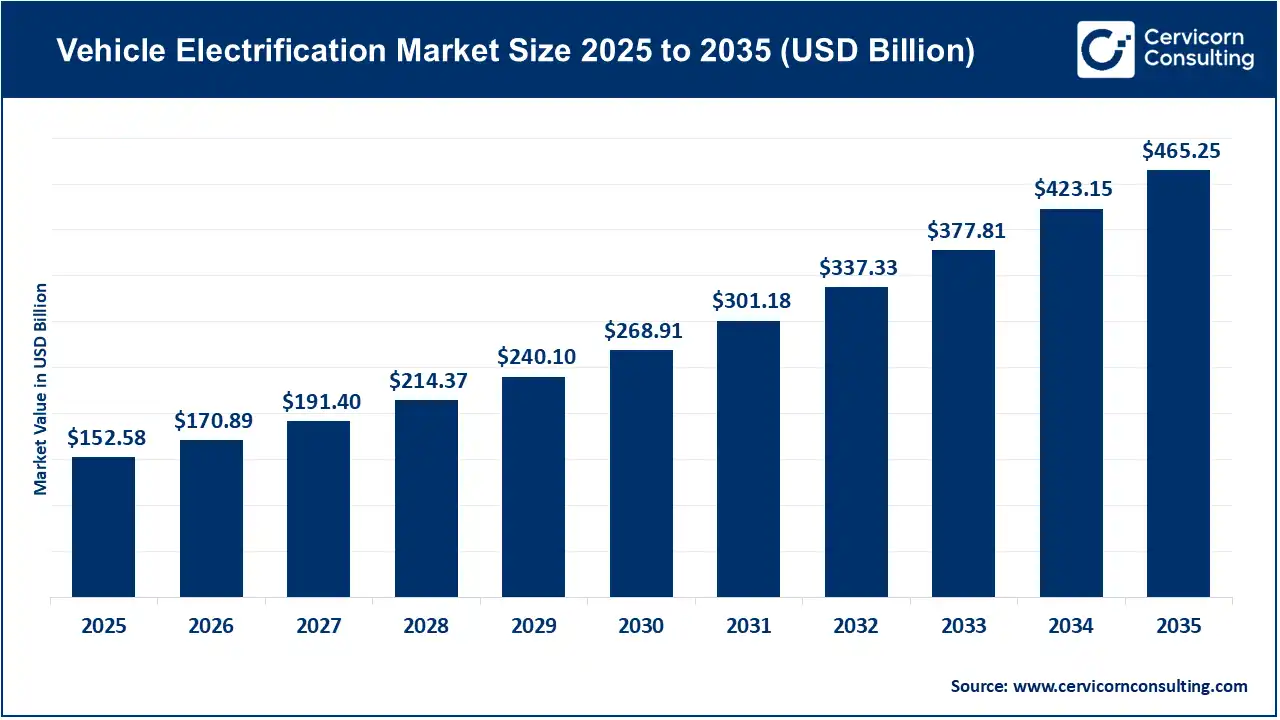
The global vehicle electrification market was valued at approximately USD 152.58 billion in 2025 and is projected to reach nearly USD 465.25 billion by 2035, growing at a CAGR of 11.79%.
Vehicle Electrification Market Growth Factors
The vehicle electrification market is experiencing remarkable growth due to increasingly stringent global emission regulations, rising fuel prices, government incentives for electric vehicles (EVs), rapid advancements in lithium-ion battery technology, expansion of EV charging infrastructure, and growing consumer demand for environmentally friendly transportation. Automakers are investing heavily in battery electric vehicles (BEVs), hybrid electric vehicles (HEVs), plug-in hybrid electric vehicles (PHEVs), and 48V mild-hybrid systems to comply with carbon neutrality targets.
Continuous improvements in battery energy density, silicon carbide (SiC) power electronics, lightweight materials, regenerative braking systems, and intelligent energy management are improving vehicle efficiency while reducing ownership costs. Additionally, connected vehicles, software-defined vehicles, autonomous driving technologies, and renewable energy integration are further accelerating vehicle electrification across passenger and commercial transportation.
What is the Vehicle Electrification Market?
The vehicle electrification market encompasses technologies, components, and systems that replace conventional mechanical and hydraulic functions in automobiles with electrically powered alternatives. It includes fully electric vehicles, hybrid vehicles, plug-in hybrids, fuel-cell electric vehicles, and electrified automotive subsystems.
Key electrification components include:
- Electric motors
- High-voltage batteries
- Battery Management Systems (BMS)
- Inverters
- DC/DC converters
- On-board chargers
- Electric power steering
- Electric compressors
- Electric pumps
- Electric air conditioning systems
- Regenerative braking systems
- Power electronics
- Thermal management systems
Vehicle electrification extends beyond passenger vehicles and is rapidly expanding into commercial trucks, buses, construction equipment, agricultural machinery, mining vehicles, marine vessels, and off-highway equipment.
The transition from internal combustion engines (ICEs) toward electric mobility is one of the largest transformations in automotive history.
Get a Free Sample: https://www.cervicornconsulting.com/sample/2666
Why is Vehicle Electrification Important?
Vehicle electrification has become a strategic priority for governments, manufacturers, and consumers because transportation remains one of the largest contributors to global greenhouse gas emissions.
Its importance includes:
Reduces Carbon Emissions
Electric vehicles significantly reduce CO₂ emissions and support climate neutrality goals.
Improves Energy Efficiency
Electric drivetrains convert over 85–90% of electrical energy into motion, compared to around 30–40% efficiency for internal combustion engines.
Reduces Fuel Dependence
Electrification decreases reliance on fossil fuels while enhancing energy security.
Lower Operating Costs
EVs require fewer moving parts, reducing maintenance expenses and total ownership costs.
Supports Smart Mobility
Electrified vehicles integrate seamlessly with connected mobility, autonomous driving, smart grids, and renewable energy systems.
Drives Innovation
Vehicle electrification accelerates innovation in batteries, semiconductors, artificial intelligence, power electronics, software, and advanced manufacturing.
Major Companies Driving the Vehicle Electrification Market
| Company | Specialization | Key Focus Areas | Notable Features | 2025 Revenue* | Estimated Market Share | Global Presence |
|---|---|---|---|---|---|---|
| Robert Bosch GmbH | Automotive technologies | Electric powertrain, battery systems, eAxles, power electronics | Comprehensive electrification portfolio for passenger and commercial vehicles | €91 billion | Leading Tier-1 supplier | 60+ countries |
| Continental AG | Automotive systems | 48V systems, battery electronics, charging solutions, thermal management | Strong software and electrification integration | Approximately €40–45 billion | Major global supplier | 55+ countries |
| DENSO CORPORATION | Automotive components | Inverters, motors, battery management, thermal systems | Toyota’s primary electrification technology partner | US$47.9 billion | Leading Asian supplier | 35+ countries |
| Aptiv | Smart vehicle architecture | High-voltage architecture, software-defined vehicles, charging systems | Advanced electrical distribution systems | Approximately US$20 billion | Major EV electrical architecture supplier | 45+ countries |
| Johnson Electric Holdings Limited | Precision motors | Electric actuators, pumps, cooling motors, braking systems | High-volume miniature electric motor manufacturing | Approximately US$3.6 billion | Strong niche market player | 30+ countries |
Robert Bosch GmbH
Bosch is among the world’s largest automotive technology suppliers. Its electrification portfolio includes eAxles, battery systems, power electronics, electric motors, fuel-cell technologies, hydrogen solutions, and intelligent charging systems.
Bosch’s expertise spans passenger vehicles, heavy-duty trucks, industrial equipment, and off-highway vehicles. The company continues investing billions annually in mobility innovation and electrification R&D.
Continental AG
Continental develops intelligent electrification technologies ranging from high-voltage battery management to electric drive components and thermal management systems.
Its integrated software platforms optimize battery efficiency, charging performance, and vehicle energy consumption while supporting software-defined vehicle architectures.
DENSO CORPORATION
DENSO is a global leader in automotive electrification technologies and supplies electric motors, inverters, battery monitoring systems, thermal management systems, and advanced power electronics.
Its close collaboration with Toyota has positioned DENSO at the forefront of hybrid and battery-electric vehicle innovation. Fiscal 2025 revenue reached approximately US$47.9 billion.
Aptiv
Aptiv specializes in intelligent vehicle architecture and electrification systems.
Its portfolio includes:
- High-voltage wiring harnesses
- Charging systems
- Battery electrical architecture
- Vehicle software platforms
- Electrical Distribution Systems (EDS)
The company’s focus on software-defined vehicles makes it a critical supplier for next-generation EV platforms.
Johnson Electric Holdings Limited
Johnson Electric manufactures precision electric motors, actuators, cooling systems, electric pumps, steering motors, and braking motors.
Its products are widely integrated into EV battery cooling systems, HVAC systems, seat adjustment mechanisms, and active safety applications.
Leading Trends and Their Impact
1. Transition Toward 800V Vehicle Architecture
Automakers are increasingly adopting 800V electrical systems.
Impact:
- Ultra-fast charging
- Reduced charging time
- Lower energy losses
- Improved driving range
2. Silicon Carbide (SiC) Power Electronics
SiC semiconductors significantly improve inverter efficiency.
Benefits include:
- Higher switching frequencies
- Smaller components
- Better thermal performance
- Longer battery life
3. Growth of Software-Defined Vehicles
Vehicle electrification increasingly depends on intelligent software.
Software controls:
- Battery optimization
- Power distribution
- Charging
- Predictive maintenance
- Vehicle diagnostics
4. Advanced Battery Management Systems
Modern BMS platforms maximize battery safety and lifespan through:
- Cell balancing
- Thermal monitoring
- State-of-health estimation
- Predictive analytics
5. Integrated eAxle Systems
Manufacturers increasingly combine:
- Electric motor
- Gearbox
- Inverter
into a single compact eAxle.
Benefits include:
- Reduced weight
- Higher efficiency
- Simplified manufacturing
6. Wireless Over-the-Air Updates
OTA software updates continuously improve:
- Battery performance
- Charging algorithms
- Vehicle efficiency
- Safety features
without dealership visits.
7. Vehicle-to-Grid (V2G) Integration
EVs increasingly function as distributed energy storage systems capable of supplying electricity back to homes or the power grid.
8. Electrification Beyond Passenger Cars
Vehicle electrification is expanding into:
- Trucks
- Agricultural machinery
- Mining equipment
- Marine transportation
- Construction vehicles
- Urban buses
Successful Examples of Vehicle Electrification Around the World
Tesla – United States
Tesla revolutionized the EV industry by combining high-performance batteries, advanced software, over-the-air updates, and a global fast-charging ecosystem.
BYD – China
BYD has become one of the world’s largest EV manufacturers through vertically integrated battery production, affordable electric vehicles, and rapid international expansion.
Hyundai Motor Group – South Korea
Hyundai’s E-GMP platform supports ultra-fast charging, long driving ranges, and 800V architecture, making it one of the industry’s leading dedicated EV platforms.
Volvo Trucks – Sweden
Volvo has successfully commercialized electric heavy-duty trucks for logistics, construction, and municipal transportation.
Mercedes-Benz – Germany
Mercedes-Benz continues expanding its EQ lineup while investing heavily in high-performance battery technologies, digital vehicle platforms, and luxury EV innovation.
Tata Motors – India
Tata Motors has emerged as India’s leading electric passenger vehicle manufacturer through models such as the Nexon EV, supported by expanding charging infrastructure and localization efforts.
Nissan – Japan
The Nissan Leaf remains one of the world’s pioneering mass-market electric vehicles and has played a significant role in accelerating consumer adoption of EV technology.
Rivian – United States
Rivian has successfully introduced premium electric pickup trucks and delivery vans with advanced battery technologies and software-driven vehicle platforms.
Global Regional Analysis
North America
North America remains a leading market due to strong EV demand, technological innovation, and substantial investments by automotive manufacturers.
Market Drivers
- Expansion of EV charging infrastructure
- Growing battery manufacturing investments
- Commercial fleet electrification
- Strong R&D ecosystem
Government Initiatives
The United States continues to support vehicle electrification through tax incentives, domestic battery manufacturing programs, investments in charging infrastructure, and federal initiatives promoting clean transportation. Canada also provides purchase incentives and supports battery supply chain development.
Europe
Europe represents one of the fastest-growing vehicle electrification markets.
Major contributors include:
- Germany
- Norway
- France
- Netherlands
- Sweden
- United Kingdom
Growth Factors
- Strict CO₂ emission standards
- Carbon neutrality commitments
- High EV adoption
- Extensive charging infrastructure
Government Policies
The European Union’s “Fit for 55” package, stricter fleet emission targets, incentives for zero-emission vehicles, and investments in battery manufacturing are accelerating electrification across member states.
Germany continues supporting EV purchases and battery production through industrial policies and research funding.
Asia-Pacific
Asia-Pacific dominates global vehicle electrification in both manufacturing and sales.
Leading countries include:
- China
- Japan
- South Korea
- India
China
China is the world’s largest EV market.
Key strengths include:
- Large-scale battery manufacturing
- Government subsidies
- Strong domestic supply chain
- Extensive charging infrastructure
- Global EV exports
Government initiatives such as the New Energy Vehicle (NEV) policy, purchase incentives, tax exemptions, and industrial support continue driving rapid electrification.
Japan
Japan remains a leader in hybrid technology, fuel-cell vehicles, and automotive electrification innovation.
Government support encourages battery R&D, hydrogen infrastructure, and zero-emission mobility.
South Korea
South Korea is investing heavily in battery manufacturing, semiconductor technologies, and global EV exports.
Major companies continue expanding lithium-ion battery production worldwide.
India
India is rapidly emerging as an important electrification market.
Government initiatives include:
- FAME incentives
- Production Linked Incentive (PLI) schemes
- Battery manufacturing support
- Charging infrastructure expansion
- State-level EV policies
The growing adoption of electric two-wheelers, passenger vehicles, buses, and commercial fleets is accelerating market growth.
Latin America
Vehicle electrification is gaining momentum across:
- Brazil
- Mexico
- Chile
- Colombia
Governments are encouraging EV adoption through import tax reductions, charging infrastructure development, and fleet electrification programs.
Electric buses are becoming increasingly common in public transportation systems.
Middle East & Africa
Although still an emerging market, the Middle East and Africa are witnessing increasing investments in sustainable transportation.
Regional Drivers
- Smart city development
- Renewable energy integration
- Public transport electrification
- Economic diversification
Countries including the UAE and Saudi Arabia are introducing EV infrastructure, charging networks, and national sustainability strategies to accelerate electric mobility adoption.
Government Initiatives and Policies Shaping the Market
Governments worldwide are playing a decisive role in accelerating vehicle electrification through a combination of regulations, financial incentives, and infrastructure investments.
Key policy measures include:
- Fuel economy and CO₂ emission standards
- Purchase subsidies and tax credits for EV buyers
- Grants for charging infrastructure deployment
- Investments in battery manufacturing and recycling
- Local content and domestic production incentives
- Research funding for next-generation batteries and power electronics
- Zero-emission vehicle mandates for public fleets
- Renewable energy integration with EV charging
- Support for hydrogen fuel-cell technologies in heavy transportation
These coordinated policies are helping create robust EV ecosystems, encouraging private investment, and accelerating the global transition toward cleaner, electrified mobility.
To Get Detailed Overview, Contact Us: https://www.cervicornconsulting.com/contact-us
Read Report: Physical AI in the Automotive Market Revenue, Trends, and Strategic Insights by 2035