AI Vehicle Scanner Market Revenue, Trends, and Strategic Insights by 2035
Table of Contents
ToggleAI Vehicle Scanner Market Size
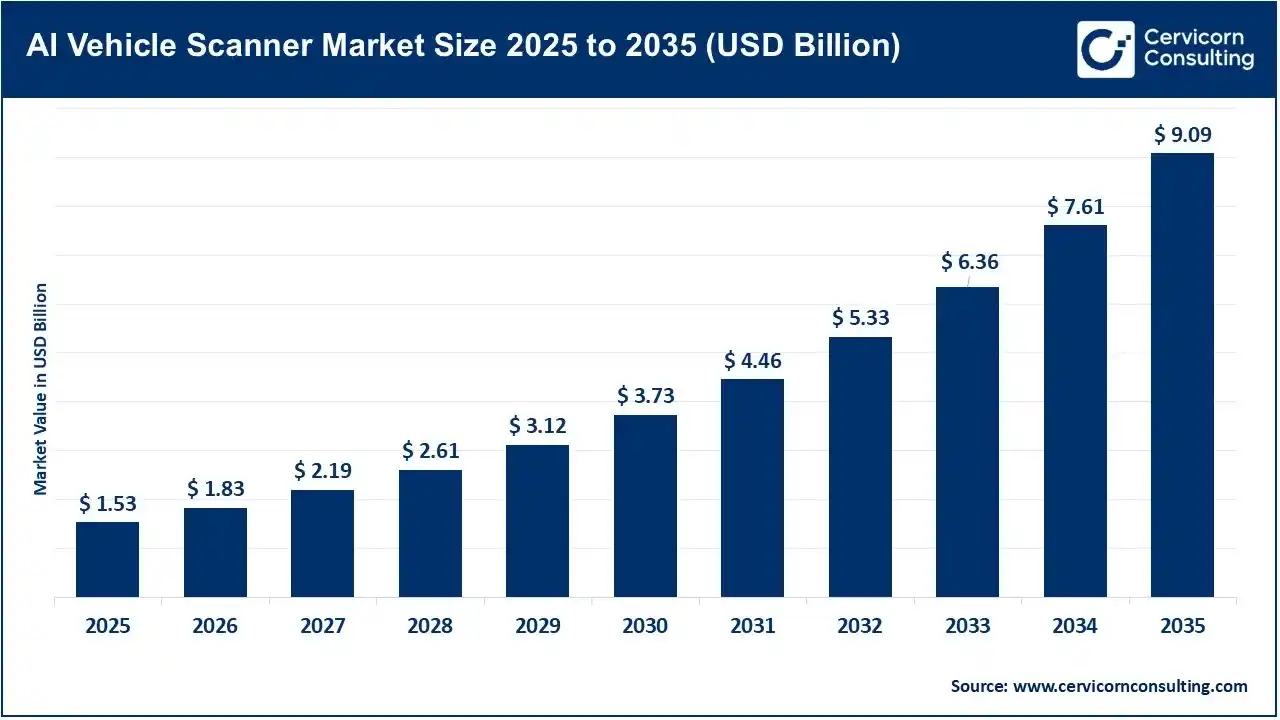
The global AI vehicle inspection system market size was USD 1.53 billion in 2025, with projections reaching USD 9.09 billion by 2035 at a 19.5% CAGR.
What Is the AI Vehicle Scanner Market?
The AI vehicle scanner market encompasses hardware, software, computer-vision platforms, sensors, cameras, AI models, cloud systems, and related services used to automatically inspect and evaluate vehicles.
A typical AI vehicle scanner can capture hundreds or thousands of images as a vehicle passes through a scanning system. AI algorithms then analyze these images to detect abnormalities and classify their severity.
Depending on the application, the scanner can inspect:
- Exterior body panels
- Tires and tread condition
- Wheels and rims
- Vehicle underbody
- Lights and accessories
- Scratches, dents and paint damage
- Missing or incorrectly installed components
- Leaks and mechanical anomalies
- Vehicle identification information
- Previous or newly occurring damage
The technology is deployed through several configurations. Drive-through systems use multiple cameras and sensors positioned around a vehicle. Mobile systems use smartphones to guide users through a 360-degree inspection. Fixed camera systems can monitor vehicles continuously in fleets, logistics centers and manufacturing environments.
The market therefore extends beyond physical scanning equipment. It includes the AI software that converts visual information into actionable information for dealerships, insurers, OEMs, fleet managers and repair organizations.
Get a Free Sample: https://www.cervicornconsulting.com/sample/3017
AI Vehicle Scanner Market Growth Factors
The AI vehicle scanner market is growing because automotive organizations increasingly need faster, standardized and objective inspection processes across high-volume operations; rising vehicle ownership and used-vehicle transactions are creating more inspection points at dealerships, auctions, rental companies and fleet facilities, while growing insurance claims volumes are encouraging insurers to automate damage assessment and repair estimation; advances in computer vision, deep learning, high-resolution imaging and edge computing are improving the ability of scanners to detect small defects that may be missed during manual inspections; the expansion of electric vehicles is also creating demand for more sophisticated inspection workflows covering tires, underbody components, batteries and other vehicle systems; labor shortages and rising inspection costs are encouraging companies to automate repetitive visual checks; meanwhile, digital claims processing, connected vehicles, fleet telematics and mobile-first inspection platforms are creating large datasets that can continuously improve AI models. Research also identifies operational efficiency and standardization across the automotive value chain as important market drivers, while the shift toward mobile-first and inspection-as-a-service models is becoming a notable trend.
Why Is AI Vehicle Scanning Important?
1. Faster inspections
Traditional inspections can require significant time, particularly when vehicles must be checked manually from multiple angles. Automated scanners can inspect vehicles in seconds, allowing dealerships, fleets and logistics facilities to process considerably higher volumes.
UVeye, for example, reports that its OEM systems can deliver more than 90% faster pre-delivery inspection cycles.
2. Greater consistency
Manual inspections can vary according to inspector experience, lighting, workload and interpretation. AI systems establish repeatable inspection processes and generate standardized digital records.
3. Reduced claims friction
Insurance companies can use computer vision to identify vehicle damage from photographs and accelerate claims decisions. Tractable, for example, uses AI to analyze vehicle damage and provide repair recommendations, helping insurers automate parts of the claims process.
4. Improved safety
AI scanning can identify tire defects, underbody problems and other potentially safety-critical conditions before vehicles return to service.
5. Better revenue opportunities
Dealerships can use automated inspection information to identify service opportunities that might otherwise be missed. UVeye reports that Tom Wood Automotive Group achieved a 12% increase in total service revenue after implementing its technology.
Leading Companies in the AI Vehicle Scanner Market
| Company | Specialization | Key Focus Areas | Notable Features | 2025 Revenue* | Market Share | Global Presence |
|---|---|---|---|---|---|---|
| UVeye | Automated vehicle scanning and computer vision | OEMs, dealerships, fleets, rentals, logistics | Drive-through scanning, tire/underbody/exterior inspection, AI reports | Not publicly disclosed; third-party estimates vary | 15% in 2024 | North America, Europe, Asia and other global markets |
| Tractable | Computer-vision vehicle damage assessment | Insurance, repair, recycling, dealerships, fleets | Photo-based AI assessment, repair recommendations, APIs | 2025 not publicly disclosed; $79.4M 2024 estimated revenue | Part of leading group; exact 2025 share not publicly disclosed | North America, Europe, Japan and other markets |
| Ravin AI | AI vehicle condition and damage assessment | Insurance, fleets, rentals, remarketing | Mobile Inspect, AutoScan, Eye dashboard, DeepDetect AI | $6.4M estimated | Part of leading market group | North America and international automotive markets |
| DeGould | Automated vehicle imaging and OEM inspection | Manufacturing, logistics, finished-vehicle inspection | Automated imaging, AI-led defect identification, vehicle records | Not publicly disclosed | Exact share not publicly disclosed | Global OEM and supply-chain deployments |
| Monk AI | Computer vision for vehicle lifecycle management | Insurance, remarketing, mobility, logistics | API, SDK, app, visual vehicle evaluation | $3.1M estimated | Exact share not publicly disclosed | Europe and global customer markets |
*Private-company revenue figures are generally not officially reported. Where available, third-party estimates are identified as estimates rather than audited company revenue. UVeye’s 15% figure is from a 2025 market analysis reporting 2024 market share; another market assessment groups UVeye, Tractable and Ravin AI among companies holding significant combined market presence.
UVeye
UVeye is one of the most prominent companies in automated vehicle inspection. Its systems use cameras, sensors and AI to inspect tires, underbody components and exterior surfaces.
The company reports 700+ customer locations, 3 million+ monthly scans and 5.2 billion images analyzed annually. Its systems are deployed across dealerships, fleets, rental companies and manufacturing operations.
UVeye has partnerships involving major automotive organizations including Amazon, General Motors, Volvo, Toyota and CarMax. In 2025, it secured an additional $191 million in funding, bringing cumulative capital raised to $380.5 million.
Tractable
Tractable focuses heavily on computer vision for vehicle damage assessment and insurance claims.
Its technology analyzes photographs of damaged vehicles, identifies damage and supports repair and claims decisions. Tractable says its AI is trained using millions of images and integrates with automotive and insurance workflows through APIs.
The company has expanded across the U.S., Europe and Japan and has worked with major insurers including Tokio Marine, Ageas, Covéa and MS&AD. Its AI has processed more than $1 billion in auto claims, according to the company.
Ravin AI
Ravin AI specializes in AI-powered vehicle condition assessment.
Its RAVIN Inspect platform enables smartphone-based inspections, while AutoScan uses four or more CCTV-style cameras to scan moving vehicles. The company also offers the RAVIN Eye dashboard for reviewing vehicle condition and generating reports.
Ravin is particularly relevant to insurers, fleets, rental companies and remarketing businesses because its technology can integrate with existing platforms and workflows.
DeGould
DeGould focuses primarily on automated vehicle imaging and inspection for OEMs and automotive logistics.
The company originated from a need to replace inconsistent manual vehicle handover inspections and has developed automated imaging solutions for vehicle manufacturing and finished-vehicle logistics. DeGould states that its systems are installed with leading OEMs and supply-chain partners worldwide.
Monk AI
Monk AI provides computer-vision solutions for the automotive, insurance and mobility sectors.
Its technology is designed to inspect and evaluate vehicles across different stages of the lifecycle, including logistics, remarketing, carsharing and insurance. Monk supports API, SDK and app-based deployment, making its model suitable for companies seeking flexible integration rather than large physical scanning infrastructure. A third-party estimate puts its 2025 revenue at approximately $3.1 million.
Leading Trends and Their Impact
Mobile-First AI Inspection
Mobile inspection is expanding because it eliminates the need for dedicated scanning infrastructure. Smartphone-based systems can guide users through a 360-degree inspection and automatically validate image quality.
Impact: This expands AI inspection into smaller dealerships, insurance claims, peer-to-peer transactions and distributed fleets.
Drive-Through Automated Scanning
High-volume businesses increasingly prefer drive-through inspection portals. Vehicles can be scanned without requiring lengthy manual procedures.
Impact: Faster throughput makes the technology attractive to dealerships, OEM plants, ports, auctions, rental companies and fleet operators.
AI-Powered Insurance Claims
Insurance represents one of the strongest use cases for AI vehicle inspection. AI can identify visible damage, classify severity and assist with repair estimates.
Impact: Claims can move from manual assessment toward near-real-time digital processing, reducing administrative workload and potentially shortening settlement cycles.
Integration With Dealer Management Systems
AI inspection companies are increasingly integrating with appraisal, pricing, inventory and dealer workflow platforms.
The UVeye-vAuto collaboration illustrates this trend. Early testing involved more than 125 users and more than 850 vehicles acquired through automated inspection processes before the solution was launched more broadly.
EV and Advanced Vehicle Inspection
The growth of EVs is pushing inspection technology beyond cosmetic damage. AI systems increasingly need to support tire condition, underbody inspection and other components relevant to modern vehicles.
Impact: Scanner manufacturers can expand from simple damage detection toward predictive maintenance and broader vehicle-health intelligence.
Inspection-as-a-Service
Cloud-based platforms and APIs are reducing the need for companies to build proprietary AI infrastructure.
Impact: Insurance companies, dealerships and fleet operators can adopt AI inspection capabilities through software integrations, accelerating market penetration.
Successful Examples of AI Vehicle Scanners Around the World
Amazon and UVeye — North America and Europe
Amazon and UVeye co-developed an automated vehicle inspection system for delivery fleets. The system scans vehicles returning from delivery routes and identifies defects.
UVeye reports 96% accuracy compared with 24% for manual inspection in the Amazon application. The system has been designed for deployment across hundreds of Amazon delivery stations in the U.S., Canada, the U.K. and Germany.
This demonstrates how AI scanners can move from dealership environments into high-volume commercial fleet operations.
JLR and UVeye — U.S. Ports
In 2025, Jaguar Land Rover partnered with UVeye to automate vehicle inspections at three major U.S. entry points: Brunswick, Georgia; Baltimore, Maryland; and Port Hueneme, California.
The initiative made JLR the first automaker in the U.S. to implement UVeye’s AI inspection technology in its Customer Acceptance Line process at these ports.
This is significant because port inspections represent a high-volume logistics environment where small defects can affect delivery quality, liability and downstream dealership operations.
Hertz and UVeye — U.S. Rental Market
Hertz partnered with UVeye in 2025 to introduce AI-powered vehicle inspection technology into its U.S. operations. The initial deployment began at Hartsfield-Jackson Atlanta International Airport, followed by planned expansion across major U.S. airport locations.
The use case focuses particularly on tire condition and automated vehicle maintenance.
LKQ and Tractable — Automotive Recycling
Tractable’s Auto Inspector has been used by LKQ to assess large numbers of salvage vehicles. The system can evaluate up to 10,000 salvage vehicles per day, helping determine which vehicles contain useful parts and panels.
This demonstrates that AI vehicle inspection is expanding beyond conventional insurance claims into circular automotive supply chains.
Warta and Tractable — Poland
Tractable’s deployment with Warta enabled AI-based visual processing of auto claims in Poland. The technology uses vehicle photographs to assess damage and recommend repair operations.
Global Regional Analysis
North America
North America currently represents one of the most mature markets for AI vehicle inspection. One market assessment estimated that North America represented 35% of AI vehicle inspection system revenue in 2023, supported by its large automotive sector, high technology adoption and strong vehicle safety requirements.
The U.S. is particularly important because it has a large network of dealerships, rental fleets, insurers, OEMs and logistics operators.
Major deployments involving Amazon, Hertz, JLR, General Motors, Volvo and other automotive organizations demonstrate the commercial maturity of the region. UVeye’s expanding dealership and fleet footprint further strengthens North America’s position.
Government initiatives and policies
U.S. policy is increasingly emphasizing vehicle safety, automated technology and data-driven transportation systems. NHTSA continues to support safe development and deployment of advanced vehicle technologies, while the U.S. Department of Transportation unveiled a new automated-vehicle framework in 2025.
Although these policies are not exclusively targeted at AI vehicle scanners, they create an environment in which automated inspection, quality assurance and vehicle condition monitoring can become increasingly important.
Europe
Europe is another important market because of its extensive automotive manufacturing base, established insurance sector, regulatory focus on vehicle safety and growing digitalization of mobility services.
Countries such as the UK, Germany, France and Poland have become important markets for computer-vision-based vehicle assessment. Tractable’s deployments with European insurers demonstrate the region’s willingness to use AI for digital claims processing.
The region also has opportunities in OEM production, finished-vehicle logistics, leasing, rental and used-car remarketing.
Government initiatives and policies
The UK’s Driver and Vehicle Standards Agency has been exploring how AI could assist MOT testing, including tester support, fraud identification and the use of vehicle and image data. The agency has also been working on connected test equipment and modernization of MOT processes.
These initiatives can support long-term adoption of computer vision and automated inspection technologies in regulated vehicle-testing environments.
Asia-Pacific
Asia-Pacific is expected to be one of the fastest-growing regions for AI vehicle inspection. The region combines enormous vehicle production volumes with rapid EV adoption, expanding automotive manufacturing and increasing digitalization.
China
China’s enormous automotive production and EV ecosystem create substantial opportunities for AI-powered quality inspection. Government authorities continue to strengthen automotive defect and recall oversight.
In 2025, China recorded 190 automotive recalls involving approximately 6.846 million vehicles, according to the State Administration for Market Regulation.
In 2026, Chinese authorities also launched stronger measures around vehicle quality, reliability and new-technology safety, including requirements for manufacturers to conduct self-audits and submit information to regulators.
These developments increase the strategic value of automated inspection and quality-control technologies throughout manufacturing and logistics.
Japan
Japan is a major opportunity because of its automotive manufacturing expertise, mature insurance sector and strong focus on quality control. Tractable has established relationships with Japanese insurers, including Tokio Marine, while UVeye has expanded its presence in Japan.
India
India represents an emerging opportunity driven by increasing vehicle ownership, used-vehicle transactions, fleet growth, digitization and vehicle scrappage policies.
India’s Motor Vehicles (Registration and Functions of Vehicle Scrapping Facility) Rules, 2021 established a framework involving Automated Testing Stations and Registered Vehicle Scrapping Facilities. These facilities are intended to assess vehicle fitness and support the formal end-of-life vehicle ecosystem.
India’s broader IndiaAI Mission is also designed to expand AI computing access, data quality, indigenous AI capabilities, industry collaboration and responsible AI development.
Together, these developments create opportunities for AI-powered inspection companies to support automated testing, fleet maintenance, vehicle resale and vehicle lifecycle management.
Latin America
Latin America is at an earlier stage of AI vehicle scanner adoption compared with North America, Europe and parts of Asia-Pacific. However, opportunities are emerging through insurance digitization, used-vehicle markets, fleet management and multinational automotive companies.
Brazil and Mexico are particularly important because of their automotive manufacturing, large vehicle populations and expanding digital ecosystems.
Mobile AI inspection solutions may have an advantage in the region because they can be deployed without requiring expensive fixed scanning infrastructure.
Middle East & Africa
The Middle East and Africa represent developing markets for AI vehicle inspection. The UAE and Saudi Arabia are particularly attractive because of their investments in smart mobility, digital infrastructure and automotive services.
Large fleet operators, rental companies, logistics providers and vehicle marketplaces can use AI inspection to standardize vehicle condition assessments.
The region also offers opportunities for AI inspection at vehicle import and export facilities, dealerships, auctions and fleet maintenance centers.
Future Market Direction
The AI vehicle scanner market is moving from simple automated image capture toward comprehensive vehicle intelligence. Future platforms are likely to combine computer vision, multimodal AI, predictive analytics, vehicle history, telematics and repair-cost databases.
Instead of simply reporting that a vehicle has a dent, next-generation systems could increasingly determine the likely severity, estimate repair requirements, compare current damage with historical images, identify whether damage is new or pre-existing, recommend maintenance actions and connect the result directly to insurance, dealership or fleet-management systems.
The competitive landscape is therefore likely to shift from standalone scanning hardware toward integrated AI vehicle lifecycle platforms.
Companies that can combine high-quality imaging, large vehicle datasets, accurate AI models, API integration and strong partnerships with OEMs, insurers, dealers and fleet operators are positioned to capture a growing share of this expanding market. Current industry research already identifies UVeye, Tractable, Ravin AI, DeGould and Monk AI among the notable participants, alongside companies such as Bdeo, Inspektlabs, Pave Metrics, ProovStation and WeProov.
To Get Detailed Overview, Contact Us: https://www.cervicornconsulting.com/contact-us
Read Report: EV Truck Battery Swapping Market Revenue, Trends, and Strategic Insights by 2035