Biohydrogen Market Revenue, Trends, and Strategic Insights by 2035
Biohydrogen Market Size
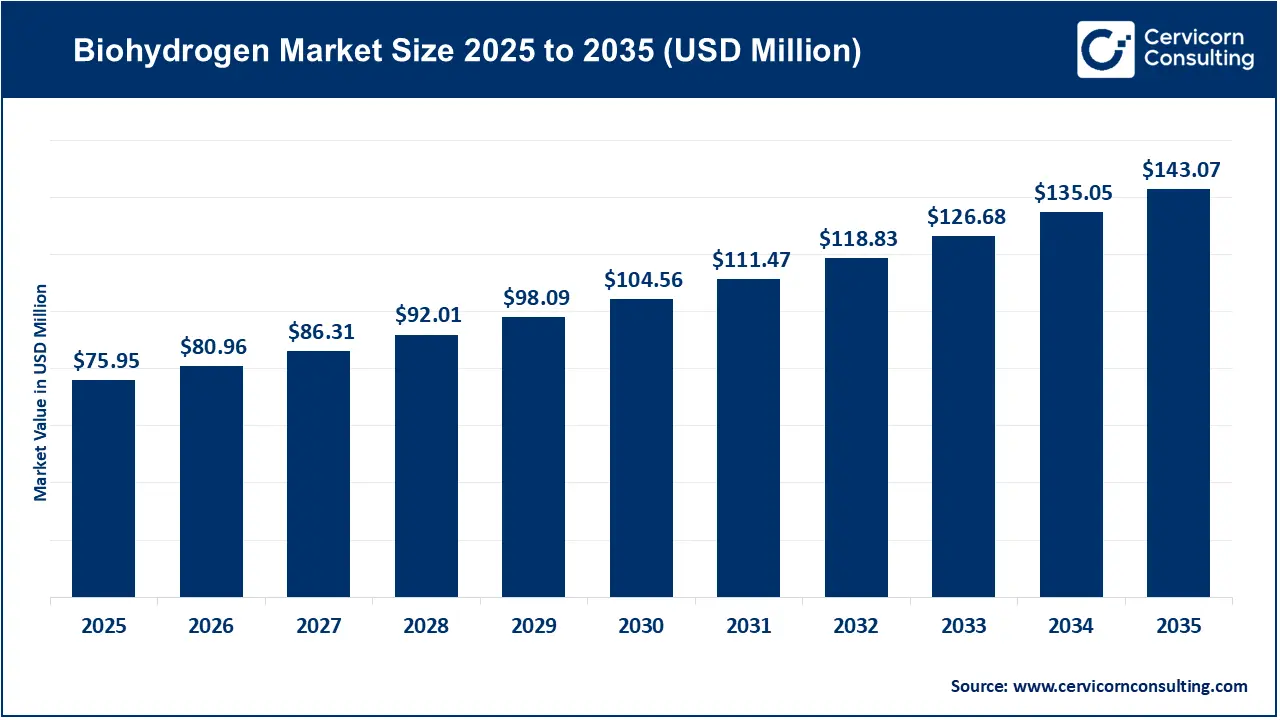
The global biohydrogen market was valued at approximately USD 75.95 million in 2025 and is projected to reach USD 143.07 million by 2035, representing a 6.54% CAGR from 2026 to 2035.
Biohydrogen Market Growth Factors
The biohydrogen market is gaining momentum as governments, industries, and energy companies search for low-carbon alternatives to conventional fossil-fuel-based hydrogen. Key growth factors include the increasing need to decarbonize hard-to-abate sectors such as refining, chemicals, steel, cement, shipping, and heavy transportation; growing availability of agricultural residues, food waste, wastewater, sewage sludge, and other organic feedstocks; advancements in dark fermentation, photofermentation, biophotolysis, microbial electrolysis, anaerobic digestion, biomass gasification, and biogas-to-hydrogen technologies; stricter greenhouse-gas-emission regulations; government funding for clean-hydrogen demonstrations; increasing investments in circular-economy projects that convert waste into energy; declining costs of renewable energy and hydrogen-related equipment; growing demand for locally produced hydrogen; and increasing corporate commitments to net-zero targets.
Biohydrogen also benefits from the potential to combine waste management with energy production, creating an additional economic value stream for municipalities, farms, wastewater treatment facilities, and industrial operators. India, the European Union, the United States and Australia are strengthening hydrogen ecosystems through incentives, demonstration programs, infrastructure investments and clean-energy policies, while technological advances are gradually improving hydrogen yields, process efficiency, purification, storage and integration with existing industrial systems.
However, the market remains at an early commercialization stage, with project economics, feedstock variability, scale-up, hydrogen purification, infrastructure and policy uncertainty continuing to influence the pace of adoption.
Get a Free Sample: https://www.cervicornconsulting.com/sample/2751
What Is the Biohydrogen Market?
The biohydrogen market refers to the ecosystem involved in producing, processing, distributing, and utilizing hydrogen generated from biological materials or biological processes. Unlike conventional hydrogen production, which is dominated by natural-gas reforming and other fossil-fuel pathways, biohydrogen uses renewable organic resources or microorganisms as part of the hydrogen-production process.
Several technological pathways fall under the biohydrogen landscape. Dark fermentation uses microorganisms to break down carbohydrate-rich organic materials under oxygen-free conditions and release hydrogen. Photofermentation uses photosynthetic microorganisms and light to convert organic substrates into hydrogen. Biophotolysis uses algae or cyanobacteria to produce hydrogen through biological processes involving water and sunlight. Microbial electrolysis cells combine microorganisms with electrochemical systems to generate hydrogen from organic matter.
The broader biomass-to-hydrogen industry also includes thermochemical conversion routes such as biomass gasification and pyrolysis, followed by gas cleaning and hydrogen separation. Hydrogen can also be produced from biogas generated through anaerobic digestion. These routes are particularly attractive when they use waste streams that would otherwise require disposal.
Academic research identifies dark fermentation, photofermentation, biophotolysis and bioelectrochemical production among the major biological hydrogen pathways, with dark fermentation receiving significant research attention because of its potential for using organic waste and carbohydrate-rich substrates.
Consequently, the term “biohydrogen” can be used narrowly for biological hydrogen production or more broadly for hydrogen derived from biomass and biogenic waste. This distinction is important when comparing market estimates because different research organizations may include different technologies.
Why Is Biohydrogen Important?
Biohydrogen is important because it connects three major global priorities: clean energy, waste management and industrial decarbonization.
First, hydrogen can be used as an energy carrier and industrial feedstock. Hydrogen is already extensively consumed in refining and chemical production, while emerging applications include steelmaking, shipping, heavy-duty mobility, energy storage and low-carbon fuels. The International Energy Agency reported that global hydrogen demand surpassed 100 million tonnes in 2025, although low-emissions hydrogen still represented only a small fraction of total production.
Second, biohydrogen can potentially transform waste into an energy resource. Agricultural residues, food-processing waste, wastewater, sewage sludge and other organic materials contain chemical energy that can be recovered rather than discarded. This creates a circular-economy model in which waste-treatment facilities can potentially become hydrogen-production sites.
Third, biohydrogen can provide decentralized production opportunities. A wastewater treatment plant, food-processing facility or agricultural operation may be able to produce hydrogen close to the point of consumption, reducing transportation requirements.
Finally, biological and biomass pathways can diversify national hydrogen supply. Countries with large agricultural sectors or abundant organic waste resources can use locally available feedstocks rather than relying entirely on imported fossil fuels or imported hydrogen.
Biohydrogen Market Value Chain
The biohydrogen value chain begins with feedstock collection and preparation. Feedstocks may include agricultural residues, sugar-rich waste, food waste, municipal organic waste, sewage sludge, wastewater and biogas.
The next stage is hydrogen production, where biological or biomass conversion technologies transform the feedstock into hydrogen-rich gas. Depending on the process, additional gases such as carbon dioxide and methane may be produced.
Hydrogen then undergoes purification and separation. Membranes, pressure-swing adsorption, catalytic systems and other technologies can be used to achieve the required purity.
The final stages include compression, storage, transportation and end use. Biohydrogen may be consumed at the production site or supplied to industrial users, mobility applications, fuel cells or hydrogen hubs.
Integration with existing waste-management and energy infrastructure is one of the most promising characteristics of the sector.
Major Companies in the Biohydrogen and Hydrogen Ecosystem
The companies below are major participants in the broader hydrogen, industrial-gas, renewable-energy and energy-transition ecosystem. They should not automatically be interpreted as pure-play biohydrogen companies.
| Company | Specialization | Key Focus Areas | Notable Features | 2025 Revenue | Biohydrogen Market Share | Global Presence |
|---|---|---|---|---|---|---|
| Air Products and Chemicals, Inc. | Industrial gases and hydrogen | Hydrogen production, distribution, clean-hydrogen projects | Major global hydrogen supplier; large-scale hydrogen infrastructure | US$12.0 billion FY2025 sales | Not publicly disclosed | 50+ countries |
| Linde plc | Industrial gases and engineering | Hydrogen, electrolyzers, industrial-gas infrastructure, engineering | Strong global industrial-gas network and hydrogen expertise | US$33.99 billion | Not publicly disclosed | Americas, EMEA and APAC |
| ENGIE SA | Energy, renewables and infrastructure | Renewable hydrogen, renewable power, energy systems | Large renewable and energy-infrastructure portfolio | €71.94 billion | Not publicly disclosed | Europe and international markets |
| Air Liquide | Industrial gases and clean-energy technologies | Hydrogen production, mobility, industrial decarbonization | Extensive hydrogen production, distribution and fueling capabilities | €26.94 billion | Not publicly disclosed | Global |
| Shell plc | Integrated energy | Hydrogen, renewable energy, low-carbon fuels and energy infrastructure | Global energy infrastructure and hydrogen capabilities | Revenue varies by reporting definition; 2025 annual report published | Not publicly disclosed | Global |
Air Products and Chemicals, Inc.
Air Products and Chemicals, Inc. is one of the world’s largest hydrogen suppliers. The company states that it operates in approximately 50 countries and identifies itself as the world’s leading hydrogen supplier. Its FY2025 sales were approximately US$12.0 billion.
Its key focus areas include hydrogen production, distribution, liquefaction, pipeline infrastructure and large-scale clean-hydrogen projects. Air Products has also developed major hydrogen projects, giving it capabilities across production, processing and distribution.
The company’s involvement is particularly relevant to the broader low-carbon hydrogen market because biohydrogen projects can require many of the same downstream capabilities—purification, compression, storage, distribution and industrial integration.
Linde plc
Linde plc is another major industrial-gas and hydrogen participant. Linde reported US$33.986 billion in 2025 sales, with operations spanning the Americas, EMEA and Asia-Pacific.
The company focuses on industrial gases, engineering, hydrogen production and hydrogen infrastructure. Its engineering capabilities can be important for large-scale hydrogen projects where production must be integrated with purification, liquefaction, storage and delivery systems.
Linde’s biohydrogen relevance is primarily through the broader hydrogen infrastructure ecosystem rather than being a pure-play biological hydrogen producer.
ENGIE SA
ENGIE SA is a major global energy and renewable-energy company. ENGIE recorded €71.944 billion in revenue in 2025, including €9.86 billion from Renewable & Flex activities.
The company’s strategic focus includes renewable energy, energy infrastructure, flexibility, storage and low-carbon energy solutions. ENGIE’s large renewable portfolio provides an important platform for developing hydrogen ecosystems.
While its activities are broader than biohydrogen, ENGIE can participate in hydrogen value chains through renewable-energy generation, project development, infrastructure and energy-system integration.
Air Liquide
Air Liquide generated approximately €26.94 billion in consolidated revenue in 2025.
Air Liquide has extensive capabilities in hydrogen production, distribution, storage and mobility applications. Its industrial-gas expertise is particularly relevant because hydrogen produced from biomass or biological processes must eventually meet commercial requirements for purity, compression and safe handling.
The company is therefore positioned more broadly in the hydrogen economy than specifically in biohydrogen.
Shell plc
Shell plc is a major integrated energy company with operations across oil, gas, chemicals, trading, renewable energy and lower-carbon technologies. Shell’s 2025 Annual Report reported US$18.5 billion in adjusted earnings, US$42.9 billion in operating cash flow and US$18.9 billion in capital expenditure.
Shell’s global energy infrastructure, hydrogen activities and investment in lower-carbon technologies give it exposure to the broader hydrogen economy. However, a standalone biohydrogen market share is not publicly reported.
Important Note on Market Share
The five companies above are not pure-play biohydrogen companies, and their public financial statements do not generally report biohydrogen revenue as a separate business segment. Therefore, assigning a precise 2025 biohydrogen market share to these companies would be misleading. Their revenues shown above are total company revenues, not biohydrogen revenues.
Leading Trends in the Biohydrogen Market and Their Impact
1. Waste-to-Hydrogen Development
One of the strongest trends is the conversion of organic waste into hydrogen. This model can provide two benefits simultaneously: waste reduction and clean-energy generation.
Projects are increasingly targeting wastewater, sewage sludge, agricultural residues, food waste and other organic streams. This trend could create opportunities for municipalities, food manufacturers, wastewater treatment operators and agricultural businesses.
2. Growth of Dark Fermentation
Dark fermentation remains an important research pathway because it can operate without light and use carbohydrate-rich organic substrates. Researchers are focusing on improving microbial strains, reactor configurations, hydrogen yield, process stability and treatment of complex waste feedstocks.
The major commercial challenge is moving from laboratory-scale performance to reliable industrial production.
3. Integration With Wastewater Treatment
Wastewater facilities are emerging as potential hydrogen-production locations because they already collect organic material and produce biogas.
A major example is the CARMA-H2 project in Navarra, Spain, which is demonstrating hydrogen production from biogas at the Arazuri wastewater treatment plant. The project aims to demonstrate a protonic membrane reformer capable of producing 500 kg of hydrogen per day, alongside CO₂ recovery.
4. Circular Economy Integration
Biohydrogen increasingly fits within circular-economy strategies. Instead of viewing waste as a disposal problem, companies can treat organic residues as energy feedstocks.
This can create additional revenue opportunities while reducing landfill use, methane emissions and dependence on conventional fuels.
5. Hydrogen Hubs
Hydrogen hubs are becoming important because hydrogen production alone does not create a market. Producers need storage, transportation, distribution and customers.
The U.S. Department of Energy’s hydrogen-hub strategy is designed to connect hydrogen producers, consumers and infrastructure. The Infrastructure Investment and Jobs Act included US$9.5 billion for hydrogen, including US$8 billion for regional hydrogen hubs.
6. Improved Hydrogen Purification
Biohydrogen and biomass-derived hydrogen often contain impurities and other gases. As a result, purification technology is becoming increasingly important.
Membrane separation, gas upgrading, pressure-swing adsorption and integrated reactor systems can improve hydrogen quality and reduce processing costs.
7. Digitalization and Process Optimization
Artificial intelligence, digital twins, sensors and advanced process controls are being incorporated into emerging hydrogen projects. These technologies can monitor feedstock quality, microbial activity, gas composition, reactor performance and energy consumption.
CARMA-H2, for example, incorporates an advanced control system and digital twin as part of its demonstration.
Successful Examples of the Biohydrogen Market Around the World
Spain – CARMA-H2 Wastewater-to-Hydrogen Project
Spain is emerging as an important European demonstration market for waste-derived hydrogen. The EU-supported CARMA-H2 project is located at the Arazuri wastewater treatment plant in Navarra.
The project will convert biogas into purified, pressurized hydrogen through an integrated protonic membrane reformer. The planned demonstration is designed to operate for at least 4,000 hours and produce approximately 500 kg/day of hydrogen.
The project is important because it demonstrates how existing wastewater infrastructure can become part of a decentralized hydrogen network.
Spain – HYIELD Waste-to-Hydrogen Demonstration
Another significant European project is HYIELD, which is developing a waste-to-hydrogen plant at a CEMEX cement facility in Spain.
The project combines waste conversion, gas cleaning and hydrogen separation. The EU Clean Hydrogen Partnership reports that the demonstrator is planned at a 3 MW scale and is expected to process thousands of tonnes of dry waste while producing hundreds of tonnes of hydrogen during the demonstration period.
This model is especially relevant to hard-to-abate industries because hydrogen can be used directly at an industrial facility.
India – Biohydrogen Research and Pilot Development
India has been investigating biological hydrogen production for years, including research involving agricultural and industrial organic wastes. The Technology Mission project on hydrogen production through biological routes, sponsored by India’s Ministry of New and Renewable Energy, has examined substrates including sugar-industry materials, distillery waste and paper-mill effluents.
India is now moving toward more formal biomass-based hydrogen demonstrations. In 2025, the government announced a call for proposals supporting pilot projects for production of green hydrogen from biomass-based and innovative technologies.
Europe – Waste Valorization and Hydrogen
Europe’s strategy increasingly links hydrogen development with waste management and industrial decarbonization.
The EU-funded projects CARMA-H2 and HYIELD illustrate two complementary approaches: converting biogas from wastewater and converting broader organic waste streams into hydrogen.
These projects demonstrate a wider European trend toward locally sourced hydrogen production and industrial integration.
Global Regional Analysis and Government Initiatives
North America
North America is one of the most important regions for the broader low-carbon hydrogen industry because of extensive industrial infrastructure, abundant feedstocks, established natural-gas networks, renewable resources and significant government funding.
United States
The United States has established a large hydrogen policy framework through the Infrastructure Investment and Jobs Act and the Inflation Reduction Act. The Department of Energy’s hydrogen programs include regional hydrogen hubs, electrolyzer research and hydrogen technology manufacturing.
The U.S. Department of Energy states that the Infrastructure Investment and Jobs Act provides US$9.5 billion for hydrogen, including US$8 billion for regional hydrogen hubs.
Biomass-derived hydrogen can benefit from this ecosystem because regional hubs are intended to combine production, infrastructure and end-use applications.
The Appalachian Hydrogen Hub is one example where proposed production pathways include biomass pyrolysis, alongside electrolysis, carbon-capture-based hydrogen and hydrogen recovery from waste gases.
The regional outlook is therefore favorable for biohydrogen and biomass-derived hydrogen, although commercialization depends on project economics, feedstock logistics and policy certainty.
Europe
Europe is a major market for renewable and low-carbon hydrogen because of strong decarbonization policies and industrial demand.
The European Hydrogen Bank was established to support renewable hydrogen production and connect supply with demand. The European Commission reported that its third auction, held from December 2025 to February 2026, awarded more than €1 billion to nine hydrogen projects across seven EEA countries.
For biohydrogen, Europe is particularly attractive because waste-management infrastructure, renewable-energy targets and industrial decarbonization policies can be combined in integrated projects.
Spain is particularly notable because of projects such as CARMA-H2 and HYIELD, which demonstrate hydrogen production from biogenic feedstocks and waste.
Asia-Pacific
Asia-Pacific has strong long-term potential because of large populations, extensive industrial activity, agricultural residues and increasing hydrogen strategies.
India
India has one of the most relevant policy frameworks for biomass-based hydrogen. The National Green Hydrogen Mission has an initial outlay of ₹19,744 crore and targets at least 5 million metric tonnes per year of green hydrogen production capacity by 2030. The Mission explicitly identifies hydrogen production from biomass among its target areas.
In November 2025, India’s Ministry of New and Renewable Energy announced a ₹100 crore call for proposals for biomass-based hydrogen pilot projects, strengthening the commercialization pathway for biomass-derived hydrogen.
India’s large agricultural sector provides significant potential feedstock availability. Rice straw, sugar-industry residues, distillery waste, municipal organic waste and wastewater could support decentralized hydrogen projects.
Australia
Australia has positioned hydrogen as an important future export and industrial-development opportunity. Its 2024 National Hydrogen Strategy provides a framework for production, domestic use and exports while emphasizing large-scale industry development.
The government has also established the Hydrogen Headstart program, with up to A$2.25 billion in support for large-scale renewable hydrogen projects.
Although Australia’s strongest hydrogen opportunities are currently associated with renewable electricity and electrolysis, biomass and waste-derived hydrogen can complement these pathways, particularly where organic feedstocks are available.
China
China has become one of the world’s largest hydrogen markets and a major manufacturer of hydrogen equipment. Its large industrial base and extensive renewable-energy deployment create opportunities for multiple hydrogen-production pathways.
The broader hydrogen market is moving toward greater technology diversification, including electrolysis, biomass conversion and waste utilization.
China’s large agricultural and municipal waste streams could create opportunities for biohydrogen, although electrolysis currently receives significant attention because of China’s large manufacturing ecosystem and declining equipment costs.
Latin America
Latin America has strong potential because of agricultural residues, sugarcane production, forestry resources, wastewater and abundant renewable-energy resources.
Brazil is particularly well positioned due to its sugarcane and bioenergy industries. Integrated projects can potentially combine biomass residues, biogas and hydrogen production.
The region’s opportunity lies in combining bioenergy infrastructure with hydrogen production rather than developing completely new feedstock networks.
Middle East and Africa
The Middle East is currently more strongly associated with renewable-powered hydrogen, particularly solar-powered electrolysis, because of abundant solar resources and large-scale energy infrastructure.
However, biomass and waste-derived hydrogen can provide complementary opportunities in cities and industrial zones where municipal waste, wastewater and organic residues are readily available.
Africa has significant potential because of agricultural residues and waste resources, but project development can be constrained by financing, infrastructure and technology availability.
Government Policies Shaping the Biohydrogen Market
Government policy will remain one of the most important factors determining whether biohydrogen progresses from demonstrations to commercial-scale deployment.
India’s National Green Hydrogen Mission provides one of the clearest examples. The Mission includes financial incentives, pilot projects, R&D, hydrogen hubs and infrastructure support, with hydrogen from biomass specifically identified as an area of interest.
India has subsequently expanded support for innovative hydrogen pathways. A 2025 biomass-based pilot call allows financial assistance of up to ₹25 crore per project, depending on applicant category and eligible equipment expenditure.
Europe is using financial mechanisms such as the European Hydrogen Bank to reduce investment risk and create demand for renewable hydrogen.
The United States is supporting hydrogen hubs and technology development through federal funding, creating regional ecosystems in which biomass-derived hydrogen can potentially compete with other low-carbon production routes.
Australia’s Hydrogen Headstart program demonstrates another approach: providing revenue support through competitive production contracts to accelerate large-scale clean-hydrogen development.
These policies have an indirect but important impact on biohydrogen. Even when programs are designed around “clean hydrogen” rather than biohydrogen specifically, they can create infrastructure, offtake agreements, certification systems, financing mechanisms and technical capabilities that reduce barriers for biomass-based pathways.
Challenges Affecting the Biohydrogen Market
Despite its potential, biohydrogen faces several challenges.
Low production yields remain a major technical concern for biological pathways. Microorganisms can be sensitive to temperature, pH, substrate composition and contaminants.
Feedstock variability is another issue. Agricultural and municipal waste can vary significantly in moisture content, chemical composition and availability.
Scale-up is particularly challenging. A process that performs well in a laboratory reactor may not maintain the same hydrogen yield or process stability at commercial scale.
Hydrogen purification can also add substantial costs because biological processes can generate hydrogen mixed with carbon dioxide, methane and other gases.
Infrastructure limitations remain important because hydrogen requires specialized compression, storage, transportation and dispensing infrastructure.
Finally, policy and certification uncertainty can affect investment. The market needs consistent definitions of renewable and low-carbon hydrogen, reliable carbon-intensity accounting and clear eligibility criteria for incentives.
Future Outlook for the Biohydrogen Market
The future of the biohydrogen market is likely to be shaped by the convergence of hydrogen technology, biotechnology, waste management and renewable energy.
In the near term, demonstration projects are expected to remain important. Wastewater treatment plants, food-processing facilities, agricultural operations, landfills and industrial sites provide attractive locations because feedstocks and energy users can be located close together.
Over the medium term, improvements in microbial engineering, reactor design, membrane separation, biogas upgrading, gasification, carbon capture and process control could improve project economics.
The most commercially attractive projects are likely to be those that generate multiple revenue streams. For example, a wastewater facility could receive value from wastewater treatment, waste reduction, biogas utilization, hydrogen production and recovered carbon dioxide.
Industrial partnerships will also become more important. Hydrogen developers need relationships with feedstock suppliers, technology companies, industrial gas companies, utilities and hydrogen offtakers.
As governments increasingly emphasize circular economies and domestic energy security, biohydrogen could occupy a strategic niche alongside electrolysis and other low-carbon hydrogen technologies.
The strongest opportunities are therefore likely to emerge not from biohydrogen competing directly with every other hydrogen-production technology, but from localized projects where biological or biomass feedstocks provide a cost, waste-management or carbon-intensity advantage.
To Get Detailed Overview, Contact Us: https://www.cervicornconsulting.com/contact-us
Read Report: Regenerative Agriculture Market Revenue, Trends, and Strategic Insights by 2035