Physical AI in the Automotive Market Revenue, Trends, and Strategic Insights by 2035
Physical AI in the Automotive Market Size
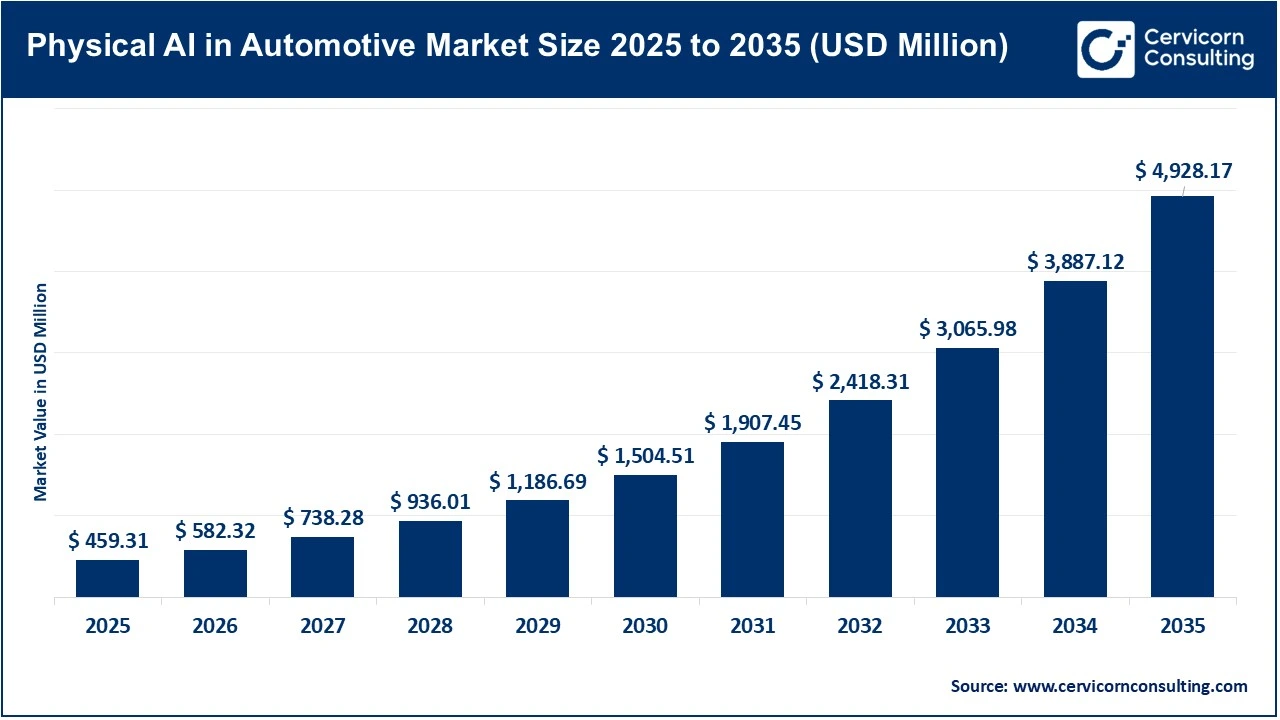
The global physical AI in automotive market was valued at approximately USD 459.31 million in 2025 and is projected to reach nearly USD 4,928.17 million by 2035, growing at a CAGR of 26.8%.
What is Physical AI in the Automotive Market?
Physical AI in the automotive market refers to the integration of advanced artificial intelligence systems with physical vehicles, enabling machines to perceive, reason, learn, and act autonomously in real-world environments. Unlike traditional software-based AI that primarily processes digital information, physical AI combines machine learning, computer vision, sensor fusion, robotics, edge computing, and autonomous control systems to interact directly with the physical world. In the automotive sector, physical AI powers autonomous driving systems, advanced driver assistance systems (ADAS), intelligent vehicle navigation, predictive maintenance, smart manufacturing, vehicle-to-everything (V2X) communication, and robotic fleet management.
Through real-time data processing from cameras, radar, LiDAR, ultrasonic sensors, and connected infrastructure, physical AI enables vehicles to make complex driving decisions while continuously adapting to changing road conditions. As automotive manufacturers accelerate investments in software-defined vehicles and autonomous mobility solutions, physical AI is emerging as a foundational technology for next-generation transportation ecosystems.
Get a Free Sample: https://www.cervicornconsulting.com/sample/2987
Physical AI in Automotive Market Growth Factors
The growth of the physical AI in automotive market is being driven by the rapid advancement of autonomous driving technologies, increasing adoption of AI-powered advanced driver assistance systems, growing investments in smart mobility infrastructure, rising demand for connected and software-defined vehicles, expanding deployment of vehicle-to-everything communication networks, continuous improvements in edge computing and semiconductor technologies, increasing road safety regulations.
Growing consumer preference for intelligent transportation solutions, rising integration of robotics in automotive manufacturing, advancements in generative AI and digital twins for vehicle development, increasing government support for autonomous mobility initiatives, growing adoption of electric vehicles equipped with AI capabilities, expanding urbanization leading to smart city projects, and significant investments from technology companies and automotive manufacturers seeking to develop fully autonomous transportation ecosystems capable of improving safety, efficiency, sustainability, and user experience.
Why is Physical AI Important in the Automotive Industry?
Physical AI is becoming increasingly important because it enables vehicles to understand and interact with complex real-world environments more effectively than traditional rule-based systems. Modern transportation systems require rapid decision-making capabilities that can adapt to dynamic traffic conditions, pedestrian behavior, weather changes, and unexpected road events.
Several factors highlight its importance:
Enhanced Road Safety
AI-powered perception and decision-making systems can identify hazards, predict potential collisions, and respond faster than human drivers. This capability significantly reduces accidents caused by human error, which remains one of the leading causes of road fatalities worldwide.
Autonomous Mobility Development
Physical AI serves as the foundation for self-driving vehicles. By combining perception, reasoning, and control functions, autonomous vehicles can navigate roads independently while continuously learning from operational experiences.
Improved Traffic Efficiency
AI-driven vehicles can optimize routing, coordinate with connected infrastructure, and reduce traffic congestion. Intelligent traffic management contributes to lower fuel consumption and reduced emissions.
Predictive Maintenance
Physical AI enables continuous monitoring of vehicle components, helping manufacturers and fleet operators predict failures before they occur. This reduces maintenance costs and vehicle downtime.
Smart Manufacturing
Automotive manufacturers increasingly use AI-powered robotics and automation systems to improve production efficiency, quality control, and operational flexibility across manufacturing facilities.
Support for Electric Vehicle Ecosystems
As electric vehicle adoption expands globally, physical AI helps optimize battery management, charging infrastructure utilization, energy consumption, and vehicle performance.
Leading Companies in the Physical AI in Automotive Market
| Company | Specialization | Key Focus Areas | Notable Features | 2025 Revenue* | Market Share* | Global Presence |
|---|---|---|---|---|---|---|
| NVIDIA Corporation | AI Computing Platforms and Autonomous Vehicle Systems | Autonomous driving, AI chips, simulation platforms, digital twins | DRIVE platform, Omniverse simulation, AI supercomputing | Approx. USD 190+ Billion | Leading AI hardware provider | North America, Europe, Asia-Pacific, Middle East |
| Tesla, Inc. | Autonomous Electric Vehicles | Full Self-Driving (FSD), AI training infrastructure, robotics | Dojo supercomputer, AI-powered EV ecosystem | Approx. USD 120+ Billion | Significant autonomous EV share | North America, Europe, China, Asia-Pacific |
| Mobileye Global Inc. | Vision-Based Autonomous Driving | ADAS, autonomous mobility, mapping technologies | REM mapping, EyeQ processors | Approx. USD 2+ Billion | Major ADAS supplier | More than 50 countries |
| Alphabet Inc. (Waymo) | Autonomous Mobility Services | Robotaxis, autonomous logistics, AI-driven transportation | Waymo Driver platform | Alphabet Revenue Exceeds USD 400 Billion | Leading robotaxi operator | United States and expanding globally |
| Qualcomm Technologies, Inc. | Automotive AI Semiconductors | Connected vehicles, cockpit AI, autonomous driving platforms | Snapdragon Digital Chassis | Parent company revenue exceeds USD 40 Billion | Major automotive chipset supplier | Global automotive ecosystem |
NVIDIA Corporation
NVIDIA has established itself as one of the most influential companies in physical AI for automotive applications. Its DRIVE platform provides end-to-end solutions for autonomous driving, in-vehicle AI processing, simulation, and validation. The company’s GPU architecture enables high-performance computing required for real-time perception and decision-making. NVIDIA’s Omniverse platform also allows automotive manufacturers to create digital twins and train autonomous systems in virtual environments before deployment.
Tesla, Inc.
Tesla continues to push the boundaries of physical AI through its Full Self-Driving technology, AI training infrastructure, and massive real-world driving dataset. The company’s Dojo supercomputer is specifically designed to train neural networks using billions of miles of driving data. Tesla’s vertically integrated approach combines AI software, custom hardware, and electric vehicle manufacturing to accelerate autonomous driving innovation.
Mobileye Global Inc.
Mobileye is widely recognized for its advanced driver assistance systems and autonomous vehicle technologies. Its EyeQ processors and computer vision algorithms are used by numerous automotive manufacturers worldwide. Mobileye’s Road Experience Management (REM) technology continuously generates high-definition maps using crowdsourced vehicle data, supporting safer autonomous navigation.
Alphabet Inc. (Waymo)
Waymo has become a global leader in autonomous mobility services through extensive deployment of self-driving robotaxi operations. The Waymo Driver platform integrates AI perception, planning, and control systems that enable vehicles to operate autonomously in urban environments. The company continues expanding autonomous transportation services across multiple metropolitan regions.
Qualcomm Technologies, Inc.
Qualcomm plays a critical role in enabling physical AI through its Snapdragon Digital Chassis platform. The company’s automotive solutions support intelligent cockpits, connectivity, autonomous driving capabilities, and vehicle-to-cloud communication. Qualcomm’s AI-enabled semiconductor technologies help manufacturers develop software-defined vehicles capable of advanced automation.
Leading Trends in the Physical AI in Automotive Market and Their Impact
Rise of Autonomous Driving Platforms
The automotive industry is witnessing rapid development of Level 3, Level 4, and Level 5 autonomous driving technologies. Physical AI systems are becoming increasingly capable of handling complex driving scenarios with minimal human intervention.
Impact: Accelerates commercial deployment of autonomous vehicles, improves transportation accessibility, and reduces accident rates.
AI-Powered Sensor Fusion
Modern vehicles integrate data from multiple sensors including cameras, radar, LiDAR, GPS, and ultrasonic systems. Physical AI combines these inputs to create highly accurate environmental models.
Impact: Enhances vehicle perception accuracy and improves safety performance under challenging conditions.
Generative AI for Vehicle Development
Automakers increasingly use generative AI to design vehicle components, optimize aerodynamics, simulate driving environments, and accelerate engineering workflows.
Impact: Reduces development timelines and improves product innovation capabilities.
Digital Twins and Virtual Testing
Digital twin technology allows manufacturers to simulate vehicle behavior in realistic virtual environments.
Impact: Lowers testing costs, accelerates regulatory compliance, and improves autonomous system reliability.
Software-Defined Vehicles
The transition from hardware-centric vehicles to software-defined architectures is reshaping the automotive industry.
Impact: Enables continuous software updates, enhanced personalization, and new revenue opportunities through digital services.
AI-Powered Manufacturing Robotics
Physical AI is transforming automotive manufacturing through intelligent robotics, automated inspection systems, and adaptive production processes.
Impact: Increases productivity, reduces defects, and lowers operational costs.
Vehicle-to-Everything (V2X) Integration
AI-enabled vehicles increasingly communicate with infrastructure, pedestrians, and other vehicles.
Impact: Improves traffic flow, reduces congestion, and enhances road safety.
Edge AI Deployment
Automotive manufacturers are moving AI processing closer to vehicles through edge computing architectures.
Impact: Reduces latency and enables real-time decision-making for safety-critical applications.
Successful Examples of Physical AI in Automotive Markets Around the World
Waymo Robotaxi Services in the United States
Waymo operates one of the world’s most advanced autonomous ride-hailing services. Its robotaxis utilize sophisticated AI systems capable of navigating urban environments without human drivers. Millions of autonomous miles driven have helped refine real-world AI capabilities.
Key Achievements
- Commercial autonomous ride services
- Extensive real-world testing data
- High safety performance metrics
- Scalable autonomous mobility platform
Tesla Full Self-Driving Program
Tesla’s FSD system represents one of the largest deployments of AI-enabled driving technology. Continuous learning from millions of connected vehicles helps improve perception and decision-making algorithms.
Key Achievements
- Massive fleet learning network
- Over-the-air software updates
- Advanced neural network training
- Global autonomous driving development
Baidu Apollo in China
China’s Baidu Apollo platform has emerged as a significant autonomous driving ecosystem integrating AI, cloud computing, and intelligent transportation infrastructure.
Key Achievements
- Autonomous taxis in major cities
- Smart transportation infrastructure integration
- Large-scale autonomous testing programs
Mercedes-Benz DRIVE PILOT in Germany
Mercedes-Benz became one of the first manufacturers to receive regulatory approval for Level 3 autonomous driving systems in selected markets.
Key Achievements
- Certified Level 3 automation
- Advanced sensor integration
- Enhanced highway automation
Mobileye Autonomous Mobility Solutions in Israel
Mobileye’s autonomous driving technologies have become a benchmark for AI-powered vehicle perception systems.
Key Achievements
- Global ADAS deployment
- Advanced mapping technology
- Autonomous vehicle pilot programs
Global Regional Analysis
North America
North America remains one of the largest markets for physical AI in automotive applications due to strong technological innovation, significant venture capital investments, and active participation from leading companies such as NVIDIA, Tesla, Qualcomm, and Waymo.
Government Initiatives and Policies
The United States government supports autonomous vehicle development through regulatory frameworks designed to encourage innovation while maintaining safety standards. Federal agencies continue developing guidelines for autonomous testing and deployment. Investments in smart transportation infrastructure and connected mobility programs further strengthen market growth.
Market Dynamics
- High adoption of autonomous vehicle technologies
- Strong AI semiconductor ecosystem
- Advanced smart city projects
- Growing robotaxi deployments
Europe
Europe represents a major hub for automotive innovation, supported by strong automotive manufacturing capabilities and regulatory leadership.
Government Initiatives and Policies
The European Union actively promotes AI adoption through its AI strategy and digital transformation initiatives. Several countries have introduced autonomous vehicle testing regulations and connected mobility frameworks. Investments in sustainable transportation align with broader environmental objectives.
Market Dynamics
- Strong presence of premium automakers
- Growing adoption of software-defined vehicles
- Significant investment in automotive R&D
- Expansion of connected mobility infrastructure
Asia-Pacific
Asia-Pacific is expected to experience the fastest growth due to rapid urbanization, expanding vehicle production, increasing AI investments, and supportive government policies.
Government Initiatives and Policies
China has established ambitious plans for autonomous vehicle commercialization and intelligent transportation systems. Japan supports AI-enabled mobility through smart city initiatives and robotics programs. South Korea promotes autonomous driving innovation through strategic technology investments and public-private partnerships.
Market Dynamics
- Large-scale automotive manufacturing
- Strong semiconductor ecosystem
- Growing autonomous vehicle pilot projects
- Expanding smart city developments
Latin America
Latin America is gradually adopting physical AI technologies, particularly in fleet management, connected vehicles, and intelligent transportation systems.
Government Initiatives and Policies
Several countries are investing in transportation modernization and digital infrastructure. Emerging regulatory frameworks support connected mobility and smart transportation initiatives.
Market Dynamics
- Growing urban mobility challenges
- Increasing adoption of connected vehicles
- Rising demand for logistics automation
- Expanding digital transformation programs
Middle East and Africa
The Middle East and Africa region is emerging as a promising market driven by smart city projects and investments in advanced transportation technologies.
Government Initiatives and Policies
Countries such as the United Arab Emirates and Saudi Arabia are investing heavily in AI-powered transportation ecosystems. National AI strategies and smart city initiatives encourage adoption of autonomous mobility technologies and intelligent infrastructure solutions.
Market Dynamics
- Smart city mega-projects
- Government-backed AI investments
- Growing interest in autonomous transportation
- Expansion of intelligent mobility services
Future Market Outlook
The physical AI in automotive market is poised for substantial expansion as autonomous driving technologies, intelligent transportation systems, AI-enabled semiconductors, software-defined vehicles, robotics, and smart mobility ecosystems continue evolving. Increasing collaboration between automotive manufacturers, technology providers, semiconductor companies, cloud service providers, and government agencies will accelerate commercialization. As computing capabilities improve and regulatory frameworks mature, physical AI is expected to redefine vehicle intelligence, transportation efficiency, road safety, and mobility experiences across global markets, creating significant opportunities for innovation and long-term industry transformation.
To Get Detailed Overview, Contact Us: https://www.cervicornconsulting.com/contact-us
Read Report: Prosthetics and Orthotics Market Revenue, Trends, and Strategic Insights by 2035