Water Pump Market Revenue, Trends, and Strategic Insights by 2035
Table of Contents
ToggleWater Pump Market Size
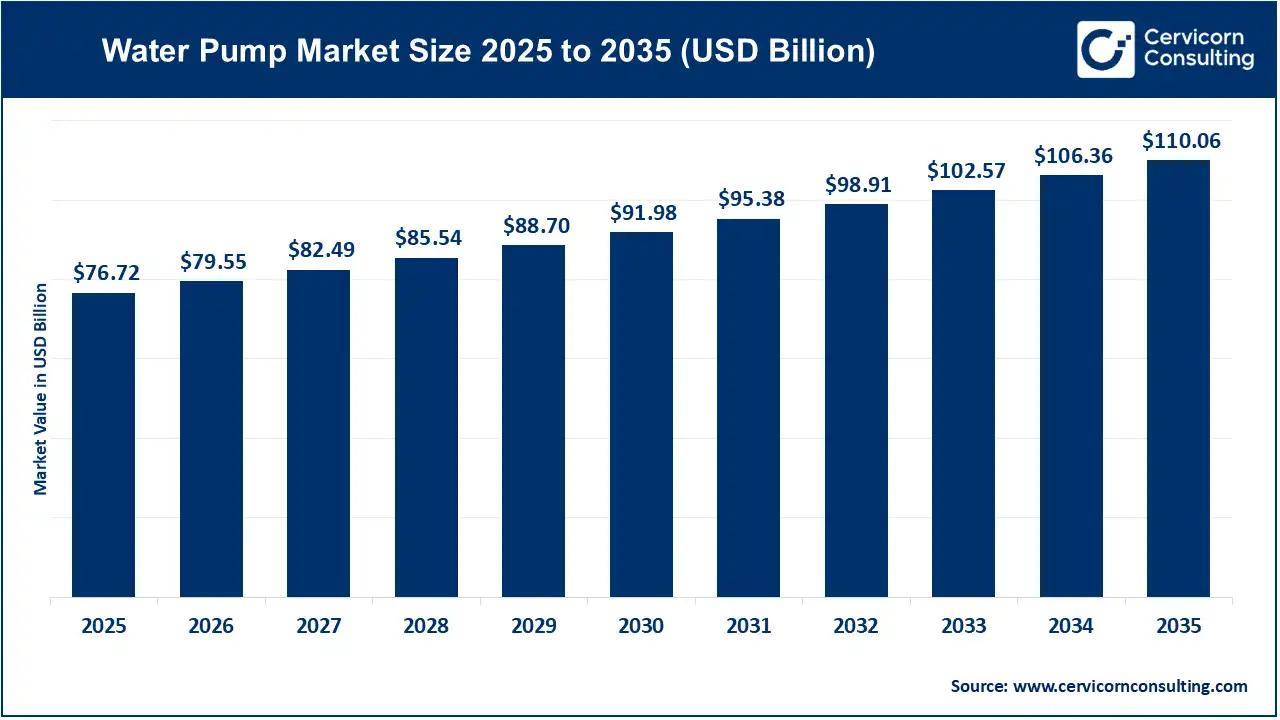
The global water pump market was valued at approximately USD 76.72 billion in 2025 and is projected to reach nearly USD 110.06 billion by 2035, growing at a CAGR of 3.67%.
Water Pump Market Growth Factors
The global water pump market is experiencing steady growth due to increasing investments in water infrastructure, rapid urbanization, industrial expansion, rising demand for efficient irrigation systems, and growing adoption of smart water management technologies. Governments across the world are investing heavily in drinking water projects, wastewater treatment facilities, desalination plants, flood control systems, and agricultural modernization, creating substantial demand for advanced pumping solutions. The expansion of manufacturing industries, mining operations, oil & gas facilities, commercial buildings, and municipal utilities further strengthens market demand.
Additionally, the replacement of aging water infrastructure, increasing focus on energy-efficient pumps, strict environmental regulations, digital monitoring technologies, and the integration of IoT-based predictive maintenance are encouraging organizations to upgrade their pumping systems. Climate change, water scarcity, and sustainable water resource management initiatives are also accelerating investments in modern water pump technologies.
Get a Free Sample: https://www.cervicornconsulting.com/sample/2668
What is the Water Pump Market?
The water pump market refers to the global industry involved in the manufacturing, distribution, installation, and maintenance of equipment designed to move water and other fluids from one location to another. Water pumps operate using mechanical energy supplied through electric motors, diesel engines, solar power, or hydraulic systems.
These pumps are used across numerous sectors including:
- Residential water supply
- Agriculture and irrigation
- Municipal water distribution
- Wastewater treatment
- Oil & gas
- Mining
- Construction
- Chemical processing
- Food & beverage
- Power generation
- HVAC systems
The market includes several pump types such as:
- Centrifugal pumps
- Positive displacement pumps
- Submersible pumps
- Booster pumps
- Diaphragm pumps
- Vertical turbine pumps
- Axial flow pumps
- Mixed flow pumps
With increasing global concerns regarding water conservation and energy efficiency, manufacturers are continuously developing intelligent, connected, and environmentally friendly pumping solutions.
Why is the Water Pump Market Important?
Water pumps form the backbone of modern water infrastructure and industrial operations.
Their importance includes:
Ensuring Safe Drinking Water
Municipal authorities rely on pumping systems for transporting clean water from treatment facilities to residential and commercial users.
Supporting Agriculture
Modern irrigation systems depend heavily on efficient pumps to improve crop productivity while reducing water wastage.
Industrial Operations
Manufacturing industries require pumps for cooling, processing, cleaning, chemical transfer, and wastewater handling.
Wastewater Management
Treatment plants utilize specialized pumps to transport sewage, sludge, and treated water safely.
Flood Prevention
Stormwater pumping stations help cities manage heavy rainfall and reduce flooding risks.
Sustainable Water Management
Energy-efficient pumping systems minimize electricity consumption while maximizing water distribution efficiency.
Major Companies Driving the Water Pump Market
| Company | Specialization | Key Focus Areas | Notable Features | 2025 Revenue* | Estimated Market Share | Global Presence |
|---|---|---|---|---|---|---|
| KSB SE & Co. KGaA | Pumps, valves, services | Water infrastructure, industry, energy | Strong municipal water portfolio, digital monitoring | €3.03 billion | ~3–4% | Operations in more than 100 countries |
| Flowserve | Industrial pumps and flow control | Oil & gas, chemicals, water treatment | Advanced engineered pumping systems | Approximately US$4.7 billion* | ~4–5% | Global operations across 50+ countries |
| ITT Inc. | Industrial pumps | Industrial processing, wastewater, mining | Goulds Pumps portfolio and engineered solutions | Approximately US$3.7 billion* | ~2–3% | Presence in over 35 countries |
| Gorman-Rupp | Water and wastewater pumps | Municipal, fire protection, construction | Durable self-priming and sewage pumps | Approximately US$0.7 billion* | <1% | Worldwide distribution network |
| Pentair | Water treatment and pumping | Residential, commercial, industrial water | Smart water solutions and filtration technologies | US$4.2 billion | ~3–4% | Business operations in more than 150 countries |
Leading Trends Transforming the Water Pump Market
1. Smart Pumps and IoT Integration
Manufacturers are integrating sensors, cloud computing, and artificial intelligence into pumping systems.
Benefits include:
- Real-time monitoring
- Predictive maintenance
- Remote diagnostics
- Energy optimization
- Reduced downtime
Smart pumping systems significantly improve operational efficiency while lowering maintenance costs.
2. Energy-Efficient Pump Technologies
Electricity accounts for a significant portion of pumping system operating expenses.
Manufacturers now emphasize:
- IE5 premium-efficiency motors
- Variable Frequency Drives (VFDs)
- Intelligent motor controls
- Optimized impeller designs
These innovations reduce energy consumption while extending equipment life.
3. Solar-Powered Water Pumps
Governments are encouraging solar irrigation pumps to reduce dependence on diesel-powered equipment.
Major benefits include:
- Lower operating costs
- Zero fuel expenses
- Reduced carbon emissions
- Reliable irrigation in remote regions
Countries including India, Australia, Kenya, and several Middle Eastern nations are investing heavily in solar pump deployment.
4. Expansion of Wastewater Infrastructure
Population growth is increasing wastewater generation.
Governments are constructing:
- Sewage treatment plants
- Industrial wastewater facilities
- Water recycling plants
- Desalination projects
Each facility requires sophisticated pumping technologies.
5. Digital Twin Technology
Large water utilities increasingly use digital twins to simulate pump performance.
Advantages include:
- Better asset planning
- Early failure prediction
- Reduced maintenance costs
- Improved operational efficiency
6. Sustainable Manufacturing
Manufacturers are reducing environmental impact through:
- Recyclable materials
- Low-carbon manufacturing
- Eco-friendly coatings
- Circular economy initiatives
Environmental sustainability has become a competitive differentiator.
Impact of Emerging Trends on the Water Pump Market
These technological developments are reshaping the industry by:
- Increasing operational efficiency
- Lowering total ownership costs
- Improving water conservation
- Enhancing equipment reliability
- Supporting carbon neutrality goals
- Reducing maintenance expenses
- Extending pump lifespan
- Enabling remote operation and automation
Utilities and industries increasingly prioritize lifecycle cost over upfront purchase price, encouraging adoption of premium, intelligent pumping systems.
Successful Examples of the Water Pump Market Around the World
Singapore – Smart Water Infrastructure
Singapore has developed one of the world’s most advanced water management systems.
High-efficiency pumps support:
- NEWater recycling facilities
- Desalination plants
- Water distribution
- Smart utility management
These systems maximize water reuse while minimizing losses.
India – Solar Irrigation Pump Programs
India has implemented one of the world’s largest solar irrigation initiatives under the PM-KUSUM scheme.
Benefits include:
- Reduced diesel consumption
- Increased farmer income
- Improved irrigation coverage
- Lower greenhouse gas emissions
Millions of farmers are gradually transitioning to solar-powered pumping systems.
Netherlands – Flood Management Systems
The Netherlands uses highly advanced pumping stations to protect low-lying regions from flooding.
Large-scale pumps continuously regulate water levels across canals, rivers, and reclaimed land.
These systems represent global best practices in flood resilience.
Saudi Arabia – Desalination Projects
Saudi Arabia operates some of the world’s largest desalination facilities.
High-capacity industrial pumps transport:
- Seawater
- Desalinated water
- Industrial process water
These facilities are critical for national water security.
United States – Municipal Water Modernization
Many U.S. cities are replacing aging pumping infrastructure with:
- Variable-speed pumps
- Smart monitoring systems
- Energy-efficient pumping stations
- Automated water distribution networks
These upgrades improve service reliability while reducing operating costs.
Australia – Mining Industry
Australia’s mining industry depends on heavy-duty pumping systems for:
- Dewatering operations
- Slurry transport
- Water recycling
- Tailings management
Modern mining pumps are designed to withstand abrasive materials and harsh operating environments.
Global Regional Analysis
North America
North America represents one of the largest water pump markets due to mature infrastructure, industrial demand, and continuous technological innovation.
Growth Drivers
- Water infrastructure modernization
- Industrial automation
- Smart city investments
- Municipal upgrades
- Aging pipeline replacement
Government Initiatives
The United States has committed significant funding to drinking water, wastewater, and resilience projects through federal infrastructure programs, supporting upgrades to water systems and pumping equipment. Canada is also investing in clean water and wastewater infrastructure through national and provincial programs.
Europe
Europe emphasizes sustainability, energy efficiency, and environmental compliance.
Countries including:
- Germany
- France
- Italy
- Netherlands
- Sweden
continue investing in modern water infrastructure.
Government Policies
European Union initiatives encourage:
- Energy-efficient industrial equipment
- Circular water management
- Wastewater recycling
- Green infrastructure
- Reduced carbon emissions
Strict eco-design regulations are accelerating replacement of inefficient pumping systems.
Asia-Pacific
Asia-Pacific is the fastest-growing regional market.
Major contributors include:
- China
- India
- Japan
- South Korea
- Australia
- Southeast Asia
Growth Drivers
- Urbanization
- Industrialization
- Population growth
- Smart city development
- Agricultural modernization
Government Initiatives
China continues expanding municipal water networks, wastewater treatment, and industrial infrastructure through large public investment programs. India supports irrigation modernization, rural water supply, and solar pumping initiatives, while Japan and South Korea invest in resilient, energy-efficient water systems and digital infrastructure.
Latin America
Latin America is witnessing increasing investment in:
- Municipal water systems
- Agriculture
- Mining
- Industrial processing
Countries such as Brazil, Mexico, Chile, and Argentina are upgrading water infrastructure to improve service coverage and efficiency.
Government Policies
Governments encourage:
- Public-private partnerships
- Water conservation
- Wastewater treatment expansion
- Sustainable irrigation
These initiatives create opportunities for pump manufacturers.
Middle East & Africa
The Middle East and Africa present significant opportunities due to water scarcity and infrastructure development.
Major applications include:
- Desalination
- Oil & gas
- Municipal water supply
- Agriculture
- Mining
Government Initiatives
Saudi Arabia, the UAE, Qatar, and other Gulf countries continue investing in desalination plants, strategic water storage, and distribution networks as part of long-term water security strategies. Across Africa, governments and development agencies are supporting rural water supply, irrigation, and sanitation projects, increasing demand for reliable pumping technologies.
Government Initiatives and Policies Shaping the Market
Water Infrastructure Modernization
Many governments are allocating substantial budgets to upgrade aging water pipelines, pumping stations, reservoirs, and treatment plants to improve reliability and reduce water losses.
Energy Efficiency Regulations
Minimum energy performance standards are encouraging industries and utilities to replace outdated pumps with high-efficiency systems equipped with advanced motors and controls.
Renewable Energy Promotion
Financial incentives, subsidies, and rural development programs are driving adoption of solar-powered water pumps, particularly in agricultural regions where grid access is limited.
Smart City Programs
Urban development strategies increasingly integrate intelligent water distribution systems featuring connected pumps, real-time monitoring, leak detection, and automated pressure management.
Wastewater Reuse Policies
Governments are expanding regulations and investment in wastewater recycling to address growing water stress, boosting demand for pumps designed for sewage, sludge, and reclaimed water applications.
Climate Adaptation and Flood Control
Public investment in flood resilience—including stormwater pumping stations, drainage systems, and coastal protection infrastructure—is creating sustained demand for high-capacity pumping equipment capable of operating under extreme weather conditions.
To Get Detailed Overview, Contact Us: https://www.cervicornconsulting.com/contact-us
Read Report: Technical Textile Market Revenue, Trends, and Strategic Insights by 2035