South Korea Physical AI Market Revenue, Trends, and Strategic Insights by 2035
Table of Contents
ToggleSouth Korea Physical AI Market Size
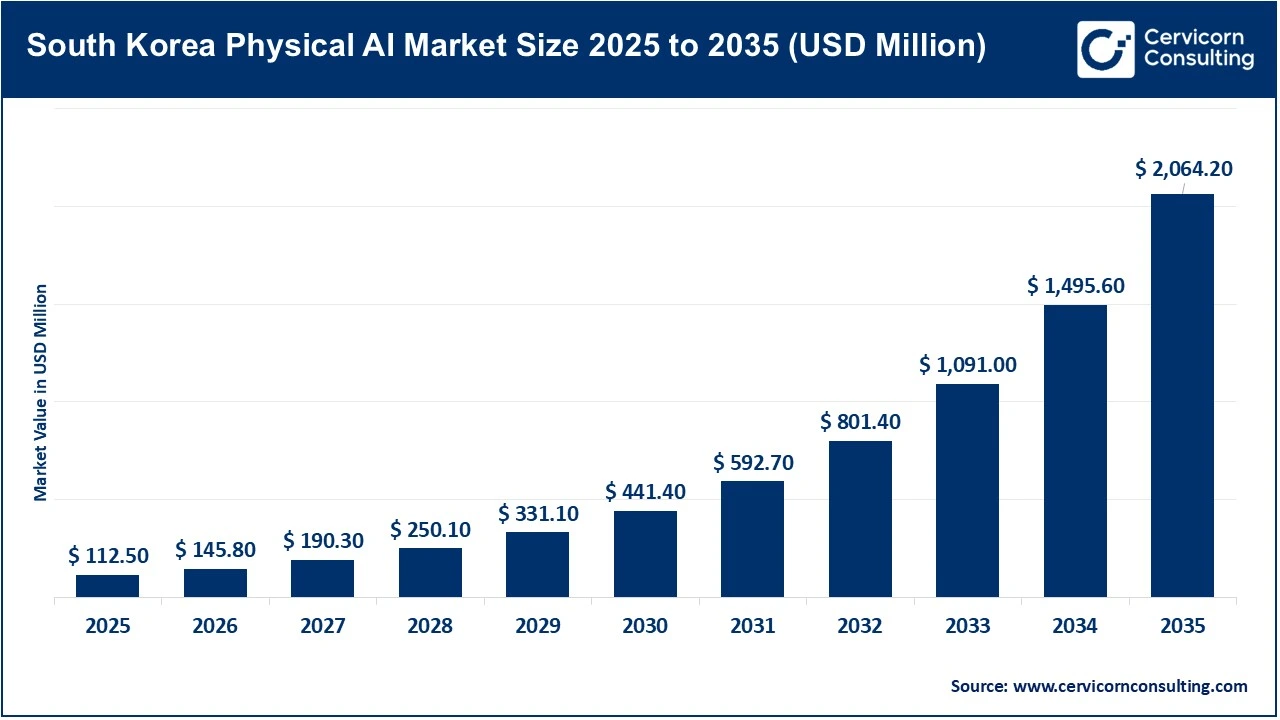
The South Korea physical AI market was valued at approximately USD 112.5 million in 2025 and is projected to reach nearly USD 2,064.2 million by 2035, growing at a CAGR of 34.2%.
South Korea Physical AI Market Growth Factors
The South Korea Physical AI market is experiencing exceptional growth due to the country’s strong semiconductor manufacturing capabilities, rapid industrial automation, expanding robotics ecosystem, increasing investments in autonomous mobility, growing adoption of collaborative robots (cobots), supportive government AI strategies, rising deployment of AI-powered manufacturing systems, development of sovereign AI infrastructure, increasing demand for smart logistics, healthcare automation, defense modernization, aging population-driven service robots, widespread adoption of edge AI computing, collaboration between global AI leaders and Korean technology companies, significant R&D spending by electronics giants, availability of high-speed 5G networks, and increasing focus on intelligent factories.
Furthermore, government-backed initiatives promoting Physical AI foundation models, AI factories, robotics innovation, and next-generation semiconductor manufacturing are accelerating commercialization while attracting domestic and international investments into the South Korean Physical AI ecosystem.
What is the South Korea Physical AI Market?
Physical AI refers to artificial intelligence systems that can perceive, understand, and interact with the physical environment through hardware such as robots, autonomous vehicles, drones, industrial equipment, smart machines, and intelligent devices.
Unlike traditional AI that primarily analyzes digital information, Physical AI combines:
- Computer vision
- Sensor fusion
- Machine learning
- Reinforcement learning
- Robotics
- Edge computing
- Real-time decision making
South Korea’s Physical AI market includes technologies powering:
- Industrial robots
- Humanoid robots
- Smart factories
- Autonomous mobile robots
- Medical robots
- AI-powered logistics
- Defense robotics
- Smart mobility
- Intelligent consumer electronics
The market integrates software intelligence with physical hardware, enabling machines to perform complex tasks with minimal human intervention.
Why is the South Korea Physical AI Market Important?
Physical AI represents one of the most significant transformations in industrial automation and intelligent systems.
Its importance includes:
Increasing Manufacturing Productivity
South Korea operates some of the world’s most advanced semiconductor and electronics manufacturing facilities.
Physical AI enables:
- Predictive maintenance
- Automated quality inspection
- Intelligent production scheduling
- Autonomous material handling
resulting in improved productivity and reduced operational costs.
Addressing Labor Shortages
South Korea faces one of the world’s fastest-aging populations.
Physical AI helps fill workforce gaps by deploying:
- Service robots
- Healthcare assistants
- Logistics robots
- Industrial cobots
to perform repetitive and labor-intensive tasks.
Advancing Smart Cities
AI-powered infrastructure enables:
- Intelligent transportation
- Autonomous public services
- Urban surveillance
- Smart waste management
- Energy optimization
making cities more efficient and sustainable.
Strengthening National Competitiveness
South Korea competes directly with the United States, China, Japan, and Europe in advanced manufacturing.
Physical AI supports leadership in:
- Semiconductor production
- Consumer electronics
- Automotive manufacturing
- Robotics exports
Accelerating Defense Modernization
The country’s defense sector increasingly deploys:
- Autonomous surveillance
- AI-enabled drones
- Intelligent command systems
- Robotics for hazardous operations
to improve national security capabilities.
Major Companies Driving the South Korea Physical AI Market
| Company | Specialization | Key Focus Areas | Notable Features | 2025 Revenue* | Estimated Market Position |
|---|---|---|---|---|---|
| LG Electronics | Consumer electronics, robotics, AI | Service robots, smart factories, AI appliances | CLOi robots, AI home ecosystem | ~USD 60–65 billion | Leading industrial AI innovator |
| Samsung Electronics | Semiconductors, AI devices | AI chips, robotics, smart manufacturing | AI-enabled semiconductor ecosystem, intelligent devices | ~USD 220–230 billion | Largest technology company in Korea |
| SK Group (SK Telecom & SK hynix) | AI infrastructure, semiconductors | AI cloud, memory chips, Physical AI platforms | HBM chips, AI cloud infrastructure | ~USD 140+ billion (combined group businesses) | Global AI infrastructure leader |
| NAVER Corporation | AI platforms, cloud, robotics | HyperCLOVA AI, cloud, digital twins | Autonomous robots, AI services, sovereign AI | ~USD 8–9 billion | Leading Korean AI software provider |
| Superb AI | Computer vision AI | Vision AI, autonomous inspection, industrial AI | No-code vision platform, manufacturing automation | Private company | Fast-growing AI startup |
*Approximate company revenues based on publicly reported FY2025 financial results or market estimates. Market share figures specific to Physical AI are not publicly disclosed because these companies operate across multiple technology sectors.
Company Profiles
LG Electronics
LG Electronics has become one of South Korea’s leading innovators in service robotics and industrial automation.
Its Physical AI strategy includes:
- CLOi service robots
- Smart factory automation
- AI-enabled home appliances
- Industrial robotics
- Digital manufacturing
The company combines AI with robotics to improve productivity across healthcare, hospitality, retail, and manufacturing.
Samsung Electronics
Samsung is expanding Physical AI through advanced semiconductor technologies, AI processors, robotics research, and intelligent manufacturing.
Major initiatives include:
- AI semiconductor development
- Intelligent factory automation
- AI-powered consumer electronics
- Robotics research
- Edge AI devices
Samsung’s semiconductor leadership provides the computing power required for Physical AI applications worldwide.
SK Group (SK Telecom & SK hynix)
SK Group plays a critical role in Korea’s AI infrastructure.
Its contributions include:
- High-bandwidth memory (HBM)
- AI cloud infrastructure
- AI networking
- Autonomous industrial systems
- AI data centers
SK Telecom is developing sovereign AI platforms, while SK hynix supplies advanced AI memory chips powering global AI systems.
NAVER Corporation
NAVER has transformed itself into one of Asia’s strongest AI software companies.
Its Physical AI ecosystem includes:
- HyperCLOVA foundation models
- Robotics platforms
- Digital twin technologies
- AI cloud infrastructure
- Smart logistics
NAVER also develops autonomous indoor delivery robots operating within commercial buildings.
Superb AI
Superb AI specializes in enterprise computer vision solutions.
Its products help organizations deploy AI faster through:
- Vision AI
- Image annotation
- AI model management
- Manufacturing inspection
- Autonomous driving datasets
The startup is increasingly supporting industrial automation projects across Asia.
Leading Trends Shaping the South Korea Physical AI Market
1. AI-Powered Smart Factories
Manufacturing facilities are becoming autonomous through:
- Intelligent robots
- Predictive maintenance
- Digital twins
- AI quality inspection
Impact:
- Higher efficiency
- Reduced downtime
- Lower operational costs
2. Humanoid Robot Development
Companies are investing heavily in humanoid robots capable of performing:
- Customer service
- Healthcare assistance
- Warehouse operations
- Manufacturing support
Impact:
Greater workforce flexibility.
3. Edge AI Computing
Instead of relying entirely on cloud infrastructure, AI processing increasingly occurs directly on devices.
Benefits include:
- Faster response times
- Better privacy
- Lower latency
- Reduced bandwidth usage
4. AI Semiconductor Innovation
South Korea remains one of the world’s largest semiconductor producers.
Advanced AI chips enable:
- Real-time robotics
- Autonomous driving
- Industrial automation
- Intelligent drones
Impact:
Faster AI inference with lower power consumption.
5. Autonomous Logistics
AI-powered mobile robots increasingly automate:
- Warehouse management
- Package sorting
- Inventory tracking
- Last-mile delivery
Impact:
Improved supply chain efficiency.
6. AI Vision Systems
Computer vision technologies are replacing manual inspection in:
- Electronics manufacturing
- Semiconductor production
- Automotive assembly
- Food processing
Impact:
Higher product quality and reduced defects.
7. Sovereign AI Development
South Korea is investing in domestic foundation models and AI infrastructure to reduce reliance on foreign AI platforms and strengthen national technological independence.
What Are Some Successful Examples of South Korea Physical AI Market Around the World?
Samsung Smart Manufacturing
Samsung has implemented AI-driven manufacturing systems across semiconductor fabrication plants.
Applications include:
- Automated defect detection
- AI quality control
- Intelligent robotics
- Predictive equipment maintenance
These technologies have become global benchmarks for smart manufacturing.
LG CLOi Robots
LG’s CLOi robots operate internationally in:
- Hotels
- Airports
- Restaurants
- Hospitals
The robots perform:
- Food delivery
- Customer assistance
- Cleaning
- Information services
NAVER Autonomous Robots
NAVER has developed autonomous indoor robots capable of navigating complex office buildings using AI-based mapping, localization, and obstacle avoidance. These technologies demonstrate scalable Physical AI for enterprise environments.
SK hynix AI Semiconductor Leadership
SK hynix supplies high-bandwidth memory (HBM) used in advanced AI systems worldwide, enabling Physical AI applications in robotics, autonomous vehicles, and large-scale AI computing.
Superb AI Industrial Inspection
Superb AI’s computer vision solutions are deployed across manufacturing industries to automate visual inspection, improving production accuracy and reducing manual quality control.
Government Initiatives and Policies Shaping the Market
The South Korean government considers AI a strategic national industry and has launched multiple initiatives to accelerate Physical AI adoption.
National AI Strategy
The government has established comprehensive AI roadmaps focusing on:
- AI commercialization
- Robotics
- Semiconductor leadership
- Digital transformation
- AI talent development
These initiatives aim to position South Korea among the world’s leading AI nations.
Sovereign AI Foundation Model Project
The Ministry of Science and ICT (MSIT) has launched a sovereign AI foundation model program, selecting leading domestic organizations—including Naver Cloud, SK Telecom, LG AI Research, Upstage, and NC AI—to develop homegrown AI models with government support.
Physical AI Development Program
The government has initiated a dedicated Physical AI technology development program focused on domestic “world model” technologies and next-generation robot foundation models. The initiative brings together major universities, research institutes, and companies, with funding to improve real-world robot performance and accelerate commercialization.
Public–Private AI Partnerships
MSIT has announced collaborations with NVIDIA and leading Korean companies to expand AI infrastructure, secure advanced GPU capacity, support AI startups, and strengthen Physical AI capabilities across manufacturing, robotics, and autonomous systems.
Semiconductor Investment Policies
Government support for semiconductor manufacturing includes tax incentives, infrastructure development, and large-scale investments in AI chip production. Samsung and SK hynix are expanding fabrication capacity as part of national plans to reinforce Korea’s position in AI hardware.
AI Computing Infrastructure
South Korea is investing in sovereign AI computing resources, including the National AI Computing Center and large-scale GPU deployments, to support AI research, Physical AI development, and enterprise adoption.
To Get Detailed Overview, Contact Us: https://www.cervicornconsulting.com/contact-us
Read Report: 6G Market Revenue, Trends, and Strategic Insights by 2035