Hyperscale Data Centers: 6 Investment Decisions That Can Improve Returns and Reduce Infrastructure Risk
Hyperscale Data Centers: 6 Decisions That Can Shape the Next Phase of Infrastructure Investment
The race to expand data center capacity is no longer just about building larger facilities. As artificial intelligence (AI), cloud computing and data-intensive applications grow, companies must decide where to build, how much power to secure, which cooling technologies to adopt and how to ensure that new capacity generates sustainable returns.
For data center developers, cloud service providers, technology companies and infrastructure investors, these decisions are becoming increasingly interconnected. A site with attractive land costs may lack sufficient grid capacity. A facility designed for conventional servers may require expensive upgrades to support high-density AI workloads. And a project announced amid strong demand may still face delays in construction, financing or customer commitments.
The challenge is not simply to expand faster. It is to invest in the right capacity, in the right location, with the right infrastructure.
A Growing Market With More Complex Investment Decisions
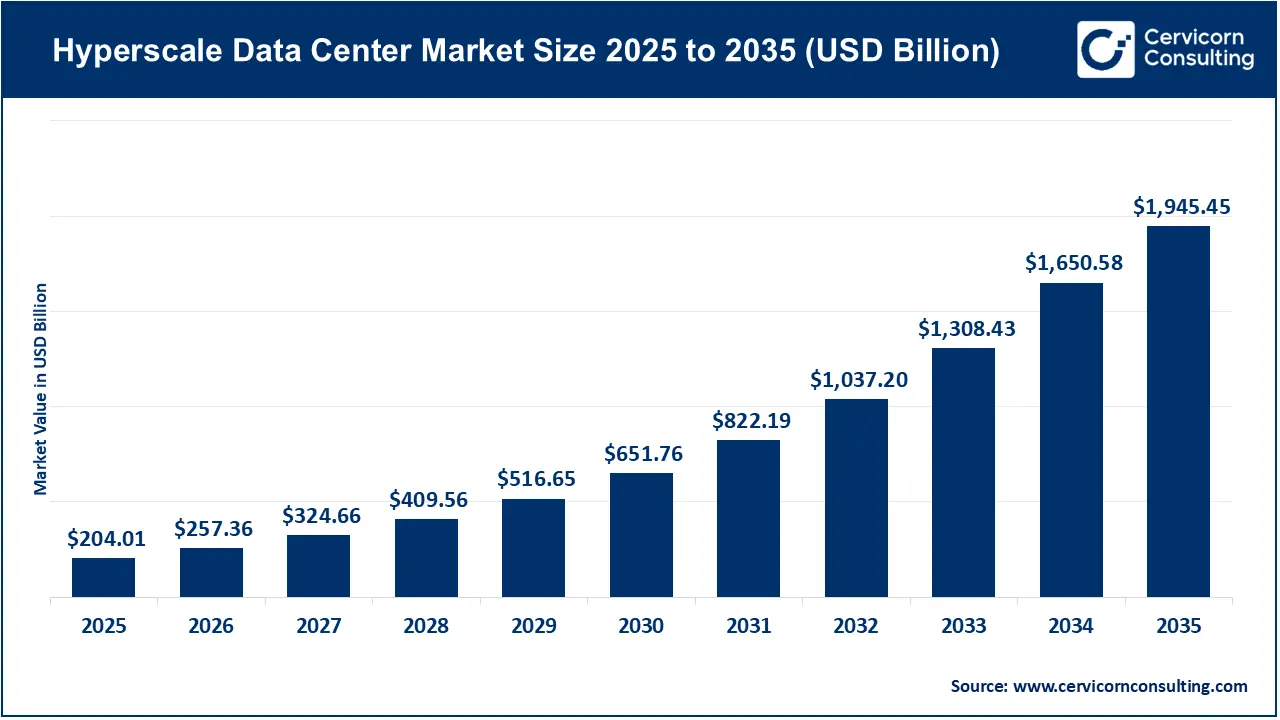
The global hyperscale data center market was valued at approximately USD 204.01 billion in 2025 and is projected to reach USD 1.94 trillion by 2035, expanding at a compound annual growth rate (CAGR) of 25.30% from 2026 to 2035.
This growth reflects the increasing importance of large-scale computing infrastructure across cloud platforms, AI services, enterprise applications and digital content delivery. However, market expansion does not automatically translate into attractive returns for every project.
Developers must balance construction costs, electricity availability, cooling efficiency, financing conditions and the pace at which customers commit to capacity. These factors can determine whether a facility becomes a profitable long-term asset or an expensive project with delayed utilization.
Six decisions deserve particular attention.
Get a Free Sample: https://www.cervicornconsulting.com/sample/2800
1. Where Should the Next Hyperscale Facility Be Built?
Location selection has traditionally involved evaluating land prices, connectivity, access to customers and proximity to major business centers. Today, power availability and the timeline for securing a grid connection can be equally important.
A location may offer favorable tax incentives and relatively low land costs, but those advantages can disappear if grid upgrades take years or require significant additional investment.
Before committing to a site, companies should evaluate:
- Power availability: Is sufficient electricity available for the initial phase and future expansion?
- Connectivity: Can the location support reliable, high-capacity network connections?
- Customer proximity: Will latency requirements influence where workloads can be hosted?
- Regulatory conditions: What permits, environmental approvals and local restrictions could delay construction?
- Expansion potential: Can the campus accommodate additional buildings, substations and cooling infrastructure?
Regional comparisons also matter. Established data center hubs may offer strong connectivity and mature supplier networks, while emerging locations may provide more room for expansion but carry greater infrastructure uncertainty.
The better investment decision comes from comparing the total cost and delivery timeline of a location—not simply its land price.
2. How Much Capacity Should Be Built Before Demand Is Confirmed?
Hyperscale facilities require substantial upfront capital. Building too little capacity can limit a company’s ability to serve new customers, while building too much too early can leave expensive infrastructure underutilized.
The decision becomes more complicated when AI demand changes the amount of computing power customers require. A facility designed around traditional cloud workloads may have very different power-density and cooling requirements from one intended for large GPU clusters.
Companies should assess three factors before finalizing capacity:
- Committed demand: How much capacity is supported by signed customer contracts or credible long-term commitments?
- Expansion flexibility: Can the project be developed in phases without significantly increasing future costs?
- Workload mix: Will the facility primarily support conventional cloud services, AI training, AI inference or a combination of workloads?
A phased construction strategy can help reduce exposure to uncertain demand. Developers can establish core infrastructure first and add capacity as customer commitments and utilization become clearer.
However, phased expansion only works when electrical systems, land planning and network architecture are designed to accommodate future growth. Retrofitting these elements later can be costly and disruptive.
The key question is not how large a facility can become, but how quickly each phase can reach commercially viable utilization.
3. Is the Power Strategy Reliable, Affordable and Scalable?
Electricity is becoming one of the most consequential constraints on hyperscale development. High-density computing increases demand for power while placing greater pressure on utilities, transmission networks and backup systems.
Securing a grid connection is only part of the challenge. Developers also need to understand electricity pricing, reliability, backup requirements and the availability of lower-carbon energy.
Decision-makers should compare:
- Grid supply and the expected timeline for connection.
- On-site backup generation and uninterruptible power supply (UPS) requirements.
- Renewable energy procurement options and the reliability of supply arrangements.
- Battery storage and other options for improving resilience.
- Long-term electricity costs under different utilization and pricing scenarios.
Renewable power agreements may help address sustainability targets and electricity-price exposure, but their value depends on contract terms, generation profiles and how electricity is delivered when demand is highest.
Similarly, backup power should be evaluated against the facility’s uptime requirements and the consequences of service interruption—not only its initial purchase cost.
For investors, the practical implication is clear: a data center’s power strategy should be evaluated as a core part of the business model rather than treated as a separate engineering decision.
To Get Detailed Overview, Contact Us: https://www.cervicornconsulting.com/contact-us
Read Report: Data Center Processors: 5 Decisions That Can Improve AI Infrastructure Investment Returns