U.S. Biofuels Market: 6 Strategic Decisions to Maximize Investment Returns, Reduce Costs, and Strengthen Competitiveness
U.S. Biofuels Market: 6 Decisions That Can Help Companies Improve Investment Returns
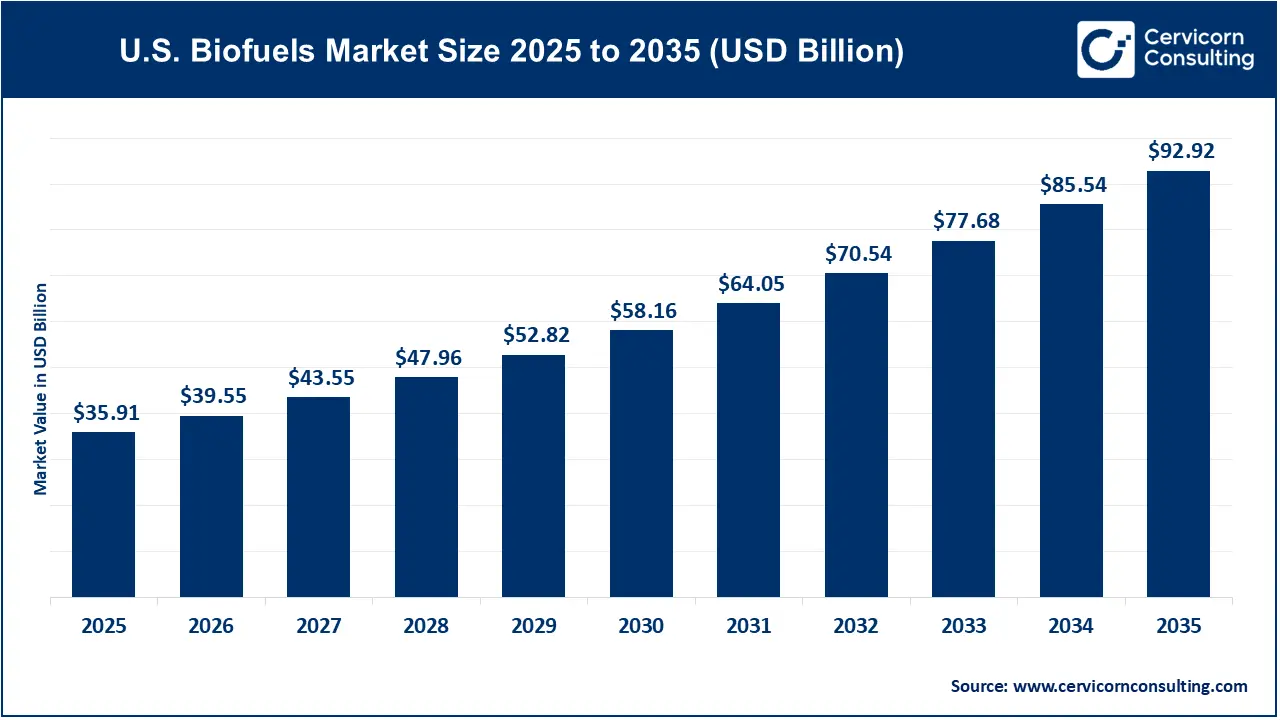
The U.S. biofuels market is entering an important phase in which production economics, feedstock availability, regulatory requirements, and access to end-user markets will increasingly determine investment outcomes. The market was valued at USD 35.91 billion in 2025 and is projected to reach USD 92.92 billion by 2035, expanding at a CAGR of 9.97% from 2026 to 2035.
However, industry growth does not automatically translate into higher margins for every producer. Ethanol, biodiesel, renewable diesel, and sustainable aviation fuel (SAF) operate under different cost structures, feedstock requirements, infrastructure constraints, and demand conditions. Companies planning new capacity or expanding existing facilities need to assess where commercial opportunities are strongest and which risks could affect project returns.
Here are six decisions that can help businesses make more informed choices in the U.S. biofuels market.
1. Which biofuel segment offers the strongest commercial opportunity?
Choosing the right fuel category is one of the most important decisions for producers, investors, and technology suppliers. Each segment presents a different balance of established demand, growth potential, infrastructure requirements, and competitive pressure.
- Ethanol: A large, established market supported by gasoline blending and extensive corn-processing infrastructure. Producers need to assess operating costs, plant utilization, corn prices, and opportunities to improve coproduct revenue.
- Biodiesel and renewable diesel: Opportunities depend on feedstock costs, fuel specifications, refining capacity, distribution access, and the economics of competing with conventional diesel.
- Sustainable aviation fuel: SAF creates opportunities for technology developers, refiners, and feedstock suppliers, but commercial viability depends on production costs, qualifying feedstocks, lifecycle emissions performance, and credible offtake agreements.
- Advanced biofuels: Fuels made from agricultural residues, waste materials, and other non-conventional feedstocks may offer differentiation, although technology maturity, feedstock collection, and conversion costs can constrain scale-up.
Decision point: Compare each segment using expected margins, capital requirements, achievable production volumes, customer commitments, and downside scenarios rather than relying on market growth rates alone.
Get a Free Sample: https://www.cervicornconsulting.com/sample/2797
2. How can companies reduce feedstock cost and supply risk?
Feedstock is a major determinant of biofuel production economics. Corn remains central to conventional U.S. ethanol production, while soybean oil, used cooking oil, animal fats, and other waste oils are important inputs for biodiesel and renewable diesel. SAF pathways can require different combinations of feedstocks depending on the production technology.
The challenge is not simply securing enough raw material. Companies must also consider price volatility, transportation costs, quality consistency, sustainability requirements, and competition from other buyers.
Businesses can strengthen their supply strategies by:
- Diversifying suppliers and, where technically feasible, qualifying alternative feedstocks.
- Evaluating long-term procurement contracts against spot-market purchasing.
- Mapping feedstock availability and transportation costs around existing or proposed facilities.
- Assessing how changes in agricultural output, waste-oil collection, and competing renewable-fuel capacity could affect procurement costs.
- Measuring the effect of feedstock-price changes on unit production costs and operating margins.
For advanced biofuel projects, a feedstock supply agreement should also address collection logistics, contamination, seasonal availability, and the cost of preprocessing.
Decision point: Model the economics of multiple feedstock scenarios before committing to new capacity. A low-cost feedstock is not necessarily commercially attractive if supply is inconsistent or transportation costs eliminate the price advantage.
3. How much do federal fuel requirements and incentives change project economics?
Policy can influence both demand and profitability in the U.S. biofuels industry. The Environmental Protection Agency’s Renewable Fuel Standard (RFS) establishes renewable-fuel volume requirements and associated compliance obligations. Renewable Identification Numbers (RINs) provide a mechanism for demonstrating compliance under the program.
In March 2026, the EPA finalized its RFS standards for 2026 and 2027. The agency stated that biodiesel and renewable diesel production and use would need to increase by more than 60% compared with 2025 volumes to meet the new requirements. It also maintained the conventional biofuel requirement at 15 billion gallons for each year. These changes are relevant to producers, feedstock suppliers, refiners, and companies evaluating capacity expansion.
Nevertheless, regulatory targets should not be treated as guaranteed sales or assured margins. Realized returns depend on compliance implementation, credit prices, eligible fuel volumes, operating costs, and competitive supply.
Companies should evaluate:
- Exposure to RIN price fluctuations and changes in compliance requirements.
- Eligibility for applicable federal and state incentives.
- The impact of emissions accounting and feedstock qualification on credit generation.
- Potential changes to tax-credit rules and the conditions attached to incentive eligibility.
- Project profitability under scenarios in which incentives decline or credit values weaken.
Decision point: Calculate project returns both with and without policy-linked revenue. Confirm eligibility and applicable requirements before incorporating incentives into investment forecasts.
4. Should companies invest in capacity expansion or improve existing facilities first?
Expanding production capacity can strengthen a company’s market position, but new facilities require substantial capital, reliable feedstock access, appropriate infrastructure, and sufficient demand. Existing plants may offer a different route to growth through process optimization, yield improvements, energy efficiency, and product diversification.
Before approving a capacity project, decision-makers should examine:
- Utilization rates: Can the existing facility produce more without a major capital investment?
- Conversion efficiency: Would process improvements increase output per unit of feedstock?
- Energy and logistics: Can utilities, storage, transportation, and fuel distribution support higher production?
- Technology readiness: Has the proposed conversion process demonstrated reliable performance at commercial scale?
- Customer access: Are there credible buyers, distribution agreements, or long-term offtake commitments?
For emerging pathways such as SAF and cellulosic fuels, pilot-scale performance may not fully reflect commercial-scale costs. Equipment integration, commissioning, feedstock variability, and operational reliability should therefore be included in project assessments.
Decision point: Compare the returns from a new facility with those from upgrading existing assets. Use sensitivity analysis for construction costs, commissioning delays, production yields, and capacity utilization before making a final capital-allocation decision.
5. Which customers and end-use markets should companies prioritize?
The U.S. biofuels market serves multiple end-use industries, including road transportation, aviation, heating, and energy generation. Each market has different purchasing criteria and fuel requirements.
Road transportation offers established channels for ethanol and diesel alternatives. Aviation presents a potential growth opportunity for SAF, but adoption depends on fuel availability, pricing, technical qualification, and airline procurement strategies. Industrial and energy applications may offer opportunities for selected biofuels depending on local infrastructure and end-user requirements.
Companies should evaluate customers according to:
- Expected purchase volumes and contract duration.
- Price sensitivity and willingness to pay for lower-carbon fuels.
- Compatibility with existing engines, equipment, and distribution systems.
- Required fuel certifications and emissions documentation.
- Geographic proximity to production facilities and delivery infrastructure.
- The financial strength and reliability of potential offtake partners.
Long-term contracts can improve revenue visibility, but their value depends on pricing mechanisms, volume commitments, adjustment clauses, and the allocation of feedstock or regulatory risks.
Decision point: Prioritize customer segments where technical requirements, delivered cost, emissions performance, and purchasing commitments align with the company’s production capabilities.
6. How can companies build a competitive advantage beyond production volume?
As more businesses pursue biofuel opportunities, scale alone may not provide a durable advantage. Companies also need to manage production costs, demonstrate fuel quality, maintain traceability, and establish reliable relationships across the value chain.
Potential sources of differentiation include:
- Feedstock flexibility: The ability to process multiple suitable feedstocks without compromising output quality or operating efficiency.
- Operational performance: Improved yields, reduced downtime, lower energy consumption, and predictive maintenance.
- Emissions performance: Reliable lifecycle emissions data and documented compliance with relevant sustainability requirements.
- Supply-chain integration: Partnerships with farmers, waste collectors, refiners, distributors, and end users.
- Product diversification: Coproduct development and the ability to serve multiple customer segments where commercially viable.
- Technology partnerships: Collaboration with process technology providers and research organizations to improve conversion efficiency and scale-up performance.
Digital monitoring, process automation, and advanced analytics may help operators identify production losses and improve plant reliability. However, technology investments should be assessed against measurable operating improvements rather than adopted simply because they are available.
Decision point: Identify the two or three capabilities most likely to lower delivered costs, improve reliability, or strengthen customer retention, and prioritize investment accordingly.
What should companies monitor before making their next move?
A practical decision framework should combine market indicators with plant-level and commercial data.
| Decision area | Indicators to monitor |
|---|---|
| Market demand | Fuel consumption, blending requirements, customer commitments, and new capacity announcements |
| Feedstock economics | Corn and soybean oil prices, waste-oil availability, procurement costs, and logistics |
| Policy exposure | RFS requirements, RIN values, tax-credit eligibility, and state-level fuel programs |
| Production economics | Capacity utilization, conversion yields, energy costs, maintenance, and capital expenditure |
| Commercial performance | Delivered fuel prices, offtake contracts, customer concentration, and contract margins |
| Competitive position | New facilities, technology improvements, feedstock access, and strategic partnerships |
These indicators should be reviewed together. For example, a favorable regulatory change may improve demand prospects, but its commercial benefit can be reduced by rising feedstock costs or excess production capacity.
To Get Detailed Overview, Contact Us: https://www.cervicornconsulting.com/contact-us
Read Report: Healthcare Supply Chain Management: 6 Decisions That Can Help Companies Reduce Costs and Prevent Disruptions