6G Market Revenue, Trends, and Strategic Insights by 2035
Table of Contents
Toggle6G Market Size
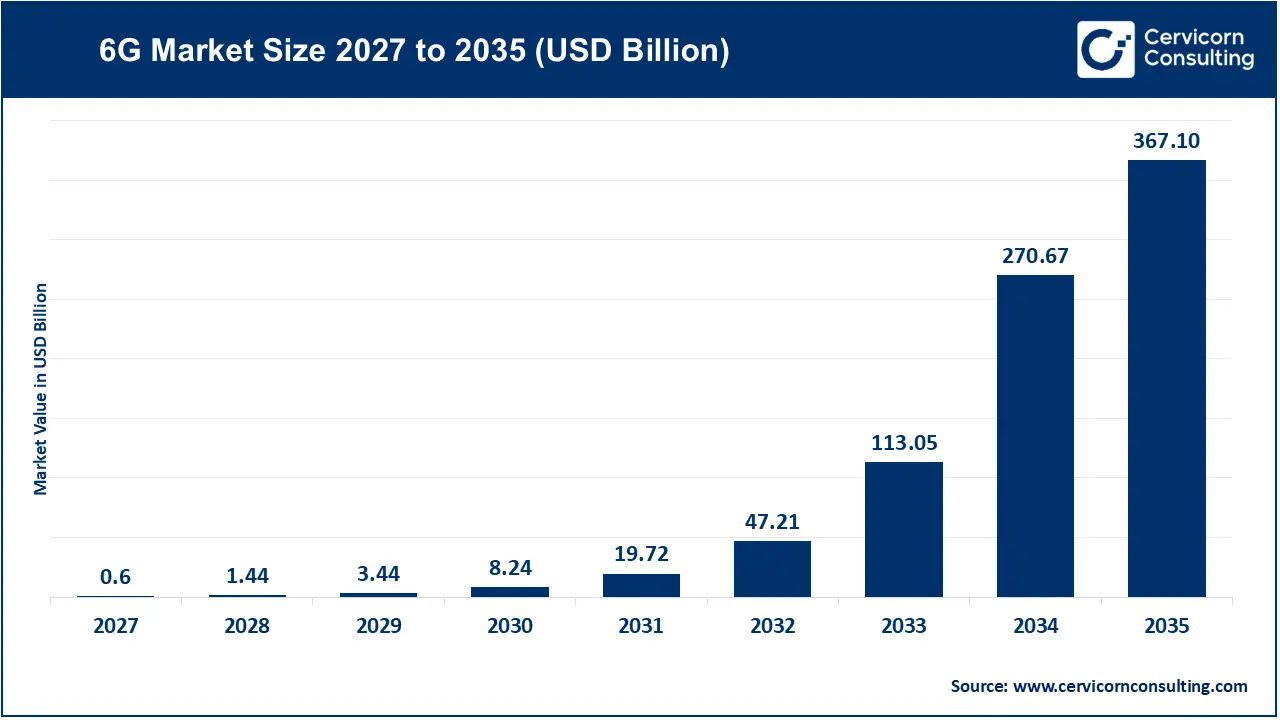
The global 6G market was valued at approximately USD 0.60 billion in 2027 and is projected to reach nearly USD 367.10 billion by 2035, growing at a CAGR of 123.01%.
6G Market Growth Factors
The global 6G market is witnessing rapid momentum due to growing demand for ultra-high-speed wireless communication, increasing adoption of artificial intelligence (AI)-driven networks, expansion of smart cities, rising investments in next-generation telecommunications infrastructure, and the emergence of immersive technologies such as extended reality (XR), holographic communication, digital twins, and the metaverse. Governments and private organizations worldwide are investing heavily in 6G research and development to maintain technological leadership and strengthen digital economies. The proliferation of Internet of Things (IoT) devices, autonomous transportation systems, Industry 5.0 applications, advanced healthcare solutions, and edge computing platforms is further accelerating market growth.
Additionally, advancements in terahertz (THz) spectrum utilization, satellite-terrestrial network integration, quantum communication technologies, and energy-efficient network architectures are creating new opportunities for telecom operators, technology providers, semiconductor manufacturers, and cloud service companies, making 6G one of the most transformative technology markets of the coming decade.
What is the 6G Market?
The 6G market refers to the global ecosystem of technologies, infrastructure, hardware, software, services, and applications associated with sixth-generation wireless communication networks. Expected to emerge commercially around 2030, 6G will succeed 5G by delivering significantly faster data rates, ultra-low latency, enhanced reliability, and intelligent network automation.
Unlike previous wireless generations that primarily focused on connectivity improvements, 6G aims to create a fully integrated digital and physical environment. It will combine AI-native networks, sensing capabilities, edge intelligence, satellite communication, cloud computing, and advanced wireless technologies to enable seamless connectivity across devices, machines, and environments.
Key components of the 6G market include:
- Network infrastructure
- Radio access networks (RAN)
- Terahertz communication systems
- AI-powered network management
- Edge computing platforms
- Semiconductor technologies
- Satellite communication systems
- Network security solutions
- Cloud-native telecom services
- Industrial and enterprise applications
The market is expected to revolutionize sectors including healthcare, manufacturing, transportation, defense, education, entertainment, agriculture, and smart cities.
Get a Free Sample: https://www.cervicornconsulting.com/sample/2658
Why is the 6G Market Important?
Enabling Next-Generation Digital Experiences
6G networks are expected to support data transmission speeds reaching up to 1 terabit per second, enabling real-time holographic communication, immersive virtual environments, and advanced augmented reality experiences.
Supporting Massive Connectivity
The future digital economy will involve billions of connected devices. 6G will provide the infrastructure necessary to manage unprecedented levels of machine-to-machine communication efficiently.
Driving Industry 5.0
Industrial automation is evolving toward intelligent collaboration between humans and machines. 6G networks will support real-time analytics, robotics, predictive maintenance, and autonomous operations.
Enhancing Healthcare Delivery
Remote surgeries, digital diagnostics, AI-powered healthcare systems, and connected medical devices require highly reliable and low-latency networks that 6G can provide.
Strengthening National Competitiveness
Countries investing in 6G research are positioning themselves as future leaders in telecommunications, digital infrastructure, cybersecurity, and economic innovation.
Advancing Sustainability Goals
Energy-efficient communication technologies and intelligent network optimization can significantly reduce carbon emissions associated with digital infrastructure.
Major Companies Shaping the 6G Market
Company Analysis
| Company | Specialization | Key Focus Areas | Notable Features | 2025 Revenue (Approx.) | Market Share Position | Global Presence |
|---|---|---|---|---|---|---|
| IBM | AI, Cloud Computing, Quantum Technologies | AI-native networks, quantum-safe communication, edge computing | Advanced AI research and hybrid cloud leadership | USD 65+ Billion | Strong technology contributor | North America, Europe, Asia-Pacific, Middle East |
| ZTE Corporation | Telecommunications Equipment | Wireless infrastructure, network solutions, 6G R&D | Strong patent portfolio and telecom innovation | USD 17+ Billion | Major telecom equipment provider | Asia-Pacific, Europe, Middle East, Africa |
| Intel | Semiconductor and Computing Solutions | Network processors, AI chips, edge computing | Leadership in telecom processors and cloud computing hardware | USD 54+ Billion | Significant semiconductor contributor | Global operations in over 50 countries |
| Telefonaktiebolaget LM Ericsson | Telecommunications Infrastructure | Radio access networks, Open RAN, advanced connectivity | Extensive global telecom deployments | USD 25+ Billion | Leading telecom infrastructure provider | More than 180 countries |
| Microsoft | Cloud Computing and AI | Azure cloud, AI-driven networking, edge intelligence | Integration of AI and cloud technologies for telecom ecosystems | USD 280+ Billion | Major digital infrastructure participant | Global presence across all major markets |
Leading Trends Transforming the 6G Market
AI-Native Network Architecture
Artificial intelligence is becoming a foundational component of next-generation networks. Unlike 5G, where AI is an enhancement, 6G networks are being designed with AI embedded into their architecture.
Impact
- Automated network management
- Self-healing communication systems
- Improved spectrum efficiency
- Reduced operational costs
- Enhanced customer experiences
Telecom operators can leverage AI to predict network failures, optimize traffic flow, and improve service quality in real time.
Terahertz Communication
Terahertz frequencies represent one of the most important technological advancements in 6G development.
Impact
- Ultra-high data transmission rates
- Reduced communication delays
- Enhanced wireless capacity
- Support for immersive applications
Researchers worldwide are exploring THz spectrum bands to overcome bandwidth limitations associated with existing wireless technologies.
Integration of Space-Air-Ground Networks
Future communication networks will integrate terrestrial, aerial, and satellite systems into a unified architecture.
Impact
- Global connectivity coverage
- Improved disaster response
- Connectivity in remote locations
- Enhanced military communications
This trend is particularly important for regions with limited telecommunications infrastructure.
Digital Twins and Cyber-Physical Systems
Digital twins create virtual replicas of physical assets, enabling real-time monitoring and optimization.
Impact
- Smarter manufacturing operations
- Predictive maintenance
- Better resource management
- Enhanced operational efficiency
6G’s low latency and high bandwidth capabilities make large-scale digital twin deployments possible.
Holographic Communication
The future of communication extends beyond video conferencing to real-time holographic interactions.
Impact
- Immersive collaboration
- Advanced telepresence
- Improved remote education
- Enhanced healthcare consultations
Holographic communication is expected to become one of the defining applications of the 6G era.
Sustainable and Green Networking
Energy efficiency is becoming a critical objective in telecommunications infrastructure.
Impact
- Reduced carbon emissions
- Lower operating expenses
- Sustainable digital transformation
- Improved resource utilization
Governments and telecom providers are prioritizing environmentally responsible network deployment strategies.
Successful Examples of 6G Initiatives Around the World
Finland’s 6G Flagship Program
Finland has emerged as one of the global leaders in 6G development through the University of Oulu’s 6G Flagship initiative.
Key Achievements
- Advanced wireless research
- Global industry partnerships
- AI-integrated network innovation
- International standardization contributions
The program serves as a benchmark for collaborative 6G ecosystem development.
South Korea’s National 6G Strategy
South Korea has invested heavily in next-generation telecommunications research.
Key Achievements
- Government-supported R&D funding
- Collaboration among telecom operators
- Semiconductor innovation
- Advanced network testing environments
The country aims to secure a significant share of future 6G patents and technology exports.
China’s 6G Satellite Program
China launched experimental satellites to test future 6G communication technologies.
Key Achievements
- Space-based network research
- Terahertz communication testing
- Satellite integration technologies
- Advanced spectrum exploration
China continues to strengthen its position in global telecommunications innovation.
United States Next G Alliance
The United States established the Next G Alliance to advance North American leadership in future wireless technologies.
Key Achievements
- Public-private collaboration
- Telecommunications research funding
- Industry standards development
- Technology commercialization support
Major technology companies and telecom operators participate in the initiative.
Japan’s Beyond 5G Promotion Consortium
Japan’s government and industry leaders are collaborating to develop future communication systems.
Key Achievements
- Smart city applications
- Industrial automation solutions
- Advanced wireless technologies
- International partnerships
Japan aims to become a major contributor to global 6G standards.
Global Regional Analysis of the 6G Market
North America
North America remains a leading region in 6G research, driven by strong investments in telecommunications, AI, semiconductor manufacturing, and cloud computing.
Market Drivers
- Advanced digital infrastructure
- Presence of major technology companies
- Government-funded research programs
- Strong venture capital ecosystem
Government Initiatives and Policies
United States
The U.S. government supports future wireless innovation through:
- Next G Alliance initiatives
- National Science Foundation research grants
- CHIPS and Science Act investments
- Federal Communications Commission spectrum research
These programs aim to strengthen domestic telecommunications capabilities and reduce supply chain vulnerabilities.
Canada
Canada supports advanced communications research through:
- Innovation funding programs
- University-industry collaborations
- Digital economy initiatives
- Smart infrastructure investments
Europe
Europe is positioning itself as a key contributor to global 6G standards and sustainable network innovation.
Market Drivers
- Strong regulatory frameworks
- Advanced industrial sectors
- Digital transformation initiatives
- Sustainability-focused policies
Government Initiatives and Policies
European Union
The European Union has launched several programs supporting 6G development.
Key initiatives include:
- Smart Networks and Services Joint Undertaking (SNS JU)
- Horizon Europe funding
- Digital Europe Programme
- Cross-border research collaborations
The EU focuses on secure, sustainable, and human-centric network development.
Germany
Germany is investing in:
- Industrial communication networks
- Industry 4.0 and Industry 5.0 applications
- Research institutes and innovation hubs
Finland
Finland continues to support:
- University-led research programs
- Global telecom innovation ecosystems
- International standards participation
Asia-Pacific
Asia-Pacific is expected to become the fastest-growing region in the 6G market.
Market Drivers
- Rapid digitalization
- Strong manufacturing capabilities
- Government-supported innovation programs
- Large consumer base
Government Initiatives and Policies
China
China’s strategy includes:
- National telecommunications development plans
- Extensive R&D investments
- Satellite communication projects
- Semiconductor self-sufficiency initiatives
China is among the leading countries in 6G patent development.
South Korea
The South Korean government supports:
- National 6G commercialization roadmap
- Telecom innovation grants
- Advanced semiconductor research
- International technology partnerships
Japan
Japan focuses on:
- Beyond 5G initiatives
- Smart society development
- Future communication technologies
- Public-private research collaboration
India
India is rapidly strengthening its position through:
- Bharat 6G Vision initiative
- Telecom technology development programs
- Indigenous innovation efforts
- Digital India transformation projects
The government aims to establish India as a global contributor to 6G standards and technologies.
Latin America
Latin America is gradually preparing for future wireless technologies through modernization of telecommunications infrastructure.
Market Drivers
- Growing mobile connectivity demand
- Smart city initiatives
- Digital transformation programs
- Increasing internet penetration
Government Initiatives and Policies
Countries such as Brazil, Mexico, and Chile are investing in:
- Spectrum planning
- Telecommunications modernization
- Digital economy development
- International technology partnerships
Regional governments are focusing on creating regulatory frameworks that can support future 6G deployments.
Middle East and Africa
The Middle East and Africa region is emerging as an important market for next-generation connectivity.
Market Drivers
- Smart city development
- Economic diversification programs
- Digital government initiatives
- Expanding telecommunications infrastructure
Government Initiatives and Policies
United Arab Emirates
The UAE is investing in:
- Future telecommunications research
- AI-powered smart cities
- Digital infrastructure expansion
- Innovation-focused economic strategies
Saudi Arabia
Saudi Arabia’s Vision 2030 supports:
- Advanced communication technologies
- Smart city ecosystems
- Industrial digitization
- Emerging technology investments
South Africa
South Africa is advancing:
- Broadband expansion
- Research collaboration
- Digital economy development
- Telecom infrastructure modernization
As governments across the Middle East and Africa accelerate digital transformation strategies, the region is expected to become increasingly important in the global 6G ecosystem.
Future Outlook of the 6G Market
The 6G market represents the next frontier of global telecommunications innovation. With AI-native networks, terahertz communication, satellite integration, digital twins, holographic communication, and intelligent automation becoming central to future digital ecosystems, 6G is poised to transform industries, economies, and societies worldwide. Continuous investments from governments, technology leaders such as IBM, ZTE Corporation, Intel, Telefonaktiebolaget LM Ericsson, and Microsoft, along with international collaboration on standards and research, are expected to accelerate the path toward commercial 6G deployment and unlock unprecedented opportunities across virtually every sector of the global economy.
To Get Detailed Overview, Contact Us: https://www.cervicornconsulting.com/contact-us
Read Report: Molecular Diagnostics Market Revenue, Trends, and Strategic Insights by 2035