Fuel Cell Market Revenue, Trends, and Strategic Insights by 2035
Fuel Cell Market Size
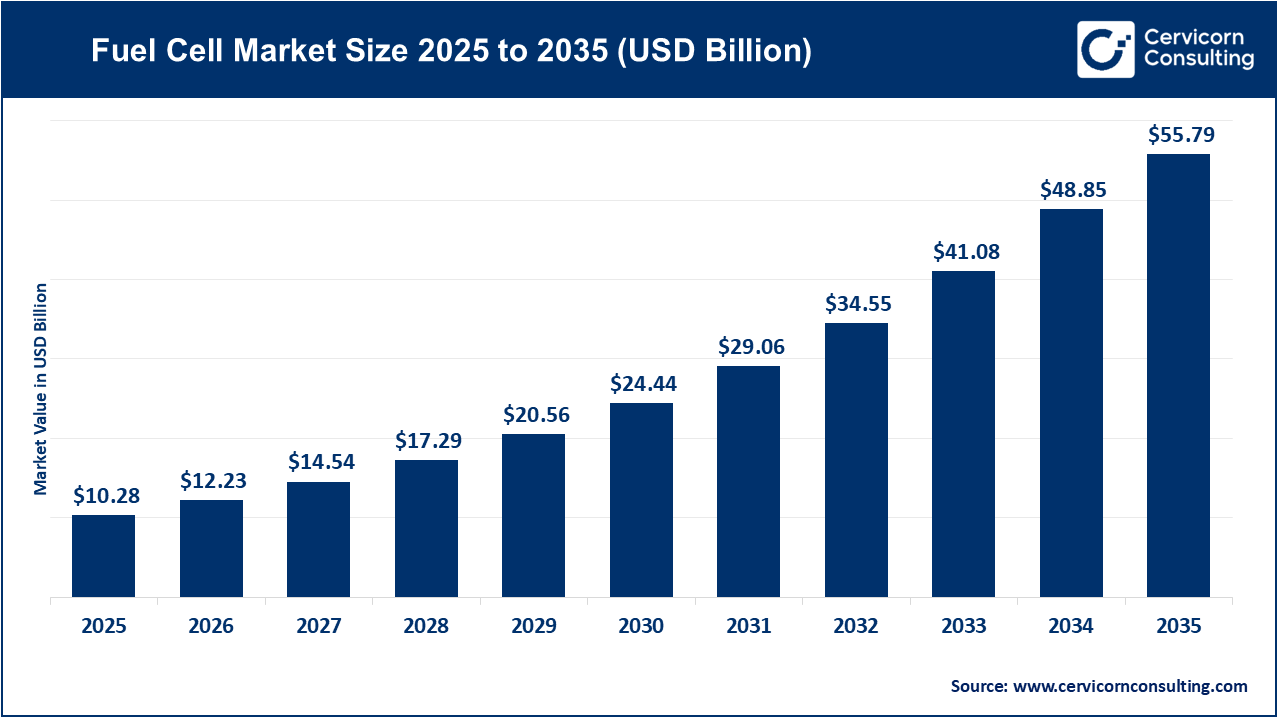
The global fuel cell market was valued at approximately USD 10.28 billion in 2025 and is projected to reach nearly USD 55.79 billion by 2035, growing at a CAGR of 18.43%.
Fuel Cell Market Growth Factors
The global fuel cell market is witnessing remarkable growth due to the accelerating transition toward clean energy, increasing investments in hydrogen infrastructure, and stricter carbon emission regulations across developed and developing economies. Governments worldwide are introducing ambitious hydrogen roadmaps, tax incentives, and funding programs to encourage commercialization of fuel cell technologies. Growing adoption of fuel cell electric vehicles (FCEVs), expanding demand for backup power systems, rising deployment of distributed energy solutions, and increasing utilization of fuel cells in marine, rail, aerospace, and industrial applications are further fueling market expansion.
Technological advancements in proton exchange membrane (PEM), solid oxide fuel cells (SOFC), and molten carbonate fuel cells (MCFC) are improving efficiency while reducing production costs. Simultaneously, partnerships between automotive manufacturers, energy companies, and hydrogen producers are creating integrated hydrogen ecosystems that support large-scale commercialization. As renewable electricity generation increases, green hydrogen production is becoming more economical, making fuel cells an increasingly attractive zero-emission energy solution for transportation, stationary power generation, and portable applications.
Get a Free Sample: https://www.cervicornconsulting.com/sample/2653
What is the Fuel Cell Market?
The fuel cell market comprises technologies, products, services, and infrastructure associated with electrochemical devices that convert hydrogen or hydrogen-rich fuels directly into electricity without combustion.
Unlike conventional engines, fuel cells generate electricity through an electrochemical reaction between hydrogen and oxygen, producing only water and heat as byproducts. This makes them one of the cleanest energy conversion technologies available today.
The market includes:
- Proton Exchange Membrane Fuel Cells (PEMFC)
- Solid Oxide Fuel Cells (SOFC)
- Molten Carbonate Fuel Cells (MCFC)
- Phosphoric Acid Fuel Cells (PAFC)
- Direct Methanol Fuel Cells (DMFC)
Fuel cells serve numerous industries including:
- Automotive
- Commercial transportation
- Power generation
- Data centers
- Residential energy
- Military
- Marine
- Aerospace
- Telecommunications
- Material handling equipment
As countries work toward net-zero emissions, fuel cells are becoming an integral component of the global hydrogen economy.
Why is the Fuel Cell Market Important?
Fuel cells are transforming the global energy landscape by enabling reliable, efficient, and low-carbon electricity generation.
Their importance includes:
Decarbonization
Fuel cells emit no harmful pollutants when powered by green hydrogen, helping industries achieve sustainability targets.
Energy Security
Hydrogen can be produced domestically from renewable resources, reducing dependence on imported fossil fuels.
Grid Reliability
Fuel cells provide uninterrupted power for hospitals, telecom towers, airports, and critical infrastructure.
Heavy Transportation
Long driving range and rapid refueling make fuel cells particularly suitable for trucks, buses, trains, and ships.
Renewable Energy Integration
Fuel cells complement renewable energy by converting stored hydrogen into electricity whenever required.
Industrial Applications
Manufacturers increasingly utilize fuel cells for distributed power generation with higher efficiency than conventional generators.
Major Companies Shaping the Fuel Cell Market
| Company | Specialization | Key Focus Areas | Notable Features | 2025 Revenue* | Estimated Fuel Cell Market Share | Global Presence |
|---|---|---|---|---|---|---|
| Ballard Power Systems | PEM Fuel Cells | Heavy-duty buses, trucks, rail, marine | Industry-leading heavy-duty PEM technology | Approximately US$99.4 million | Strong leader in heavy-duty PEM fuel cells | North America, Europe, China, Japan, Australia |
| Bosch | Hydrogen technologies and fuel cell systems | Automotive, stationary fuel cells, hydrogen components | Extensive automotive manufacturing ecosystem | Approximately €91 billion (Group revenue) | Significant strategic participant | Operations in over 60 countries |
| Horizon Fuel Cell Technologies | Fuel cell systems | Mobility, UAVs, marine, educational systems | Broad hydrogen solutions portfolio | Privately held (financials not publicly disclosed) | Growing niche player | Asia-Pacific, Europe, North America |
| ElringKlinger | Fuel cell stacks and components | Automotive fuel cell systems | Advanced fuel cell stack development | Approximately €1.64 billion | Emerging automotive supplier | Europe, North America, Asia |
| Hydrogenics (now part of Cummins Accelera) | Electrolyzers and PEM fuel cells | Hydrogen production and commercial mobility | Integrated hydrogen ecosystem solutions | Included within Cummins’ Accelera business | Strong commercial hydrogen technology portfolio | Global operations across North America, Europe, and Asia |
Company Profiles
Ballard Power Systems
Ballard Power Systems remains among the world’s most recognized fuel cell manufacturers, specializing in proton exchange membrane technology for heavy-duty transportation.
Its products power:
- Transit buses
- Long-haul trucks
- Passenger trains
- Marine vessels
- Backup power systems
The company continues expanding partnerships with vehicle manufacturers worldwide while improving fuel cell durability and reducing lifecycle costs.
Bosch
Bosch has emerged as a major investor in hydrogen technologies.
The company focuses on:
- Fuel cell power modules
- Hydrogen storage technologies
- Automotive integration
- Industrial hydrogen solutions
Leveraging its extensive automotive manufacturing expertise, Bosch is accelerating commercialization across Europe, Asia, and North America.
Horizon Fuel Cell Technologies
Headquartered in Singapore, Horizon Fuel Cell Technologies develops:
- Fuel cell stacks
- Hydrogen generators
- UAV fuel cells
- Marine propulsion systems
- Educational hydrogen kits
The company is recognized for making hydrogen technology accessible to research institutions and commercial industries.
ElringKlinger
Originally known as an automotive supplier, ElringKlinger has successfully diversified into hydrogen mobility.
Its major developments include:
- Fuel cell stack modules
- Bipolar plates
- Fuel cell components
- Hydrogen mobility systems
The company collaborates with automotive manufacturers to accelerate zero-emission vehicle production.
Hydrogenics (Cummins Accelera)
Hydrogenics pioneered commercial hydrogen technologies before becoming part of Cummins.
Today, its technologies support:
- Electrolyzers
- Fuel cell engines
- Hydrogen refueling infrastructure
- Industrial hydrogen production
- Commercial vehicle electrification
Its integrated hydrogen ecosystem enables large-scale decarbonization projects worldwide.
Leading Trends Transforming the Fuel Cell Market
1. Green Hydrogen Production
Declining renewable energy costs are making green hydrogen increasingly competitive.
This directly improves the sustainability and economics of fuel cell deployment.
2. Heavy-Duty Commercial Vehicles
Long-distance trucks increasingly adopt hydrogen fuel cells because batteries remain challenging for very long-range freight.
Several manufacturers now offer commercial hydrogen trucks across Europe, North America, and Asia.
3. Stationary Power Generation
Data centers, hospitals, airports, and industrial facilities increasingly install stationary fuel cells for continuous electricity generation.
This reduces dependence on diesel backup generators.
4. AI and Data Center Demand
Rapid expansion of AI infrastructure is increasing demand for resilient, low-emission onsite power. Fuel cell systems are gaining attention as an alternative where grid capacity is constrained, supporting continuous operations while reducing emissions compared with conventional backup generation.
5. Hydrogen Infrastructure Expansion
Countries worldwide are investing billions in:
- Hydrogen pipelines
- Refueling stations
- Storage facilities
- Production plants
This infrastructure accelerates fuel cell commercialization.
6. Maritime Decarbonization
Shipping companies increasingly test hydrogen-powered vessels to meet IMO emission regulations.
Fuel cells offer quiet operation and zero local emissions.
7. Fuel Cells in Rail Transportation
Hydrogen trains eliminate diesel emissions on non-electrified rail networks while avoiding expensive electrification projects.
8. Distributed Energy Systems
Businesses increasingly deploy fuel cells for microgrids, improving resilience during grid outages.
Impact of These Trends
These developments are reshaping the industry by:
- Reducing greenhouse gas emissions
- Lowering lifecycle operating costs
- Improving energy resilience
- Supporting renewable energy integration
- Increasing investment in hydrogen infrastructure
- Expanding commercial-scale hydrogen production
- Accelerating global clean transportation
The result is a rapidly expanding ecosystem connecting renewable electricity, hydrogen production, storage, transportation, and fuel cell applications.
Successful Examples of the Fuel Cell Market Around the World
Japan’s Hydrogen Society Initiative
Japan has invested heavily in hydrogen technologies through its Basic Hydrogen Strategy.
Achievements include:
- Nationwide hydrogen refueling stations
- Residential fuel cell systems (ENE-FARM)
- Hydrogen-powered buses
- Commercial hydrogen supply chains
Japan continues to position hydrogen as a cornerstone of its long-term energy security strategy.
South Korea’s Hydrogen Economy
South Korea has become one of the world’s largest fuel cell adopters.
Major initiatives include:
- Hydrogen cities
- Fuel cell power plants
- Commercial FCEVs
- National hydrogen infrastructure
The country’s Hydrogen Economy Roadmap promotes widespread deployment across transportation and power generation.
Germany’s Hydrogen Mobility Program
Germany has invested significantly in hydrogen transportation.
Examples include:
- Hydrogen trains
- Fuel cell buses
- Industrial hydrogen hubs
- Green hydrogen production facilities
The National Hydrogen Strategy supports industrial decarbonization and clean mobility.
California, United States
California leads North America in fuel cell vehicle deployment.
Key achievements include:
- Public hydrogen stations
- Fuel cell passenger vehicles
- Heavy-duty truck demonstrations
- Government incentive programs
The state’s Zero-Emission Vehicle policies continue encouraging hydrogen adoption.
China’s Fuel Cell Expansion
China has rapidly expanded:
- Hydrogen industrial parks
- Fuel cell truck fleets
- Hydrogen buses
- Domestic fuel cell manufacturing
Government subsidies have accelerated commercialization across multiple provinces.
Global Regional Analysis Including Government Initiatives and Policies
North America
North America remains one of the largest fuel cell markets, supported by strong investments in clean transportation and hydrogen infrastructure.
Key Growth Drivers
- Commercial truck deployment
- Data center power
- Hydrogen hubs
- Industrial decarbonization
- Renewable hydrogen
Government Initiatives
United States
- Regional Clean Hydrogen Hubs program
- Clean hydrogen production incentives
- Zero-emission vehicle policies
- Federal and state funding for hydrogen infrastructure
Canada
- Hydrogen Strategy for Canada
- Provincial hydrogen programs
- Fuel cell commercialization support
- Clean energy investments
These policies continue encouraging commercialization across transportation and industrial sectors.
Europe
Europe remains among the most advanced hydrogen markets.
Key Countries
- Germany
- France
- Netherlands
- Norway
- United Kingdom
- Denmark
Government Policies
European governments support:
- Green hydrogen production
- Renewable energy integration
- Hydrogen mobility
- Carbon neutrality targets
- Industrial hydrogen deployment
The European Union’s hydrogen initiatives, combined with carbon reduction regulations, are driving significant investment in fuel cell manufacturing and infrastructure.
Asia-Pacific
Asia-Pacific represents the fastest-growing regional market.
Major Markets
- China
- Japan
- South Korea
- India
- Australia
- Singapore
Government Initiatives
Japan
- Basic Hydrogen Strategy
- Hydrogen refueling expansion
- Residential fuel cell incentives
South Korea
- Hydrogen Economy Roadmap
- Fuel cell power generation support
- Hydrogen city projects
China
- Provincial hydrogen subsidies
- Fuel cell vehicle demonstration programs
- Hydrogen industrial clusters
India
- National Green Hydrogen Mission
- Renewable hydrogen incentives
- Industrial decarbonization initiatives
These programs are creating one of the world’s largest future markets for hydrogen technologies.
Latin America
Latin America is emerging as a promising region due to abundant renewable energy resources.
Growth Opportunities
- Green hydrogen exports
- Renewable electricity
- Mining applications
- Industrial decarburization
Government Support
Countries such as Chile and Brazil have introduced national hydrogen strategies encouraging private investment in hydrogen production, export infrastructure, and clean industrial development.
Middle East & Africa
The Middle East is positioning itself as a major global hydrogen supplier.
Regional Growth Drivers
- Solar-powered hydrogen production
- Export-oriented hydrogen projects
- Industrial diversification
- Energy transition investments
Government Policies
Countries including Saudi Arabia and the UAE have announced multi-billion-dollar hydrogen initiatives, supporting large-scale production facilities, export terminals, and international partnerships. Meanwhile, South Africa is advancing hydrogen commercialization through its Hydrogen Society Roadmap, focusing on fuel cells for mining, transport, and power applications.
To Get Detailed Overview, Contact Us: https://www.cervicornconsulting.com/contact-us
Read Report: Agentic AI Market Revenue, Trends, and Strategic Insights by 2035