Printed Circuit Board (PCB) Market Revenue, Trends, and Strategic Insights by 2035
Table of Contents
TogglePrinted Circuit Board (PCB) Market Size
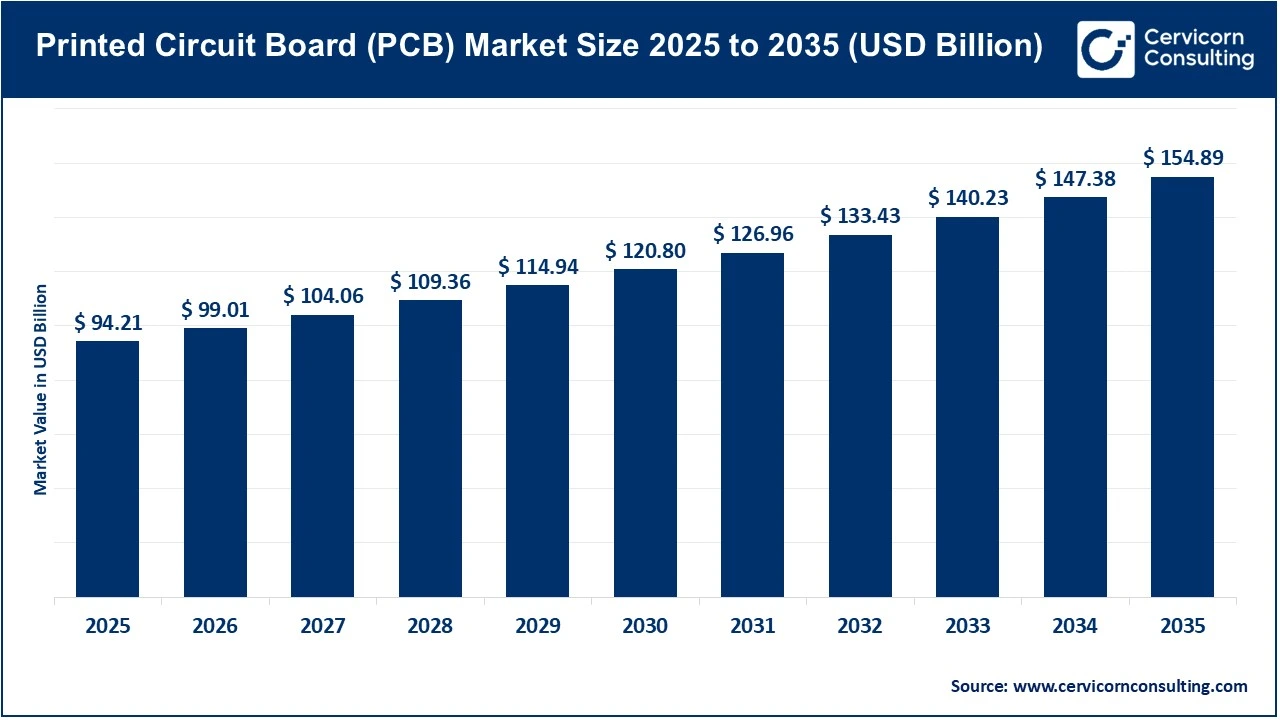
The global printed circuit board (PCB) market was valued at approximately USD 94.21 billion in 2025 and is projected to reach around USD 154.89 billion by 2035, expanding at a compound annual growth rate (CAGR) of 5.1% over the forecast period from 2026 to 2035.
What is Printed Circuit Board (PCB) Market?
The Printed Circuit Board (PCB) market refers to the global industry involved in the design, manufacturing, and supply of PCBs—essential components used to mechanically support and electrically connect electronic components using conductive pathways etched onto non-conductive substrates. PCBs are foundational to nearly every electronic device, including smartphones, computers, automotive systems, industrial machinery, medical equipment, and aerospace technologies.
The market encompasses various types of PCBs such as single-sided, double-sided, multilayer, high-density interconnect (HDI), flexible, and rigid-flex boards, each designed to meet specific application requirements. With the rapid expansion of electronics, telecommunications, and smart technologies, the PCB market has become a critical backbone of the global electronics manufacturing ecosystem.
As of recent estimates, the global PCB market is valued in tens of billions and is expected to grow steadily, driven by increasing demand across sectors like consumer electronics, automotive electronics, industrial automation, and telecommunications.
Why is Printed Circuit Board (PCB) Market Important?
The PCB market is crucial because it underpins the entire electronics industry. Without PCBs, modern electronic systems would lack the structure and connectivity required to function efficiently. PCBs serve as the central nervous system of electronic devices, enabling communication between components and ensuring reliability, compactness, and scalability.
Their importance can be understood through several dimensions:
- Enabling Miniaturization: PCBs allow complex circuits to be packed into small devices such as smartphones and wearables.
- Enhancing Performance: Advanced PCBs support high-speed data transfer, thermal management, and signal integrity.
- Supporting Innovation: Technologies like AI, IoT, 5G, and electric vehicles rely heavily on advanced PCB designs.
- Ensuring Reliability: In critical sectors such as aerospace and healthcare, PCBs provide stable and durable electronic performance.
Without PCBs, industries like telecommunications, automotive electronics, and consumer electronics would not be able to scale or innovate at the current pace.
Get a Free Sample: https://www.cervicornconsulting.com/sample/2946
Printed Circuit Board (PCB) Market Growth Factors
The growth of the printed circuit board (PCB) market is primarily driven by the rising demand for consumer electronics, increasing adoption of electric vehicles (EVs), rapid expansion of 5G infrastructure, and advancements in artificial intelligence (AI) and Internet of Things (IoT) technologies; the need for compact, lightweight, and high-performance electronic devices has accelerated the adoption of high-density interconnect (HDI) and flexible PCBs, while industrial automation and smart manufacturing are further fueling demand across sectors, additionally, the surge in data centers and cloud computing infrastructure requires advanced PCB solutions for high-speed connectivity, and ongoing innovations in materials, thermal management, and miniaturization technologies continue to enhance product capabilities, collectively supporting sustained market expansion globally.
Key Companies in the PCB Market
Below is a detailed overview of major companies in the PCB market, including their specialization, focus areas, and market positioning:
1. Zhen Ding Technology Holding Limited
- Specialization: HDI PCBs, flexible PCBs, IC substrates
- Key Focus Areas: Consumer electronics, smartphones, wearables
- Notable Features: Large-scale production, strong OEM partnerships, leadership in miniaturization technologies
- 2024 Revenue: Approx. USD 3.61 billion
- Market Share: ~12–17%
- Global Presence: Strong footprint in Asia with global supply chain integration
Zhen Ding is considered a global leader in PCB manufacturing, particularly in high-density and flexible circuit technologies used in next-generation electronics.
2. Unimicron Technology Corporation
- Specialization: IC substrates, HDI PCBs, multilayer PCBs
- Key Focus Areas: AI computing, 5G infrastructure, data centers
- Notable Features: Advanced packaging technologies and strong R&D investments
- 2024 Revenue: Not publicly standardized (major global revenue contributor)
- Market Share: ~8–12%
- Global Presence: Extensive manufacturing network across Asia and global clients
Unimicron plays a critical role in high-performance computing and semiconductor packaging, making it a key enabler of AI and data-driven technologies.
3. Nippon Mektron Ltd.
- Specialization: Flexible printed circuit boards (FPCBs)
- Key Focus Areas: Smartphones, medical devices, wearable technology
- Notable Features: Leadership in lightweight and compact PCB solutions
- 2024 Revenue: Not publicly specified (major global player)
- Market Share: ~10–15%
- Global Presence: Strong presence in Japan, Asia-Pacific, and global electronics markets
Nippon Mektron is widely recognized for its dominance in flexible PCBs, especially in compact and portable devices.
4. TTM Technologies Inc.
- Specialization: Rigid, flexible, RF/microwave PCBs
- Key Focus Areas: Aerospace, defense, automotive, telecom
- Notable Features: High-reliability PCB solutions and advanced manufacturing capabilities
- 2024 Revenue: Not explicitly stated (major U.S.-based leader)
- Market Share: ~2.75%
- Global Presence: Strong presence in North America and global defense sectors
TTM Technologies is known for its expertise in mission-critical applications, particularly in aerospace and defense.
5. AT&S Austria Technologie & Systemtechnik AG
- Specialization: High-end PCBs and IC substrates
- Key Focus Areas: Automotive electronics, industrial applications, semiconductors
- Notable Features: Advanced manufacturing facilities and strong R&D capabilities
- 2024 Revenue: Approx. EUR 90 million profit (FY 2025)
- Market Share: ~1.13%
- Global Presence: Europe, Asia, and global manufacturing sites
AT&S is a leading European PCB manufacturer with strong expertise in high-performance and automotive-grade PCB solutions.
Leading Trends and Their Impact
1. Miniaturization and HDI Technology
The shift toward smaller and more powerful devices has accelerated the adoption of HDI PCBs, enabling higher component density and improved performance.
2. Rise of Electric Vehicles (EVs)
EVs require advanced PCBs for battery management systems, power electronics, and infotainment systems, significantly boosting demand.
3. 5G and Telecommunications Expansion
The rollout of 5G networks is driving demand for high-frequency PCBs capable of supporting faster data transmission.
4. AI and Data Centers
AI servers and data centers require advanced PCB substrates to handle high-speed computing and thermal management.
5. Flexible and Rigid-Flex PCBs
Wearables and foldable devices are increasing the adoption of flexible PCBs, offering design flexibility and durability.
Impact:
These trends are pushing manufacturers toward innovation, higher R&D investments, and advanced manufacturing processes, resulting in improved product performance and expanded application areas.
Successful Examples of PCB Market Around the World
1. Taiwan – Global Manufacturing Hub
Taiwan dominates the PCB industry with companies like Unimicron and Zhen Ding, benefiting from strong semiconductor integration and export-driven growth.
2. China – High-Volume Production
China leads in mass PCB production, supported by government initiatives and large-scale manufacturing capabilities.
3. Japan – Precision and Innovation
Companies like Nippon Mektron focus on high-quality, flexible PCBs for advanced electronics and medical devices.
4. United States – High-End Applications
TTM Technologies leads in aerospace and defense PCBs, emphasizing high reliability and performance.
5. Europe – Automotive Electronics
AT&S plays a major role in automotive PCB innovation, particularly in electric vehicles and industrial automation.
These examples highlight how different regions specialize in volume production, innovation, or niche applications, collectively driving global market growth.
Global Regional Analysis Including Government Initiatives and Policies
Asia-Pacific (APAC)
- Market Position: Dominant region with the largest market share
- Key Countries: China, Taiwan, Japan, South Korea
- Government Initiatives:
- China’s “Made in China 2025” promotes domestic electronics manufacturing
- Taiwan supports semiconductor and PCB integration
- Impact: Strong manufacturing ecosystem and cost advantages
Asia-Pacific leads the PCB market due to its well-established electronics manufacturing base and government-backed industrial policies.
North America
- Market Position: Advanced and innovation-driven
- Key Countries: United States, Canada
- Government Initiatives:
- Investments in semiconductor manufacturing and defense electronics
- Policies supporting domestic production and supply chain resilience
- Impact: Growth in aerospace, defense, and high-performance computing
North America focuses on high-end PCB applications, particularly in defense and advanced technologies.
Europe
- Market Position: Strong in automotive and industrial sectors
- Key Countries: Germany, Austria, France
- Government Initiatives:
- EU Green Deal promoting sustainable electronics
- Investments in EV and smart manufacturing
- Impact: Growth in automotive electronics and industrial automation
Europe emphasizes sustainability and innovation, particularly in automotive electronics.
Latin America
- Market Position: Emerging market
- Key Countries: Brazil, Mexico
- Government Initiatives:
- Support for electronics assembly and manufacturing
- Impact: Moderate growth with increasing industrialization
Middle East & Africa
- Market Position: Nascent but growing
- Government Initiatives:
- Investments in smart cities and digital infrastructure
- Impact: Gradual adoption of PCB technologies
Final Thoughts
The printed circuit board (PCB) market continues to evolve as a cornerstone of the global electronics ecosystem. With strong growth drivers, technological advancements, and regional specialization, the market is poised for sustained expansion in the coming years.
To Get Detailed Overview, Contact Us: https://www.cervicornconsulting.com/contact-us
Read Report: Data Center Battery Market Revenue, Trends, and Strategic Insights by 2035