Data Center Battery Market Revenue, Trends, and Strategic Insights by 2035
Table of Contents
ToggleData Center Battery Market Overview and Growth Outlook
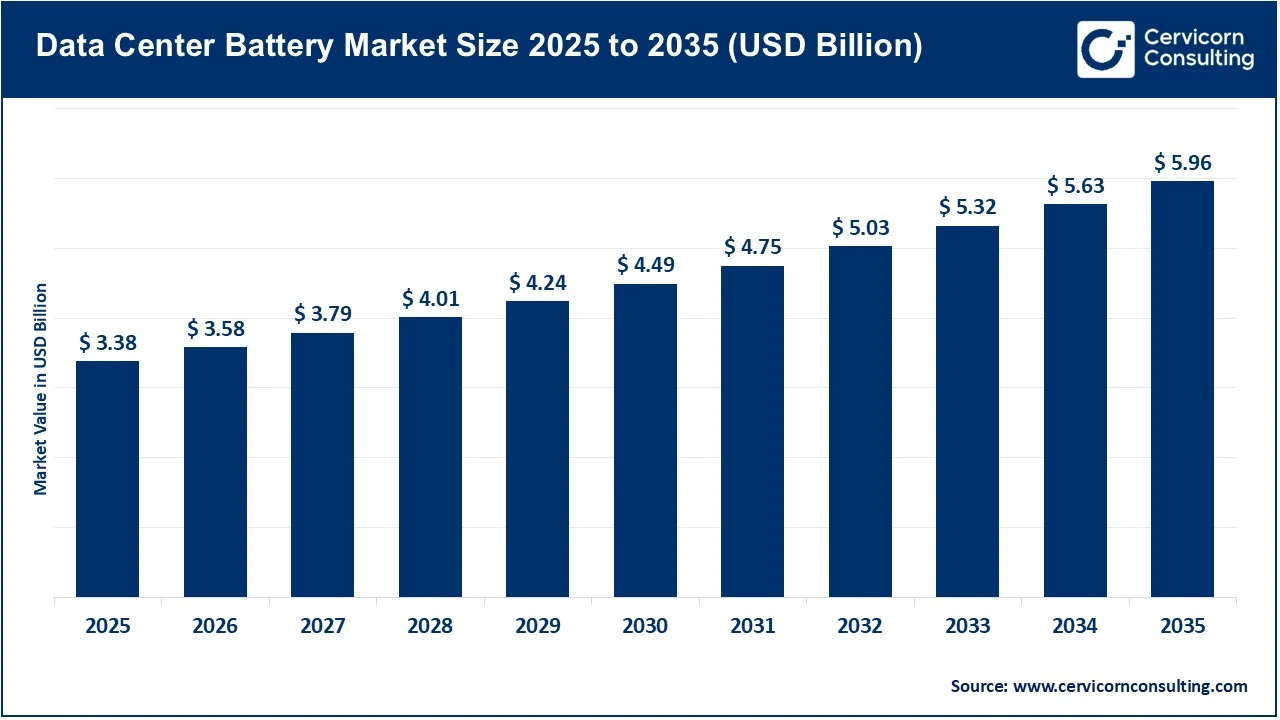
The global data center battery market was valued at approximately USD 3.38 billion in 2025 and is projected to reach around USD 5.96 billion by 2035, expanding at a compound annual growth rate (CAGR) of 5.9% over the forecast period from 2026 to 2035.
A major driver is the UPS segment, which accounts for the largest share due to its role in protecting mission-critical workloads.
What is the Data Center Battery Market?
The data center battery market refers to the global industry focused on designing, manufacturing, and deploying advanced battery systems that provide backup power and energy storage for data centers. These batteries are a critical part of Uninterruptible Power Supply (UPS) systems, ensuring continuous operation of servers, networking equipment, and storage infrastructure even during power outages, voltage fluctuations, or grid instability.
Data centers—especially hyperscale, colocation, and edge facilities—operate mission-critical digital workloads such as cloud computing, artificial intelligence (AI), financial transactions, streaming services, and enterprise applications. Even a few seconds of downtime can lead to massive financial losses, making battery-backed power systems essential.
The market includes multiple battery chemistries such as:
- Lead-acid batteries (VRLA)
- Lithium-ion batteries
- Nickel-zinc batteries
- Emerging solid-state and hybrid energy storage systems
These systems are integrated into UPS architectures, energy storage systems (ESS), and hybrid grid-support solutions.
Get a Free Sample: https://www.cervicornconsulting.com/sample/2938
Why is the Data Center Battery Market Important?
The importance of the data center battery market lies in its role as the foundation of digital infrastructure reliability.
Key reasons include:
- Zero downtime requirement: Data centers must maintain near-100% uptime for cloud services and enterprise systems.
- Critical infrastructure protection: Batteries prevent data loss and hardware damage during power disruptions.
- Cloud and AI expansion: Rapid growth of AI workloads and cloud computing has increased power density requirements.
- Energy transition: Data centers are integrating renewable energy, requiring storage systems to balance supply fluctuations.
- Grid instability risks: Many regions face unreliable electricity supply, making backup power essential.
- Cost of outages: Even milliseconds of downtime in financial or cloud systems can result in millions of dollars in losses.
In modern digital economies, batteries are no longer optional—they are a core infrastructure layer.
Data Center Battery Market Growth Factors
The data center battery market is experiencing strong growth due to increasing global demand for uninterrupted digital services, rapid expansion of hyperscale and edge data centers, rising adoption of cloud computing and AI workloads, and growing dependency on real-time data processing across industries.
Additionally, the shift toward renewable energy integration, combined with the need for grid stability and energy efficiency, is driving adoption of advanced lithium-ion and hybrid energy storage systems. Technological advancements in battery chemistry, battery management systems (BMS), modular UPS designs, and improvements in energy density and lifecycle performance are further accelerating deployment. Regulatory pressures for carbon reduction, sustainability targets, and government incentives for energy-efficient infrastructure are also contributing significantly to market expansion. As data traffic continues to surge globally, organizations are increasingly investing in resilient, scalable, and intelligent backup power solutions to ensure operational continuity and minimize downtime risks.
Key Companies in the Data Center Battery Market
1. EnerSys
- Specialization: Industrial energy storage, UPS batteries, motive power systems
- Key Focus Areas: Lead-acid and lithium-ion batteries for critical infrastructure
- Notable Features: Strong global supply chain and long lifecycle industrial battery expertise
- 2024 Revenue: Estimated multi-billion USD (company-wide industrial battery segment dominates revenue)
- Market Share: One of the top global UPS battery suppliers
- Global Presence: North America, Europe, Asia-Pacific
EnerSys is widely used in enterprise and hyperscale data centers due to its reliability in UPS backup systems.
2. Exide Technologies
- Specialization: Lead-acid and advanced lithium energy storage systems
- Key Focus Areas: UPS batteries, grid storage, industrial backup systems
- Notable Features: Strong innovation in hybrid energy storage solutions
- 2024 Revenue: Significant revenue contribution from industrial battery division
- Market Share: Strong presence in Europe and emerging markets
- Global Presence: Europe, North America, Asia
Exide is transitioning from traditional VRLA batteries toward more efficient lithium-based systems.
3. East Penn Manufacturing
- Specialization: VRLA and AGM battery manufacturing
- Key Focus Areas: UPS systems, telecom, data center backup power
- Notable Features: Vertically integrated manufacturing and strong quality control
- 2024 Revenue: Estimated multi-billion-dollar private company scale
- Market Share: Major supplier in North American UPS segment
- Global Presence: Primarily North America with global distribution
East Penn remains a dominant player in traditional lead-acid UPS ecosystems.
4. GS Yuasa Corporation
- Specialization: High-performance industrial and automotive batteries
- Key Focus Areas: Lithium-ion UPS batteries, energy storage systems
- Notable Features: Advanced lithium technology and aerospace-grade reliability
- 2024 Revenue: Multi-billion USD total company revenue
- Market Share: Strong in Asia and global UPS markets
- Global Presence: Japan, Asia-Pacific, Europe, global exports
GS Yuasa is known for high-reliability applications in mission-critical environments.
5. Samsung SDI
- Specialization: Advanced lithium-ion battery technologies
- Key Focus Areas: Energy storage systems, UPS lithium solutions, EV crossover technology
- Notable Features: High energy density, modular lithium battery systems, strong R&D pipeline
- 2024 Revenue: Multi-billion USD battery segment revenue
- Market Share: Fast-growing share in energy storage and data center lithium batteries
- Global Presence: South Korea, USA, Europe, China
Samsung SDI is rapidly expanding into data center energy storage systems, leveraging EV battery expertise.
Leading Trends and Their Impact
1. Shift from Lead-Acid to Lithium-Ion Batteries
Lithium-ion batteries are replacing traditional VRLA systems due to:
- Higher energy density
- Longer lifespan
- Reduced maintenance
- Smaller footprint
Impact: Lower total cost of ownership and improved efficiency for hyperscale data centers.
2. Rise of Hyperscale Data Centers
Hyperscale facilities dominate demand due to cloud and AI expansion.
Impact:
- Higher power density requirements
- Larger UPS installations
- Increased adoption of modular battery systems
3. Integration with Renewable Energy
Battery systems are increasingly integrated with solar and wind energy sources.
Impact:
- Reduced carbon emissions
- Improved energy resilience
- Grid stabilization capabilities
4. AI-Driven Power Demand
AI workloads cause fluctuating power consumption patterns.
Impact:
- Need for fast-response battery systems
- Adoption of grid-interactive UPS (GiUPS)
- Multi-layer storage systems
5. Modular Battery Systems
Modular UPS designs allow scalable expansion.
Impact:
- Flexible deployment in colocation data centers
- Lower upfront capital expenditure
- Improved redundancy
6. Second-Life Battery Adoption
Used EV batteries are being repurposed for data center backup.
Impact:
- Lower cost energy storage
- Sustainability benefits
- Circular economy integration
Successful Examples of Data Center Battery Deployments Worldwide
1. Hyperscale Cloud Data Centers (USA)
Companies like AWS, Google Cloud, and Microsoft Azure deploy large-scale lithium-ion UPS systems across global facilities to ensure near-zero downtime operations.
2. European Green Data Centers
Countries like Germany and the Netherlands use renewable-integrated battery storage systems to power carbon-neutral data centers.
3. Asia-Pacific AI Data Centers
China, India, and Singapore are rapidly expanding AI-ready data centers with high-density lithium-ion UPS infrastructure.
4. Colocation Facilities in North America
Equinix and Digital Realty integrate modular UPS battery systems for scalable enterprise hosting.
5. Edge Data Centers in Telecom Networks
Telecom operators deploy compact battery systems at edge locations to support 5G and IoT infrastructure.
Global Regional Analysis and Government Policies
North America
North America dominates the market due to hyperscale cloud providers and advanced infrastructure.
Key drivers:
- Strong AI and cloud adoption
- Early lithium-ion adoption
- Grid modernization investments
Government initiatives:
- Energy efficiency regulations for data centers
- Incentives for renewable integration
- Federal funding for grid resilience programs
Europe
Europe emphasizes sustainability and carbon neutrality.
Key drivers:
- Strict environmental regulations
- Renewable-powered data centers
- High adoption of energy storage systems
Government policies:
- EU Green Deal initiatives
- Carbon neutrality targets (2050)
- Energy efficiency mandates for digital infrastructure
Asia-Pacific
Fastest-growing region due to digital expansion.
Key drivers:
- Rapid data center construction in India, China, Singapore
- 5G and AI infrastructure growth
- Rising cloud adoption
Government initiatives:
- China’s digital infrastructure expansion programs
- India’s data localization policies and digital mission
- Singapore’s energy-efficient data center regulations
Middle East & Africa
Emerging hub for hyperscale investments.
Key drivers:
- Smart city projects (UAE, Saudi Arabia)
- Cloud region expansions
- Renewable-powered infrastructure
Government policies:
- Vision 2030 (Saudi Arabia)
- UAE digital transformation programs
Latin America
Growing demand from cloud and fintech sectors.
Key drivers:
- Brazil’s data center expansion
- Increasing internet penetration
- Cloud migration trends
Government initiatives:
- Incentives for digital infrastructure investment
- Renewable energy integration policies
Final Perspective on Industry Direction
The data center battery market is transitioning from a traditional backup power segment into a strategic digital infrastructure enabler. The convergence of AI workloads, cloud computing, renewable energy integration, and grid modernization is reshaping how batteries are designed and deployed. Companies are increasingly focusing on lithium-ion innovation, modular architectures, and intelligent energy management systems to support the next generation of always-on digital ecosystems.
To Get Detailed Overview, Contact Us: https://www.cervicornconsulting.com/contact-us
Read Report: Managed Security Services Market Revenue, Trends, and Strategic Insights by 2035