Plastic Compounding Market Revenue, Trends, and Strategic Insights by 2035
Plastic Compounding Market Size
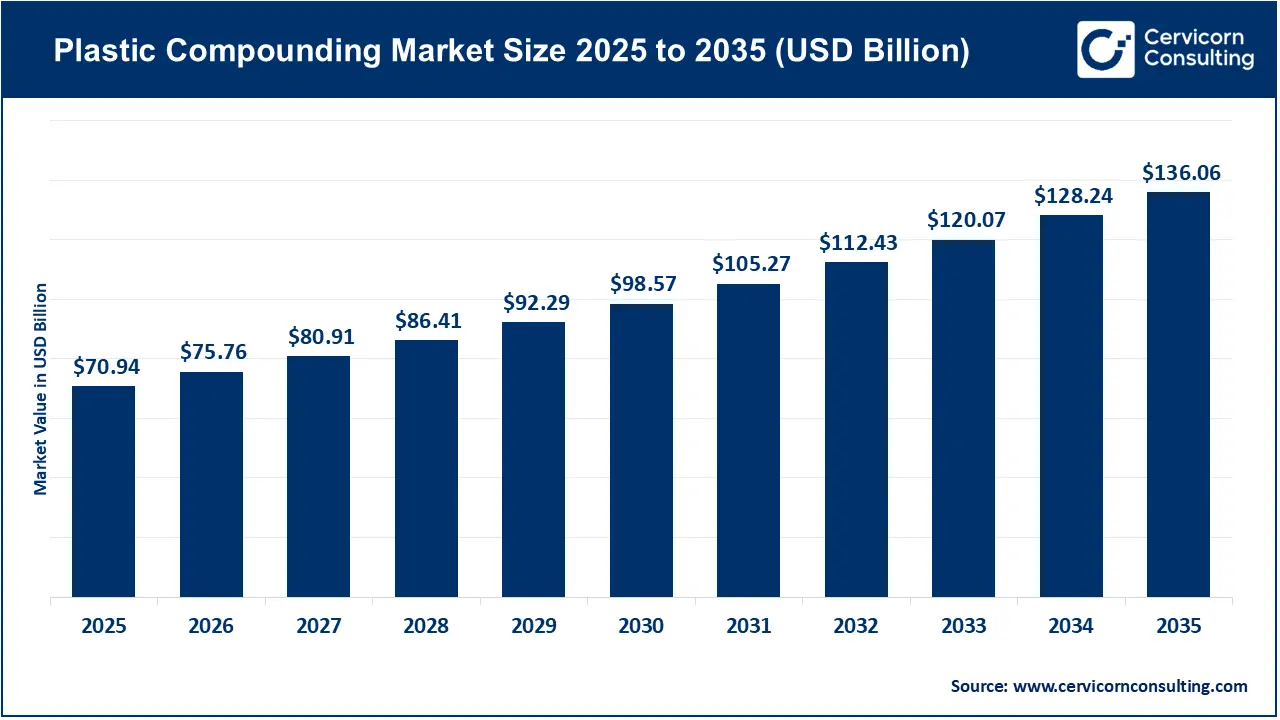
The global plastic compounding market was valued at approximately USD 70.94 billion in 2025 and is projected to reach USD 136.06 billion by 2035, expanding at a CAGR of 6.73% during the forecast period.
Plastic Compounding Market Growth Factors
The plastic compounding market is experiencing strong momentum due to increasing demand for lightweight materials in the automotive industry, expanding applications in electrical and electronics manufacturing, rising infrastructure development, growing use of high-performance polymers in healthcare, increasing packaging requirements driven by e-commerce, rapid industrialization in emerging economies, technological advancements in polymer engineering, rising demand for flame-retardant and impact-resistant materials, expanding renewable energy infrastructure, and continuous innovations in recyclable and bio-based plastics. Additionally, stricter environmental regulations are encouraging manufacturers to develop sustainable compounds with recycled content, creating new opportunities for advanced plastic compounding technologies.
What is the Plastic Compounding Market?
The plastic compounding market refers to the global industry involved in modifying and enhancing raw polymer resins through the addition of fillers, reinforcements, colorants, stabilizers, impact modifiers, flame retardants, lubricants, UV stabilizers, and other specialty additives. The resulting compounded plastics exhibit enhanced physical, mechanical, thermal, and chemical characteristics tailored for specific industrial applications.
Unlike standard plastic resins, compounded plastics are engineered to deliver superior performance under demanding conditions. They are designed according to customer requirements, enabling manufacturers to achieve better strength, flexibility, durability, heat resistance, conductivity, appearance, and processing efficiency.
Plastic compounds are widely utilized in:
- Automotive components
- Consumer electronics
- Medical devices
- Building and construction materials
- Food packaging
- Aerospace components
- Industrial machinery
- Telecommunications
- Electrical appliances
- Renewable energy equipment
As industries continue demanding customized materials capable of replacing metals and traditional engineering materials, plastic compounding has become a vital part of modern manufacturing.
Get a Free Sample: https://www.cervicornconsulting.com/sample/2698
Why is the Plastic Compounding Market Important?
Plastic compounding plays a critical role in enabling innovation across multiple industries by providing materials with tailored performance characteristics. Lightweight plastic compounds contribute significantly to improved fuel efficiency in automobiles and extended battery range in electric vehicles. Advanced flame-retardant compounds enhance electrical safety, while medical-grade compounds ensure compliance with stringent healthcare regulations.
The market is equally important for sustainability initiatives. Plastic compounders increasingly incorporate recycled plastics and bio-based polymers into formulations, helping reduce dependence on virgin fossil-based materials. These developments support circular economy objectives and reduce greenhouse gas emissions.
Furthermore, plastic compounding allows manufacturers to achieve higher productivity, reduce production costs, improve product durability, and extend component life. Customized formulations enable companies to meet regulatory requirements without compromising product performance.
Major Companies Operating in the Plastic Compounding Market
| Company | Specialization | Key Focus Areas | Notable Features | Estimated 2025 Revenue | Estimated Market Share | Global Presence |
|---|---|---|---|---|---|---|
| Asahi Kasei Corporation | Engineering plastics and specialty compounds | Automotive, electronics, healthcare | Advanced engineering polymers, sustainable materials | Approximately USD 20 Billion | Medium | Asia, Europe, North America |
| BASF SE | Performance plastics and specialty compounds | Automotive, industrial manufacturing, construction | Broad product portfolio and strong R&D capabilities | Approximately USD 75 Billion | Leading | More than 90 countries |
| DuPont | High-performance engineering materials | Electronics, aerospace, transportation | Innovative polymer technologies and specialty compounds | Approximately USD 13 Billion | Significant | Global manufacturing network |
| Celanese Corporation | Engineered thermoplastics and polymer compounds | Automotive, industrial equipment, consumer products | High-performance engineered materials | Approximately USD 11 Billion | Strong | North America, Europe, Asia-Pacific |
| Covestro AG | Polycarbonate and polyurethane compounds | Construction, automotive, electronics | Circular economy initiatives and sustainable plastics | Approximately USD 17 Billion | Major | Over 100 countries |
Leading Trends Transforming the Plastic Compounding Market
1. Growing Adoption of Recycled Plastic Compounds
Sustainability has become one of the strongest drivers in the plastic industry. Manufacturers are increasingly incorporating post-consumer and post-industrial recycled plastics into compounded materials.
This trend helps:
- Reduce landfill waste
- Lower carbon emissions
- Meet government sustainability regulations
- Support circular economy objectives
Many global manufacturers now offer recycled polypropylene, polyethylene, PET, and engineering plastic compounds.
Market Impact
Recycled plastic compounds are opening entirely new revenue streams while reducing raw material costs and environmental footprints.
2. Increasing Demand from Electric Vehicles
Electric vehicles require lightweight yet mechanically strong materials.
Plastic compounds are increasingly replacing aluminum and steel in:
- Battery housings
- Charging systems
- Interior panels
- Power electronics
- Connectors
- Cooling systems
Specialized flame-retardant compounds are also gaining importance for EV battery safety.
Market Impact
The rapid expansion of EV production is significantly boosting demand for engineering plastic compounds worldwide.
3. Expansion of Bio-Based Plastic Compounds
Growing environmental awareness is encouraging manufacturers to invest in renewable polymer technologies.
Bio-based compounds now include:
- PLA compounds
- Bio-polyamide
- Bio-polyesters
- Renewable polypropylene blends
These materials reduce fossil fuel dependency while maintaining performance standards.
Market Impact
Bio-based compounds are creating premium product categories with strong growth potential.
4. Smart Additives Enhancing Material Performance
Manufacturers increasingly incorporate advanced additives that improve:
- UV resistance
- Anti-static properties
- Thermal stability
- Antimicrobial protection
- Conductivity
- Wear resistance
These innovations expand the application range of compounded plastics.
Market Impact
High-value specialty compounds generate greater profit margins than commodity plastics.
5. Digital Manufacturing and Industry 4.0
Artificial intelligence, automation, and digital twins are improving compounding operations.
Benefits include:
- Improved formulation accuracy
- Reduced waste
- Faster product development
- Better quality control
- Predictive maintenance
Market Impact
Smart manufacturing increases production efficiency while reducing operational costs.
Successful Examples of Plastic Compounding Around the World
Automotive Lightweighting in Germany
German automotive manufacturers extensively utilize glass fiber reinforced polypropylene and polyamide compounds for engine components, structural parts, and interior systems.
These compounds reduce vehicle weight while maintaining structural integrity, contributing to improved fuel efficiency and electric vehicle range.
Consumer Electronics Manufacturing in South Korea
Electronics manufacturers use flame-retardant engineering plastic compounds in smartphones, televisions, semiconductor equipment, and home appliances.
Customized compounds improve durability while ensuring compliance with stringent electrical safety standards.
Medical Device Manufacturing in the United States
Medical-grade compounded plastics are widely used in:
- Syringes
- Surgical instruments
- Catheters
- Diagnostic devices
- Drug delivery systems
Special formulations provide biocompatibility, sterilization resistance, and chemical stability.
Packaging Innovation in Japan
Japanese packaging manufacturers increasingly utilize high-barrier compounded plastics for food preservation.
These advanced compounds extend shelf life while reducing food waste.
Renewable Energy Applications in China
China uses specialized engineering plastic compounds for:
- Solar panel components
- Wind turbine systems
- Battery storage equipment
- Electric vehicle charging stations
These materials provide excellent weather resistance and long operational lifespans.
Global Regional Analysis
North America
North America remains one of the largest plastic compounding markets due to advanced manufacturing capabilities and strong demand from automotive, aerospace, healthcare, and electronics industries.
The United States continues investing heavily in advanced manufacturing technologies and sustainable material innovation.
Government Initiatives
Government agencies support:
- Advanced manufacturing research
- Recycling infrastructure
- Circular economy programs
- Electric vehicle production incentives
- Clean energy investments
- Sustainable material innovation
Policies promoting domestic manufacturing and infrastructure modernization are increasing demand for engineering plastic compounds.
Europe
Europe represents one of the most mature plastic compounding markets, supported by strict environmental regulations and strong automotive manufacturing.
Countries including Germany, France, Italy, and the Netherlands continue investing in sustainable polymer technologies.
Government Policies
European governments promote:
- Circular Economy Action Plan
- Plastic recycling mandates
- Carbon neutrality targets
- Green Deal investments
- Sustainable packaging regulations
- Automotive emission standards
These initiatives encourage manufacturers to develop recyclable and bio-based compounded plastics.
Asia-Pacific
Asia-Pacific is expected to experience the fastest market growth due to rapid industrialization, expanding manufacturing sectors, urbanization, and rising consumer demand.
China, India, Japan, South Korea, and Southeast Asian countries are major contributors.
Growing production of automobiles, consumer electronics, appliances, and construction materials continues driving demand.
Government Initiatives
Regional governments support:
China
- Advanced manufacturing policies
- Electric vehicle subsidies
- Domestic polymer production
- Recycling infrastructure investments
India
- Make in India initiative
- Plastic recycling programs
- Infrastructure expansion
- Manufacturing incentives
Japan
- Green growth strategy
- Advanced materials research
- Sustainable manufacturing support
South Korea
- Smart factory initiatives
- Semiconductor industry investments
- Carbon neutrality roadmap
These policies continue strengthening regional manufacturing capabilities.
Latin America
Latin America is gradually emerging as an important market due to expanding packaging, automotive, and consumer goods industries.
Brazil and Mexico account for the largest share of regional demand.
Government Support
Governments promote:
- Industrial modernization
- Foreign direct investment
- Automotive manufacturing
- Plastic recycling initiatives
- Infrastructure development
Growing investments in manufacturing facilities continue supporting market expansion.
Middle East & Africa
The Middle East is benefiting from strong petrochemical industries that provide abundant polymer feedstocks for plastic compounding.
Countries such as Saudi Arabia and the United Arab Emirates continue investing in downstream polymer manufacturing.
Africa is witnessing increasing demand from construction, packaging, agriculture, and consumer products.
Government Policies
Regional initiatives include:
- Economic diversification programs
- Petrochemical expansion projects
- Industrial free zones
- Manufacturing localization
- Sustainable development strategies
These efforts are encouraging investments in value-added polymer processing and compounding industries.
Competitive Landscape
The plastic compounding market is highly competitive, with global chemical manufacturers focusing on innovation, sustainability, and customized material solutions. Companies are expanding production capacities, acquiring regional compounders, and investing heavily in research and development to meet evolving customer requirements.
Key competitive strategies include:
- Development of recyclable and bio-based plastic compounds
- Expansion of manufacturing facilities in emerging economies
- Strategic partnerships with automotive and electronics manufacturers
- Adoption of AI-driven quality control and digital manufacturing
- Investment in specialty additives and high-performance polymers
- Strengthening regional distribution networks
- Vertical integration across polymer value chains
As demand for lightweight, durable, and environmentally sustainable materials continues to rise, companies that combine advanced compounding technologies with strong sustainability initiatives are expected to maintain a competitive advantage in the evolving global plastic compounding market.
To Get Detailed Overview, Contact Us: https://www.cervicornconsulting.com/contact-us
Read Report: Commercial Vehicle Market Revenue, Trends, and Strategic Insights by 2035