Generative AI in Insurance Market Revenue, Trends, and Strategic Insights by 2035
Generative AI in Insurance Market Size
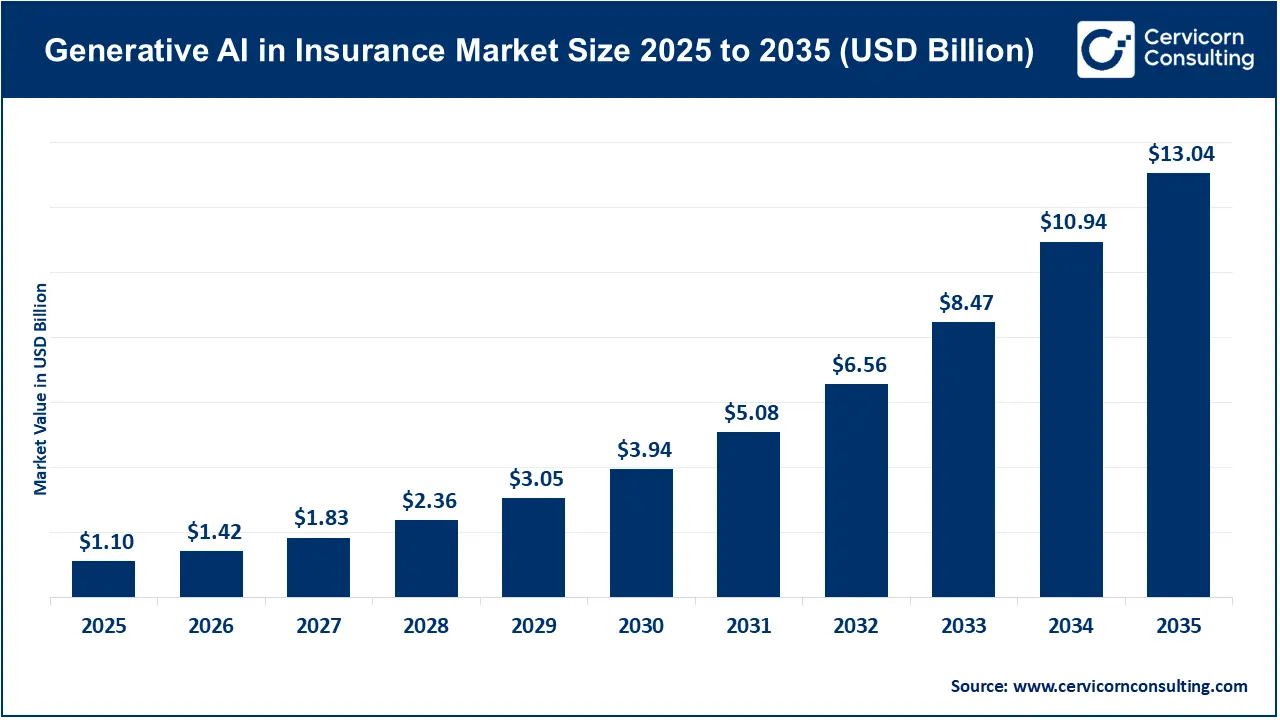
The global generative AI in insurance marketsize was valued at approximatelyUSD 1.10 billion in 2025 and is projected to reach around USD 13.04 billion by 2035, expanding at a CAGR of 28.05% from 2026 to 2035.
Generative AI in Insurance Market Growth Factors
The generative AI in insurance market is growing because insurers are under increasing pressure to reduce administrative costs, accelerate underwriting and claims processing, personalize customer interactions, manage enormous volumes of structured and unstructured data, detect fraud, and improve employee productivity while maintaining regulatory compliance.
Insurance organizations process contracts, medical records, claims documents, inspection reports, customer correspondence, legal documents, policy schedules, and regulatory material, making the sector particularly suitable for large language models and retrieval-augmented generation systems. The growing availability of cloud computing, foundation models, AI application programming interfaces, computer vision, natural language processing, and enterprise AI platforms is lowering the technical barriers to adoption.
At the same time, customers increasingly expect instant digital service, personalized recommendations, conversational assistance, and faster claims decisions. Rising insurance complexity, climate-related risks, increasing fraud, talent shortages, and pressure on combined ratios are further encouraging insurers to automate repetitive knowledge-intensive work. AI adoption is already significant across insurance: NAIC surveys found that 88% of responding auto insurers, 70% of home insurers, 58% of life insurers, and 92% of responding health insurers either use, plan to use, or plan to explore AI/ML models.
Get a Free Sample: https://www.cervicornconsulting.com/sample/2757
What Is Generative AI in Insurance Market?
The generative AI in insurance market represents the ecosystem of technologies, platforms, software, services, and applications that use generative artificial intelligence to support or automate insurance-related activities.
Generative AI models can generate text, summarize information, answer questions, create reports, extract information from documents, draft policy communications, assist employees, and interact with customers through conversational interfaces.
In insurance, the technology can be applied throughout the policy lifecycle. During underwriting, GenAI can summarize applicant information, analyze documentation, identify missing information, and support risk assessment. During claims management, it can review claims descriptions, policy documents, photographs, correspondence, and supporting records to help claims professionals reach decisions faster.
For customer service, generative AI-powered virtual agents can answer policy questions, explain coverage, support quote generation, and guide customers through claims. IBM identifies summarization, classification, generation, extraction, and question answering as major generative AI capabilities relevant to insurers.
Why Is Generative AI Important for Insurance?
Generative AI is important because insurance is fundamentally a data-intensive and document-intensive business. Underwriters, claims professionals, agents, brokers, actuaries, and customer service teams spend considerable time reviewing information before making decisions.
Faster underwriting
GenAI can consolidate information from applications, policy documents, inspection reports, financial statements, and external sources into concise summaries. This enables underwriters to spend more time on judgment-intensive activities rather than document processing.
More efficient claims management
Claims teams can use GenAI to summarize case histories, identify relevant policy clauses, draft communications, classify claims, and highlight inconsistencies. Human claims professionals can then review AI-generated recommendations before final decisions.
Better customer experience
Conversational AI allows customers to interact with insurers using natural language instead of navigating complicated websites or telephone menus. Customers can receive assistance with policy questions, claim status, coverage explanations, and documentation at any time.
Fraud detection
Generative AI can help investigators review large volumes of claim narratives, correspondence, and supporting documents. When combined with predictive analytics and traditional fraud models, it can identify unusual patterns and provide investigators with a more understandable case summary.
Employee productivity
Insurance employees can use AI copilots to draft emails, summarize meetings, prepare reports, search internal knowledge bases, and retrieve information from large collections of documents.
Lower operating costs
The economic opportunity is particularly significant for repetitive administrative processes. For example, AWS reports that EXL’s generative AI-based underwriting assistant reduced insurance underwriting costs by up to 80% and accelerated processing from days to hours.
Major Companies in the Generative AI in Insurance Market
| Company | Specialization | Key Focus Areas | Notable Features | 2025 Revenue | Generative AI Insurance Market Share | Global Presence |
|---|---|---|---|---|---|---|
| Microsoft Corporation | Cloud computing, enterprise AI and software | Azure AI, Azure OpenAI, Copilot, claims, fraud, underwriting | Enterprise-grade AI infrastructure, Copilot ecosystem, Azure OpenAI | USD 281.72 billion | Not publicly disclosed | Global |
| Amazon Web Services Inc. | Cloud infrastructure and AI services | Amazon Bedrock, SageMaker AI, document processing, underwriting | Scalable cloud AI, foundation-model access, AI application development | AWS: approximately USD 128.7 billion | Not publicly disclosed | Global |
| IBM Corporation | Enterprise AI, hybrid cloud and consulting | watsonx, governance, claims, customer engagement, compliance | AI governance, enterprise integration, insurance consulting | USD 67.54 billion | Not publicly disclosed | Global |
| Avaamo Inc. | Conversational and generative enterprise AI | Customer service, claims, policy servicing, virtual agents | Multi-turn conversations, automated insurance servicing | Private company; revenue not publicly disclosed | Not publicly disclosed | International |
| Cape Analytics LLC | Property intelligence and AI analytics | Property underwriting, risk assessment, claims, computer vision | Geospatial analytics, property condition intelligence, AI-powered risk assessment | Private company; revenue not publicly disclosed | Not publicly disclosed | Primarily North America with expanding industry reach |
Microsoft Corporation
Microsoft is one of the most important technology providers supporting generative AI adoption in insurance through Azure, Azure OpenAI Service, Microsoft 365 Copilot, Azure AI Foundry, and related enterprise technologies.
Microsoft reported USD 281.724 billion in revenue for fiscal 2025, up 15% from fiscal 2024. Its Intelligent Cloud segment generated USD 106.265 billion.
Microsoft’s insurance strategy focuses on integrating generative AI into customer engagement, underwriting, claims, fraud management, employee productivity, and application modernization. Its Azure OpenAI infrastructure has already been used by insurance technology providers. For example, Shift Technology uses Azure OpenAI Service and Azure AI infrastructure to process policy, claim, and documentation data, reducing workflows that previously took weeks to days.
Amazon Web Services Inc.
AWS provides cloud infrastructure and AI services that allow insurers and insurance technology companies to build customized generative AI applications. Key technologies include Amazon Bedrock, Amazon SageMaker AI, data analytics services, and cloud infrastructure.
AWS sales increased 20% during 2025, while AWS generated approximately USD 128.7 billion in annual sales.
Insurance use cases include underwriting assistants, claims document analysis, customer service, fraud analytics, and risk prediction. EXL’s underwriting assistant is one notable example of insurance GenAI being developed using Amazon Bedrock.
IBM Corporation
IBM combines enterprise AI, hybrid cloud, consulting, automation, data management, and AI governance capabilities. Its watsonx portfolio is particularly relevant to insurers that need generative AI with strong governance and enterprise integration.
IBM reported USD 67.535 billion in 2025 revenue, including USD 29.962 billion from software and USD 21.055 billion from consulting.
IBM’s insurance applications include virtual agents, conversational search, regulatory and compliance processes, claims investigation, application modernization, customer engagement, digital labor, cybersecurity, and IT operations.
Avaamo Inc.
Avaamo specializes in conversational AI and enterprise virtual agents. Its insurance applications are focused heavily on customer service and policyholder engagement.
Avaamo states that its conversational AI serves more than 500 million customers globally, automates more than 82,000 customer queries daily, and handles 97% of interactions without human support across its deployments. The company also reports that its insurance digital agents can reduce quote-completion time from as much as 72 hours to less than 10 minutes and reduce claims cycle time by 50% in applicable deployments.
Because Avaamo is privately held, a verified 2025 company-wide revenue figure and precise share of the global generative AI in insurance market are not publicly disclosed.
Cape Analytics LLC
Cape Analytics focuses on AI-powered property intelligence for property and casualty insurers. Its technology combines geospatial analytics, computer vision, property information, and AI to help insurers evaluate property conditions and risks.
Applications include property underwriting, risk assessment, claims, loss prevention, and portfolio management. Cape Analytics highlights the role of generative AI, agentic AI, computer vision, and geospatial analytics in moving property insurance toward more personalized and proactive underwriting.
Cape Analytics is privately held, so its 2025 revenue and exact global generative AI insurance market share are not publicly disclosed.
Leading Trends and Their Impact on the Generative AI in Insurance Market
1. AI-powered underwriting
Underwriting is moving from manual document review toward AI-assisted risk intelligence. Generative AI can summarize applications and identify relevant information, while predictive models provide quantitative risk assessments.
Impact: Faster quote generation, reduced administrative work, improved consistency, and increased underwriter productivity.
2. Generative AI-powered claims
Claims processing is becoming one of the most attractive GenAI applications. AI can read documents, summarize claims, analyze policy language, draft correspondence, and assist claims professionals.
Impact: Shorter claims cycle times, lower processing costs, and faster customer communication.
3. AI agents and autonomous workflows
The market is moving beyond chatbots toward AI agents capable of executing multi-step workflows. Microsoft describes this transition as insurers embedding intelligent agents across marketing, customer engagement, underwriting, and claims operations.
Impact: Greater automation and the potential for end-to-end workflow orchestration rather than isolated task automation.
4. Retrieval-augmented generation
RAG systems connect foundation models with proprietary insurer data. Instead of relying only on information embedded in a model, the system retrieves relevant policy documents, claims information, underwriting guidelines, and internal knowledge before generating an answer.
Impact: More relevant responses and lower risk of unsupported answers, provided the underlying data and retrieval architecture are well controlled.
5. Human-in-the-loop AI
Insurance decisions can have significant financial and personal consequences. Consequently, insurers are increasingly using AI to assist rather than completely replace human decision makers.
Impact: Better balance between automation and accountability, particularly for underwriting, pricing, claims, and customer disputes.
6. AI governance and explainability
The growing adoption of GenAI is increasing demand for model governance, audit trails, data lineage, bias testing, cybersecurity, and explainability.
Impact: Higher compliance requirements but also greater trust among regulators, employees, and policyholders.
7. Multimodal insurance AI
Future systems will increasingly combine text, images, video, geospatial data, voice, and structured insurance information.
Impact: Particularly strong opportunities in motor, property, health, and commercial insurance where risk assessment frequently depends on multiple data formats.
Successful Examples of Generative AI in Insurance Around the World
EXL and AWS — Automated underwriting
EXL developed an underwriting assistant using generative AI on AWS. The solution was completed in approximately 60 days and reportedly reduced underwriting costs by up to 80%, while accelerating processing from days to hours. This demonstrates how GenAI can produce measurable operational benefits when deployed against a clearly defined workflow.
Shift Technology and Microsoft — Claims fraud
Shift Technology uses Azure OpenAI Service and Azure AI infrastructure to enhance insurance fraud detection. Its systems process large amounts of policy and claims documentation, helping insurers move from lengthy manual document review toward faster AI-assisted analysis.
Avaamo — Automated insurance servicing
Avaamo’s conversational AI is used by large insurance organizations for customer interactions, quote generation, claims management, underwriting assistance, and policy servicing. Its platform demonstrates the potential of conversational GenAI to automate large volumes of repetitive policyholder interactions.
ICICI Lombard and Microsoft — AI-enabled claims
In India, ICICI Lombard has expanded from technology-led operations toward an AI-first strategy. Microsoft reports that the insurer has deployed AI and machine learning across health claims processing, customer service, fraud monitoring, underwriting, workforce enablement, and product development.
Zurich Insurance and AWS — AI-driven risk prevention
Zurich Insurance has been using AWS technologies to strengthen AI and machine learning capabilities. Its work includes using Amazon SageMaker AI to anticipate flood claims and support proactive customer protection, demonstrating the industry’s transition from simply paying claims toward preventing losses.
Global Regional Analysis Including Government Initiatives and Policies
North America
North America currently represents the largest regional market for generative AI in insurance. One recent estimate places its share at approximately 44% in 2025.
The region benefits from a mature insurance industry, large technology ecosystem, high cloud adoption, substantial venture investment, and extensive availability of insurance data.
The United States is also developing a more structured regulatory approach to AI in insurance. The National Association of Insurance Commissioners adopted its Model Bulletin on the Use of Artificial Intelligence Systems by Insurers in December 2023. The bulletin emphasizes governance, risk management, accuracy, fairness, documentation, and compliance with insurance laws.
NAIC’s current work also includes oversight of third-party AI systems, model evaluation, data privacy, explainability, cybersecurity, and AI testing. In 2025–2026, regulators have been developing an AI Systems Evaluation Tool, with a pilot involving 12 participating states as of March 2026.
These policies are likely to influence how insurers deploy generative AI, particularly when AI affects underwriting, pricing, claims, or consumer outcomes.
Europe
Europe is becoming an important market for responsible and regulated AI deployment. The European Union’s AI Act introduces a risk-based framework for artificial intelligence.
Importantly for insurance, the EU identifies AI systems used for risk assessment and pricing in relation to life and health insurance as high-risk use cases. Requirements around risk management, transparency, human oversight, documentation, and fundamental-rights protection therefore have major implications for insurers using advanced AI systems.
For European insurers, generative AI adoption is therefore likely to emphasize governed enterprise platforms, explainability, data protection, human oversight, and auditable AI processes rather than unrestricted automation.
Asia-Pacific
Asia-Pacific is expected to be one of the fastest-growing regions for generative AI in insurance. Rapid digitalization, expanding insurance penetration, large technology markets, mobile-first customers, and growing demand for automated services are supporting adoption.
China, Japan, South Korea, India, Singapore, and Australia are developing increasingly sophisticated AI ecosystems. Insurance companies are applying AI to customer service, underwriting, fraud detection, claims, risk analysis, and distribution.
India represents a particularly important opportunity because of its large customer base and expanding digital insurance infrastructure. Indian insurers are increasingly integrating AI into claims, customer service, fraud monitoring, underwriting, and product development. ICICI Lombard’s AI initiatives with Microsoft illustrate how Indian insurers are moving from individual AI applications toward broader AI-first operating models.
India’s insurance regulatory environment is also evolving as IRDAI expands its focus on technology and digital transformation. Regulatory initiatives and digital insurance infrastructure are expected to encourage insurers to improve data accessibility, automation, customer service, and claims efficiency while maintaining security and consumer protection.
Latin America
Latin America offers substantial long-term potential as insurers seek to improve access to insurance and reduce administrative costs. Countries such as Brazil, Mexico, Argentina, Chile, and Colombia are experiencing growing fintech and insurtech activity.
Generative AI can help insurers address multilingual customer engagement, automated claims support, digital distribution, fraud detection, and agent assistance.
However, adoption remains dependent on data quality, digital infrastructure, cybersecurity capabilities, regulatory clarity, and the ability of insurers to integrate AI with legacy systems.
Middle East and Africa
The Middle East is emerging as a technology investment hub, with countries such as the United Arab Emirates and Saudi Arabia investing heavily in AI, cloud infrastructure, and digital transformation.
For insurers, GenAI can support customer service, claims processing, underwriting, risk management, and multilingual interactions. Government-led digital transformation programs are helping create an environment for enterprise AI adoption.
Africa presents a different opportunity. Low insurance penetration, mobile-first consumers, and limited access to traditional insurance distribution create opportunities for AI-powered digital insurance models. Generative AI could help insurers automate customer education, distribution, claims communication, and agent support.
Government Initiatives and Policies Shaping the Global Market
Government and regulatory initiatives are becoming a major factor in the development of the generative AI in insurance market.
In the United States, the NAIC Model Bulletin establishes expectations for insurers using AI and requires AI-supported decisions to remain compliant with applicable insurance laws. Regulators are also increasingly examining third-party AI models and data providers.
In the European Union, the AI Act creates a risk-based framework and specifically identifies life and health insurance risk assessment and pricing as high-risk AI applications. This is likely to encourage insurers to build stronger governance and documentation into AI systems from the beginning.
In India, IRDAI’s continuing digital and technology initiatives are encouraging insurers to modernize operations, strengthen customer service, and develop technology-enabled insurance ecosystems. The regulator’s circular and advisory framework increasingly reflects the importance of technology and data in insurance operations.
Globally, regulators are converging around several principles: human oversight, fairness, transparency, explainability, data protection, cybersecurity, accountability, model validation, and consumer protection. These requirements will influence which generative AI applications move from pilot projects into production.
The next stage of the generative AI in insurance market will therefore not be defined only by the sophistication of foundation models. It will increasingly depend on insurers’ ability to combine AI capabilities with high-quality proprietary data, secure cloud infrastructure, domain-specific workflows, regulatory governance, and human expertise.
To Get Detailed Overview, Contact Us: https://www.cervicornconsulting.com/contact-us
Read Report: Containerized Battery Energy Storage System (BESS) Market Revenue, Trends, and Strategic Insights by 2035