Lithium-Ion Battery Market Revenue, Trends, and Strategic Insights by 2035
Table of Contents
ToggleLithium-Ion Battery Market Size and Overview
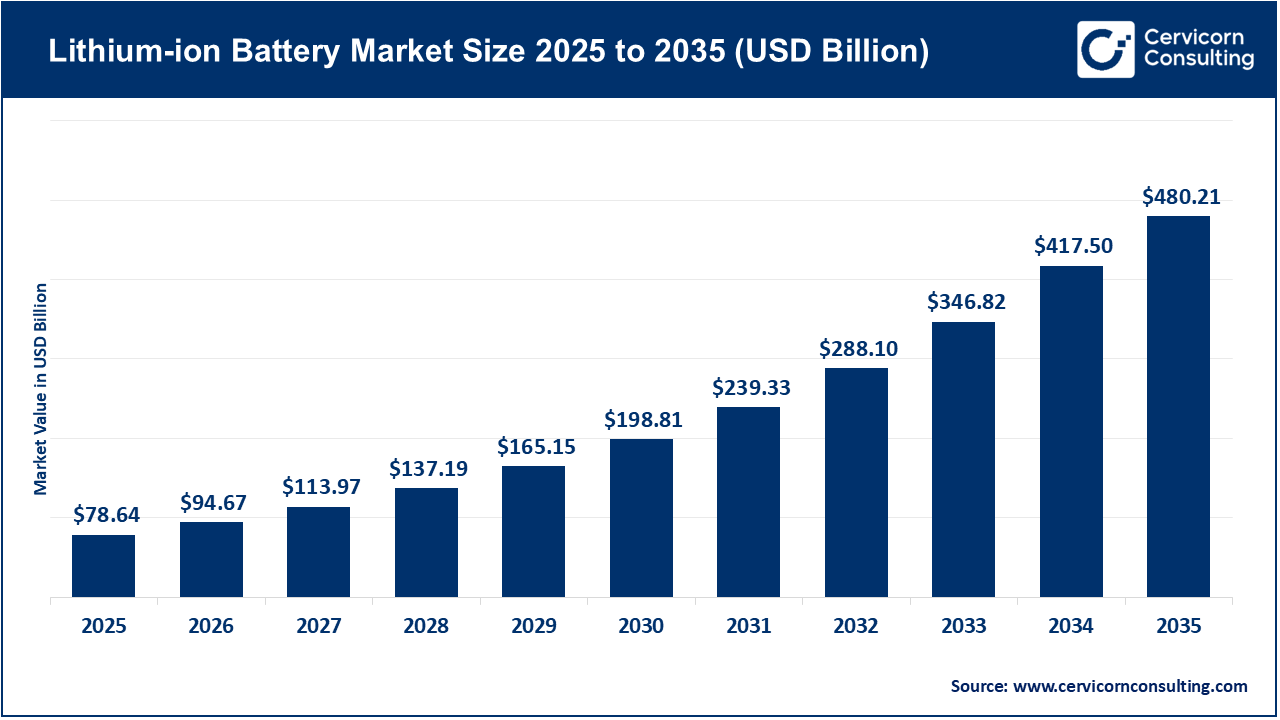
The global lithium-ion battery market was valued at USD 78.64 billion in 2025 and is projected to reach approximately USD 480.21 billion by 2035, growing at a robust CAGR of 19.83% during the forecast period from 2026 to 2035.
The global lithium-ion battery market has emerged as one of the fastest-growing sectors within the energy storage and advanced manufacturing industries. Driven by the rapid adoption of electric vehicles (EVs), renewable energy integration, consumer electronics expansion, and industrial automation, lithium-ion batteries have become a cornerstone of modern electrification. Governments worldwide are investing heavily in battery manufacturing, energy storage infrastructure, and sustainable transportation initiatives to reduce carbon emissions and improve energy security. As battery technology continues to evolve, improvements in energy density, charging speed, lifespan, and safety are expanding the range of applications across transportation, utilities, healthcare, aerospace, and consumer electronics sectors.
What is the Lithium-Ion Battery Market?
The lithium-ion battery market refers to the global industry involved in the research, development, manufacturing, distribution, and deployment of rechargeable lithium-ion batteries and related components. These batteries store electrical energy through the movement of lithium ions between positive and negative electrodes during charging and discharging cycles.
The market encompasses:
- Battery cell manufacturing
- Battery pack assembly
- Cathode and anode material production
- Electrolyte manufacturing
- Battery management systems (BMS)
- Recycling and second-life battery applications
- Energy storage solutions
- Electric vehicle batteries
- Consumer electronics batteries
Lithium-ion batteries are widely used in smartphones, laptops, electric vehicles, grid-scale energy storage systems, power tools, medical devices, and industrial equipment due to their high energy density, low self-discharge rates, and long operational life.
Get a Free Sample: https://www.cervicornconsulting.com/sample/2591
Why the Lithium-Ion Battery Market is Important
The lithium-ion battery market plays a critical role in supporting global decarbonization and clean energy goals. As countries work toward reducing dependence on fossil fuels, batteries provide a reliable solution for storing renewable energy generated from solar and wind resources. In the transportation sector, lithium-ion batteries are the primary power source for electric vehicles, enabling significant reductions in greenhouse gas emissions.
The market is also essential for advancing energy independence, supporting smart grid development, and facilitating the digital economy through portable electronic devices. Furthermore, battery innovation is driving economic growth by creating manufacturing jobs, encouraging investments in critical minerals, and fostering technological advancements in energy storage and electrification.
Lithium-Ion Battery Market Growth Factors
The growth of the lithium-ion battery market is being driven by accelerating electric vehicle adoption worldwide, increasing investments in renewable energy storage systems, growing demand for smartphones, laptops, and wearable devices, advancements in battery chemistry and manufacturing technologies, government incentives promoting clean transportation and energy transition, rising deployment of grid-scale energy storage projects, declining battery production costs, expansion of smart cities and industrial automation, increasing focus on carbon neutrality goals, growing demand for uninterrupted power supply systems, rapid development of battery recycling infrastructure, and significant investments by automotive manufacturers in next-generation battery technologies and gigafactory projects.
Key Companies in the Lithium-Ion Battery Market
Toshiba Corp.
Toshiba Corporation is a major participant in advanced battery technologies and energy storage solutions.
| Category | Details |
|---|---|
| Specialization | Rechargeable batteries, SCiB lithium-ion batteries |
| Key Focus Areas | Electric vehicles, industrial equipment, energy storage |
| Notable Features | Fast charging capability and long battery life |
| 2025 Revenue | Approximately USD 23–25 billion |
| Market Share | Strong presence in specialized industrial battery segments |
| Global Presence | Asia-Pacific, North America, Europe, Middle East |
Strategic Position
Toshiba’s SCiB battery technology is recognized for its high safety profile, rapid charging capabilities, and long cycle life. The company focuses heavily on transportation, renewable energy storage, and industrial applications.
Samsung SDI Co., Ltd.
Samsung SDI is among the world’s leading lithium-ion battery manufacturers.
| Category | Details |
|---|---|
| Specialization | EV batteries, energy storage systems, electronic batteries |
| Key Focus Areas | Automotive batteries, ESS solutions |
| Notable Features | High-energy-density battery technology |
| 2025 Revenue | Approximately USD 15–18 billion |
| Market Share | Significant global EV battery market participant |
| Global Presence | Asia, Europe, North America |
Strategic Position
Samsung SDI continues to invest in next-generation battery technologies, including solid-state batteries and premium EV battery platforms. The company supplies major automotive manufacturers worldwide.
Saft
Saft specializes in industrial and mission-critical battery applications.
| Category | Details |
|---|---|
| Specialization | Industrial lithium-ion batteries |
| Key Focus Areas | Aerospace, defense, railways, renewable energy |
| Notable Features | High reliability in extreme environments |
| 2025 Revenue | Approximately USD 1.5–2 billion |
| Market Share | Strong niche position in industrial batteries |
| Global Presence | Europe, Americas, Asia-Pacific |
Strategic Position
Saft is known for delivering high-performance battery systems for demanding environments where safety, durability, and reliability are critical.
Panasonic Corp.
Panasonic Corporation remains one of the most influential battery producers globally.
| Category | Details |
|---|---|
| Specialization | EV batteries and consumer electronics batteries |
| Key Focus Areas | Automotive partnerships and energy storage |
| Notable Features | Advanced cylindrical battery technology |
| 2025 Revenue | Approximately USD 55–60 billion |
| Market Share | Major supplier within the EV battery sector |
| Global Presence | Worldwide operations across major markets |
Strategic Position
Panasonic has maintained strong partnerships with leading electric vehicle manufacturers and continues expanding battery manufacturing capacity to meet rising global demand.
LG Chem
LG Chem is a global leader in advanced battery materials and lithium-ion battery production.
| Category | Details |
|---|---|
| Specialization | EV batteries, battery materials, energy storage |
| Key Focus Areas | High-nickel cathodes and advanced battery chemistry |
| Notable Features | Strong vertical integration capabilities |
| 2025 Revenue | Approximately USD 40–45 billion |
| Market Share | Major participant in global EV battery supply chains |
| Global Presence | Asia-Pacific, Europe, North America |
Strategic Position
LG Chem’s extensive expertise in materials science allows the company to develop high-performance battery solutions while maintaining competitiveness across automotive and energy storage sectors.
Leading Trends in the Lithium-Ion Battery Market and Their Impact
1. Rapid Expansion of Electric Vehicles
Electric vehicles remain the largest growth driver for lithium-ion batteries. Automakers are committing billions of dollars toward EV development, creating unprecedented demand for high-capacity battery packs.
Impact
- Increased battery production capacity
- Lower battery costs through economies of scale
- Strong demand for critical minerals
2. Emergence of Solid-State Batteries
Solid-state technology promises higher energy density, improved safety, and faster charging compared to conventional lithium-ion batteries.
Impact
- Enhanced vehicle range
- Reduced fire risks
- New investment opportunities for battery manufacturers
3. Grid-Scale Energy Storage Deployment
Utilities increasingly use lithium-ion battery systems to store renewable energy and stabilize electricity grids.
Impact
- Greater renewable energy adoption
- Reduced grid instability
- Expansion of utility-scale battery projects
4. Battery Recycling and Circular Economy
Growing environmental concerns are accelerating investments in battery recycling technologies.
Impact
- Reduced dependence on raw material mining
- Improved supply chain resilience
- Lower environmental footprint
5. Advanced Battery Management Systems
AI-powered battery management systems are improving battery performance and lifespan.
Impact
- Better safety monitoring
- Increased operational efficiency
- Reduced maintenance costs
6. Localization of Battery Manufacturing
Countries are establishing domestic battery supply chains to reduce geopolitical risks.
Impact
- Increased regional investments
- Job creation
- Enhanced supply chain security
Successful Examples of the Lithium-Ion Battery Market Around the World
China’s Electric Vehicle Ecosystem
China has built the world’s largest battery manufacturing ecosystem, supporting millions of electric vehicles annually. Extensive government subsidies, charging infrastructure development, and industrial policy support have enabled the country to dominate global battery production.
Key Achievements
- Largest EV market globally
- Extensive battery supply chain
- Strong domestic manufacturing capacity
United States Gigafactory Expansion
Large-scale battery manufacturing facilities have transformed the U.S. battery landscape. Gigafactories support EV production, energy storage deployment, and domestic supply chain development.
Key Achievements
- Increased domestic battery production
- Reduced import dependence
- Growth in clean energy jobs
European Battery Alliance
The European Union has established a coordinated strategy to develop battery manufacturing capabilities across member states.
Key Achievements
- New gigafactory investments
- Strengthened regional battery ecosystem
- Enhanced energy independence
South Korea’s Global Battery Leadership
South Korean manufacturers have become leading suppliers of advanced lithium-ion batteries for automotive and industrial applications.
Key Achievements
- Strong export performance
- Continuous technological innovation
- Global automotive partnerships
Japan’s Advanced Battery Innovation
Japan continues to lead in battery research, materials development, and manufacturing quality standards.
Key Achievements
- Advanced battery chemistries
- High-performance manufacturing processes
- Significant intellectual property portfolio
Global Regional Analysis of the Lithium-Ion Battery Market
Asia-Pacific
Market Overview
Asia-Pacific dominates the global lithium-ion battery market due to strong manufacturing capabilities, extensive supply chains, and high EV adoption rates.
Major countries include:
- China
- Japan
- South Korea
- India
Government Initiatives and Policies
China
The Chinese government has implemented:
- EV purchase incentives
- Battery manufacturing subsidies
- Renewable energy integration programs
- Strategic support for critical mineral supply chains
These policies have enabled China to become the world’s largest battery producer.
Japan
Japan supports battery innovation through:
- Advanced R&D funding
- Green growth initiatives
- Industry-academia collaboration programs
South Korea
South Korea promotes battery competitiveness through:
- Tax incentives
- Export support measures
- Investments in next-generation battery technologies
India
India’s government initiatives include:
- Production Linked Incentive (PLI) Scheme
- National Electric Mobility Mission Plan
- FAME (Faster Adoption and Manufacturing of Electric Vehicles) programs
- Advanced Chemistry Cell manufacturing support
These measures aim to establish a domestic battery manufacturing ecosystem.
North America
Market Overview
North America is experiencing rapid growth due to increasing EV adoption and substantial investments in battery manufacturing.
Key countries:
- United States
- Canada
- Mexico
Government Initiatives and Policies
United States
Major initiatives include:
- Inflation Reduction Act incentives
- Federal EV tax credits
- Domestic battery manufacturing support
- Critical minerals supply chain investments
These policies encourage local battery production and clean energy adoption.
Canada
Canada promotes battery manufacturing through:
- Critical mineral strategies
- Clean technology investments
- Sustainable mining initiatives
The country is positioning itself as a major supplier of battery raw materials.
Europe
Market Overview
Europe is rapidly expanding battery manufacturing capacity to support climate goals and reduce dependence on imports.
Major markets include:
- Germany
- France
- United Kingdom
- Sweden
- Netherlands
Government Initiatives and Policies
European Union
The EU supports battery development through:
- European Battery Alliance
- Green Deal policies
- Carbon reduction targets
- Strategic autonomy initiatives
Germany
Germany provides:
- EV incentives
- Gigafactory investment support
- Research funding programs
France
France promotes:
- Clean mobility programs
- Industrial battery manufacturing investments
- Renewable energy integration initiatives
These policies are accelerating regional battery production and EV deployment.
Latin America
Market Overview
Latin America plays a critical role in the battery supply chain due to its lithium resources.
Key countries:
- Chile
- Argentina
- Brazil
Government Initiatives and Policies
Chile
Chile supports:
- Sustainable lithium extraction
- Foreign investment partnerships
- Battery value chain development
Argentina
Argentina encourages:
- Lithium mining expansion
- Export development
- Resource processing investments
The region remains a crucial source of raw materials for global battery manufacturing.
Middle East and Africa
Market Overview
The region is gradually increasing investments in renewable energy storage and electric mobility.
Key countries include:
- United Arab Emirates
- Saudi Arabia
- South Africa
Government Initiatives and Policies
Saudi Arabia
Saudi Arabia is investing in:
- Electric vehicle manufacturing
- Renewable energy storage projects
- Industrial diversification programs under Vision 2030
United Arab Emirates
The UAE promotes:
- Smart city development
- Sustainable transportation initiatives
- Renewable energy integration projects
South Africa
South Africa focuses on:
- Battery mineral development
- EV infrastructure expansion
- Energy storage deployment
Growing renewable energy adoption and economic diversification efforts are expected to strengthen the lithium-ion battery market across the region.
To Get Detailed Overview, Contact Us: https://www.cervicornconsulting.com/contact-us
Read Report: Quantum Computing Market Revenue, Trends, and Strategic Insights by 2035