Silicon Photonics Market Revenue, Trends, and Strategic Insights by 2035
Silicon Photonics Market Size
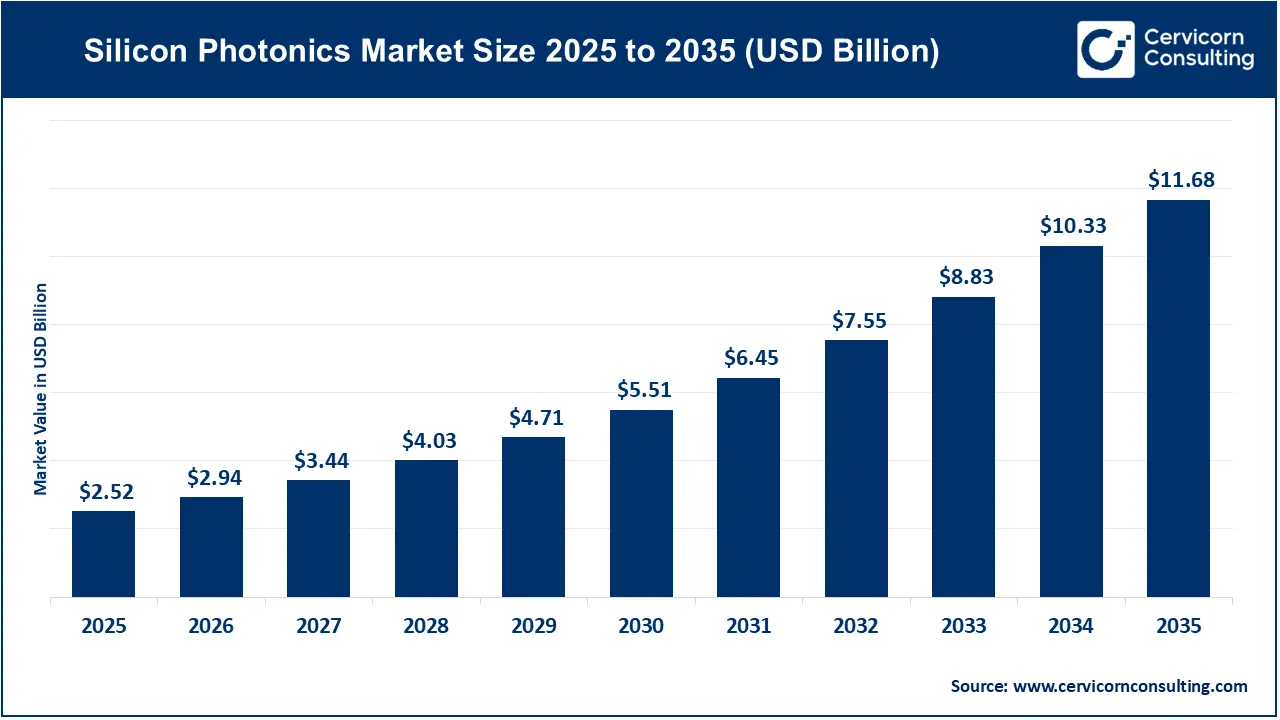
The global silicon photonics market was valued at approximately USD 2.52 billion in 2025 and is projected to reach nearly USD 11.68 billion by 2035, growing at a CAGR of 16.57%.
Silicon Photonics Market Growth Factors
The silicon photonics market is experiencing rapid expansion due to the explosive growth of artificial intelligence (AI), cloud computing, hyperscale data centers, 5G infrastructure, high-performance computing (HPC), and increasing internet traffic worldwide. Organizations are replacing conventional copper interconnects with optical communication technologies capable of delivering significantly higher bandwidth, lower latency, and improved energy efficiency.
Rising investments in semiconductor manufacturing, government support for domestic chip production, advancements in photonic integrated circuits (PICs), increasing adoption of co-packaged optics (CPO), growing demand for 800G and 1.6T optical transceivers, and the expanding use of silicon photonics in healthcare, automotive LiDAR, aerospace, quantum computing, and telecommunications continue to accelerate market growth. The convergence of CMOS manufacturing with optical technologies also enables cost-effective mass production, making silicon photonics one of the fastest-growing segments within the semiconductor industry.
Get a Free Sample: https://www.cervicornconsulting.com/sample/2682
What is the Silicon Photonics Market?
Silicon photonics refers to the integration of optical components such as lasers, modulators, waveguides, detectors, and multiplexers onto silicon chips. Instead of transmitting information through electrical signals, silicon photonics uses light to transfer enormous volumes of data with exceptional speed and minimal power consumption.
The silicon photonics market encompasses technologies, devices, software, manufacturing services, and integrated optical solutions used across:
- Data centers
- Cloud infrastructure
- Telecommunications
- Artificial intelligence
- High-performance computing
- Healthcare imaging
- Defense and aerospace
- Consumer electronics
- Automotive sensing
- Quantum computing
By combining mature CMOS semiconductor manufacturing with photonic devices, silicon photonics enables scalable and economical production of high-speed optical components.
Why is Silicon Photonics Important?
Silicon photonics has become one of the most critical enabling technologies for the digital economy because traditional electrical interconnects are approaching physical performance limitations.
Its importance can be understood through several key advantages:
Massive Data Transmission
Modern AI applications generate petabytes of data daily. Silicon photonics enables ultra-high-speed optical communication between processors, memory, storage systems, and networking equipment.
Lower Energy Consumption
Optical transmission consumes substantially less power than electrical signaling, making large data centers more sustainable and reducing operational costs.
Higher Bandwidth
Silicon photonics supports transmission speeds from 400G to 1.6T and beyond, meeting future networking requirements.
Reduced Latency
Light-based communication minimizes delays, improving AI training, financial trading, autonomous vehicles, and real-time analytics.
Scalability
Silicon photonics leverages existing semiconductor fabrication infrastructure, allowing large-scale manufacturing without building entirely new production ecosystems.
Smaller Device Footprint
Highly integrated photonic chips reduce hardware complexity while increasing overall system performance.
Major Applications of Silicon Photonics
Silicon photonics technology has expanded into numerous industries:
- AI infrastructure
- Hyperscale data centers
- Optical networking
- High-performance computing
- Healthcare diagnostics
- LiDAR systems
- Military communications
- Aerospace electronics
- Quantum computing
- Biosensors
- Machine vision
- Industrial automation
Silicon Photonics Market Company Analysis
| Company | Specialization | Key Focus Areas | Notable Features | 2025 Revenue* | Estimated Silicon Photonics Market Share | Global Presence |
|---|---|---|---|---|---|---|
| Intel Corporation | Optical transceivers, photonic integrated circuits | Data centers, AI networking, co-packaged optics | Industry leader with large-scale CMOS-compatible photonics manufacturing | Approximately USD 47.9 Billion | Approximately 21.5% | North America, Europe, Asia-Pacific, Middle East |
| Cisco Systems, Inc. | Optical networking, silicon photonics switches | Enterprise networking, hyperscale cloud, telecom | Luxtera acquisition strengthened silicon photonics portfolio | Approximately USD 56–57 Billion | Approximately 17.6% | More than 100 countries |
| DAS Photonics | Defense photonics, RF-over-fiber systems | Aerospace, defense, secure communications | Strong expertise in military-grade optical technologies | Privately held (not publicly disclosed) | Niche participant | Europe, North America, Middle East |
| Hamamatsu Photonics K.K. | Optical sensors, detectors, imaging | Medical diagnostics, industrial sensing, scientific instruments | Global leader in photodetectors and imaging technologies | Approximately USD 1.5 Billion | Moderate specialized share | Asia-Pacific, Europe, Americas |
| IBM Corporation | Photonic integrated circuits, AI hardware | Quantum computing, HPC, cloud infrastructure | Advanced research in silicon photonics and optical AI interconnects | Approximately USD 63–64 Billion | Technology innovator | More than 170 countries |
Leading Silicon Photonics Market Trends and Their Impact
1. AI Infrastructure Expansion
Artificial intelligence is dramatically increasing the need for ultra-fast communication between GPUs and processors.
Impact
- Higher demand for optical transceivers
- Increased investment in photonic chips
- Expansion of optical networking
2. Co-Packaged Optics (CPO)
Instead of placing optical modules separately, manufacturers are integrating optics directly beside processors.
Impact
- Reduced power consumption
- Lower latency
- Improved bandwidth
- Higher computing efficiency
3. Growth of Hyperscale Data Centers
Cloud providers continue building massive data centers requiring faster communication between servers.
Impact
- Increased demand for optical interconnects
- Higher deployment of photonic integrated circuits
- Rapid adoption of 800G networking
4. Transition Toward 1.6T Optical Modules
Network operators are moving beyond 400G and 800G technologies.
Impact
- Increased investment in next-generation silicon photonics
- Strong demand for integrated optical engines
- Improved network scalability
5. Integration with Quantum Computing
Quantum processors require highly stable optical communication technologies.
Impact
- New opportunities for silicon photonics
- Growth in quantum networking
- Increased research funding
6. Healthcare Innovation
Silicon photonics is increasingly used in:
- Medical imaging
- Lab-on-chip devices
- Biosensors
- Disease diagnostics
Impact
- Faster diagnosis
- Miniaturized medical equipment
- Lower healthcare costs
7. Automotive LiDAR
Autonomous vehicles require precise environmental sensing.
Impact
- Higher LiDAR performance
- Improved safety
- Better detection range
8. Edge Computing
Edge AI requires rapid data processing near users.
Impact
- Faster communication
- Reduced latency
- Better real-time analytics
Successful Examples of Silicon Photonics Around the World
Intel’s Optical Transceivers
Intel has commercialized high-volume silicon photonics transceivers that support hyperscale cloud providers by delivering high-bandwidth, energy-efficient optical connectivity for modern AI and data center environments.
Cisco’s Luxtera Integration
Cisco strengthened its networking portfolio through the acquisition of Luxtera, enabling advanced silicon photonics technology across enterprise networking, cloud infrastructure, and high-speed optical switching.
IBM Research
IBM continues to develop photonic integrated circuits designed for AI computing, cloud infrastructure, and quantum technologies, demonstrating how optics can improve processor-to-processor communication.
Hamamatsu Photonics
Hamamatsu has successfully deployed photonic sensors and optical detectors across healthcare, industrial automation, scientific research, and semiconductor inspection.
Defense Applications in Europe
DAS Photonics provides advanced RF-over-fiber communication systems supporting military surveillance, secure communications, radar, and aerospace platforms.
Global Regional Analysis
North America
North America represents the largest regional market due to:
- Strong semiconductor ecosystem
- Presence of major technology companies
- Extensive cloud infrastructure
- Significant AI investments
- Early adoption of optical networking
The United States remains the global innovation hub for silicon photonics through continuous investment in advanced semiconductor manufacturing and optical networking technologies.
Government Initiatives
The U.S. government has introduced large-scale semiconductor manufacturing incentives through programs such as the CHIPS and Science Act, encouraging domestic fabrication, research, workforce development, and supply-chain resilience. These initiatives support next-generation semiconductor technologies, including silicon photonics, for AI, defense, and telecommunications.
Europe
Europe has become a major research and manufacturing center for photonic technologies.
Growth is supported by:
- Strong academic research
- Advanced semiconductor manufacturing
- Growing AI adoption
- Industrial automation
Countries including Germany, France, the Netherlands, and the United Kingdom continue expanding photonics innovation.
Government Policies
The European Chips Act encourages semiconductor manufacturing, research collaboration, and investment across the European Union. Public funding also supports photonics innovation through Horizon Europe and national R&D programs aimed at strengthening Europe’s semiconductor capabilities.
Asia-Pacific
Asia-Pacific is expected to witness the fastest market growth.
Major growth drivers include:
- Large semiconductor manufacturing capacity
- Expansion of AI infrastructure
- Growth of cloud service providers
- Increasing 5G deployment
- Rising demand for consumer electronics
China, Japan, South Korea, Taiwan, and Singapore continue investing heavily in advanced semiconductor fabrication and optical technologies.
Government Initiatives
China promotes domestic semiconductor development through strategic industrial policies and investment funds. Japan supports photonics and semiconductor R&D through collaborations between government, universities, and industry. South Korea continues investing in advanced chip manufacturing and AI infrastructure, while Taiwan strengthens semiconductor production through ongoing support for foundries and research institutes.
Latin America
Although still an emerging market, Latin America is experiencing increasing adoption of:
- Cloud computing
- Digital infrastructure
- Telecommunications modernization
- Data center investments
Governments are encouraging digital transformation initiatives that indirectly support future deployment of optical networking technologies.
Middle East & Africa
The Middle East is investing aggressively in digital infrastructure, AI adoption, smart cities, and next-generation telecommunications.
Countries including the United Arab Emirates and Saudi Arabia are expanding hyperscale data centers that are expected to increase demand for optical networking and silicon photonics technologies.
Government Policies
National digital transformation programs, AI strategies, smart city initiatives, and investments in cloud infrastructure across Gulf countries are creating favorable conditions for advanced semiconductor and photonics technologies. Several governments are partnering with international technology companies to strengthen regional digital ecosystems.
Future Outlook
The silicon photonics market is expected to remain one of the fastest-growing segments within the semiconductor industry as AI computing, cloud infrastructure, optical networking, and high-performance computing continue to evolve. Continued advances in photonic integrated circuits, co-packaged optics, quantum technologies, and high-speed optical interconnects are likely to expand commercial adoption across enterprise, healthcare, automotive, defense, and telecommunications sectors. Ongoing government support for semiconductor manufacturing and research, combined with increasing demand for energy-efficient computing, will further accelerate innovation and global market expansion.
To Get Detailed Overview, Contact Us: https://www.cervicornconsulting.com/contact-us
Read Report: Green Steel Market Revenue, Trends, and Strategic Insights by 2035