Hydrogen Bikes Market Revenue, Trends, and Strategic Insights by 2035
Hydrogen Bikes Market Size
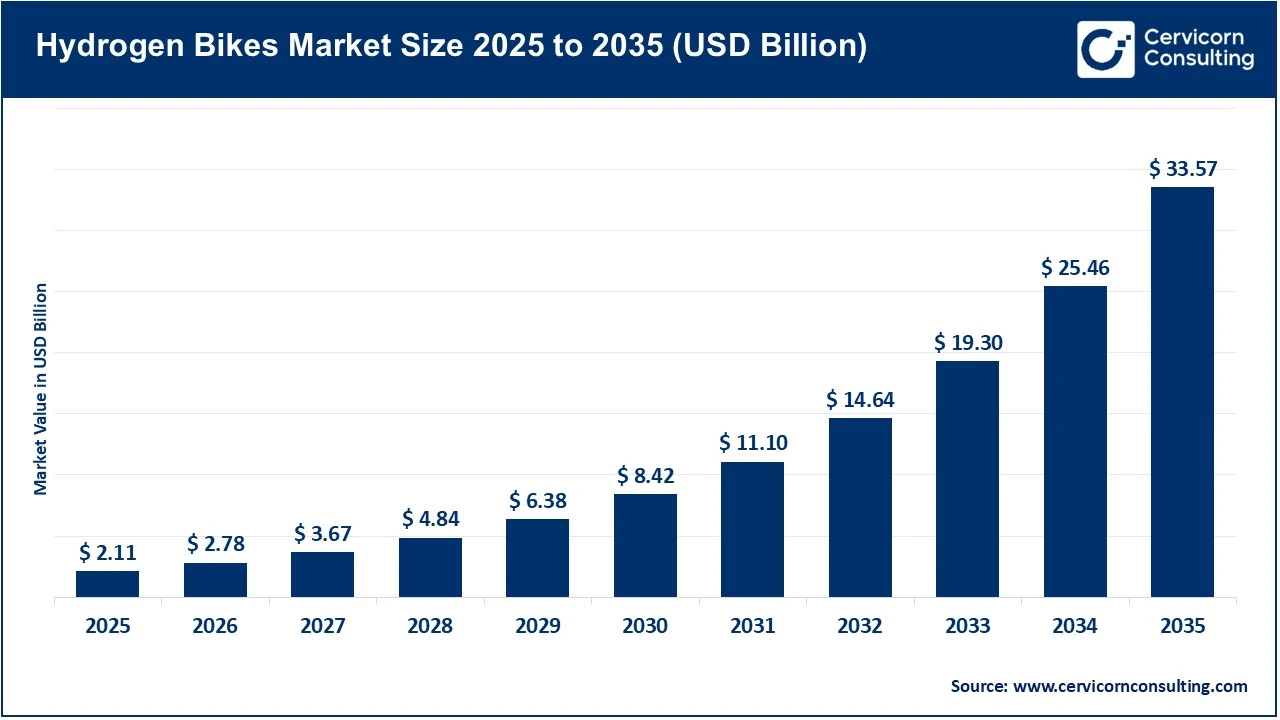
The global hydrogen bikes market was valued at approximately USD 2.11 billion in 2025 and is projected to reach nearly USD 33.57 billion by 2035, expanding at a compound annual growth rate (CAGR) of about 31.9% between 2026 and 2035.
What is the Hydrogen Bikes Market?
The hydrogen bikes market refers to the global industry involved in the development, manufacturing, commercialization, and adoption of motorcycles, scooters, mopeds, and other two-wheelers powered by hydrogen-based technologies. These vehicles typically operate through hydrogen fuel cells that convert hydrogen gas into electricity to power electric motors. Some models also use hydrogen internal combustion engines, although fuel-cell systems dominate the market due to higher efficiency and lower emissions.
The market includes a wide range of stakeholders such as motorcycle manufacturers, fuel-cell technology developers, hydrogen infrastructure providers, energy companies, battery and component suppliers, and research organizations. Hydrogen bikes are designed to provide clean transportation while overcoming some limitations associated with battery-electric vehicles, particularly charging time and driving range.
The hydrogen bikes ecosystem includes:
- Hydrogen fuel-cell systems
- Hydrogen storage tanks
- Electric drivetrain technologies
- Refueling infrastructure
- Mobility software and connectivity platforms
- Advanced safety systems
- Lightweight chassis and frame technologies
As governments worldwide continue targeting carbon neutrality goals, hydrogen bikes are increasingly viewed as an important alternative mobility solution alongside electric motorcycles.
Get a Free sample: https://www.cervicornconsulting.com/sample/2950
Why the Hydrogen Bikes Market is Important
The hydrogen bikes market is important because it addresses multiple global transportation challenges simultaneously, including air pollution, fossil fuel dependence, greenhouse gas emissions, and urban mobility efficiency. Transportation remains one of the largest contributors to global carbon emissions, and two-wheelers represent a major share of urban transportation in countries such as India, China, Indonesia, Vietnam, and Thailand. Transitioning these vehicles toward cleaner energy sources can significantly reduce urban pollution levels.
Hydrogen bikes also provide practical advantages over conventional electric bikes. One of the key limitations of battery-powered two-wheelers is charging time. Hydrogen-powered bikes can be refueled in just a few minutes, making them highly suitable for commercial fleets, delivery services, ride-sharing platforms, and long-distance commuting.
The market is also important because it encourages innovation in hydrogen production, storage, and infrastructure. Investments in hydrogen mobility can accelerate the development of broader hydrogen ecosystems that benefit buses, trucks, trains, and industrial applications. Additionally, hydrogen bikes can play a major role in energy diversification and energy security by reducing dependence on imported petroleum products.
From an economic perspective, the market is creating opportunities for manufacturers, technology developers, infrastructure companies, and renewable energy providers. The expansion of hydrogen mobility can generate employment, stimulate research and development, and promote sustainable industrial growth.
Hydrogen Bikes Market Growth Factors
The hydrogen bikes market is experiencing strong growth due to increasing environmental concerns, rising global investments in hydrogen infrastructure, rapid advancements in fuel-cell technologies, and supportive government policies promoting clean mobility solutions. The growing demand for zero-emission transportation, combined with stricter emission regulations in major economies, is encouraging manufacturers to develop hydrogen-powered two-wheelers. Expanding renewable energy adoption is also supporting green hydrogen production, improving the sustainability profile of hydrogen mobility. In addition, hydrogen bikes offer fast refueling capabilities and longer driving ranges compared to many battery-electric alternatives, making them attractive for urban commuting and commercial transportation. Strategic collaborations between automotive companies, hydrogen suppliers, and research institutions are further accelerating innovation and commercialization across the market.
Company Analysis in the Hydrogen Bikes Market
Key Companies Driving Market Innovation
| Company | Specialization | Key Focus Areas | Notable Features | 2024 Revenue | Estimated Market Share | Global Presence |
|---|---|---|---|---|---|---|
| Honda | Hydrogen fuel-cell motorcycles and sustainable mobility | Fuel-cell technology, electric mobility, clean transportation | Advanced hydrogen prototypes, strong R&D ecosystem | Approx. USD 130 billion | 18% | Asia-Pacific, Europe, North America |
| Yamaha Motor | Hydrogen-powered performance motorcycles | Alternative fuels, hydrogen engines, lightweight engineering | Focus on sports and performance hydrogen bikes | Approx. USD 18 billion | 14% | Japan, Europe, Southeast Asia, North America |
| Suzuki | Hydrogen combustion and fuel-cell systems | Compact mobility, low-emission transportation | Strong expertise in affordable mobility solutions | Approx. USD 31 billion | 11% | Asia-Pacific, Europe, Latin America |
| Kawasaki Motors | High-performance hydrogen motorcycles | Hydrogen internal combustion engines, premium bikes | Innovative hydrogen-powered Ninja platform | Approx. USD 15 billion | 10% | Japan, Europe, North America |
| Toyota Motor Corporation | Hydrogen fuel-cell technology leadership | Hydrogen ecosystem development, fuel cells, mobility infrastructure | Advanced hydrogen innovation and large-scale investments | Approx. USD 310 billion | 22% | Global operations across all major regions |
Honda
“Honda”, a Japanese multinational mobility manufacturer, is among the most active companies in the hydrogen mobility sector. The company has been investing heavily in hydrogen fuel-cell technology as part of its broader carbon neutrality strategy. Honda’s expertise in motorcycles and fuel-cell systems positions it as a strong leader in hydrogen bike innovation.
Honda focuses on integrating lightweight fuel-cell systems into motorcycles while maintaining performance, efficiency, and rider safety. The company is also collaborating with infrastructure providers to support hydrogen refueling ecosystems. Honda’s long-standing reputation for reliability and engineering excellence gives it a significant advantage in commercializing hydrogen-powered two-wheelers.
Yamaha Motor
“Yamaha Motor”, a Japanese motorcycle and mobility company, is exploring hydrogen-powered internal combustion engines and fuel-cell motorcycle concepts aimed at performance-oriented riders. Yamaha has emphasized maintaining the excitement and performance characteristics of traditional motorcycles while reducing emissions.
The company’s research focuses on lightweight engineering, fuel efficiency, and hydrogen combustion technologies. Yamaha is leveraging its motorsports expertise to develop high-performance hydrogen-powered bikes capable of competing with traditional gasoline motorcycles.
Suzuki
“Suzuki”, a Japanese automotive and motorcycle manufacturer, is actively developing sustainable mobility technologies, including hydrogen-powered motorcycles and compact transportation solutions. Suzuki aims to provide affordable hydrogen mobility options for emerging markets where two-wheelers dominate daily transportation.
The company’s strategy includes partnerships with energy providers and technology companies to improve hydrogen accessibility and reduce production costs. Suzuki’s focus on cost-effective engineering may help accelerate hydrogen bike adoption in price-sensitive markets.
Kawasaki Motors
“Kawasaki Motors”, a Japanese motorcycle manufacturer, has gained significant attention for its hydrogen-powered motorcycle initiatives. The company is developing hydrogen internal combustion engine bikes designed to preserve the sound, feel, and performance experience associated with traditional motorcycles.
Kawasaki’s hydrogen projects are part of broader initiatives under the Japanese hydrogen mobility ecosystem. The company has introduced prototype hydrogen motorcycles that showcase the potential of high-performance hydrogen-powered riding experiences.
Toyota Motor Corporation
“Toyota Motor Corporation”, a Japanese automotive company, is considered one of the global leaders in hydrogen fuel-cell technology. Although Toyota is primarily recognized for hydrogen-powered cars and commercial vehicles, its fuel-cell innovations are influencing the development of hydrogen bikes and broader two-wheeler ecosystems.
Toyota is investing heavily in hydrogen production, fuel-cell stack development, and infrastructure partnerships. The company’s extensive hydrogen expertise supports the advancement of compact and scalable fuel-cell technologies that can be adapted for motorcycles and scooters.
Leading Trends in the Hydrogen Bikes Market and Their Impact
Expansion of Green Hydrogen Production
One of the most significant trends shaping the hydrogen bikes market is the expansion of green hydrogen production. Green hydrogen is produced using renewable energy sources such as solar and wind power through electrolysis. As governments and energy companies invest in renewable hydrogen infrastructure, hydrogen bikes become more environmentally sustainable.
The availability of green hydrogen can reduce lifecycle emissions associated with hydrogen mobility, strengthening the market’s long-term viability. This trend is expected to accelerate consumer acceptance and regulatory support.
Development of Hydrogen Refueling Infrastructure
Infrastructure development remains a critical trend in the market. Several countries are investing in hydrogen refueling stations to support fuel-cell vehicles. The growth of hydrogen infrastructure will directly influence the commercial adoption of hydrogen bikes.
Improved refueling accessibility can increase consumer confidence and encourage fleet operators to adopt hydrogen-powered two-wheelers. Infrastructure expansion also reduces range anxiety and operational limitations.
Lightweight Fuel-Cell Technology
Manufacturers are increasingly focusing on lightweight fuel-cell systems and compact hydrogen storage technologies. Reducing the size and weight of fuel-cell components is essential for motorcycles because weight significantly affects performance and maneuverability.
Advancements in lightweight materials, high-pressure storage tanks, and miniaturized fuel-cell stacks are improving vehicle efficiency and overall riding experience.
Integration of Smart Mobility Features
Hydrogen bikes are increasingly incorporating smart mobility technologies such as GPS navigation, IoT connectivity, predictive maintenance systems, and AI-powered diagnostics. These features enhance user convenience and operational efficiency.
Connected mobility solutions can also improve fleet management, optimize fuel consumption, and support real-time monitoring of hydrogen systems.
Strategic Partnerships and Collaborations
Automotive manufacturers, energy companies, and technology providers are forming strategic partnerships to accelerate hydrogen mobility development. Collaborative initiatives are helping reduce research costs, improve technology standardization, and expand infrastructure deployment.
These partnerships are expected to accelerate commercialization and improve market competitiveness.
Successful Examples of Hydrogen Bikes Around the World
Kawasaki Hydrogen Motorcycle Prototype – Japan
Japan has emerged as a major hub for hydrogen mobility innovation. Kawasaki’s hydrogen motorcycle prototype represents one of the most advanced examples of hydrogen-powered two-wheelers. The motorcycle uses a hydrogen internal combustion engine and demonstrates how traditional motorcycle performance can be combined with cleaner fuel technologies.
The project reflects Japan’s national hydrogen strategy and showcases the potential of hydrogen-powered performance bikes.
Suzuki Hydrogen Burgman – Japan and Europe
Suzuki has developed hydrogen-powered versions of its Burgman scooter platform. These projects focus on urban mobility applications and low-emission transportation. The hydrogen Burgman initiative demonstrates how hydrogen technology can be adapted for practical commuter transportation.
The project has contributed to research on fuel-cell integration, hydrogen storage, and commercial feasibility.
Segway Hydrogen Scooter Concepts – China
Chinese mobility companies are increasingly exploring hydrogen-powered scooters for urban transportation. Segway-Ninebot has introduced hydrogen scooter concepts aimed at smart city mobility solutions.
China’s strong focus on alternative energy vehicles and urban emission reduction policies supports the development of hydrogen-powered two-wheelers.
European Hydrogen Mobility Demonstration Programs
Several European countries are conducting pilot programs involving hydrogen-powered motorcycles and scooters. These initiatives are often supported by government-funded clean transportation projects and research institutions.
Europe’s strong sustainability policies and hydrogen investment frameworks are helping create favorable conditions for hydrogen bike adoption.
Global Regional Analysis of the Hydrogen Bikes Market
Asia-Pacific
Asia-Pacific dominates the hydrogen bikes market due to strong government support, advanced automotive manufacturing capabilities, and growing demand for clean mobility solutions. Countries such as Japan, China, South Korea, and India are actively investing in hydrogen technologies and sustainable transportation infrastructure.
Japan is one of the leading markets because of its national hydrogen strategy and significant investments in fuel-cell technology. Major Japanese companies including Honda, Yamaha, Suzuki, Kawasaki, and Toyota are driving innovation across the region.
China is rapidly expanding its hydrogen ecosystem through investments in fuel-cell vehicles, renewable energy, and infrastructure development. The country’s focus on reducing urban air pollution and achieving carbon neutrality is expected to support future growth.
India also presents strong potential due to its large two-wheeler market and increasing interest in clean transportation. Government initiatives promoting green hydrogen and alternative fuels could create significant opportunities for hydrogen bike manufacturers.
Government Initiatives and Policies in Asia-Pacific
- Japan’s Basic Hydrogen Strategy promotes hydrogen infrastructure development and fuel-cell mobility.
- China’s New Energy Vehicle policies support alternative fuel transportation technologies.
- India’s National Green Hydrogen Mission encourages hydrogen production and clean mobility investments.
- South Korea’s Hydrogen Economy Roadmap aims to expand hydrogen adoption across transportation sectors.
Europe
Europe represents a major growth region for the hydrogen bikes market due to strong environmental regulations, carbon neutrality goals, and investments in sustainable transportation. European governments are actively supporting hydrogen projects through grants, subsidies, and infrastructure programs.
Countries such as Germany, France, the United Kingdom, and the Netherlands are leading hydrogen mobility initiatives. The region’s focus on reducing transportation emissions is encouraging manufacturers to explore hydrogen-powered motorcycles and scooters.
European consumers are also increasingly interested in environmentally friendly transportation alternatives, creating favorable market conditions.
Government Initiatives and Policies in Europe
- The European Union Hydrogen Strategy supports large-scale hydrogen adoption and infrastructure investment.
- Germany’s National Hydrogen Strategy promotes hydrogen mobility and clean transportation technologies.
- France provides incentives for low-emission transportation and hydrogen innovation projects.
- The United Kingdom is investing in hydrogen hubs and decarbonization programs.
North America
North America is experiencing growing interest in hydrogen mobility, particularly in the United States and Canada. The region’s market growth is supported by investments in renewable energy, clean transportation, and hydrogen infrastructure.
Automotive manufacturers and technology companies are increasingly exploring hydrogen fuel-cell applications for various mobility segments, including motorcycles and scooters. The expansion of green hydrogen production projects is also contributing to market development.
Although battery-electric vehicles currently dominate the alternative mobility landscape in North America, hydrogen technology is gaining attention for its fast refueling capabilities and long-range performance.
Government Initiatives and Policies in North America
- The U.S. Inflation Reduction Act supports clean hydrogen production and renewable energy projects.
- California’s hydrogen infrastructure programs promote fuel-cell vehicle adoption.
- Canada’s Hydrogen Strategy aims to position the country as a global leader in clean hydrogen production.
- Government grants and research funding are supporting hydrogen transportation innovation.
Latin America
Latin America is gradually emerging as a potential market for hydrogen-powered mobility solutions. Countries such as Brazil and Chile are investing in renewable energy and green hydrogen production.
The region’s abundant renewable energy resources create opportunities for low-cost green hydrogen generation. While hydrogen bikes are still in the early stages of adoption, growing environmental awareness and urban transportation challenges may support future market expansion.
Government Initiatives and Policies in Latin America
- Chile’s National Green Hydrogen Strategy promotes hydrogen exports and transportation applications.
- Brazil is investing in renewable energy integration and alternative fuel research.
- Regional sustainability programs are encouraging clean transportation adoption.
Middle East and Africa
The Middle East and Africa region is increasingly investing in hydrogen production and renewable energy infrastructure. Countries such as Saudi Arabia and the United Arab Emirates are developing large-scale green hydrogen projects aimed at diversifying their energy economies.
Although hydrogen bike adoption remains limited in the region, future infrastructure development and clean mobility initiatives may create new growth opportunities.
Government Initiatives and Policies in the Middle East and Africa
- Saudi Arabia’s NEOM project includes significant investments in green hydrogen production.
- The UAE is promoting hydrogen innovation as part of its clean energy transition strategy.
- African countries are exploring renewable energy-driven hydrogen production opportunities.
Future Outlook of the Hydrogen Bikes Market
The future of the hydrogen bikes market appears highly promising as governments, manufacturers, and energy providers intensify efforts toward decarbonization and sustainable transportation. Technological advancements in fuel cells, hydrogen storage, and renewable hydrogen production are expected to reduce costs and improve commercial feasibility.
The market is likely to benefit from expanding hydrogen infrastructure, increasing environmental regulations, and rising consumer demand for zero-emission mobility solutions. Strategic collaborations between automotive companies and energy providers will continue accelerating innovation and commercialization.
Hydrogen bikes may initially gain traction in commercial fleets, delivery services, and urban mobility applications before achieving wider consumer adoption. As production scales and infrastructure improves, hydrogen-powered motorcycles and scooters could become a significant component of the global sustainable mobility ecosystem.
To Get Detailed Overview, Contact Us: https://www.cervicornconsulting.com/contact-us
Read Report: Hydrogen Aircraft Market Revenue, Trends, and Strategic Insights by 2035