Contactless Payment Market Revenue, Trends, and Strategic Insights by 2035
Contactless Payment Market Size
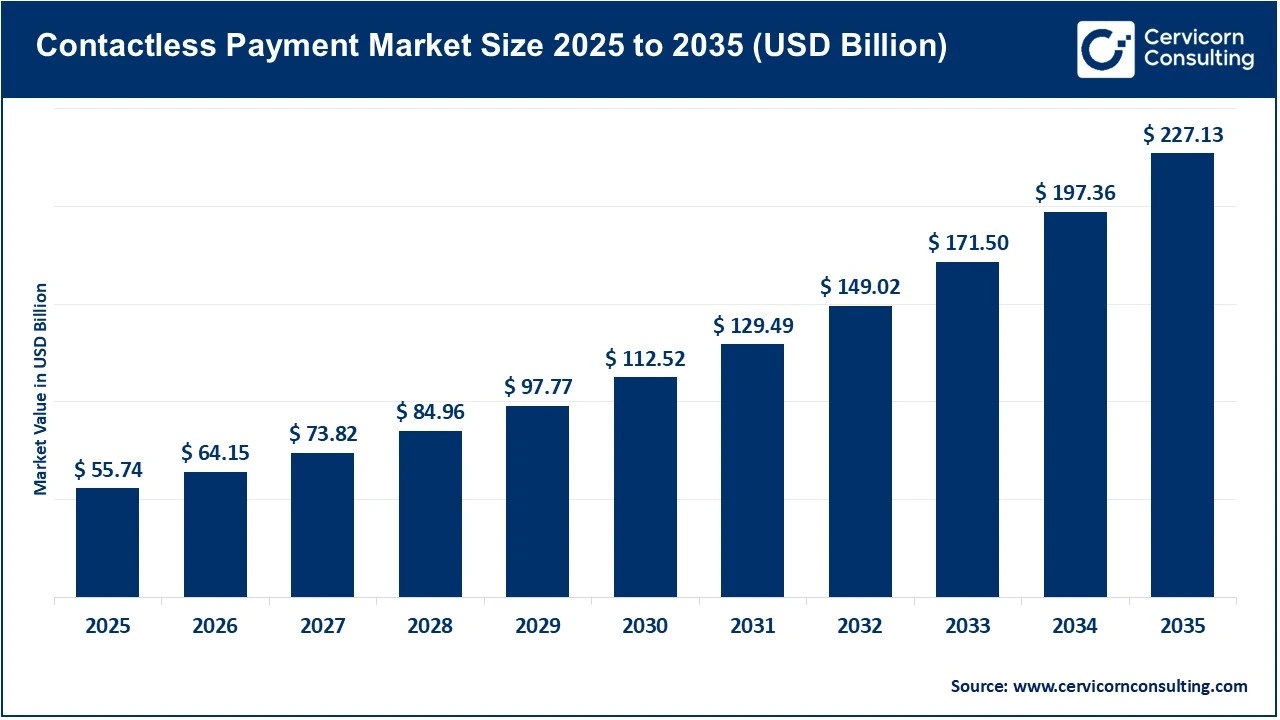
The global contactless payment market size was estimated at about USD 55.74 billion in 2025 and is projected to reach nearly USD 227.13 billion by 2035, expanding at a CAGR of 15.1%.
What is the Contactless Payment Market?
The contactless payment market refers to the ecosystem of technologies, devices, platforms, and services that enable payments without physical contact between the payment device and the payment terminal. Transactions are completed using NFC technology, QR codes, RFID, biometric authentication, or mobile wallet systems.
Contactless payments can be made using:
- Contactless debit and credit cards
- Smartphones with digital wallets
- Smartwatches and wearable devices
- QR-code-based payment applications
- NFC-enabled payment devices
These payment methods are widely used in retail stores, transportation systems, restaurants, healthcare facilities, hospitality services, entertainment venues, and e-commerce platforms.
The increasing integration of digital payment technologies into everyday financial activities is transforming the global payment landscape. Businesses are adopting contactless payment systems to improve operational efficiency, reduce transaction time, and enhance customer experience.
Why the Contactless Payment Market is Important?
The contactless payment market plays a crucial role in modernizing financial ecosystems and supporting digital economies worldwide. Contactless payment solutions provide faster transaction processing, improved convenience, enhanced customer satisfaction, and better operational efficiency for businesses.
One of the primary advantages of contactless payments is speed. Transactions are completed within seconds, reducing waiting time at checkout counters and improving customer flow in high-traffic environments such as supermarkets, transit stations, and quick-service restaurants.
Security is another major factor contributing to market importance. Advanced encryption, tokenization, biometric authentication, and dynamic verification methods help reduce fraud risks and improve transaction security.
The market also supports financial inclusion by enabling digital payment access in developing economies where traditional banking infrastructure may be limited. Governments and financial institutions are encouraging digital transactions to improve transparency, reduce cash handling costs, and enhance tax compliance.
In addition, the increasing popularity of e-commerce, mobile banking, and digital wallets is creating new opportunities for payment providers, retailers, fintech companies, and financial institutions.
Get a Free Sample: https://www.cervicornconsulting.com/sample/2948
Contactless Payment Market Growth Factors
The contactless payment market is experiencing significant growth due to rising smartphone penetration, increasing adoption of digital wallets, expansion of NFC-enabled POS terminals, growing demand for fast and secure payment methods, rapid growth of e-commerce platforms, supportive government initiatives promoting cashless economies, increasing use of wearable payment devices, technological advancements in fintech infrastructure, rising internet penetration in emerging markets, and growing consumer preference for convenient transaction methods. Additionally, the expansion of public transportation contactless ticketing systems, increasing investments in payment security technologies, and the growing influence of fintech startups are accelerating the adoption of contactless payment solutions globally.
Key Companies in the Contactless Payment Market
The competitive landscape of the contactless payment market is dominated by global payment technology companies, digital wallet providers, fintech firms, and financial service organizations. These companies are continuously investing in innovation, cybersecurity, AI-driven fraud prevention, and payment infrastructure modernization.
Company Profile Comparison Table
| Company | Specialization | Key Focus Areas | Notable Features | 2024 Revenue | Market Share | Global Presence |
|---|---|---|---|---|---|---|
| Visa | Digital payment network | Contactless cards, digital payments, payment processing | Extensive global payment network, secure transaction systems | Approx. USD 35+ Billion | Leading global card payment share | Operates in more than 200 countries |
| Mastercard | Payment processing technology | NFC payments, cross-border transactions, digital banking | AI fraud detection, tokenization, strong banking partnerships | Approx. USD 28+ Billion | Strong global payment network share | Presence in over 210 countries and territories |
| PayPal | Online and mobile payments | Digital wallets, peer-to-peer transfers, merchant services | PayPal Wallet, Venmo integration, strong e-commerce ecosystem | Approx. USD 31.8 Billion | Major digital wallet market participant | Available in over 200 markets |
| Apple | Mobile wallet ecosystem | Apple Pay, wearable payments, NFC smartphone payments | Biometric authentication, secure enclave technology | Approx. USD 391+ Billion overall company revenue | Strong mobile wallet market share | Significant presence across North America, Europe, and Asia Pacific |
| Adyen | Financial technology and payment processing | Omnichannel payments, merchant acquiring, payment gateway solutions | Unified commerce platform, real-time payment analytics | Approx. USD 2+ Billion | Growing fintech payment market share | Operates across Europe, North America, Asia Pacific, and Latin America |
Visa
Visa is one of the most influential companies in the global contactless payment market. The company operates one of the world’s largest digital payment networks, enabling secure and efficient electronic transactions across multiple industries and geographies.
Visa has significantly expanded its contactless payment capabilities through NFC-enabled cards, tokenization technologies, mobile wallet integrations, and advanced fraud prevention systems. The company collaborates with banks, fintech firms, merchants, and governments to accelerate digital payment adoption.
The company’s strong global presence, large customer base, and advanced payment infrastructure position it as a leading player in the market.
Mastercard
Mastercard is a global leader in payment technology and digital transaction processing. The company has invested heavily in contactless payment technologies, cybersecurity, AI-powered fraud prevention systems, and digital banking solutions.
Mastercard’s contactless payment offerings include tap-and-pay cards, mobile wallet integrations, biometric authentication systems, and secure tokenization services. The company is actively supporting financial inclusion initiatives and digital transformation projects in emerging economies.
Its strong partnerships with financial institutions, retailers, and fintech companies continue to strengthen its market position globally.
PayPal
PayPal is a major digital payment platform provider known for its online payment solutions, digital wallets, and peer-to-peer transaction services. The company has expanded its contactless payment capabilities through QR-code payments, mobile wallet integration, and NFC payment technologies.
PayPal’s ecosystem includes Venmo, Braintree, and merchant payment solutions, enabling seamless digital transactions across online and offline channels. The company is also focusing on AI-driven payment optimization and enhanced security systems.
The increasing growth of e-commerce and mobile commerce continues to support PayPal’s expansion in the contactless payment industry.
Apple
Apple has transformed the mobile payment ecosystem through Apple Pay, one of the world’s most widely recognized mobile wallet platforms. Apple Pay allows users to make secure contactless payments using iPhones, Apple Watches, iPads, and Mac devices.
The company utilizes biometric authentication technologies such as Face ID and Touch ID to enhance payment security and user convenience. Apple’s strong ecosystem integration, premium customer base, and expanding wearable device market are major growth drivers for its contactless payment business.
Apple continues to collaborate with banks, retailers, transportation providers, and financial institutions to expand Apple Pay services globally.
Adyen
Adyen is a leading fintech company specializing in omnichannel payment processing and merchant acquiring solutions. The company provides unified payment platforms that support online, mobile, and in-store contactless transactions.
Adyen’s technology platform enables businesses to manage payment operations, data analytics, fraud prevention, and customer experiences through a single integrated system.
The company has gained strong market traction among large global retailers, hospitality providers, and digital commerce businesses due to its scalable payment infrastructure and advanced payment technologies.
Leading Trends in the Contactless Payment Market and Their Impact
Rising Adoption of Digital Wallets
Digital wallets such as Apple Pay, Google Pay, Samsung Pay, and PayPal are becoming increasingly popular among consumers worldwide. These platforms offer secure, fast, and convenient payment experiences that reduce dependence on physical cash and cards.
The growing use of smartphones and wearable devices is driving digital wallet adoption across retail, transportation, healthcare, entertainment, and e-commerce sectors. Consumers prefer digital wallets because they simplify payments while offering enhanced security through tokenization and biometric authentication.
The impact of this trend is significant because it is transforming consumer spending behavior and accelerating the transition toward cashless economies. Businesses are increasingly integrating digital wallet support into their payment infrastructure to improve customer convenience and boost sales conversion rates.
Expansion of NFC Technology
Near-field communication technology has become a critical foundation for contactless payments. NFC technology enables consumers to complete transactions simply by tapping their cards or devices against compatible POS terminals.
Banks, retailers, and payment technology providers are rapidly expanding NFC-enabled infrastructure worldwide. Smartphones, payment cards, smartwatches, and transit systems increasingly support NFC functionality.
This trend is improving transaction speed, reducing checkout queues, and enhancing customer experiences in retail stores, transportation hubs, and hospitality environments.
Growth of Wearable Payment Devices
Wearable payment devices such as smartwatches, fitness trackers, and smart rings are gaining strong popularity among technology-focused consumers.
Companies such as Apple, Samsung, and Garmin are integrating payment capabilities into wearable products, enabling users to make transactions without carrying wallets or smartphones.
The impact of wearable payment adoption is creating a more connected and convenient digital payment ecosystem while encouraging innovation in consumer electronics and fintech industries.
Artificial Intelligence and Fraud Detection Technologies
Artificial intelligence and machine learning technologies are becoming essential tools for payment security and fraud prevention.
Financial institutions and payment providers are using AI-powered analytics to monitor transaction behavior, detect anomalies, identify suspicious activities, and improve risk assessment.
The impact of AI adoption is strengthening consumer trust in digital payments while reducing financial losses caused by payment fraud and cybersecurity threats.
QR Code-Based Payments
QR-code-based payment systems are rapidly expanding, especially in emerging markets where merchants may lack expensive POS infrastructure.
Consumers can complete transactions by scanning QR codes using smartphones and mobile banking applications. This method is widely used in retail stores, restaurants, transportation systems, and peer-to-peer payment applications.
The impact of QR payment adoption is increasing financial inclusion, enabling small businesses to accept digital payments, and accelerating digital commerce growth in developing economies.
Biometric Authentication
Biometric authentication technologies such as fingerprint scanning, facial recognition, and iris scanning are becoming increasingly integrated into contactless payment systems.
Biometric verification enhances payment security while simplifying authentication processes for users.
This trend is reducing fraud risks, improving user confidence, and encouraging broader adoption of digital payment technologies across global markets.
Contactless Payments in Public Transportation
Public transportation systems worldwide are increasingly implementing contactless ticketing solutions to improve commuter convenience and operational efficiency.
Passengers can now use contactless cards, smartphones, and wearable devices to pay for transit services without purchasing paper tickets.
The impact of this trend includes faster boarding processes, lower operational costs for transportation authorities, and increased adoption of digital payment methods among consumers.
Successful Examples of Contactless Payment Markets Around the World
China
China represents one of the world’s largest and most advanced contactless payment markets. Mobile payment platforms such as Alipay and WeChat Pay dominate the country’s digital transaction ecosystem.
Consumers widely use QR-code-based payments for retail purchases, transportation, healthcare services, food delivery, utility payments, and entertainment.
China’s strong smartphone penetration, advanced fintech ecosystem, and supportive digital infrastructure have accelerated cashless payment adoption across urban and rural regions.
United States
The United States has witnessed strong growth in contactless card payments and mobile wallet adoption.
Major payment providers including Visa, Mastercard, Apple Pay, Google Pay, and PayPal have significantly expanded NFC-enabled payment infrastructure across retail stores, restaurants, transportation systems, and online platforms.
The country’s strong e-commerce industry, digital banking adoption, and fintech innovation ecosystem continue to support market growth.
United Kingdom
The United Kingdom is one of Europe’s leading contactless payment markets. Consumers frequently use contactless debit and credit cards for everyday purchases.
London’s transportation network is globally recognized for its successful integration of contactless transit payments, enabling passengers to pay directly using contactless cards and mobile wallets.
The country’s mature banking infrastructure and high consumer awareness have contributed to strong market penetration.
India
India’s contactless payment market is expanding rapidly due to increasing smartphone usage, government-led digitalization initiatives, and the success of UPI-based payment systems.
Digital payment platforms such as PhonePe, Google Pay, Paytm, and BHIM are driving widespread adoption of QR-code and NFC-based payments.
Government programs supporting financial inclusion and cashless transactions are further strengthening the country’s digital payment ecosystem.
Singapore
Singapore has emerged as a major fintech and digital payment hub in Asia Pacific.
The country supports advanced contactless payment systems across retail, transportation, hospitality, healthcare, and financial sectors.
Singapore’s Smart Nation initiative and strong digital infrastructure have accelerated contactless payment adoption while encouraging innovation in fintech solutions.
Global Regional Analysis
North America
North America remains one of the largest contactless payment markets due to strong digital infrastructure, advanced banking systems, high smartphone penetration, and widespread consumer acceptance of cashless transactions.
The United States and Canada are major contributors to regional growth. Consumers increasingly prefer mobile wallets, NFC-enabled cards, and digital banking platforms for daily transactions.
Major market players including Visa, Mastercard, Apple, PayPal, and fintech startups continue to invest heavily in cybersecurity, payment innovation, and real-time transaction technologies.
Government Initiatives and Policies in North America
Governments and financial regulators in North America are supporting digital payment adoption through cybersecurity regulations, fintech innovation frameworks, and modernization of banking infrastructure.
The United States government has promoted digital financial inclusion programs, faster payment initiatives, and enhanced data security standards.
Canada has also focused on secure digital banking systems and modernization of payment processing infrastructure.
Europe
Europe represents a mature contactless payment market characterized by strong banking infrastructure, high consumer trust, and supportive regulatory frameworks.
Countries such as the United Kingdom, Germany, France, and the Netherlands have high adoption rates for contactless cards and mobile payment systems.
The region is also witnessing rapid growth in wearable payments, digital banking services, and open banking ecosystems.
Government Initiatives and Policies in Europe
The European Union’s PSD2 regulation has played a major role in encouraging digital payment innovation and open banking development.
European governments are actively promoting cashless economies, strengthening cybersecurity regulations, and supporting fintech expansion.
Public transportation modernization programs in cities such as London, Paris, and Berlin are further increasing contactless payment adoption.
Asia Pacific
Asia Pacific is the fastest-growing contactless payment market due to rapid urbanization, smartphone penetration, fintech innovation, and strong e-commerce growth.
China, India, Japan, South Korea, and Southeast Asian countries are major contributors to regional expansion.
The region has seen widespread adoption of QR-code payments, mobile wallets, super apps, and app-based financial ecosystems.
Government Initiatives and Policies in Asia Pacific
Governments across Asia Pacific are actively promoting digital economies and financial inclusion.
India’s Unified Payments Interface (UPI) initiative has revolutionized the country’s digital transaction ecosystem by enabling real-time bank-to-bank transfers.
China has supported digital payment growth through investments in fintech infrastructure and supportive digital economy policies.
Singapore’s Smart Nation initiative and Japan’s cashless promotion programs are also driving regional market expansion.
Latin America
Latin America is emerging as a high-potential contactless payment market due to rising smartphone adoption, growing internet access, and fintech expansion.
Countries such as Brazil, Mexico, Argentina, and Chile are witnessing increased use of mobile wallets, QR-code payments, and digital banking services.
The region’s expanding e-commerce sector and banking digitalization initiatives are creating strong growth opportunities for payment providers.
Government Initiatives and Policies in Latin America
Governments and central banks in Latin America are promoting financial inclusion and real-time payment infrastructure development.
Brazil’s PIX instant payment system has significantly accelerated digital payment adoption across consumers and businesses.
Regulatory authorities are also introducing fintech-friendly frameworks and cybersecurity standards to support digital payment ecosystems.
Middle East and Africa
The Middle East and Africa region is gradually becoming an important market for contactless payments due to increasing fintech investments, smartphone penetration, and banking modernization.
Countries such as the UAE, Saudi Arabia, South Africa, and Nigeria are witnessing strong growth in digital wallet usage and contactless payment technologies.
Smart city initiatives, retail expansion, and growing e-commerce industries are contributing to market growth.
Government Initiatives and Policies in the Middle East and Africa
Governments in the Middle East are investing heavily in digital transformation and smart city development.
Saudi Arabia’s Vision 2030 initiative and the UAE’s digital government programs are encouraging widespread adoption of cashless payment systems.
African governments are promoting mobile banking and digital financial inclusion initiatives to improve access to financial services in underserved populations.
Future Outlook of the Contactless Payment Market
The future outlook for the contactless payment market remains highly positive as digital transformation continues to reshape the global financial ecosystem.
Technological advancements in blockchain, artificial intelligence, biometric authentication, cloud computing, and Internet of Things (IoT)-enabled payment systems are expected to create new opportunities for innovation.
The integration of contactless payment technologies across healthcare, retail, transportation, hospitality, education, and entertainment industries will continue to expand.
The increasing adoption of central bank digital currencies (CBDCs), embedded finance solutions, and open banking platforms is expected to further transform payment ecosystems.
Financial institutions, fintech companies, payment technology providers, and governments are expected to continue investing in secure, scalable, and user-friendly digital payment infrastructure.
Emerging economies are likely to experience particularly strong growth due to rising smartphone penetration, expanding internet access, and supportive government policies promoting financial inclusion.
The global contactless payment market is expected to remain one of the fastest-growing segments within the broader fintech industry as consumers increasingly prioritize speed, convenience, security, and seamless transaction experiences.
To Get Detailed Overview, Contact Us: https://www.cervicornconsulting.com/contact-us
Read Report: Reverse Osmosis (RO) Membrane Market Revenue, Trends, and Strategic Insights by 2035