Ethanol Market: 6 Business Decisions That Can Improve Profitability and Reduce Investment Risk
Ethanol Production: 6 Business Decisions That Can Protect Margins and Support Long-Term Growth
Ethanol demand is influenced by more than the transition toward cleaner fuels. For producers, the commercial opportunity depends on feedstock availability, procurement prices, plant utilization, government policy and the ability to sell into different end-use markets.
A production facility may have sufficient capacity but still struggle with profitability if raw material costs increase, procurement conditions change or competing buyers offer better returns. For companies considering new investments, the challenge is not simply determining whether ethanol demand will grow. It is understanding where demand will translate into sustainable returns.
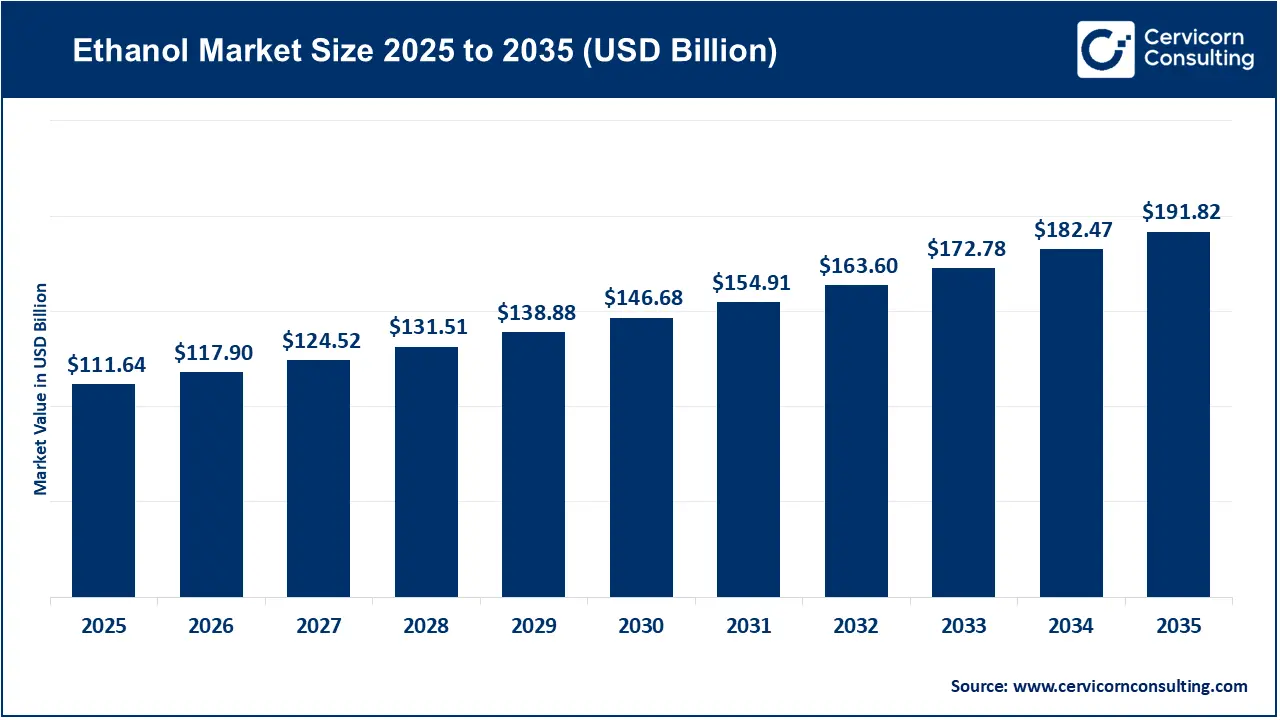
The global ethanol market was valued at USD 111.64 billion in 2025 and is projected to reach USD 191.82 billion by 2035, at a CAGR of 5.56%. However, market growth alone does not establish whether a particular production project, feedstock strategy or geographic expansion will be commercially viable.
Six business decisions deserve closer attention.
1. Which Feedstock Offers the Most Reliable Profitability?
Feedstock selection is one of the most important decisions in ethanol production because it affects input costs, conversion efficiency, production reliability and exposure to agricultural price fluctuations.
Producers may use sugarcane, molasses, corn, wheat or other suitable raw materials, depending on local availability, production technology and regulatory conditions. Each option creates a different cost structure.
For example, a sugar-based producer may benefit from an established relationship with a sugar mill but face seasonal supply constraints. A grain-based producer may have greater flexibility in sourcing raw materials, yet compete with food, animal feed and industrial users for the same agricultural inputs.
Companies should evaluate:
- Delivered feedstock cost: Purchase price, transportation, storage and handling expenses.
- Conversion efficiency: The volume of ethanol produced from each unit of raw material.
- Supply consistency: Seasonal availability, supplier concentration and exposure to weather conditions.
- Alternative uses: Whether selling the feedstock into another market offers a better return.
- Regulatory exposure: Whether procurement rules or incentives favor particular feedstocks.
India provides a useful example of why this assessment must be updated regularly. The government reported that maize accounted for a growing share of ethanol production as the country expanded blending. However, in October 2026, a new procurement tender for the 2026–27 supply year excluded ethanol produced from sugarcane juice, sugar syrup and B-heavy molasses, while seeking supplies from alternative sources. This illustrates how quickly a policy change can alter the economics of an established production strategy.
The decision for producers is not to select one feedstock permanently, but to understand which combination remains viable under changing supply and pricing conditions.
Get a Free Sample: https://www.cervicornconsulting.com/sample/2799
2. Should Companies Expand Capacity or Improve Existing Plants?
Increasing production capacity can help companies respond to rising demand, but additional capacity does not automatically translate into higher profits.
Before approving a new facility or expansion, management should examine actual plant utilization, feedstock availability, operating costs, customer commitments and the expected time required to recover the investment.
A plant operating below capacity because of inconsistent raw material supplies may benefit more from procurement improvements than from additional production lines. Similarly, an expansion project may struggle if regional ethanol demand is already adequately supplied or if transportation costs make distant customers uneconomical.
Three questions can help guide the decision:
- Is existing capacity being constrained by demand, feedstock supply, equipment performance or logistics?
- Can the proposed investment achieve competitive production costs at realistic utilization levels?
- Would upgrading fermentation, distillation, dehydration or energy recovery deliver better returns than building new capacity?
Companies should also assess the time required to obtain permits, secure financing, establish feedstock contracts and connect production to customers.
The objective is to identify the source of the constraint before committing capital. A larger plant is valuable only when it can produce and sell ethanol at an acceptable margin.
3. How Much Should Producers Depend on Fuel Ethanol?
Fuel blending policies have created an important demand base for ethanol. However, dependence on a single end-use market can expose producers to changes in procurement terms, pricing structures and policy priorities.
India achieved approximately 20% average ethanol blending during the 2025–26 supply year, according to government reporting. This represents a substantial change from the 1.53% blending rate recorded in 2013–14.
Yet a mature blending programme raises a new strategic question: where will incremental demand come from, and under what commercial conditions?
Producers should assess opportunities across several applications:
- Fuel and energy: Ethanol supplied for petrol blending and other approved fuel applications.
- Industrial chemicals: Ethanol used in solvents, coatings, cleaning products and chemical manufacturing.
- Pharmaceuticals and personal care: Applications requiring appropriate purity, quality controls and regulatory compliance.
- Food and beverage: Uses subject to relevant product specifications and applicable regulations.
- Emerging bio-based applications: Potential opportunities in advanced fuels and renewable chemical value chains.
Diversification does not mean that every producer should enter every segment. Industrial, pharmaceutical and food-related markets may require different purification processes, certifications, distribution arrangements and customer relationships.
The more practical approach is to compare the contribution margin, qualification requirements, customer concentration and investment needs of each potential market.
A producer with a cost advantage in fuel-grade ethanol may find that improving operational efficiency is more attractive than entering a highly specialized market. Another producer with suitable purification infrastructure may find that industrial customers provide a useful additional revenue stream.
4. How Should Companies Respond to Changing Government Policies?
Government policy can influence ethanol demand, but it can also change the economics of individual projects.
Blending mandates, procurement prices, eligible feedstocks, financing support, taxes and environmental requirements can affect both revenue visibility and operating costs.
India’s experience illustrates this distinction. The national programme helped expand ethanol blending to 20%, while the October 2026 procurement changes demonstrated that the government may also adjust sourcing priorities to balance fuel requirements, agricultural supply and food security.
For management teams, this creates several priorities:
Build multiple policy scenarios. Assess project returns under different feedstock eligibility rules, procurement prices and blending assumptions.
Avoid relying entirely on temporary incentives. Determine whether a facility remains commercially viable when financial support changes or expires.
Monitor procurement decisions. Tender conditions, supplier eligibility and contract terms can affect which production facilities receive demand.
Review the regulatory position before investing. A technology or feedstock that is technically suitable may not qualify for a particular programme or application.
The key question is not whether a government supports ethanol in principle. It is whether the specific project can remain competitive under the rules that determine its access to customers and revenue.
5. Can Operational Improvements Deliver Better Returns Than Higher Output?
Ethanol production involves substantial energy, water and process-management requirements. Variations in fermentation performance, steam consumption, equipment downtime and product quality can affect the economics of every litre produced.
This makes plant efficiency a strategic issue rather than simply an operational concern.
Management should examine the relationship between production yield and total conversion cost. Improving output from available feedstock may be more economical than purchasing additional raw materials or expanding capacity.
Priority areas include:
- Fermentation yield and process consistency.
- Steam and electricity consumption per litre.
- Water recovery and wastewater treatment.
- Equipment reliability and preventive maintenance.
- Product quality, off-specification output and reprocessing.
- Recovery and utilization of suitable process by-products.
Digital monitoring and process automation can help identify inefficiencies, but investment decisions should be tied to measurable operating outcomes. A new monitoring platform is useful only if it improves yield, reduces downtime, lowers energy consumption or supports more reliable quality.
Companies should establish a baseline for cost per litre, yield, energy intensity and plant availability before evaluating technology investments. This makes it easier to compare expected savings with implementation costs and determine which improvements deserve priority.
6. Which Markets and Investments Offer the Strongest Long-Term Opportunity?
Ethanol investment decisions increasingly require a regional perspective. Countries differ in blending requirements, feedstock availability, infrastructure, production costs and the maturity of their industrial customer base.
A region with strong policy support may still be unattractive if feedstock is expensive or competing production capacity is abundant. Conversely, a smaller market may offer better returns when local supply is limited and transportation costs create a meaningful advantage for nearby producers.
Before entering a new region, companies should compare:
- Existing and planned production capacity.
- Current and potential ethanol consumption by application.
- Feedstock prices, availability and competing uses.
- Import dependence and transportation infrastructure.
- Government support and regulatory stability.
- Competitor cost positions and customer relationships.
- Capital requirements, expected utilization and payback periods.
Advanced technologies also deserve careful evaluation. Cellulosic ethanol and other non-food feedstock pathways may create opportunities to use agricultural residues and industrial by-products. However, their commercial attractiveness depends on technology maturity, feedstock collection costs, conversion performance and the ability to operate at scale.
Investors should distinguish between a promising technology and a commercially proven project. Demonstration results, financing assumptions and long-term feedstock contracts matter as much as the size of the potential market.
What Ethanol Companies Should Evaluate Before Their Next Investment
The central challenge in ethanol is converting demand growth into dependable financial returns. A growing market can create opportunities, but profitability depends on the decisions made around sourcing, capacity, product mix, policy exposure and plant performance.
Before approving an expansion, entering a new application or changing feedstock strategy, decision-makers should establish a clear view of five variables:
- Demand visibility: How much demand is supported by existing contracts, procurement programmes and established end users?
- Cost competitiveness: Can the company produce ethanol at a competitive cost under realistic feedstock and energy-price assumptions?
- Capacity utilization: Is there sufficient demand and raw material supply to operate the proposed facility efficiently?
- Policy resilience: How sensitive are projected returns to changes in incentives, eligibility rules and procurement conditions?
- Investment returns: Does the proposed project outperform alternatives such as plant modernization, supply-chain improvements or product diversification?
These variables should be assessed together rather than independently. A low-cost production process may not be attractive without reliable demand, while a strong customer opportunity may not justify investment if feedstock supply is uncertain.
For ethanol producers, agricultural businesses, fuel suppliers and investors, the most valuable opportunity is therefore not necessarily the fastest-growing segment. It is the market, production model and feedstock strategy that offer the strongest combination of demand visibility, cost advantage and sustainable returns.
To Get Detailed Overview, Contact Us: https://www.cervicornconsulting.com/contact-us
Read Report: Clinical Trial Supplies Market: How Can Pharma Companies Optimize Supply Costs Without Delaying Trials?