AI in Drug Development Market Revenue, Trends, and Strategic Insights by 2035
AI in Drug Development Market Size
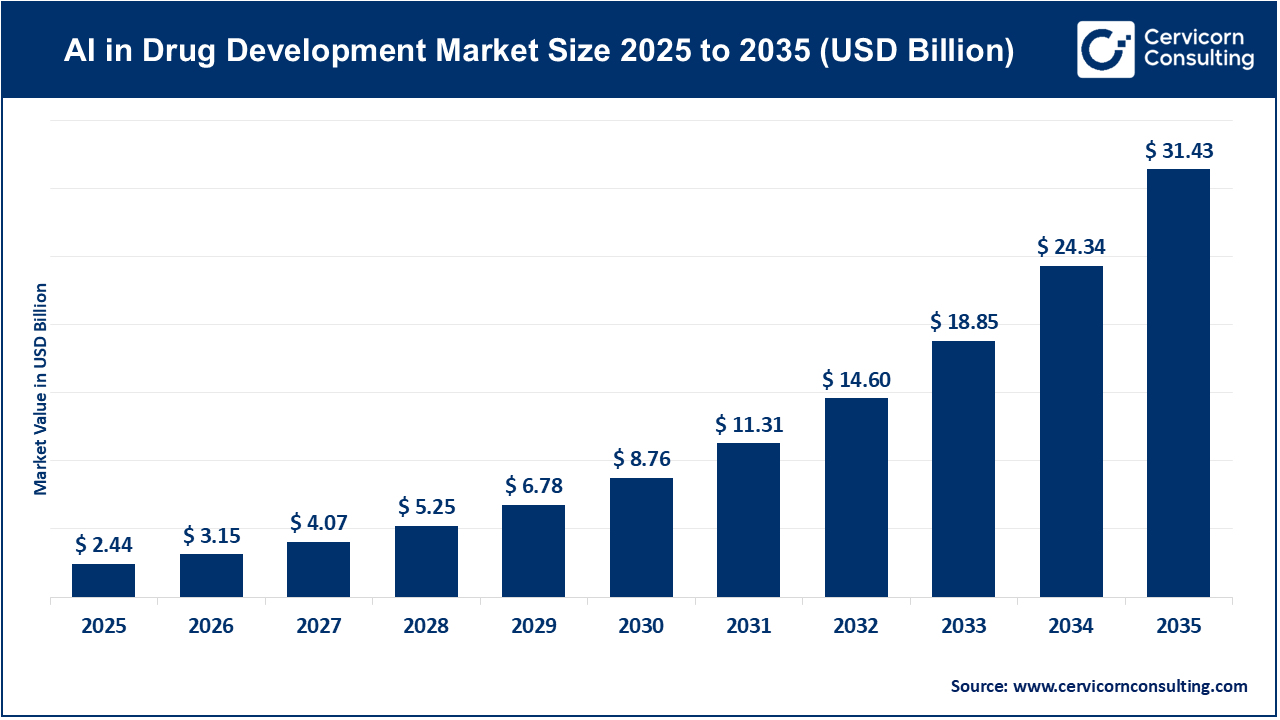
The global AI in drug discovery market, closely aligned with the broader drug development market, was valued at around USD 2.44 billion in 2025 and is projected to expand to multibillion‑dollar valuations by the end of this decade, with forecasts ranging up to USD 31.43 billion by 2035 with a CAGR of 29.2%.
What Is the AI in Drug Development Market?
The AI in drug development market refers to the ecosystem of technologies, platforms, companies, and services that use AI — including machine learning (ML), deep learning, natural language processing (NLP), and generative AI — to automate, optimize, and accelerate various stages of drug discovery and development. These stages include:
- Target identification — finding potential biological targets (genes, proteins) associated with diseases.
- Hit identification and lead optimization — screening large chemical libraries and optimizing molecule structures.
- Predictive modeling — forecasting efficacy, toxicity, and pharmacokinetics.
- Preclinical and clinical trial design — improving success rates and patient stratification.
- Repurposing existing drugs — identifying new uses for approved molecules.
Traditionally, drug discovery is a high‑cost, long‑duration process (often more than 10 – 15 years and ~$2 billion per drug). AI-driven tools analyze vast biomedical datasets faster, help reduce trial failures, and enable smarter decision‑making, creating an entirely new paradigm where computational design and simulation augment laboratory experiments.
AI in Drug Development Market — Growth Factors
The growth of the AI in drug development market is being propelled by a confluence of factors, including exponential increases in biological and clinical data availability, urgent demand to reduce decades‑long drug discovery timelines and exorbitant costs, breakthroughs in generative AI and deep learning models capable of navigating complex chemical space, rising investments from venture capital and pharma partnerships, the digitization of healthcare and computational infrastructure expansion, and collaborative ecosystems that bring together AI specialists, biopharma firms, and academic researchers to co‑develop next‑generation therapeutics. Additionally, increasing investor confidence, government backing for AI research initiatives, and the need for personalized medicine solutions are creating fertile ground for sustained market growth.
Why the AI in Drug Development Market Is Important
AI’s significance in drug development lies in its ability to fundamentally change how drugs are discovered and brought to patients. In contrast to conventional trial‑and‑error approaches, AI systems can rapidly learn from massive datasets — including genomics, proteomics, real-world clinical outcomes, and chemical libraries — to generate insights that humans alone would take years to uncover. This capability translates to:
- Faster target discovery and molecular design
- Reduced preclinical and clinical failure rates
- Lower R&D costs and improved ROI
- Enhanced ability to tackle complex diseases
- Accelerated response to emerging health threats
AI also supports precision medicine, where treatments are tailored to an individual’s biology rather than one-size-fits-all therapies, and enables more sustainable pharma pipelines through predictive safety modeling. Collectively, these capabilities are reshaping the economics and timelines of drug development — potentially bringing new therapies to patients faster and more safely than ever before.
Get a Free Sample: https://www.cervicornconsulting.com/sample/2916
Major Companies in the AI in Drug Development Market
Below is a snapshot of key players driving innovation in AI‑enabled drug discovery and development, including their specialization, key focus areas, notable features, 2024 revenues, market share insights, and global reach.
1) Insilico Medicine
- Specialization & Focus Areas: Insilico Medicine leverages deep learning and big data analytics to support end-to-end drug discovery — from target identification to clinical outcome prediction. The company focuses on aging, fibrosis, oncology, immunology, and central nervous system diseases.
- Notable Features: Its Pharma.AI platform integrates multiple modules (e.g., PandaOmics, Chemistry42) for de novo design and optimization. The company advanced its AI-designed drug ISM001‑055 into Phase II trials — one of the first AI-originated candidates to reach this stage.
- 2024 Revenue & Market Share: Insilico’s revenue was approximately USD 74 million in 2024, positioning it as a prominent mid-tier player in the AI drug discovery market.
- Global Presence: Headquartered in the U.S., with R&D centers in Hong Kong, New York, Montreal, and collaborations across North America and Asia.
Notable Contribution: One of the first AI-generated clinical candidates, demonstrating AI’s practical impact beyond computational predictions.
2) Exscientia
- Specialization & Focus Areas: UK-based Exscientia uses its Centaur Chemist™ platform for automating molecular design and connecting data to synthesis. Focus areas include oncology, immunology, and metabolic diseases.
- Notable Features: The platform closes the loop from target knowledge to candidate synthesis, enabling faster lead optimization cycles.
- 2024 Revenue & Market Share: About USD 120 million, making it a notable AI drug design contributor.
- Global Presence: Based in Oxford, UK, with partnerships and research collaborations across Europe and North America.
Strategic Updates: Many of Exscientia’s programs involve partnerships with major pharma — reinforcing the trend toward collaborative AI-driven R&D.
3) Atomwise
- Specialization & Focus Areas: Atomwise specializes in structure-based AI models (AtomNet®) to predict how molecules bind to specific targets, accelerating hit discovery across oncology, neurology, and infectious diseases.
- Notable Features: AtomNet screens billions of compounds in silico, vastly improving speed versus traditional methods.
- 2024 Revenue & Market Share: Estimated USD 55 million, with broad licensing and research collaborations.
- Global Presence: Headquarters in San Francisco with partnerships worldwide.
4) Schrödinger, Inc.
- Specialization & Focus Areas: Combines physics-based simulations with AI and computational chemistry to enhance molecular modeling and lead optimization.
- Notable Features: Platforms like LiveDesign and PyMOL help pharma and biotech teams visualize and optimize molecular interactions.
- 2024 Revenue & Market Share: Reported revenue around USD 217 million, reflecting AI and computational chemistry demand.
- Global Presence: Headquartered in New York with a global customer base in life sciences, materials science, and academic research.
5) BenevolentAI
- Specialization & Focus Areas: Uses a biomedical knowledge graph to uncover disease biology, prioritize targets, and support drug repurposing.
- Notable Features: Integrates diverse datasets (literature, clinical, chemical) to identify connections human researchers might miss.
- 2024 Revenue & Market Share: Approximately USD 60 million, a significant UK AI drug discovery company.
- Global Presence: Based in London with multinational collaborators, especially in Europe and North America.
Leading Trends and Their Impact on the Market
1. Generative AI for Molecule Design
Generative models design novel compounds optimized for efficacy, pharmacokinetics, and toxicity. AI-generated molecules move from concept to real screening faster than traditional methods.
2. De Novo Drug Design & Predictive Analytics
AI enables more accurate hit-to-lead and lead optimization workflows, reducing failure rates in clinical development.
3. Cloud-Based and Scalable AI Infrastructure
Cloud adoption expands computational capacity for massive compound screening and federated learning, protecting sensitive biomedical data.
4. Deep Pharma-Tech Partnerships
Collaborations with tech giants integrate AI frameworks with domain expertise and large datasets for next-level innovation.
5. Regulators Supporting AI Integration
Regulatory agencies are encouraging validated computational approaches in drug discovery to reduce reliance on animal testing.
6. Personalized Medicine and Biomarker-Driven Trials
AI parses patient-level data to support biomarker discovery, trial cohort optimization, and improved precision therapy outcomes.
Successful Examples of AI in Drug Development Around the World
- Insilico Medicine — ISM001‑055: Advanced into Phase II trials, marking one of the first AI-originated clinical candidates.
- BenevolentAI Partnerships: Collaborates with major pharma for target identification and drug repurposing.
- Atomwise AtomNet: Screens billions of compounds computationally, leading to prioritized hits across multiple disease areas.
- Regulatory Momentum: FDA initiatives emphasize computational toxicology and AI modeling as alternatives to animal testing.
Global Regional Analysis: Government Initiatives & Policies
North America (U.S. & Canada)
Largest AI in drug development market, backed by robust R&D infrastructure, venture capital, and active partnerships. Government support includes research funding and regulatory frameworks to encourage validated AI models in discovery workflows.
Europe
Strong public-private partnerships and initiatives like the Innovative Medicines Initiative (IMI). Focus on federated learning and ethical AI usage, while balancing data privacy regulations such as GDPR.
Asia-Pacific (China, Japan, India, South Korea)
Fastest-growing region with government-backed AI infrastructure and digital health policies. Investments in computational biology and biotechnology foster rapid adoption.
Latin America, Middle East, and Africa (LAMEA)
Emerging market region with modernization efforts, increased healthcare investments, and international collaborations introducing AI tools to local research and clinical applications.
To Get Detailed Overview, Contact Us: https://www.cervicornconsulting.com/contact-us
Read Report: On-Board Charger Market Revenue, Trends, and Strategic Insights by 2035