Technical Textile Market Revenue, Trends, and Strategic Insights by 2035
Table of Contents
ToggleTechnical Textile Market Size
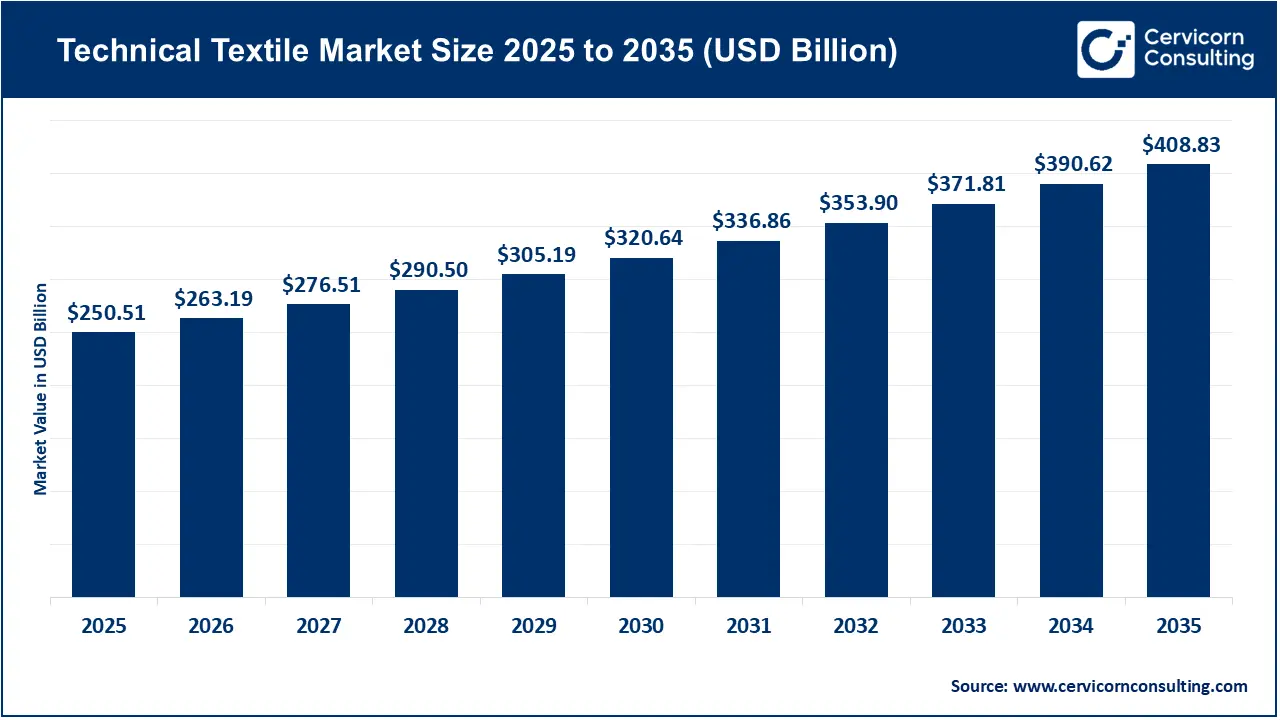
The global technical textile market was valued at approximately USD 250.51 billion in 2025 and is projected to reach nearly USD 408.83 billion by 2035, growing at a CAGR of 5.02%.
Technical Textile Market Growth Factors
The technical textile market is witnessing robust growth due to the increasing demand for high-performance materials across automotive, healthcare, construction, defense, agriculture, aerospace, sports, and industrial manufacturing. Rapid industrialization, rising investments in infrastructure development, stricter workplace safety regulations, expanding medical textile applications, growing electric vehicle production, and the increasing adoption of lightweight composite materials are accelerating market expansion. Technological advancements in nanotechnology, smart textiles, antimicrobial fabrics, conductive fibers, and sustainable recyclable materials are enabling manufacturers to develop innovative products with enhanced durability and functionality.
Additionally, government initiatives supporting domestic textile manufacturing, sustainability goals, circular economy practices, and research funding for advanced materials are encouraging greater investments in technical textile production. The growing preference for environmentally friendly nonwoven fabrics and bio-based fibers further strengthens long-term market opportunities as industries seek materials that combine performance with sustainability.
Get a Free Sample: https://www.cervicornconsulting.com/sample/2673
What is the Technical Textile Market?
The technical textile market refers to the manufacturing, distribution, and commercialization of textiles designed primarily for functionality rather than aesthetics. Unlike conventional textiles used for clothing or decoration, technical textiles are engineered to provide specific performance characteristics such as durability, chemical resistance, flame retardancy, water repellency, thermal insulation, electrical conductivity, filtration efficiency, and high tensile strength.
These specialized textiles serve numerous industries, including:
- Automotive
- Medical & healthcare
- Aerospace
- Defense & military
- Construction
- Agriculture
- Sports equipment
- Industrial manufacturing
- Environmental protection
- Packaging
Technical textiles include woven, knitted, braided, nonwoven, and composite fabrics manufactured using synthetic fibers, natural fibers, glass fibers, carbon fibers, aramids, polypropylene, polyester, and advanced polymers.
As industries continue demanding lightweight, durable, and multifunctional materials, technical textiles have become indispensable across modern manufacturing.
Why is the Technical Textile Market Important?
Technical textiles have evolved from niche industrial products into strategic materials supporting critical infrastructure and advanced manufacturing.
Their importance lies in several factors:
Enhancing Industrial Performance
Technical textiles improve product lifespan, operational efficiency, and safety across manufacturing sectors.
Supporting Medical Innovation
Medical textiles are widely used in:
- Surgical gowns
- Face masks
- Implantable fabrics
- Wound dressings
- Artificial ligaments
- Hospital bedding
Healthcare demand has significantly expanded following the COVID-19 pandemic.
Improving Vehicle Efficiency
Automotive manufacturers increasingly rely on lightweight textile composites to reduce vehicle weight, improve fuel efficiency, and extend electric vehicle battery range.
Strengthening Infrastructure
Geotextiles stabilize roads, railways, bridges, and drainage systems while reducing long-term maintenance costs.
Advancing Sustainability
Modern technical textiles enable recyclable materials, reusable industrial fabrics, biodegradable fibers, and energy-efficient manufacturing.
Increasing Worker Safety
Protective clothing manufactured from advanced fibers provides resistance against:
- Fire
- Heat
- Chemicals
- Electrical hazards
- Ballistic threats
- Extreme weather
Major Companies Shaping the Technical Textile Market
| Company | Specialization | Key Focus Areas | Notable Features | 2025 Revenue* | Market Share** | Global Presence |
|---|---|---|---|---|---|---|
| Asahi Kasei | Advanced fibers, industrial materials, performance textiles | Automotive, filtration, healthcare | High-performance synthetic fibers and composite materials | Approx. ¥3.07 trillion (company sales) | Strong Asia-Pacific presence | Operations in more than 20 countries |
| Baltex | Warp knitting and technical fabrics | Medical, automotive, aerospace | Specialist knitted technical textiles | Private company (not publicly disclosed) | Niche manufacturer | Europe, North America, Asia |
| DuPont | High-performance fibers | Protective clothing, aerospace, industrial safety | Kevlar®, Nomex®, Tyvek® product portfolio | Approx. US$12.4 billion (company revenue) | Leading global supplier of specialty fibers | Worldwide operations across 70+ countries |
| Filspec | Engineered yarns and industrial threads | Medical, military, industrial textiles | Custom-engineered yarn technologies | Private company (not publicly disclosed) | Regional specialty supplier | North America with global exports |
| Freudenberg Performance Materials | Nonwoven technical textiles | Automotive, filtration, construction, apparel | Global leader in engineered nonwovens | Freudenberg Group sales €11.73 billion; Technical Textiles & Filtration business €2.55 billion | Significant share in nonwoven textiles | More than 35 countries |
*Revenue figures represent overall company revenue or parent company revenue where business-unit-only revenue is unavailable.
**Exact global technical textile market shares are not publicly disclosed because most companies operate across multiple industrial segments.
Leading Trends Transforming the Technical Textile Market
1. Smart Textiles
Smart textiles embedded with sensors, conductive fibers, and IoT capabilities are revolutionizing healthcare, military operations, and sports monitoring.
Impact:
- Real-time health monitoring
- Predictive maintenance
- Connected industrial systems
- Military surveillance
2. Sustainable Technical Textiles
Manufacturers are replacing petroleum-based materials with:
- Recycled polyester
- Bio-based polymers
- Organic fibers
- Circular textile solutions
Impact:
- Lower carbon footprint
- Reduced plastic waste
- Compliance with ESG regulations
3. Rapid Expansion of Nonwoven Fabrics
Nonwoven technologies dominate hygiene, filtration, and medical applications due to lower production costs and superior functionality.
Impact:
- Increased healthcare manufacturing
- Growth in disposable medical products
- Better filtration efficiency
4. Automotive Lightweight Materials
Vehicle manufacturers increasingly integrate textile composites to reduce weight without compromising strength.
Impact:
- Higher EV efficiency
- Better fuel economy
- Lower emissions
5. Growth of Medical Textiles
Healthcare continues to create demand for:
- Implant textiles
- Surgical fabrics
- Compression garments
- Antimicrobial textiles
Impact:
- Improved patient outcomes
- Reduced infection rates
- Expansion of healthcare infrastructure
6. Nanotechnology Integration
Nanotechnology enables fabrics with advanced properties including:
- Water repellency
- Self-cleaning
- UV resistance
- Antimicrobial performance
Impact:
- Longer product lifespan
- Enhanced industrial performance
- Reduced maintenance
7. High-Performance Protective Clothing
Industrial safety regulations continue driving demand for:
- Fire-resistant fabrics
- Chemical-resistant garments
- Ballistic protection
- Arc-flash protective clothing
Impact:
- Higher workplace safety
- Regulatory compliance
- Expansion of PPE manufacturing
Successful Examples of the Technical Textile Market Around the World
Germany: Automotive Interior Innovation
Germany’s automotive industry extensively incorporates lightweight technical textiles into vehicle interiors, insulation systems, airbags, seat fabrics, and composite structural components. These materials improve fuel efficiency while maintaining passenger safety.
Japan: High-Performance Industrial Fibers
Japanese manufacturers have pioneered advanced synthetic fibers for automotive reinforcement, filtration systems, lithium-ion battery separators, and medical devices. Continuous investment in research has positioned Japan as a leader in premium technical textiles.
United States: Protective Textiles
The U.S. has developed globally recognized protective fibers used in firefighting gear, military uniforms, body armor, and industrial safety apparel. Innovations in aramid and high-strength synthetic fibers have significantly enhanced worker and defense personnel protection.
China: Large-Scale Nonwoven Manufacturing
China has become one of the world’s largest producers of nonwoven technical textiles, supporting healthcare, construction, hygiene products, filtration, and infrastructure development through large-scale manufacturing capacity.
India: Geotextiles for Infrastructure
India increasingly utilizes geotextiles in highway construction, riverbank protection, railways, airports, and erosion control projects. Government-backed infrastructure programs continue driving domestic production and application.
Europe: Sustainable Technical Textiles
European manufacturers are leading circular textile initiatives by integrating recycled fibers, biodegradable materials, and low-emission manufacturing processes into technical textile production.
Global Regional Analysis
North America
North America remains one of the most technologically advanced technical textile markets.
Market Characteristics
- Strong aerospace industry
- Advanced medical textile manufacturing
- High adoption of industrial safety standards
- Growing electric vehicle production
- Significant R&D investments
Government Initiatives and Policies
The United States supports advanced manufacturing through initiatives that encourage innovation in advanced materials, domestic manufacturing, defense modernization, and research collaborations between industry and academic institutions. Public procurement standards for healthcare and defense also stimulate demand for high-performance technical textiles.
Canada promotes advanced manufacturing, sustainable materials, and industrial innovation through federal and provincial programs supporting clean technologies and high-value manufacturing.
Europe
Europe represents one of the most mature technical textile markets globally.
Market Characteristics
- Strong sustainability regulations
- Advanced automotive manufacturing
- High-quality industrial production
- Extensive research ecosystem
Germany, France, Italy, and the United Kingdom remain major production centers.
Government Initiatives and Policies
The European Union’s Green Deal, Circular Economy Action Plan, and research funding programs encourage recyclable textiles, low-carbon manufacturing, and sustainable innovation. Regulations on industrial safety and environmental performance continue driving adoption of advanced technical textiles across multiple sectors.
Asia-Pacific
Asia-Pacific is the fastest-growing regional market.
Market Characteristics
- Expanding manufacturing capacity
- Rapid urbanization
- Large automotive production
- Increasing healthcare investments
- Growing exports
China, Japan, South Korea, and India dominate regional production.
Government Initiatives and Policies
China
The government promotes advanced manufacturing through industrial modernization policies focused on high-value materials, smart manufacturing, and technological self-reliance.
Japan
Japan supports innovation through public-private research partnerships emphasizing advanced fibers, healthcare technologies, robotics, and automotive materials.
India
India has introduced dedicated programs such as the National Technical Textiles Mission to strengthen domestic production, promote research and development, enhance exports, and encourage wider adoption across agriculture, healthcare, infrastructure, and defense. Production-linked incentives and investments in textile parks further support industry expansion.
Latin America
Latin America continues expanding technical textile applications across agriculture, mining, construction, and healthcare.
Market Characteristics
- Infrastructure modernization
- Agricultural textiles
- Mining applications
- Growing industrial manufacturing
Government Initiatives and Policies
Governments are investing in transportation infrastructure, water management, and industrial diversification, creating opportunities for geotextiles, filtration materials, and protective textiles.
Middle East & Africa
The Middle East & Africa market is gradually expanding through industrial diversification and infrastructure investments.
Market Characteristics
- Oil and gas protective clothing
- Infrastructure projects
- Water filtration
- Industrial safety
- Healthcare modernization
Government Initiatives and Policies
Countries across the Gulf Cooperation Council are promoting advanced manufacturing through national diversification strategies, while investments in healthcare, smart cities, and transportation infrastructure are increasing demand for specialized technical textiles. African governments are also supporting textile manufacturing through industrial development programs and export-oriented initiatives.
Future Opportunities in the Technical Textile Market
Several emerging opportunities are expected to shape the market over the coming years:
- Expansion of wearable healthcare technologies
- Rising demand for recyclable and bio-based technical textiles
- Increased use of textile composites in electric vehicles
- Smart construction materials for resilient infrastructure
- Growth in defense modernization programs
- Development of advanced filtration media for air and water purification
- Integration of AI-enabled smart fabrics for industrial and consumer applications
- Increased adoption of technical textiles in renewable energy, including wind turbine blades and battery technologies
As industries continue to prioritize performance, sustainability, and innovation, technical textiles are expected to play an increasingly central role in global manufacturing and infrastructure development.
To Get Detailed Overview, Contact Us: https://www.cervicornconsulting.com/contact-us
Read Report: 3D Printing in Defence Market Revenue, Trends, and Strategic Insights by 2035