Power-to-X Market Revenue, Trends, and Strategic Insights by 2035
Table of Contents
TogglePower-to-X Market Size
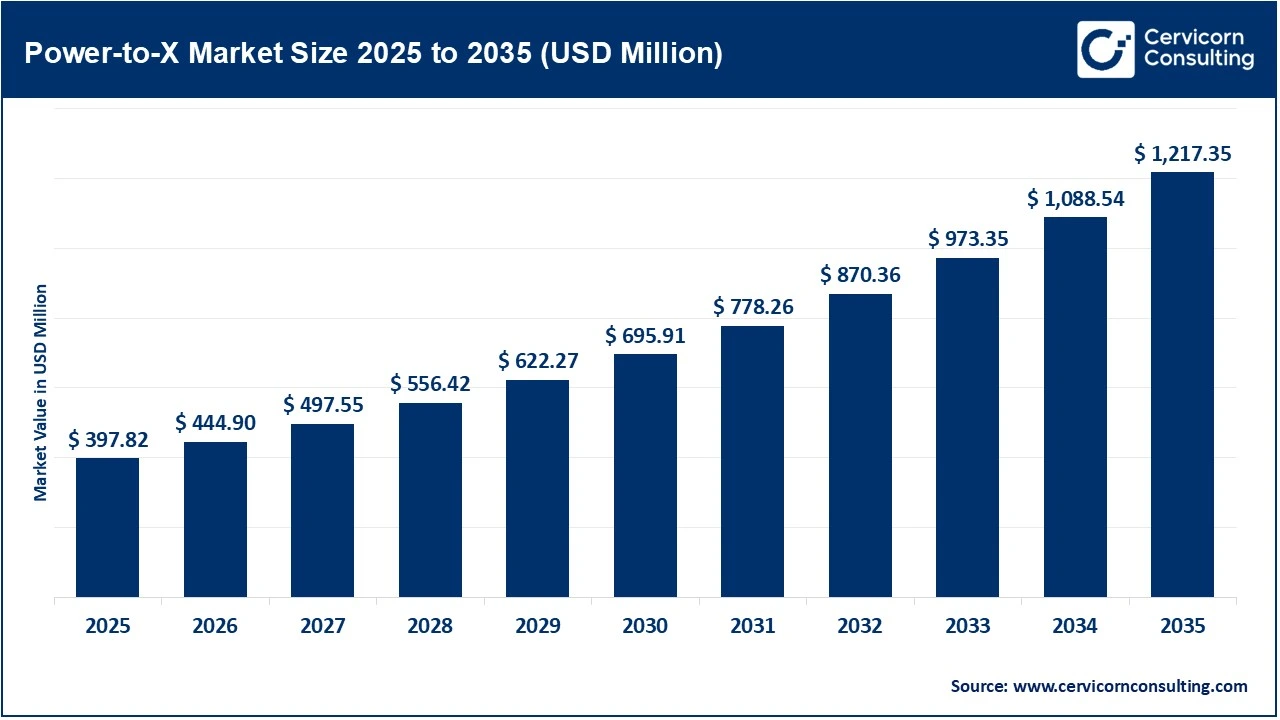
The global Power-to-X market was valued at approximately USD 397.82 million in 2025 and is projected to reach nearly USD 1,217.35 million by 2035, growing at a CAGR of about 11.83% during the forecast period. Europe currently leads adoption due to strong policy frameworks supporting hydrogen and synthetic fuels, while Asia-Pacific is expected to witness the fastest growth due to industrial demand and renewable expansion.
What Is the Power-to-X Market?
Power-to-X refers to a group of technologies that convert renewable electricity into alternative energy carriers such as hydrogen, methane, ammonia, synthetic fuels, and chemicals. These conversions allow excess renewable electricity—especially from solar and wind—to be stored, transported, or reused in sectors that cannot be easily electrified directly.
Key Power-to-X pathways include:
- Power-to-Hydrogen (PtH₂)
- Power-to-Methane (PtCH₄)
- Power-to-Ammonia (PtNH₃)
- Power-to-Methanol
- Power-to-Synthetic fuels (e-fuels)
These technologies help integrate renewable electricity into heavy industry, aviation, shipping, fertilizers, and long-distance transport sectors that rely heavily on fossil fuels today.
Why the Power-to-X Market Is Important?
Power-to-X technologies play a critical role in enabling deep decarbonization across global energy systems. While renewable electricity adoption continues to increase, direct electrification alone cannot meet all energy needs—especially in heavy transport, chemical production, and steel manufacturing. Power-to-X bridges this gap by converting renewable electricity into versatile fuels and industrial feedstocks.
Its importance can be understood across several dimensions:
Renewable Energy Storage
Wind and solar energy generation is intermittent. Power-to-X solutions convert surplus electricity into hydrogen or synthetic fuels that can be stored long-term and reused later.
Industrial Decarbonization
Industries such as steel, cement, chemicals, and fertilizers require high-temperature heat and chemical feedstocks. Hydrogen generated through PtX can replace coal-based processes.
Transportation Sector Transformation
Heavy-duty transport, aviation, and maritime shipping require energy-dense fuels. Synthetic fuels produced through PtX technologies provide sustainable alternatives.
Energy Security Enhancement
Countries with limited fossil fuel resources can produce domestic synthetic fuels using renewable electricity.
Sector Coupling
Power-to-X integrates electricity, gas, transport, and industrial sectors into a unified clean energy ecosystem.
Get a Free Sample: https://www.cervicornconsulting.com/sample/2920
Power-to-X Market Growth Factors
The growth of the Power-to-X market is driven by the rapid expansion of renewable energy capacity worldwide, increasing government commitments to net-zero emissions targets, rising investments in hydrogen infrastructure, and the urgent need to decarbonize hard-to-electrify sectors such as aviation, shipping, chemicals, and heavy manufacturing. Declining costs of renewable electricity—especially solar and wind—are improving the economic viability of electrolysis technologies used in Power-to-X production, while policy frameworks such as hydrogen strategies, carbon pricing mechanisms, and green fuel mandates are accelerating commercialization across Europe, North America, and Asia-Pacific.
In addition, increasing industrial demand for green hydrogen as a feedstock replacement for fossil-fuel-derived hydrogen is strengthening adoption, and advancements in electrolyzer efficiency and large-scale hydrogen storage infrastructure are enabling deployment at commercial scale across transportation, utilities, and manufacturing sectors globally.
Key Companies Driving the Power-to-X Market
Below is a structured overview of major industry players shaping the global Power-to-X ecosystem.
| Company | Specialization | Key Focus Areas | Notable Features | 2024 Revenue | Market Share | Global Presence |
|---|---|---|---|---|---|---|
| Siemens Energy | Energy infrastructure & electrolyzers | Hydrogen production systems, grid integration | Strong electrolyzer deployment expertise | ~$34B (approx.) | Strong in Europe hydrogen projects | Europe, U.S., Asia |
| Air Liquide | Industrial gases & hydrogen supply | Green hydrogen infrastructure | Large hydrogen production network | ~$30B+ | Major hydrogen supplier | 75+ countries |
| Linde plc | Industrial gases & electrolyzer engineering | Hydrogen storage & synthetic fuels | World’s largest industrial gas company | ~$33B+ | Global leadership in hydrogen supply | 100+ countries |
| thyssenkrupp Uhde GmbH | Chemical engineering solutions | Ammonia & methanol PtX plants | Strong EPC capabilities | Part of thyssenkrupp group | Strong ammonia technology share | Europe, Middle East, Asia |
| Nel ASA | Electrolyzer manufacturing | Hydrogen production equipment | PEM & alkaline electrolyzers | ~$160M+ | Fast-growing hydrogen tech player | Europe, U.S. |
These companies are central to scaling electrolyzers, synthetic fuel production facilities, hydrogen distribution infrastructure, and integrated Power-to-X platforms globally.
Leading Trends in the Power-to-X Market and Their Impact
The Power-to-X market is evolving rapidly due to technological advancements and supportive policy frameworks worldwide.
Expansion of Green Hydrogen Projects
Green hydrogen represents the largest segment within Power-to-X solutions. It enables decarbonization across fertilizer production, refining, steelmaking, and transportation sectors.
Impact:
- Accelerates adoption of renewable fuels
- Reduces dependence on fossil-fuel-derived hydrogen
- Enables industrial transformation
Integration with Renewable Energy Projects
Countries are integrating PtX facilities with solar and wind farms to utilize surplus electricity efficiently.
Impact:
- Reduces renewable curtailment
- Improves grid stability
- Enhances energy storage flexibility
Growth of Synthetic Aviation Fuels
Sustainable aviation fuels produced through PtX technologies are gaining traction globally.
Impact:
- Supports aviation decarbonization targets
- Creates new synthetic fuel value chains
- Encourages airport hydrogen infrastructure investments
Development of Power-to-Ammonia Infrastructure
Green ammonia is emerging as a hydrogen carrier and shipping fuel.
- Impact:
- Enables hydrogen transportation globally
- Supports fertilizer industry decarbonization
- Expands maritime clean-fuel adoption
- Large-Scale Electrolyzer Deployment
- Electrolyzer manufacturing capacity is expanding rapidly worldwide.
- Impact:
- Reduces hydrogen production costs
- Enables gigawatt-scale hydrogen hubs
- Strengthens supply chain maturity
- Successful Examples of Power-to-X Projects Around the World
- Several large-scale PtX initiatives demonstrate how countries are deploying these technologies commercially.
- Germany: Hydrogen Backbone Initiative
- Germany is building a national hydrogen pipeline network connecting renewable hydrogen producers with industrial consumers.
- Impact:
- Supports steel and chemical industry decarbonization
- Enables large-scale hydrogen transport
- Strengthens Europe’s hydrogen leadership
- Denmark: Power-to-X Hub in Esbjerg
- Denmark is investing heavily in offshore wind-based hydrogen production facilities linked to PtX fuel generation.
- Impact:
- Supports maritime fuel transformation
- Enables export-oriented synthetic fuel production
- Integrates offshore renewable energy
- Chile: Green Hydrogen Export Strategy
- Chile is leveraging solar and wind resources to become a global exporter of green hydrogen.
- Impact:
- Strengthens renewable energy exports
- Attracts international investment
- Builds synthetic fuel supply chains
- Saudi Arabia: NEOM Green Hydrogen Project
- One of the world’s largest hydrogen production facilities is being built in NEOM.
- Impact:
- Produces green ammonia for export
- Supports energy diversification strategy
- Establishes Middle East leadership in hydrogen
- Australia: Hydrogen Export Infrastructure
- Australia is developing large-scale hydrogen export facilities targeting Asian markets.
- Impact:
- Expands clean energy exports
- Supports industrial decarbonization partnerships
- Enhances regional energy cooperation
- Global Regional Analysis Including Government Initiatives and Policies Shaping the Market
- Government support plays a central role in accelerating Power-to-X adoption globally.
- Europe
- Europe dominates the global Power-to-X market due to strong hydrogen strategies and renewable deployment policies.
- Key initiatives:
- European Hydrogen Strategy
- Fit-for-55 climate package
- Carbon pricing mechanisms
- Renewable Energy Directive targets
- Germany, Denmark, France, and the Netherlands are investing heavily in hydrogen infrastructure and electrolyzer manufacturing.
- Impact:
- Accelerates electrolyzer deployment
- Supports synthetic fuel production
- Enables cross-border hydrogen trade networks
- North America
- The United States and Canada are expanding PtX adoption through clean-energy incentives.
- Key initiatives:
- U.S. Inflation Reduction Act hydrogen tax credits
- DOE hydrogen hub programs
- Canada Hydrogen Strategy
- Impact:
- Encourages private investment
- Supports industrial decarbonization
- Enables hydrogen mobility deployment
- Asia-Pacific
- Asia-Pacific represents one of the fastest-growing regions due to rising energy demand and industrial expansion.
- Key initiatives:
- Japan Hydrogen Roadmap
- South Korea Hydrogen Economy Strategy
- India National Green Hydrogen Mission
- China renewable fuel deployment programs
- Impact:
- Strengthens hydrogen mobility adoption
- Expands ammonia fuel infrastructure
- Supports export-oriented synthetic fuel production
- Middle East & Africa
- The Middle East is emerging as a global hub for hydrogen exports.
- Key initiatives:
- Saudi Arabia NEOM hydrogen project
- UAE hydrogen strategy
- Morocco renewable hydrogen partnerships
- Impact:
- Enables synthetic fuel export leadership
- Supports economic diversification
- Leverages solar energy advantages
- Latin America
- Latin America is gaining momentum due to strong renewable resources.
- Key initiatives:
- Chile Green Hydrogen Strategy
- Brazil renewable hydrogen pilot projects
- Impact:
- Strengthens export opportunities
- Enables low-cost hydrogen production
- Supports industrial decarbonization partnerships
To Get Detailed Overview, Contact Us: https://www.cervicornconsulting.com/contact-us
Read Report: Internet of Military Things Market Revenue, Trends, and Strategic Insights by 2035