3D Printing in Healthcare Market Revenue, Trends, and Strategic Insights by 2035
Table of Contents
Toggle3D Printing in Healthcare Market Size
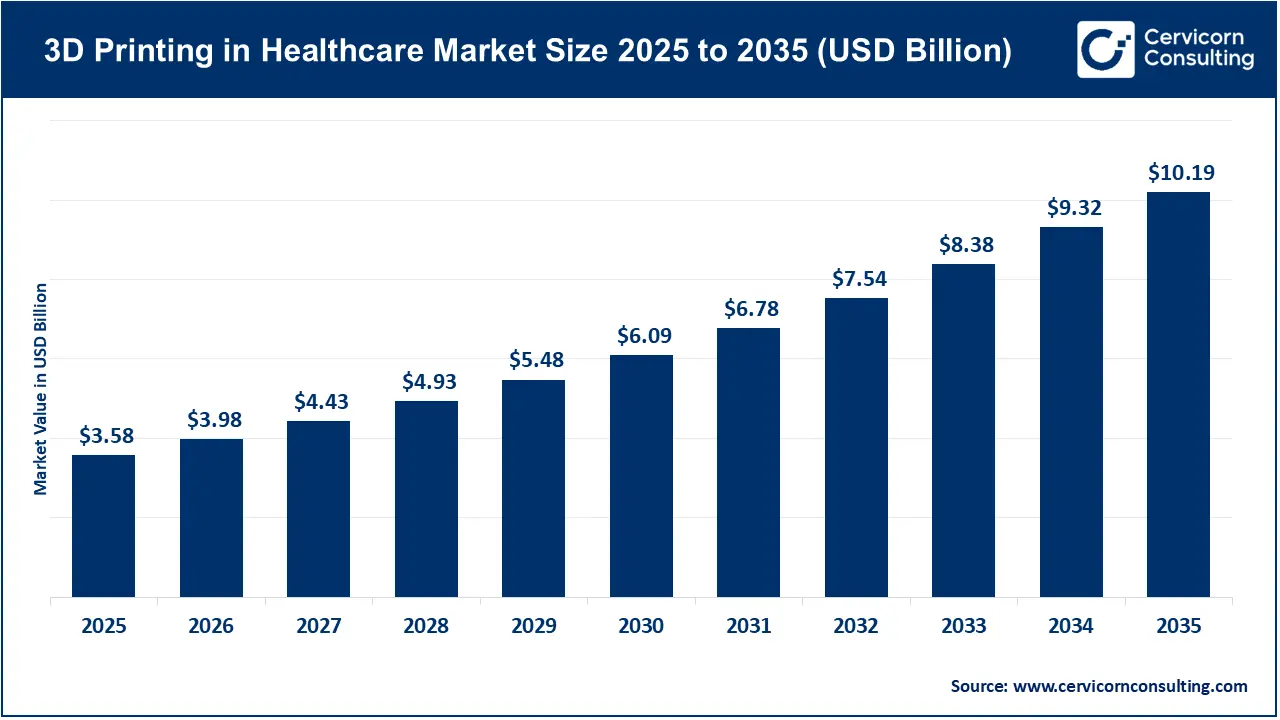
The global 3D printing in healthcare market was valued at approximately USD 3.58 billion in 2025 and is projected to reach nearly USD 10.19 billion by 2035, growing at a CAGR of 11.03%.
What is the 3D Printing in Healthcare Market?
The 3D printing in healthcare market refers to the ecosystem of technologies, materials, software solutions, services, and equipment used to manufacture medical products through additive manufacturing processes. Unlike traditional manufacturing methods that remove material from a solid block, 3D printing builds objects layer by layer using digital designs generated from medical imaging data such as CT scans, MRI scans, and CAD software.
Healthcare applications of 3D printing include customized orthopedic implants, prosthetics, dental restorations, hearing aids, surgical guides, anatomical models for surgical planning, drug delivery systems, tissue engineering, and bioprinting. The market encompasses hardware manufacturers, software developers, material suppliers, healthcare providers, and research organizations working together to advance patient-specific medical solutions.
The increasing integration of artificial intelligence, digital healthcare systems, advanced biomaterials, and regenerative medicine is further expanding the scope of 3D printing technologies across healthcare sectors worldwide.
Get a Free Sample: https://www.cervicornconsulting.com/sample/2672
3D Printing in Healthcare Market Growth Factors
The growth of the 3D printing in healthcare market is being driven by increasing demand for personalized medical devices and implants, rising prevalence of chronic diseases requiring surgical interventions, growing adoption of patient-specific treatment approaches, advancements in bioprinting and tissue engineering technologies, increasing healthcare investments in digital manufacturing solutions, expanding applications in dentistry and orthopedics, growing demand for rapid prototyping in medical research, improvements in biomaterials and printing accuracy, rising healthcare expenditure worldwide, favorable regulatory support for innovative medical technologies, increasing use of 3D-printed anatomical models for surgical planning and education, and continuous technological developments that reduce production costs while improving manufacturing efficiency and patient outcomes.
Why is 3D Printing in Healthcare Important?
Personalized Patient Care
One of the most significant advantages of 3D printing is the ability to create customized medical solutions tailored to individual patient anatomy. Personalized implants, prosthetics, and surgical guides improve treatment effectiveness and patient comfort.
Enhanced Surgical Planning
Healthcare professionals increasingly use 3D-printed anatomical models to better understand complex patient conditions before surgery. These models improve precision, reduce operation times, and minimize surgical complications.
Reduced Manufacturing Costs
Traditional manufacturing often involves expensive tooling and lengthy production processes. 3D printing enables rapid production with reduced material waste and lower manufacturing costs.
Faster Product Development
Medical device companies utilize additive manufacturing for rapid prototyping, accelerating innovation cycles and reducing time-to-market for new products.
Improved Accessibility
3D printing makes it possible to produce affordable prosthetics, implants, and medical devices in regions where traditional manufacturing and supply chains may be limited.
Advancement of Regenerative Medicine
Bioprinting technologies are paving the way for the development of tissues, organs, and regenerative therapies that could revolutionize future healthcare practices.
Major Companies in the 3D Printing in Healthcare Market
Company Profiles and Competitive Landscape
| Company | Specialization | Key Focus Areas | Notable Features | 2025 Revenue* | Market Share* | Global Presence |
|---|---|---|---|---|---|---|
| Formlabs Inc. | Desktop and professional 3D printing systems | Dental applications, medical prototyping, healthcare manufacturing | High-resolution SLA printing technology and medical-grade materials | Approx. USD 400 Million | Significant private market presence | North America, Europe, Asia-Pacific |
| General Electric (GE Additive) | Industrial additive manufacturing solutions | Medical device manufacturing, aerospace-inspired healthcare applications | Advanced metal additive manufacturing systems | Approx. USD 70+ Billion (GE overall) | Strong industrial segment presence | More than 170 countries |
| 3D Systems Corporation | Healthcare-focused additive manufacturing | Surgical planning, medical modeling, personalized healthcare solutions | Comprehensive healthcare software and printing ecosystem | Approx. USD 500+ Million | Leading healthcare 3D printing provider | Americas, Europe, Asia-Pacific |
| ExOne Company | Binder jetting technology | Medical research, specialized healthcare manufacturing | Industrial-scale additive manufacturing expertise | Part of Desktop Metal portfolio | Niche market participant | Global operations across key regions |
| Materialise NV | Medical software and 3D printing services | Surgical planning, medical imaging, personalized implants | Industry-leading medical imaging and planning software | Approx. USD 300+ Million | Strong healthcare software market share | More than 25 countries |
*Revenue and market-share figures represent recent industry estimates and company-wide revenues where applicable.
Leading Trends Shaping the 3D Printing in Healthcare Market
Expansion of Bioprinting Technologies
Bioprinting has become one of the most exciting developments in healthcare additive manufacturing. Researchers are increasingly developing techniques to print living tissues using bioinks containing cells and biomaterials.
Impact on the Market
- Accelerates regenerative medicine research
- Supports organ transplantation alternatives
- Creates new opportunities in pharmaceutical testing
- Expands long-term healthcare applications
Growing Adoption of Personalized Implants
Customized implants designed specifically for individual patients are becoming increasingly common in orthopedic, craniofacial, and spinal surgeries.
Impact on the Market
- Improved patient outcomes
- Better implant compatibility
- Reduced recovery times
- Increased surgeon confidence
Integration with Artificial Intelligence
AI-driven software is enhancing design optimization, predictive modeling, and manufacturing accuracy in healthcare 3D printing.
Impact on the Market
- Improved product quality
- Faster design processes
- Enhanced treatment planning
- Reduced manufacturing errors
Rise of Point-of-Care Manufacturing
Hospitals are increasingly establishing in-house 3D printing facilities to manufacture surgical guides, anatomical models, and customized medical devices.
Impact on the Market
- Faster patient treatment
- Lower logistics costs
- Enhanced customization capabilities
- Greater healthcare system flexibility
Advanced Biomaterial Development
The development of biocompatible metals, polymers, ceramics, and bioinks is significantly expanding healthcare applications.
Impact on the Market
- Broader treatment possibilities
- Increased device durability
- Improved patient safety
- Enhanced regulatory compliance
Dental 3D Printing Boom
Dental clinics and laboratories are rapidly adopting additive manufacturing for crowns, bridges, aligners, dentures, and surgical guides.
Impact on the Market
- Shorter treatment times
- Reduced production costs
- Improved patient satisfaction
- Higher procedural efficiency
Successful Examples of 3D Printing in Healthcare Around the World
Customized Titanium Implants in Europe
Several European healthcare institutions have successfully utilized 3D-printed titanium implants for cranial reconstruction and orthopedic surgeries. Patient-specific implants have improved surgical outcomes while reducing recovery times.
Patient-Specific Surgical Models in the United States
Leading hospitals in the United States routinely use 3D-printed anatomical models for preoperative planning in cardiovascular, neurological, and orthopedic procedures. These models help surgeons visualize complex anatomy before entering the operating room.
3D-Printed Prosthetics in Africa
Nonprofit organizations and healthcare providers across Africa have leveraged low-cost 3D printing technologies to manufacture affordable prosthetic limbs for underserved populations, significantly improving accessibility.
Dental Manufacturing in Germany
Germany has emerged as a major hub for dental additive manufacturing, producing millions of customized dental restorations annually through advanced 3D printing systems.
Bioprinting Research in South Korea
South Korean research institutions are actively developing bioprinted tissues and regenerative medicine solutions supported by government-funded healthcare innovation programs.
Orthopedic Applications in Australia
Australian healthcare centers have implemented 3D printing technologies for personalized orthopedic implants and trauma surgery planning, enhancing patient-specific treatment outcomes.
Hearing Aid Manufacturing Worldwide
The hearing aid industry represents one of the most successful examples of healthcare 3D printing adoption, with a majority of modern hearing aids now produced using additive manufacturing technologies.
Global Regional Analysis of the 3D Printing in Healthcare Market
North America
North America remains the largest market for healthcare 3D printing technologies due to strong healthcare infrastructure, advanced research capabilities, and substantial investments in medical innovation.
Key Market Drivers
- High healthcare expenditure
- Strong presence of leading manufacturers
- Extensive research and development activities
- Rapid adoption of personalized medicine
Government Initiatives and Policies
The United States government continues supporting additive manufacturing innovation through federal research grants, healthcare innovation programs, and collaborations involving the National Institutes of Health (NIH), Department of Defense (DoD), and National Science Foundation (NSF). Regulatory frameworks from the U.S. Food and Drug Administration (FDA) are also facilitating the approval of 3D-printed medical devices while ensuring patient safety.
Canada is investing in advanced manufacturing technologies through innovation funding programs and partnerships between universities, healthcare institutions, and private companies.
Market Outlook
North America is expected to maintain its leadership position due to continuous innovation in bioprinting, medical devices, and digital healthcare technologies.
Europe
Europe represents a highly developed market supported by advanced healthcare systems, robust manufacturing capabilities, and strong regulatory frameworks.
Key Market Drivers
- Growing demand for personalized healthcare
- Advanced medical research infrastructure
- Strong adoption in dentistry and orthopedics
- Increasing healthcare digitization
Government Initiatives and Policies
The European Union actively supports additive manufacturing through research and innovation programs such as Horizon Europe. Numerous projects focus on healthcare innovation, bioprinting, regenerative medicine, and advanced medical device development.
Countries including Germany, France, the Netherlands, and Belgium provide substantial funding for medical technology research and industrial-scale additive manufacturing initiatives.
The European Medical Device Regulation (MDR) framework establishes standards that encourage safe deployment of innovative healthcare technologies.
Market Outlook
Europe is expected to witness sustained growth driven by medical device innovation, aging populations, and increasing demand for patient-specific healthcare solutions.
Asia-Pacific
Asia-Pacific is emerging as the fastest-growing regional market for healthcare 3D printing technologies.
Key Market Drivers
- Expanding healthcare infrastructure
- Rising healthcare investments
- Growing medical tourism industry
- Increasing adoption of advanced technologies
Government Initiatives and Policies
China has integrated additive manufacturing into national industrial development strategies and supports healthcare applications through innovation funding and industrial modernization programs.
Japan promotes healthcare robotics, regenerative medicine, and advanced manufacturing technologies through government-supported research initiatives.
South Korea invests heavily in bioprinting, biotechnology, and healthcare innovation through national research programs.
India supports medical device manufacturing and healthcare innovation through initiatives encouraging domestic production, digital healthcare adoption, and advanced manufacturing technologies.
Singapore actively promotes biomedical innovation through research grants and public-private collaborations focused on healthcare technologies.
Market Outlook
Asia-Pacific is expected to experience the highest growth rate due to increasing healthcare demand, expanding patient populations, and supportive government initiatives.
Latin America
Latin America is gradually adopting healthcare 3D printing technologies, particularly in dental, orthopedic, and educational applications.
Key Market Drivers
- Growing healthcare modernization
- Increasing awareness of personalized medicine
- Rising medical education investments
- Expanding private healthcare sector
Government Initiatives and Policies
Countries such as Brazil, Mexico, and Chile are supporting healthcare technology adoption through innovation programs and partnerships between universities and healthcare providers.
Research institutions across the region are increasingly participating in additive manufacturing projects focused on healthcare accessibility and affordability.
Market Outlook
The region presents significant growth opportunities as healthcare systems modernize and digital manufacturing capabilities expand.
Middle East and Africa
The Middle East and Africa region is witnessing increasing interest in healthcare additive manufacturing technologies.
Key Market Drivers
- Healthcare infrastructure development
- Growing medical tourism
- Government healthcare transformation programs
- Increasing investments in advanced technologies
Government Initiatives and Policies
The United Arab Emirates has launched several initiatives promoting advanced manufacturing and healthcare innovation as part of broader economic diversification strategies.
Saudi Arabia’s Vision 2030 program includes investments in healthcare modernization, medical technology adoption, and research infrastructure development.
South Africa supports healthcare innovation through academic research institutions and partnerships focused on medical device development.
Market Outlook
The region is expected to experience steady growth as governments continue investing in healthcare infrastructure, advanced manufacturing capabilities, and medical innovation ecosystems.
Future Opportunities in the 3D Printing in Healthcare Market
Several emerging opportunities are expected to shape the future evolution of the market:
- Commercialization of bioprinted tissues and organs
- Expansion of personalized medicine applications
- Growth of hospital-based manufacturing facilities
- Development of smart implants integrated with sensors
- Increased adoption in pharmaceutical manufacturing
- Integration with artificial intelligence and digital twins
- Expansion of regenerative medicine applications
- Growing demand for pediatric and customized prosthetics
- Enhanced remote healthcare manufacturing capabilities
- Adoption of sustainable and biodegradable printing materials
As healthcare systems worldwide increasingly embrace precision medicine and digital transformation, 3D printing technologies are expected to become a foundational component of next-generation healthcare delivery, medical manufacturing, and patient-centered treatment strategies.
To Get Detailed Overview, Contact Us: https://www.cervicornconsulting.com/contact-us
Read Report: Ammonia Market Revenue, Trends, and Strategic Insights by 2035