Electronic Health Records Market Revenue, Trends, and Strategic Insights by 2035
Table of Contents
ToggleElectronic Health Records Market Size
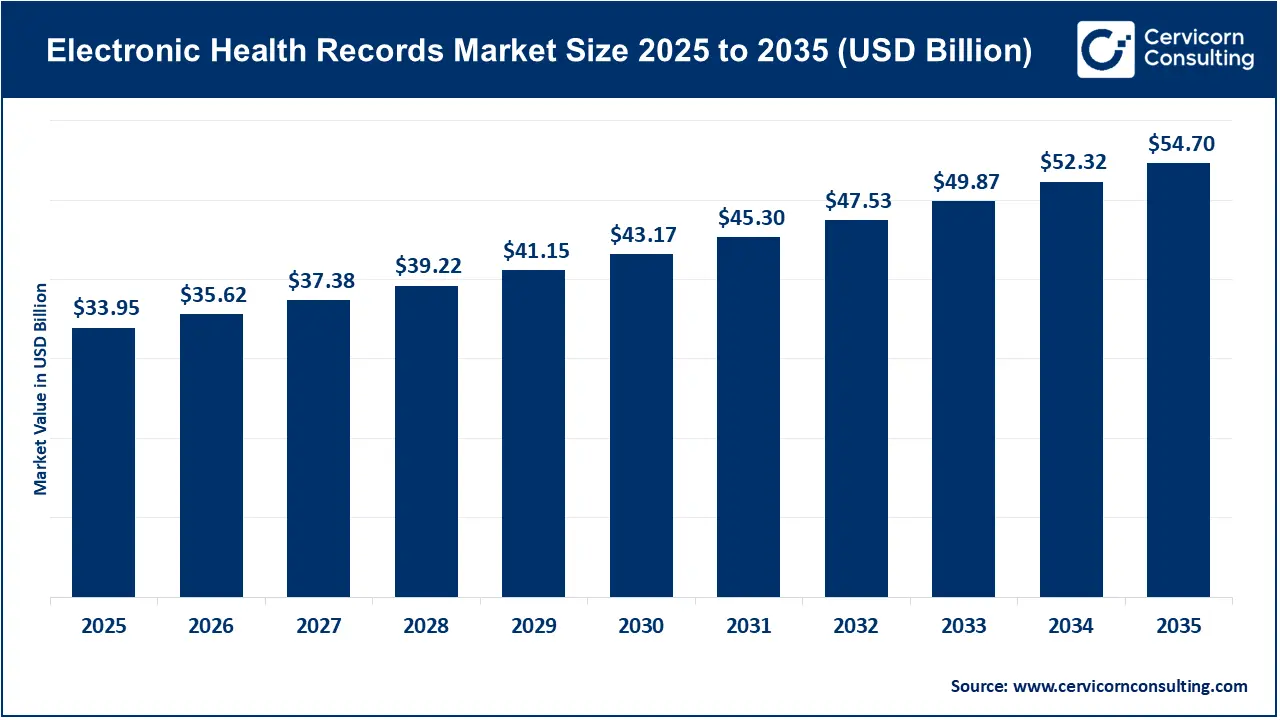
The global electronic health records market was valued at approximately USD 33.95 billion in 2025 and is projected to reach nearly USD 54.70 billion by 2035, growing at a CAGR of 4.89%.
Electronic Health Records Market Growth Factors
The global electronic health records (EHR) market is experiencing sustained growth due to the increasing digitalization of healthcare systems, government mandates encouraging electronic documentation, rising demand for interoperable healthcare platforms, growing adoption of cloud-based healthcare IT solutions, expansion of telemedicine, integration of artificial intelligence (AI) and predictive analytics into clinical workflows, increasing prevalence of chronic diseases, demand for value-based healthcare, improvements in cybersecurity infrastructure, widespread use of mobile healthcare applications, and rising investments in hospital modernization.
Healthcare providers are increasingly adopting EHR solutions to improve clinical efficiency, reduce medical errors, streamline administrative operations, enable data-driven decision-making, and enhance patient engagement. Continuous innovations in cloud computing, interoperability standards such as FHIR, and AI-powered clinical decision support systems are further accelerating market expansion.
Get a Free Sample: https://www.cervicornconsulting.com/sample/2680
What is the Electronic Health Records Market?
The electronic health records (EHR) market consists of software platforms, cloud services, implementation solutions, analytics tools, and interoperability technologies that enable healthcare organizations to digitally create, store, manage, and exchange patient health information.
Unlike traditional paper-based medical records, EHRs provide real-time patient information that can be securely accessed by authorized physicians, nurses, specialists, laboratories, pharmacies, and healthcare administrators across different healthcare facilities.
Modern EHR systems typically include:
- Patient demographics
- Medical history
- Laboratory reports
- Imaging results
- Prescriptions
- Physician notes
- Billing information
- Clinical decision support
- Population health analytics
- Telehealth integration
- AI-assisted documentation
Today, EHR platforms have evolved from simple record-keeping systems into intelligent healthcare ecosystems capable of supporting precision medicine, predictive analytics, remote patient monitoring, and hospital-wide operational optimization.
Why is the Electronic Health Records Market Important?
Electronic health records have become the backbone of modern healthcare delivery.
Their importance extends beyond digital documentation by improving clinical outcomes, operational efficiency, patient safety, and healthcare accessibility.
Major benefits include:
- Reduced medication errors
- Faster diagnosis and treatment
- Improved physician collaboration
- Better patient engagement
- Lower administrative costs
- Enhanced regulatory compliance
- Improved billing accuracy
- Efficient chronic disease management
- Population health monitoring
- Support for AI-driven clinical insights
For governments, EHR systems enable better healthcare surveillance, epidemic tracking, and national healthcare planning.
For hospitals, they improve workflow efficiency while reducing paperwork and duplication.
For patients, they create a seamless healthcare experience across hospitals, clinics, pharmacies, and diagnostic centers.
Leading Companies in the Electronic Health Records Market
| Company | Specialization | Key Focus Areas | Notable Features | 2025 Revenue* | Market Share* | Global Presence |
|---|---|---|---|---|---|---|
| Epic Systems Corporation | Enterprise EHR Solutions | Hospitals, Academic Medical Centers | MyChart, interoperability, AI integration | Estimated US$5.5–5.7 billion | ~44% of U.S. acute-care hospitals | North America, Europe, Middle East, Asia-Pacific |
| Oracle Cerner | Enterprise Healthcare IT | Hospitals, Government Healthcare | Oracle Cloud integration, analytics, population health | Included within Oracle Health segment (Oracle does not separately report Cerner revenue) | ~22% of U.S. acute-care hospitals | More than 35 countries |
| MEDITECH | Integrated EHR Platform | Community Hospitals, Regional Health Systems | Expanse cloud platform, interoperability | Estimated ~US$700 million | ~15% of U.S. acute-care hospitals | North America, UK, South Africa, Australia, Middle East |
| CPSI (TruBridge) | Rural Healthcare EHR | Rural Hospitals, Critical Access Hospitals | Revenue cycle management, rural healthcare expertise | Public company revenue reported through TruBridge business (approximately US$350–400 million range) | ~8% of U.S. acute-care hospitals | Primarily United States |
| WellSky | Post-Acute Care Software | Home Health, Hospice, Rehabilitation | Care coordination, post-acute analytics | Privately held (revenue not publicly disclosed) | Strong position in post-acute care software | North America, Europe, Asia-Pacific |
Leading Trends Transforming the Electronic Health Records Market
1. Artificial Intelligence Integration
AI is revolutionizing EHR systems through:
- Clinical documentation automation
- Predictive disease modeling
- Intelligent coding
- Automated clinical summaries
- Ambient voice transcription
- Personalized treatment recommendations
AI reduces physician burnout while improving documentation quality.
2. Cloud-Based EHR Platforms
Healthcare providers are rapidly replacing on-premise systems with cloud solutions because they offer:
- Lower infrastructure costs
- Automatic software updates
- Improved scalability
- Better disaster recovery
- Remote accessibility
- Enhanced cybersecurity
Cloud deployment is becoming the preferred implementation model for both hospitals and outpatient clinics.
3. Interoperability Standards
Healthcare organizations increasingly require seamless data exchange between:
- Hospitals
- Pharmacies
- Diagnostic laboratories
- Insurance providers
- Telehealth platforms
FHIR (Fast Healthcare Interoperability Resources) and APIs are enabling more efficient and secure information sharing, reducing fragmented care.
4. Mobile Health Integration
Patients increasingly expect healthcare access through smartphones.
Modern EHR platforms now include:
- Appointment scheduling
- Prescription renewals
- Lab result viewing
- Teleconsultations
- Health monitoring
- Patient messaging
Patient portals significantly improve healthcare engagement.
5. Clinical Decision Support Systems
Modern EHR platforms incorporate:
- Drug interaction alerts
- Allergy warnings
- Diagnostic suggestions
- Treatment guidelines
- Risk prediction
- Preventive care reminders
These features improve patient safety while reducing clinical errors.
6. Cybersecurity Investments
Healthcare remains one of the most targeted sectors for cyberattacks.
Consequently, EHR vendors are investing heavily in:
- Multi-factor authentication
- Encryption
- Zero-trust architecture
- AI-based threat detection
- Secure cloud infrastructure
- Continuous monitoring
Cybersecurity has become a major purchasing criterion for hospitals.
Impact of These Trends
These innovations are transforming healthcare delivery by:
- Increasing physician productivity
- Reducing administrative burden
- Lowering operational costs
- Improving patient outcomes
- Supporting precision medicine
- Accelerating value-based healthcare
- Enhancing healthcare accessibility
- Strengthening healthcare resilience
Healthcare organizations adopting next-generation EHR platforms are increasingly able to deliver coordinated, data-driven care while meeting evolving regulatory and patient expectations.
Successful Examples of the Electronic Health Records Market Around the World
United States
The United States remains the world’s most mature EHR market.
Large health systems such as Mayo Clinic, Cleveland Clinic, Kaiser Permanente, and Johns Hopkins have implemented enterprise-wide EHR platforms integrating hospitals, outpatient clinics, laboratories, and pharmacies.
Epic continues to dominate the U.S. acute-care hospital EHR market, while Oracle Health and MEDITECH maintain significant footprints.
United Kingdom
The UK’s National Health Service (NHS) continues expanding digital patient records across hospitals and primary care.
Government-backed initiatives support:
- National patient records
- Digital prescribing
- AI-assisted diagnostics
- Integrated Care Systems
- Digital outpatient services
These initiatives are reducing administrative complexity while improving continuity of care.
Canada
Canada has significantly expanded provincial digital health programs.
Many provinces have implemented centralized EHR platforms that allow physicians, laboratories, and pharmacies to share patient information securely.
The country also continues investing in interoperability standards and virtual healthcare.
Australia
Australia’s My Health Record program represents one of the world’s largest national EHR implementations.
The platform enables citizens to access:
- Medical history
- Prescription information
- Diagnostic reports
- Vaccination records
- Hospital discharge summaries
Healthcare professionals across Australia can securely access authorized patient information.
Nordic Countries
Denmark, Finland, Sweden, and Norway consistently rank among global leaders in healthcare digitalization.
Their healthcare systems benefit from:
- Nationwide EHR adoption
- Digital prescriptions
- Integrated public health databases
- AI-supported healthcare planning
- Advanced interoperability
These countries demonstrate how nationwide digital health infrastructure can improve healthcare efficiency and outcomes.
Global Regional Analysis
North America
North America represents the largest electronic health records market.
Major growth drivers include:
- Mature healthcare IT infrastructure
- High healthcare spending
- Extensive cloud adoption
- AI integration
- Value-based care initiatives
- Strong regulatory support
Government Initiatives
The U.S. government has promoted EHR adoption through legislation and programs such as the Health Information Technology for Economic and Clinical Health (HITECH) Act and interoperability rules under the 21st Century Cures Act, encouraging certified EHR technology, health information exchange, and patient access to electronic records.
Canada also continues funding digital health infrastructure through provincial electronic health initiatives.
Europe
Europe represents a highly regulated yet rapidly expanding EHR market.
Growth is driven by:
- Aging populations
- Rising chronic diseases
- National healthcare digitization
- Cross-border health data exchange
- Cloud adoption
Government Policies
The European Union is advancing initiatives such as the European Health Data Space (EHDS), designed to facilitate secure cross-border sharing and secondary use of health data while maintaining strong privacy protections. Many member states are also expanding national digital health records and e-prescription services.
Countries including Germany, France, the Netherlands, Denmark, and Finland continue investing heavily in nationwide EHR modernization.
Asia-Pacific
Asia-Pacific is projected to experience the fastest market growth.
Growth factors include:
- Rapid healthcare infrastructure development
- Expanding health insurance coverage
- Large patient populations
- Rising healthcare expenditure
- AI adoption
- Increasing digital transformation
Government Initiatives
- China is promoting hospital digitization under its Healthy China strategy, with investments in smart hospitals and regional health information platforms.
- India is implementing the Ayushman Bharat Digital Mission (ABDM), creating a nationwide digital health ecosystem with health IDs and interoperable records.
- Japan is accelerating healthcare digitalization through initiatives supporting electronic medical records and nationwide health information exchange.
- South Korea continues investing in AI-enabled hospitals and advanced digital healthcare infrastructure.
These policies are encouraging widespread EHR deployment across both public and private healthcare providers.
Latin America
Latin America is witnessing growing EHR adoption as governments modernize healthcare systems.
Major contributors include:
- Brazil
- Mexico
- Chile
- Colombia
Growth drivers include:
- Public healthcare reforms
- Expansion of private hospitals
- Cloud healthcare solutions
- Telemedicine adoption
Government Support
Several countries are introducing national digital health strategies, improving interoperability standards, and expanding electronic prescription systems to strengthen care coordination.
Middle East & Africa
Healthcare digital transformation is accelerating across the Middle East and parts of Africa.
Countries leading adoption include:
- United Arab Emirates
- Saudi Arabia
- Qatar
- South Africa
Growth drivers include:
- Smart hospital investments
- Healthcare infrastructure expansion
- Digital transformation programs
- Cloud healthcare deployment
Government Initiatives
- Saudi Arabia’s Vision 2030 emphasizes healthcare digitization, integrated care, and smart hospitals.
- UAE continues implementing nationwide digital health platforms and AI-enabled healthcare services.
- South Africa is expanding electronic health information systems to improve public healthcare delivery.
Government-led modernization programs are expected to continue driving EHR implementation across the region.
Future Outlook
The electronic health records market is moving beyond basic record management toward intelligent, connected healthcare ecosystems. Advances in AI, cloud computing, interoperability, cybersecurity, and predictive analytics are reshaping how providers manage patient information and deliver care. As governments continue investing in digital health infrastructure and healthcare organizations prioritize data-driven, patient-centric services, EHR platforms are expected to remain foundational to modern healthcare transformation worldwide.
To Get Detailed Overview, Contact Us: https://www.cervicornconsulting.com/contact-us
Read Report: South Korea Physical AI Market Revenue, Trends, and Strategic Insights by 2035