360-Degree Camera Market Revenue, Trends, and Strategic Insights by 2035
360-Degree Camera Market Size
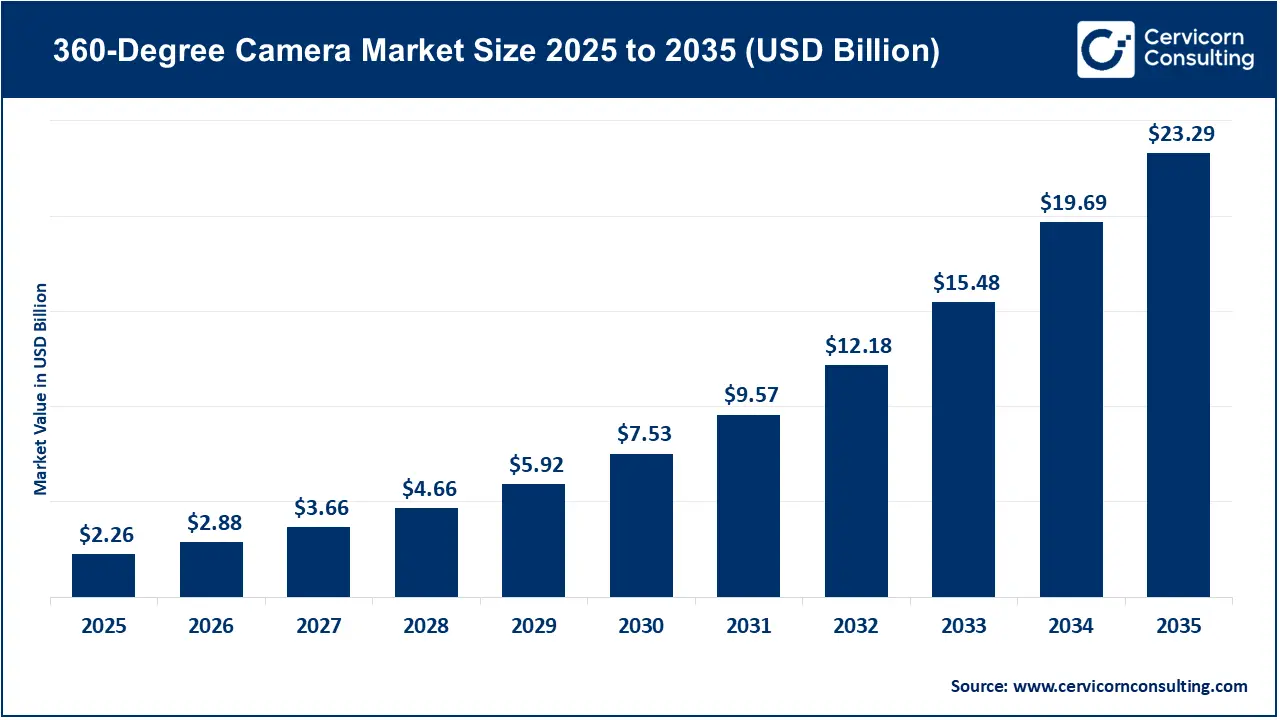
The global 360-degree camera market was valued at approximately USD 2.26 billion in 2025 and is projected to reach USD 23.29 billion by 2035, expanding at a CAGR of 26.27% during the forecast period.
360-Degree Camera Market Growth Factors
The global 360-degree camera market is experiencing robust growth due to the rapid adoption of immersive content across social media, virtual reality (VR), augmented reality (AR), gaming, tourism, real estate, automotive, public safety, sports broadcasting, and industrial inspection. Increasing consumer demand for high-resolution panoramic photography and video, coupled with technological advancements such as AI-powered image stabilization, computational photography, 8K recording, cloud-based editing, and real-time live streaming, is accelerating market expansion. Businesses are increasingly using 360-degree cameras for virtual tours, remote collaboration, digital twins, training simulations, and surveillance, while governments are adopting immersive imaging technologies for smart city projects, traffic monitoring, disaster management, and law enforcement.
Growing investments in creator economies, expanding 5G connectivity, declining hardware costs, and the integration of advanced sensors and machine learning algorithms continue to create new opportunities for manufacturers and software developers across both consumer and enterprise applications.
Get a Free Sample: https://www.cervicornconsulting.com/sample/2706
What is the 360-Degree Camera Market?
The 360-degree camera market comprises hardware, software, and related services that enable users to capture panoramic images and videos covering an entire environment in every direction simultaneously. Unlike conventional cameras that capture only a limited field of view, 360-degree cameras use multiple ultra-wide-angle lenses and advanced stitching software to generate immersive spherical content.
Modern 360-degree cameras have evolved significantly from niche imaging devices into professional-grade content creation tools. They are now used in filmmaking, journalism, construction, education, tourism, sports, healthcare, military training, industrial inspection, mapping, insurance documentation, and virtual collaboration.
The market includes:
- Consumer 360-degree cameras
- Professional VR cameras
- Industrial imaging systems
- Enterprise collaboration cameras
- Automotive panoramic cameras
- Security and surveillance solutions
- Software for image stitching and editing
- Cloud-based content management platforms
Growing demand for immersive experiences continues to expand the commercial value of these technologies worldwide.
Why is the 360-Degree Camera Market Important?
The importance of the 360-degree camera market extends far beyond consumer photography.
Revolutionizing Digital Storytelling
Content creators can capture entire environments instead of selecting a single viewing angle, allowing audiences to experience events interactively.
Driving Virtual Reality Adoption
VR experiences depend heavily on immersive content. High-quality 360-degree cameras make virtual environments more realistic and engaging.
Supporting Business Digitalization
Companies use panoramic imaging for:
- Remote inspections
- Employee training
- Digital twins
- Virtual site visits
- Product demonstrations
This reduces travel costs while improving operational efficiency.
Enhancing Tourism and Real Estate
Hotels, museums, travel agencies, and real estate developers increasingly rely on virtual tours to attract global customers.
Improving Industrial Operations
Manufacturers and infrastructure companies use panoramic imaging for:
- Asset monitoring
- Safety inspections
- Construction progress tracking
- Remote maintenance
These capabilities improve productivity while reducing operational risks.
Major Companies Operating in the 360-Degree Camera Market
| Company | Specialization | Key Focus Areas | Notable Features | 2025 Revenue* | Estimated Market Position | Global Presence |
|---|---|---|---|---|---|---|
| GoPro, Inc. | Action & 360 cameras | Adventure sports, creators | Rugged design, AI editing, MAX series | Approximately US$652 million (company revenue) | Strong premium brand | North America, Europe, Asia-Pacific, Latin America |
| Samsung Electronics Co., Ltd. | Consumer electronics | Smartphones, imaging, immersive technologies | Strong ecosystem integration | KRW 333.6 trillion company revenue | Global electronics leader | More than 80 countries |
| Ricoh Company, Ltd. | Imaging & enterprise cameras | Professional 360 imaging | THETA product family | Multi-billion-dollar global revenue | Leading enterprise imaging supplier | Worldwide |
| Insta360 | 360 cameras & AI imaging | Consumer and professional creators | AI editing, FlowState stabilization, 8K capture | Privately held (not publicly disclosed) | One of the fastest-growing brands | Global distribution network |
| LG Electronics Inc. | Consumer electronics | Smart devices and immersive technologies | Integration with connected ecosystems | Multi-billion-dollar global revenue | Diversified electronics manufacturer | Over 100 countries |
Leading Trends Transforming the 360-Degree Camera Market
AI-Powered Video Editing
Artificial intelligence now automates:
- Object tracking
- Auto reframing
- Scene recognition
- Horizon leveling
- Noise reduction
Impact:
- Faster production workflows
- Better creator productivity
- Reduced editing complexity
8K and Ultra-HD Recording
Manufacturers are introducing increasingly higher recording resolutions to improve image clarity.
Impact:
- Professional filmmaking
- VR production
- Tourism applications
- Sports broadcasting
Higher resolutions also allow flexible cropping without quality loss.
Cloud-Based Collaboration
Cloud platforms enable teams to edit, store, and share immersive content remotely.
Benefits include:
- Faster collaboration
- Secure storage
- Enterprise scalability
Integration with Virtual Reality
VR headsets are becoming mainstream across:
- Healthcare
- Manufacturing
- Education
- Gaming
This increases demand for immersive content creation.
Live Streaming
Organizations increasingly use 360-degree live streaming for:
- Sporting events
- Concerts
- Conferences
- Religious gatherings
- Product launches
This creates highly engaging viewing experiences.
Digital Twin Development
Construction, manufacturing, and infrastructure companies increasingly integrate panoramic imaging into digital twin platforms.
Benefits include:
- Accurate documentation
- Remote inspections
- Predictive maintenance
- Improved planning
AI Stabilization Technology
Modern cameras now deliver exceptionally smooth footage without bulky gimbals.
Impact:
- Better outdoor recording
- Easier sports filming
- Improved consumer experience
Enterprise Adoption
Businesses increasingly purchase 360-degree cameras for:
- Factory inspections
- Insurance claims
- Safety compliance
- Construction documentation
- Asset management
Enterprise applications are becoming one of the fastest-growing revenue segments.
Successful Examples of the 360-Degree Camera Market Around the World
Tourism in Switzerland
Swiss tourism agencies use immersive virtual tours to attract international travelers before they book vacations.
Visitors can experience:
- Mountain resorts
- Ski destinations
- Historic cities
- Scenic rail journeys
This significantly improves digital engagement.
Real Estate in the United States
American property developers increasingly provide virtual home walkthroughs.
Benefits include:
- Faster property sales
- Reduced physical visits
- Improved customer experience
Virtual property marketing has become standard practice for premium developments.
Smart Cities in Singapore
Singapore integrates panoramic imaging into:
- Infrastructure monitoring
- Urban planning
- Traffic management
- Public safety
These applications support smart city initiatives and operational efficiency.
Manufacturing in Germany
German manufacturers deploy 360-degree cameras for:
- Factory monitoring
- Equipment inspections
- Worker training
- Remote maintenance
The technology supports Industry 4.0 transformation.
Sports Broadcasting
International sporting organizations increasingly use immersive cameras during:
- Football matches
- Motorsports
- Cycling
- Winter sports
Fans enjoy interactive viewing experiences unavailable through conventional broadcasting.
Education in Japan
Universities employ immersive classrooms using panoramic video for:
- Medical training
- Engineering education
- Laboratory demonstrations
- Virtual campus tours
This enhances remote learning experiences.
Global Regional Analysis
North America
North America remains one of the largest markets due to:
- High consumer technology adoption
- Strong creator economy
- Mature VR ecosystem
- Large entertainment industry
Government Initiatives
Government agencies continue supporting:
- Smart infrastructure
- Digital innovation
- Public safety modernization
- Advanced manufacturing
Federal investments in broadband and emerging technologies also encourage immersive content adoption.
Market Outlook
Demand remains particularly strong across:
- Media
- Sports
- Construction
- Defense
- Real estate
Europe
Europe continues expanding due to:
- Industry 4.0 adoption
- Digital manufacturing
- Smart tourism
- Enterprise digitization
Countries including Germany, France, and the United Kingdom are investing heavily in immersive visualization technologies.
Government Policies
European governments promote:
- Digital transformation
- Green smart cities
- Innovation funding
- AI development
The European Union also encourages advanced digital technologies through multiple innovation programs.
Key Growth Areas
- Industrial inspection
- Heritage preservation
- Virtual tourism
- Construction
Asia-Pacific
Asia-Pacific represents the fastest-growing regional market.
Major growth countries include:
- China
- Japan
- South Korea
- India
- Singapore
Strong electronics manufacturing capabilities accelerate regional innovation.
Government Initiatives
Several governments actively support:
- Smart city programs
- AI development
- Digital education
- Industrial automation
- Semiconductor manufacturing
China continues investing heavily in AI and smart manufacturing, while Japan promotes Society 5.0 initiatives integrating immersive digital technologies. South Korea supports advanced imaging, 5G, and XR innovation through national digital transformation strategies.
Market Opportunities
Rapid expansion is occurring across:
- Consumer electronics
- Content creation
- Manufacturing
- E-commerce
- Smart factories
Latin America
Latin America is gradually emerging as a promising market.
Increasing adoption is driven by:
- Tourism promotion
- Digital marketing
- Real estate
- Education
Countries including Brazil and Mexico are witnessing increasing demand for immersive imaging.
Government Support
Governments continue investing in:
- Broadband expansion
- Smart city infrastructure
- Digital public services
These initiatives improve accessibility for cloud-based imaging applications.
Middle East & Africa
Digital transformation strategies continue driving market expansion.
Major adopters include:
- UAE
- Saudi Arabia
- South Africa
Government Policies
Governments increasingly support:
- Smart cities
- Tourism diversification
- Digital infrastructure
- Artificial intelligence
- Innovation ecosystems
Projects such as Saudi Vision 2030 and smart city initiatives across the Gulf Cooperation Council are creating favorable conditions for immersive imaging technologies.
Market Applications
Key sectors include:
- Tourism
- Construction
- Oil & gas inspections
- Public safety
- Entertainment
Government Initiatives and Policies Shaping the Market
Governments worldwide recognize immersive imaging as an enabling technology for digital transformation.
Key policy initiatives include:
- Smart city investments supporting panoramic monitoring systems.
- Expansion of 5G infrastructure to facilitate high-bandwidth live streaming and cloud collaboration.
- Industry 4.0 programs encouraging digital inspection, predictive maintenance, and digital twins.
- National AI strategies that accelerate development of intelligent imaging software.
- Tourism digitization initiatives funding virtual destination experiences.
- Education modernization programs supporting immersive learning environments.
- Public safety modernization projects integrating panoramic imaging into emergency response, surveillance, and disaster management.
- Innovation grants and research funding encouraging development of advanced imaging sensors, computational photography, and mixed reality applications.
These policy measures are strengthening research, commercialization, and adoption across consumer, enterprise, and government sectors, positioning the 360-degree camera market for sustained long-term growth.
To Get Detailed Overview, Contact Us: https://www.cervicornconsulting.com/contact-us
Read Report: Advanced Biofuel Market Revenue, Trends, and Strategic Insights by 2035