Drug Discovery Services Market Revenue, Trends, and Strategic Insights by 2035
Drug Discovery Services Market Size
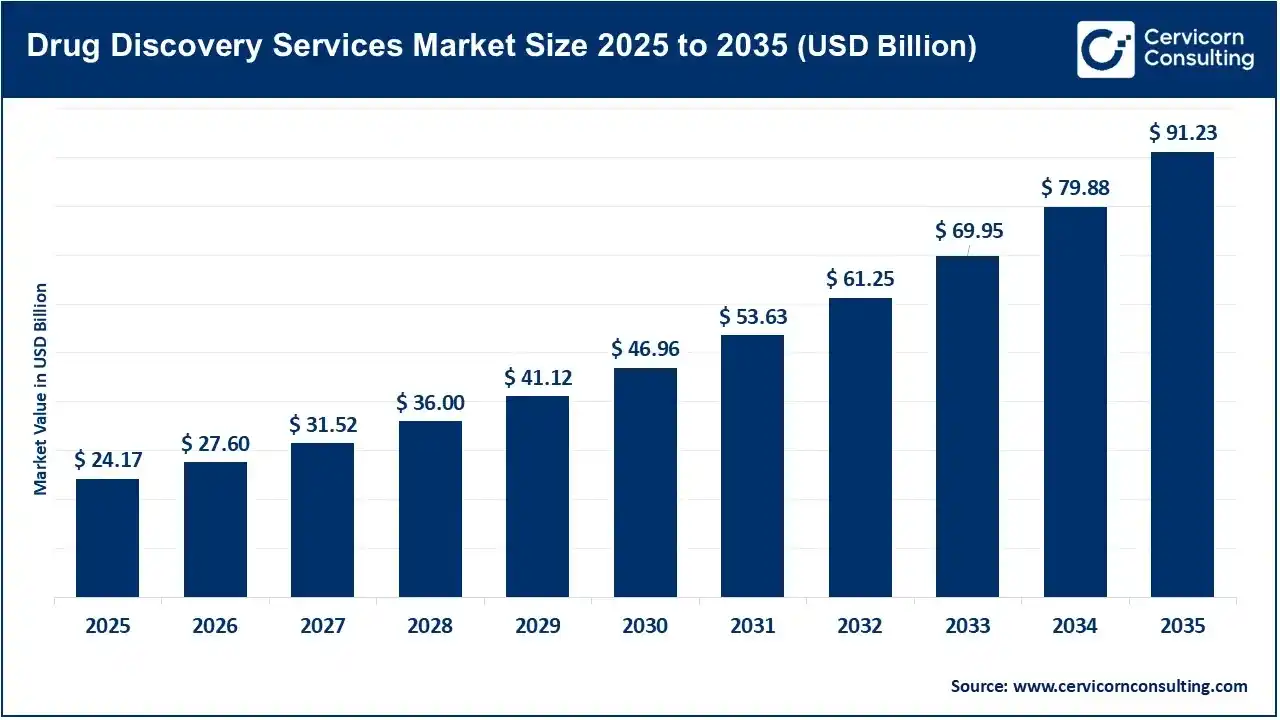
The global drug discovery services market was valued at approximately USD 24.17 billion in 2025 and is projected to reach USD 91.23 billion by 2035, representing a 14.21% CAGR from 2026 to 2035.
Drug discovery services market growth factors
The global drug discovery services market is expanding as pharmaceutical and biotechnology companies increasingly outsource research activities to specialized contract research organizations (CROs), while rising R&D expenditure, growing biotechnology pipelines, increasing demand for complex therapeutic modalities, adoption of artificial intelligence (AI) and machine learning, and the need to accelerate drug development timelines create additional demand for external research capabilities.
North America represented the largest regional market in 2025, while Asia Pacific is projected to be the fastest-growing region. Pharmaceutical and biotechnology companies are increasingly relying on CROs for medicinal chemistry, target identification, hit identification, lead optimization, pharmacology, toxicology, bioanalysis, computational drug design, and other specialized research activities. The increasing complexity of drug candidates is also encouraging companies to access external expertise rather than develop every capability internally. At the same time, AI-enabled molecular design, high-throughput screening, genomics, structural biology, organoid models, automation, and advanced analytical technologies are creating new opportunities for drug discovery service providers.
Get a Free Sample: https://www.cervicornconsulting.com/sample/3029
What is the drug discovery services market?
The drug discovery services market consists of outsourced research services that support pharmaceutical, biotechnology, academic, and other life-science organizations in identifying, designing, screening, optimizing, and advancing potential drug candidates.
Drug discovery represents one of the earliest and most research-intensive phases of pharmaceutical development. It can involve target identification and validation, assay development, compound screening, hit identification, hit-to-lead development, medicinal chemistry, computer-aided drug design, lead optimization, pharmacology, drug metabolism and pharmacokinetics (DMPK), bioanalysis, biomarker development, and preclinical research.
CROs provide these services through specialized scientists, laboratories, databases, biological models, computational platforms, screening technologies, and analytical infrastructure. Depending on the provider, customers can purchase individual services or integrated workflows covering multiple discovery activities.
The increasing use of outsourcing has also changed the competitive structure of the industry. Large pharmaceutical companies may maintain substantial internal research organizations while outsourcing specific programs or specialized technologies. Biotechnology companies and emerging drug developers may depend more heavily on CROs because external providers allow them to access sophisticated infrastructure without making equivalent investments in laboratories and personnel.
Why is the drug discovery services market important?
Accelerating pharmaceutical research
Drug discovery can require repeated cycles of experimentation, compound design, screening, optimization, and validation. CROs can provide established workflows and specialized scientific teams, helping sponsors manage these activities across multiple projects.
Supporting biotechnology companies
Biotechnology companies often focus on innovative targets, biological mechanisms, or novel therapeutic modalities. External discovery partners can provide chemistry, biology, DMPK, structural biology, and preclinical capabilities that complement internal research.
Reducing infrastructure requirements
Advanced drug discovery requires expensive equipment, specialist laboratories, computational resources, biological models, and highly trained personnel. Outsourcing allows pharmaceutical and biotechnology organizations to obtain access to these resources according to project requirements.
Expanding access to specialized technologies
Modern drug discovery increasingly depends on AI, genomics, proteomics, structural biology, high-content screening, automation, and advanced biological models. Specialized service providers can invest in these platforms and make them available to multiple customers.
Improving research flexibility
External providers can help sponsors scale projects according to pipeline requirements. This flexibility is particularly relevant when companies need additional capacity for several programs simultaneously or require capabilities that are not available internally.
Drug discovery services market competitive landscape
Global Market Insights estimates that the five companies specified for this analysis—Charles River Laboratories International, Inc., WuXi AppTec Co., Ltd., Pharmaron Beijing Co., Ltd., Labcorp Drug Development, and Evotec SE—collectively accounted for approximately 38% of the global drug discovery services market in 2025. Charles River Laboratories held approximately 14%, while the other four companies each held an estimated 4%–8% share according to the same market assessment. These market-share figures refer specifically to the drug discovery services market and should not be interpreted as each company’s share of the broader pharmaceutical services industry.
Charles River Laboratories International, Inc.
Specialization: Charles River Laboratories provides research models and services, discovery and safety assessment, and manufacturing solutions. Its discovery capabilities include pharmacology, toxicology, bioanalysis, and preclinical research.
Key focus areas: Drug discovery, pharmacology, safety assessment, toxicology, research models, bioanalysis, and preclinical development.
Notable features: Charles River has an integrated service model that enables pharmaceutical and biotechnology customers to access multiple research and preclinical capabilities through a global organization. Its Discovery and Safety Assessment (DSA) segment generated USD 2.40 billion in revenue in 2025.
2025 revenue: Charles River reported USD 4.02 billion in total revenue in fiscal 2025.
Market share: Approximately 14% in 2025, according to Global Market Insights.
Global presence: Charles River operates across major pharmaceutical and biotechnology markets, providing discovery, safety assessment, research-model, and related services to global customers.
WuXi AppTec Co., Ltd.
Specialization: WuXi AppTec operates as a global pharmaceutical contract research, development, and manufacturing organization (CRDMO), providing integrated research and development services.
Key focus areas: Small-molecule discovery, chemistry, biology, drug development, testing, analytical services, and integrated pharmaceutical R&D.
Notable features: Its integrated model connects discovery, development, testing, and manufacturing capabilities. This structure enables pharmaceutical and biotechnology companies to outsource multiple activities to one service platform.
2025 revenue: WuXi AppTec reported RMB 45.46 billion in total revenue in 2025, representing 15.8% year-over-year growth. Revenue from continuing operations reached RMB 43.42 billion, up 21.4%.
Market share: Global Market Insights places WuXi AppTec within the leading group, with an estimated individual market share of approximately 4%–8% in 2025.
Global presence: WuXi AppTec maintains extensive operations in China and international pharmaceutical markets and serves global pharmaceutical and biotechnology customers.
Pharmaron Beijing Co., Ltd.
Specialization: Pharmaron provides integrated pharmaceutical R&D and manufacturing services covering drug discovery, preclinical research, clinical development, and multiple therapeutic modalities.
Key focus areas: Medicinal chemistry, biology, computational chemistry, DMPK, bioanalysis, pharmacology, structural biology, biologics, cell and gene therapy, and integrated drug discovery.
Notable features: Pharmaron operates a broad platform covering small molecules, biologics, and cell and gene therapy products. Its laboratory services include chemistry, in vitro and in vivo biology, DMPK, safety assessment, bioanalysis, and integrated drug discovery.
2025 revenue: Pharmaron reported RMB 6.441 billion in revenue for the first half of 2025, representing a 14.9% year-over-year increase. A full-year figure should be presented separately once the audited FY2025 annual result is used; therefore, the H1 figure is not treated here as full-year revenue.
Market share: Approximately 4%–8% in 2025, based on Global Market Insights’ assessment of the leading providers.
Global presence: Pharmaron has operations across China, the United States, and the United Kingdom, with more than 29,000 employees according to its current company information.
Pharmaron also expanded its structural biology capabilities through its announced acquisition of Biortus in 2025, adding capabilities in protein production, X-ray crystallography, cryo-EM, structure-based drug discovery, and AI/ML-enabled protein design.
Labcorp
Specialization: Labcorp provides laboratory and drug development services, including central laboratory, bioanalysis, clinical development, diagnostics, and specialty testing capabilities.
Key focus areas: Drug development, central laboratory services, bioanalysis, diagnostics, specialty testing, clinical research support, and pharmaceutical research.
Notable features: Labcorp combines a large global laboratory network with drug development capabilities. Its corporate information states that approximately 71,000 employees serve customers in around 100 countries.
2025 revenue: Labcorp reported USD 13.95 billion in FY2025 revenue, compared with USD 13.01 billion in 2024.
Market share: Approximately 4%–8% in the drug discovery services market in 2025, according to Global Market Insights.
Global presence: Labcorp serves customers in approximately 100 countries, providing laboratory, diagnostics, and drug development services internationally.
Evotec SE
Specialization: Evotec provides drug discovery and preclinical development capabilities alongside its Just – Evotec Biologics platform.
Key focus areas: Target identification, drug discovery, translational research, preclinical development, biologics, and integrated research partnerships.
Notable features: Evotec combines discovery and preclinical development with technology-enabled biologics capabilities.
2025 revenue: Evotec reported €788.4 million in group revenue in 2025. Its Discovery & Preclinical Development segment generated €528.9 million, while Just – Evotec Biologics generated €259.4 million.
Market share: Approximately 4%–8% in 2025, according to Global Market Insights.
Global presence: Evotec has research and development operations across Europe, North America, and other international markets, supporting pharmaceutical and biotechnology programs.
Leading trends and their impact on the drug discovery services market
AI and machine learning-enabled drug discovery
AI is increasingly being incorporated into target identification, virtual screening, molecular design, compound prioritization, structure prediction, and lead optimization. The technology can help researchers analyze large chemical and biological datasets and identify candidates for experimental validation.
For CROs, this creates an opportunity to combine computational drug discovery with laboratory experimentation. Pharmaron, for example, has highlighted AI/ML capabilities within its structural biology and protein science expansion.
The UK’s Life Sciences Sector Plan also identifies AI-driven drug discovery as an important TechBio opportunity and calls for greater investment in AI and health-data infrastructure.
Increasing outsourcing
Pharmaceutical and biotechnology companies are increasingly using external research providers to supplement internal teams. Outsourcing can provide access to specialized technologies, scientists, laboratory infrastructure, and flexible project capacity.
This trend supports demand for CROs capable of providing integrated discovery services rather than only individual laboratory tests.
Growth of biologics and advanced modalities
Drug discovery is expanding beyond conventional small molecules. Monoclonal antibodies, antibody-drug conjugates, peptides, oligonucleotides, cell therapies, gene therapies, and protein degraders are creating demand for new discovery and characterization capabilities.
Service providers are responding by expanding biologics, cell and gene therapy, protein science, analytical, and translational capabilities.
Structural biology and protein science
Structural biology is becoming increasingly important for understanding target structures and designing molecules against challenging biological targets. X-ray crystallography, cryo-electron microscopy, protein production, and computational modeling are therefore becoming important service areas.
Pharmaron’s 2025 Biortus transaction illustrates this trend, particularly its focus on structure-based drug discovery and AI/ML-enabled protein research.
Automation and high-throughput screening
Automation enables CRO laboratories to process larger numbers of compounds and samples while improving workflow standardization. Automated liquid handling, high-content imaging, robotics, and data-management platforms are becoming increasingly important in screening and compound optimization.
Alternative preclinical models
Interest is increasing in human-relevant models, organoids, translational models, and other approaches that can complement conventional animal studies. The UK government has committed to establishing preclinical translational infrastructure and developing alternative models as part of its Life Sciences Sector Plan.
Successful examples of drug discovery services around the world
Integrated discovery and preclinical services in the United States
Charles River Laboratories represents an example of an integrated research-services model spanning research models, drug discovery, safety assessment, and manufacturing-related capabilities. Its DSA segment generated approximately USD 2.40 billion in 2025, demonstrating the scale of outsourced discovery and preclinical services.
Integrated pharmaceutical R&D services in China
WuXi AppTec demonstrates the scale of China’s global CRDMO ecosystem. The company generated RMB 45.46 billion in total revenue in 2025, with continuing-operations revenue increasing 21.4%. Its integrated platform supports pharmaceutical and biotechnology companies across research, development, testing, and manufacturing activities.
Multi-modality research services through Pharmaron
Pharmaron provides an example of a multi-modality platform combining small-molecule, biologics, and cell and gene therapy capabilities. Its laboratory platform incorporates chemistry, biology, DMPK, bioanalysis, pharmacology, safety assessment, and integrated drug discovery.
Its 2025 acquisition agreement involving Biortus further expanded capabilities in structural biology, protein science, screening, and structure-based drug design.
Data-driven drug discovery development in the UK
The UK is developing an ecosystem connecting AI, biotechnology, health data, research infrastructure, and pharmaceutical development. The government’s Life Sciences Sector Plan identifies TechBio and AI-enabled drug discovery as strategic areas and proposes increased R&D investment, improved access to health data, AI skills development, and translational research infrastructure.
Global regional analysis
North America
North America held the largest position in the global drug discovery services market in 2025, supported by extensive pharmaceutical and biotechnology activity, high R&D expenditure, established CRO infrastructure, academic research institutions, and a large concentration of biotechnology companies.
The United States remains a major outsourcing market because pharmaceutical companies and emerging biotechnology organizations require access to specialized discovery platforms. The region’s CRO ecosystem includes providers spanning chemistry, biology, pharmacology, toxicology, bioanalysis, and clinical development.
The combination of pharmaceutical R&D, venture-backed biotechnology, advanced computational capabilities, and sophisticated research infrastructure supports continued demand for external drug discovery services.
Europe
Europe represents another major drug discovery services hub, supported by pharmaceutical companies, biotechnology clusters, universities, research organizations, and government-funded life-sciences programs.
The UK is strengthening this ecosystem through its Life Sciences Sector Plan, which was launched in 2025 and updated in July 2026. The plan includes more than £2 billion of government funding over the Spending Review period, alongside UKRI and NIHR funding, and focuses on world-class R&D, investment, clinical research, health innovation, data infrastructure, and biotechnology.
The plan specifically addresses AI-enabled life sciences, TechBio, preclinical translational infrastructure, alternative models, and improved access to health data. It also proposes a national Health Data Research Service designed to provide streamlined access to health datasets, including AI-ready pathology, radiology, and genomic data.
These measures can support demand for computational drug discovery, translational research, biomarker development, and data-driven pharmaceutical research.
Asia Pacific
Asia Pacific is projected to be the fastest-growing regional market during the forecast period.
China is a particularly important contributor because of its expanding biotechnology sector and large CRO/CRDMO ecosystem. WuXi AppTec and Pharmaron have developed substantial integrated research platforms serving both domestic and international customers.
China’s regulatory policy is also focused on strengthening pharmaceutical innovation. The National Medical Products Administration has described reforms intended to optimize the review and approval process for innovative-drug clinical trials and improve the efficiency of clinical development.
Japan also maintains significant government support for biomedical research. The Japan Agency for Medical Research and Development (AMED) was established to coordinate medical R&D support and, under its FY2025–FY2029 Third Medium- to Long-Term Plan, continues integrated support across eight projects centered on areas including drug discovery and therapeutic approaches.
India is another emerging market within Asia Pacific, supported by its pharmaceutical manufacturing base, scientific workforce, biotechnology ecosystem, and expanding life-sciences R&D capabilities. The region’s combination of scientific talent, expanding biotechnology investment, and growing demand for cost-efficient research services provides opportunities for both domestic and international CROs.
Latin America
Latin America represents an emerging opportunity for drug discovery and broader pharmaceutical research outsourcing. Brazil, Mexico, and Argentina have established pharmaceutical and academic research ecosystems, while increasing participation in global drug development programs can create additional demand for laboratory, preclinical, clinical, and bioanalytical services.
The region’s future development will depend on research infrastructure, investment, regulatory harmonization, biotechnology funding, and connections between academic institutions, pharmaceutical companies, and CROs.
Middle East and Africa
The Middle East and Africa currently represent smaller portions of the global drug discovery services industry but offer longer-term opportunities as governments and private organizations invest in biotechnology, healthcare infrastructure, genomics, research institutions, and pharmaceutical manufacturing.
Countries pursuing economic diversification are increasingly developing life-sciences strategies, research centers, biotechnology parks, and pharmaceutical manufacturing capabilities. These investments can create opportunities for international CRO partnerships, localized research capabilities, and technology transfer.
Government initiatives and policies shaping the drug discovery services market
United States
U.S. pharmaceutical research is supported by a mature regulatory, academic, biotechnology, and private-sector ecosystem. Regulatory modernization, biomedical research funding, and initiatives supporting faster translation from discovery to development can influence demand for specialized CRO services.
United Kingdom
The UK Life Sciences Sector Plan provides one of the more comprehensive current policy frameworks affecting drug discovery. It focuses on R&D investment, translational research, AI, health data, genomics, clinical trials, biotechnology investment, and regulatory modernization. The plan specifically calls for investment in AI-related R&D, preclinical translational infrastructure, alternative research models, and a national health-data ecosystem.
The UK’s AI Adoption Plan for Life Sciences also identifies TechBio and AI-driven drug discovery as areas where government intends to support adoption, skills, research investment, and partnerships.
China
China’s regulatory reforms are aimed at improving the pharmaceutical industry’s innovation environment. The State Council’s 2025 policy framework calls for deeper reform of drug and medical-device regulation and development of a globally competitive innovation ecosystem.
The NMPA has also worked on optimizing innovative-drug clinical-trial review and approval processes, supporting the broader objective of improving the efficiency of innovative pharmaceutical development.
Japan
Japan’s AMED provides coordinated government-backed support for medical R&D. Its FY2025–FY2029 plan continues integrated programs covering drug discovery and therapeutic approaches, helping connect basic research with practical medical applications.
Cross-market policy direction
Across major pharmaceutical markets, policy is increasingly focused on accelerating the movement from basic research to clinical development, strengthening biotechnology ecosystems, improving health-data infrastructure, supporting AI adoption, developing new preclinical models, and improving regulatory efficiency. These policy changes are likely to influence pharmaceutical outsourcing strategies and create additional opportunities for CROs with capabilities spanning computational research, laboratory discovery, translational science, and preclinical development.
To Get Detailed Overview, Contact Us: https://www.cervicornconsulting.com/contact-us
Read Report: C5ISR Market Revenue, Trends, and Strategic Insights by 2035