Which water-based battery technologies could shape the next phase of energy storage?
Water-based Battery Market: Can Safer Energy Storage Scale With Renewable Power?
Renewable energy is expanding, but storing that energy safely and economically remains a major challenge.
Solar and wind generation can fluctuate throughout the day, while electricity demand does not always follow the same pattern. At the same time, utilities, businesses, and communities are looking for energy storage technologies that can reduce safety risks, support grid reliability, and limit dependence on costly or constrained battery materials.
This is creating greater interest in water-based batteries, which use aqueous electrolytes and can offer a different balance of safety, cost, sustainability, and material availability compared with conventional lithium-ion systems.
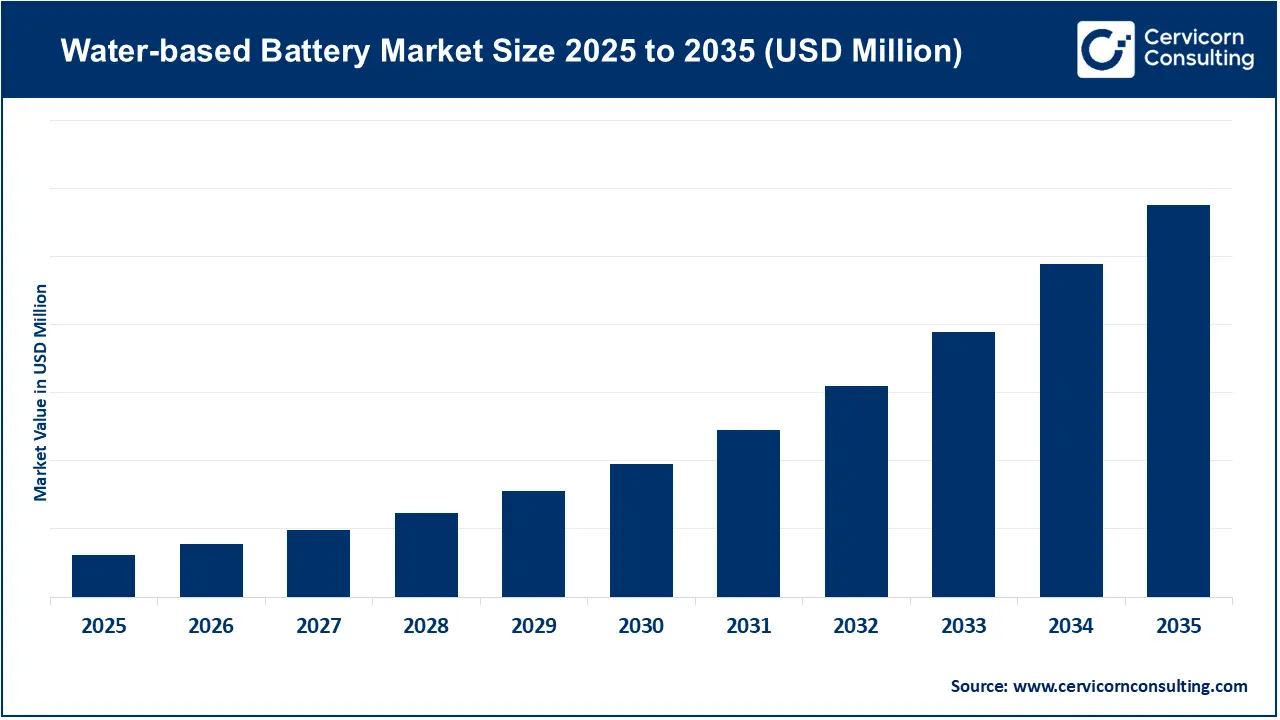
According to Cervicorn Consulting, the global water-based battery market is expanding at a 25.1% CAGR from 2026 to 2035. The market is being supported by renewable-energy integration, grid storage requirements, sustainability goals, and investment in chemistries including zinc-ion, zinc-manganese, and aqueous sodium-ion batteries.
Why are water-based batteries attracting attention?
The fundamental proposition is relatively straightforward: energy storage needs are expanding, but the requirements for stationary storage are not necessarily identical to those of electric vehicles or portable electronics.
Water-based battery technologies can use water-based electrolytes and more abundant materials such as zinc, iron, and manganese. This can potentially reduce dependence on materials associated with lithium-ion supply chains while also addressing concerns around fire safety and environmental impact.
Safety is particularly important as battery storage moves closer to homes, commercial buildings, industrial facilities, and critical infrastructure. Cervicorn’s analysis identifies safety and sustainability as important market drivers, alongside the availability of lower-cost raw materials.
The opportunity therefore extends beyond developing another battery chemistry. The larger question is where aqueous storage can deliver sufficient economic and operational value to justify deployment.
Get a Free Sample: https://www.cervicornconsulting.com/sample/2770
Grid storage is becoming a major opportunity
One of the clearest applications is grid energy storage.
As renewable generation increases, electricity systems need storage technologies that can absorb surplus power and provide electricity when generation falls. Water-based batteries are being explored for applications including peak-load management, renewable integration, microgrids, and longer-duration stationary storage.
Grid energy storage accounted for 41.2% of the water-based battery market revenue share, according to Cervicorn Consulting. On-grid systems represented 46.3%, highlighting the importance of integrating these technologies with existing electricity infrastructure. Utilities and power providers accounted for 44.5% of the market by end user.
This combination points to an important commercial opportunity: water-based batteries do not necessarily need to replace lithium-ion technology across every application. Instead, their growth can come from stationary applications where safety, material availability, cycle life, and system economics are particularly important.
Which battery chemistries are gaining attention?
Water-based batteries represent a broad technology category rather than a single chemistry.
Aqueous sodium-ion batteries held the largest battery-type share at 38.6%, according to the Cervicorn report. Their appeal comes from the potential combination of safety, cost advantages, and reduced reliance on lithium-based materials.
Zinc-ion batteries are another important area of development. Zinc is relatively abundant and can support rechargeable aqueous systems designed for stationary applications.
Zinc-manganese batteries are being developed around low-cost and stable materials, while zinc-air batteries use oxygen from the air as a cathode reactant and are being explored for longer-duration storage and off-grid applications.
Other water-based chemistries include nickel-zinc, iron-flow, and hybrid aqueous systems. This diversity means that the competitive landscape is likely to depend not only on battery chemistry but also on application requirements, system architecture, manufacturing economics, and scalability.
Renewable integration could accelerate adoption
The renewable-energy transition is creating a particularly relevant use case for water-based storage.
Solar and wind projects can produce electricity when demand is relatively low, creating a need for storage that can shift electricity availability across different periods. Water-based systems are being investigated for grid-scale storage, microgrids, and hybrid renewable installations.
Cervicorn identifies integration with renewable energy as one of the key trends shaping the market. The report also highlights grid-scale storage and rural electrification as important areas of opportunity.
This could create opportunities in markets where renewable capacity is growing alongside demand for resilient electricity infrastructure.
Asia-Pacific is already a major market
The geographic opportunity is particularly significant in Asia-Pacific.
The region accounted for 50.8% of water-based battery market revenue, supported by renewable-energy investment, urbanization, and government incentives for sustainable battery technologies. China and Japan are identified as important markets, while zinc-ion and zinc-air systems are also being explored across Japan, South Korea, and India.
For battery manufacturers and technology developers, this makes Asia-Pacific an important region to monitor—not simply because of current demand, but because of its combination of manufacturing capabilities, renewable-energy deployment, and emerging storage requirements.
North America is also seeing activity around grid and residential storage, while European markets are emphasizing sustainability and regulatory considerations. LAMEA presents additional opportunities through rural electrification and off-grid energy projects.
The technology still has a commercialization problem
High growth expectations do not eliminate the technical and commercial barriers.
One of the biggest limitations is energy density. Water-based batteries generally have lower energy density than lithium-ion systems, making them less suitable for applications where compact size and high energy output are critical.
This makes stationary storage particularly important. Grid-scale facilities, commercial storage, microgrids, and backup systems can accommodate different physical and performance requirements than electric vehicles or consumer electronics.
Another challenge is infrastructure. Existing storage installations and power systems may require modifications when adopting new battery technologies. Cervicorn’s analysis also identifies the difficulty of moving promising technologies from pilot projects to reliable, large-scale commercial production as a key market challenge.
The competitive environment is another consideration. Water-based technologies are competing for stationary-storage investment with lithium-ion, sodium-ion, solid-state, and flow-battery technologies. Developers therefore need to demonstrate not only safety or sustainability advantages but also commercially viable performance.
Where could the next opportunities emerge?
Several applications could shape the next phase of market development.
Grid-scale storage offers the largest direct opportunity as renewable generation expands and utilities seek additional flexibility.
Commercial and industrial storage could benefit where businesses require backup power, energy-cost management, and improved resilience.
Microgrids and rural electrification present another opportunity because safety, material availability, and operating economics can be particularly important in locations where conventional infrastructure is limited.
Residential storage could also expand as consumers combine solar generation with battery-based backup systems.
Finally, military, emergency, and critical-infrastructure applications are creating interest in storage technologies that prioritize safety and reliability alongside energy performance.
What does the competitive landscape look like?
The water-based battery ecosystem includes technology developers, battery manufacturers, energy-storage companies, and larger industrial players.
Companies identified in Cervicorn Consulting’s market analysis include ESS Tech, Inc., Zinc8 Energy Solutions, Redflow Limited, Primus Power, Enerpoly AB, Aquion Energy, Furukawa Electric, VRB Energy, CellCube Energy Storage Systems, Dalian Rongke Power, Sonnen, CATL, HiNa Battery Technology, and Lockheed Martin.
Recent developments also indicate increasing efforts to strengthen manufacturing and technology capabilities. For example, Cervicorn’s report highlights Enerpoly’s acquisition of Nilar’s production line and dry-electrode technology and developments involving VRB Energy’s manufacturing expansion.
For investors, manufacturers, utilities, and technology companies, the important question is therefore not simply whether water-based batteries will grow. It is which chemistries, applications, deployment models, and regions will capture that growth as the technology moves toward larger-scale commercialization.
The detailed Cervicorn Consulting analysis tracks these opportunities across battery types, applications, deployment modes, end users, regions, competitive developments, and the 2026–2035 forecast period.
To Get Detailed Overview, Contact Us: https://www.cervicornconsulting.com/contact-us
Read Report: Robotic Process Automation in Chemical Market Revenue, Trends, and Strategic Insights by 2035