Robotic Process Automation in Chemical Market Revenue, Trends, and Strategic Insights by 2035
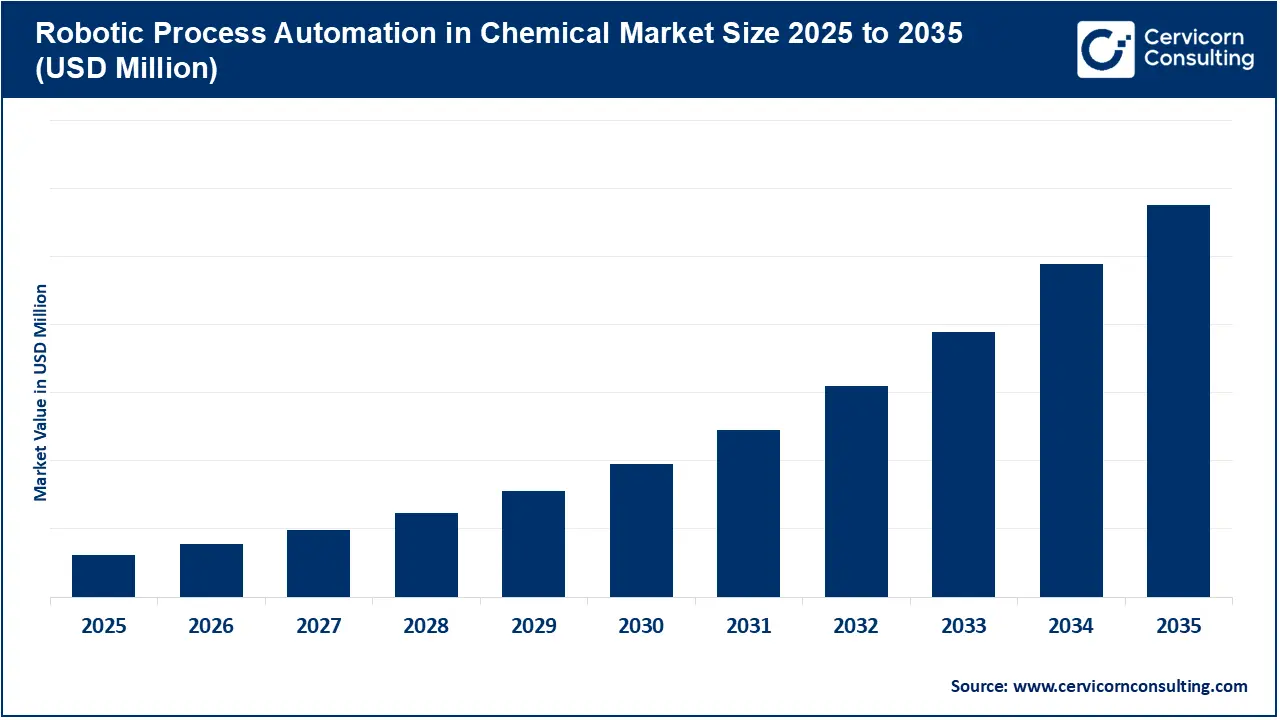
Robotic Process Automation in Chemical Market Size
The global remote monitoring and control market size was valued at USD 25.60 billion in 2025 and is projected to reach USD 34.97 billion by 2035, representing a 3.17% CAGR.
Robotic process automation in chemical market – Growth Factors
The robotic process automation (RPA) in chemical market is expanding as chemical manufacturers, specialty chemical companies, petrochemical producers, and pharmaceutical-chemical organizations increasingly digitize repetitive and data-intensive business processes. The major growth factors include the need to reduce administrative costs, improve operational accuracy, accelerate procurement and finance workflows, strengthen regulatory compliance, and integrate fragmented enterprise systems. Chemical companies manage large volumes of invoices, purchase orders, laboratory records, quality documents, shipping records, customer requests, regulatory submissions, and production-related data, creating strong opportunities for software robots to automate rule-based activities.
The increasing adoption of enterprise resource planning (ERP), manufacturing execution systems (MES), industrial Internet of Things (IIoT), cloud platforms, artificial intelligence (AI), optical character recognition (OCR), and intelligent document processing is further expanding the scope of RPA beyond basic repetitive tasks. Chemical companies are also under pressure to improve productivity while managing energy costs, sustainability requirements, supply-chain volatility, and stringent environmental and safety regulations. Government-backed digital manufacturing programs are reinforcing this transition.
For example, China’s petrochemical and chemical digital-transformation guidance specifically targets production control, inspection, quality management, equipment maintenance, safety, environmental management, energy management, supply chains, and R&D as digitalization opportunities.
Get a Free Sample: https://www.cervicornconsulting.com/sample/2768
What is robotic process automation in chemical market?
Robotic process automation in the chemical market refers to the use of software robots and automation platforms to execute repetitive, rule-based, structured, and semi-structured business processes across chemical-industry operations. Unlike physical industrial robots that manipulate materials or operate machinery, RPA software robots work with digital systems such as ERP, CRM, laboratory information management systems, spreadsheets, email platforms, procurement applications, finance systems, and regulatory databases.
In a chemical company, an RPA bot can automatically extract information from invoices, validate purchase orders, update an ERP system, reconcile financial records, prepare reports, send notifications, or transfer information between systems. When RPA is combined with OCR, AI, machine learning, natural-language processing, and document understanding, it can also handle documents that contain handwritten, scanned, or unstructured information.
The technology is particularly relevant to chemical companies because their operations generate large amounts of interconnected data. A single chemical product may involve raw-material procurement, batch production, laboratory testing, quality approval, inventory management, logistics, invoicing, customer documentation, and regulatory reporting. Automating the digital portions of these workflows can reduce manual intervention and create more consistent processes.
RPA therefore acts as a digital layer connecting existing enterprise applications without necessarily requiring organizations to replace their underlying IT infrastructure. This is important for chemical manufacturers operating legacy systems alongside newer cloud and industrial platforms.
Why is robotic process automation important in the chemical industry?
1. Reduction of repetitive administrative work
Chemical companies perform thousands of repetitive transactions involving purchase orders, invoices, shipments, inventory updates, customer records, and financial reconciliation. RPA can execute these tasks according to predefined rules, allowing employees to concentrate on analysis, process improvement, customer service, and technical activities.
2. Improved data accuracy
Manual data entry can introduce errors when information must be transferred between ERP systems, spreadsheets, laboratory platforms, and other applications. Software robots can perform standardized data-transfer tasks consistently, reducing transcription errors and improving data quality.
3. Faster regulatory and compliance processes
The chemical industry operates under extensive environmental, health, safety, transportation, product, and quality requirements. RPA can help collect information from multiple systems, generate reports, maintain documentation, and route records for approval. Automation does not eliminate the need for human compliance oversight, but it can reduce the administrative burden associated with compliance.
4. Better supply-chain coordination
Chemical supply chains can involve numerous suppliers, distributors, warehouses, transportation providers, and customers. RPA can automate supplier onboarding, purchase-order processing, shipment tracking, inventory reconciliation, and exception notifications.
5. Integration of legacy systems
Many chemical manufacturers operate complex technology environments built over several decades. RPA can interact with existing applications through their user interfaces, making it useful when direct application programming interfaces are unavailable or costly to develop.
6. Support for digital transformation
RPA can serve as an entry point into broader automation strategies involving AI, analytics, digital twins, IIoT, cloud computing, and intelligent document processing. This makes RPA particularly relevant as chemical manufacturers transition toward connected and data-driven operations.
Major companies in the robotic process automation in chemical market
UiPath
Specialization: Enterprise automation, robotic process automation, AI-powered automation, process orchestration, and intelligent document processing.
Key Focus Areas: Finance, procurement, supply chain, customer operations, document processing, regulatory workflows, IT automation, and enterprise-wide process automation.
Notable Features: UiPath combines RPA with AI, document understanding, process mining, orchestration, and automation agents. Its chemical-industry applications include invoice processing, shipping workflows, document extraction, and administrative operations.
2025 Revenue: UiPath reported fiscal-year 2025 revenue of approximately $1.43 billion for the year ended January 31, 2025.
Market Share: UiPath does not publicly disclose a specific 2025 market-share percentage for RPA within the chemical industry.
Global Presence: UiPath serves organizations across North America, Europe, Asia-Pacific, and other international markets.
A notable chemical-industry example is Clariant, where UiPath reports that approximately 50% of invoices in a pilot region were automatically processed, with around 2,500 invoices processed per month and 40,000 printouts eliminated per quarter.
Another example is LG Chem, where UiPath reports 350 tasks automated since 2019, approximately 14,000 hours saved, and processing time reduced by more than 70% for the documented use case.
Automation Anywhere
Specialization: Cloud-native RPA, intelligent automation, AI-powered digital workers, process automation, and enterprise workflow automation.
Key Focus Areas: Finance, supply chain, procurement, customer service, IT operations, document processing, shared services, and back-office automation.
Notable Features: Automation Anywhere focuses strongly on cloud-based enterprise automation and the combination of RPA with generative AI, intelligent document processing, and AI agents.
2025 Revenue: Automation Anywhere is privately held and does not provide a publicly comparable audited 2025 revenue figure equivalent to the annual-report figures available for publicly traded companies.
Market Share: A chemical-industry-specific 2025 market-share percentage is not publicly disclosed.
Global Presence: The company serves enterprises across North America, Europe, Asia-Pacific, and other international markets.
For chemical manufacturers, Automation Anywhere’s relevance is centered on automating high-volume business processes while connecting employees, enterprise applications, and AI-based automation capabilities.
SS&C Technologies / Blue Prism
Specialization: Enterprise automation, digital workers, workflow orchestration, AI, business-process automation, and intelligent automation through Blue Prism.
Key Focus Areas: Finance, shared services, operations, compliance, customer processes, document processing, and enterprise workflow orchestration.
Notable Features: Blue Prism provides digital workers capable of performing deterministic processes and is increasingly integrated with AI agents, human-in-the-loop workflows, and centralized orchestration.
2025 Revenue: SS&C Technologies reported $6.27 billion in total 2025 revenue. Blue Prism is part of SS&C and its standalone revenue is not separately reported in the company’s consolidated financial statements.
Market Share: Blue Prism’s chemical-industry-specific 2025 market share is not separately disclosed.
Global Presence: SS&C operates internationally across North America, Europe, Asia-Pacific, and other markets.
The platform is relevant to chemical companies seeking centralized automation across finance, procurement, shared services, compliance, and other administrative processes.
Pegasystems
Specialization: Intelligent automation, workflow management, customer engagement, case management, AI, and business-process orchestration.
Key Focus Areas: Customer service, operations, process management, workflow automation, decisioning, and enterprise transformation.
Notable Features: Pega combines workflow automation, case management, AI-powered decisioning, process orchestration, and robotic automation capabilities.
2025 Revenue: Pegasystems reported approximately $1.75 billion in total revenue in 2025.
Market Share: A chemical-industry-specific 2025 market-share percentage is not publicly disclosed.
Global Presence: Pega serves enterprises internationally, with operations and customers across North America, Europe, Asia-Pacific, and other regions.
For chemical companies, Pega’s value proposition extends beyond basic task automation toward orchestrating complex processes involving multiple systems, departments, and human decision points.
NICE
Specialization: Intelligent automation, customer experience, AI, workforce management, analytics, and process optimization.
Key Focus Areas: Customer operations, employee workflows, contact centers, back-office automation, analytics, and AI-enabled process management.
Notable Features: NICE combines automation with AI, cloud platforms, analytics, workforce management, and customer-interaction technologies.
2025 Revenue: NICE reported $2.945 billion in total revenue for 2025, including approximately $2.238 billion from cloud revenue.
Market Share: NICE does not publicly disclose a specific 2025 RPA market share for the chemical industry.
Global Presence: NICE generated revenue across the Americas, EMEA, and Asia-Pacific. In 2025, the company reported approximately $2.466 billion in Americas revenue, $325.1 million in EMEA revenue, and $154.7 million in APAC revenue.
Leading trends and their impact on the robotic process automation in chemical market
AI-powered intelligent automation
The RPA market is moving from simple rule-based bots toward intelligent automation. AI can classify documents, interpret natural-language requests, identify exceptions, extract information, and recommend next actions. For chemical companies, this expands automation into procurement documents, laboratory records, quality documentation, customer communications, and regulatory information.
Intelligent document processing
Chemical organizations handle invoices, certificates of analysis, safety documentation, shipping documents, purchase orders, and supplier records in numerous formats. OCR and AI-based document understanding enable RPA platforms to extract relevant information and feed it into enterprise systems.
The LG Chem example demonstrates this transition, with handwritten reports being processed using UiPath Document Understanding and automation.
RPA combined with generative AI
Generative AI is increasing the range of processes that automation platforms can address. Instead of simply following fixed rules, automated workflows can summarize information, generate responses, classify requests, and assist employees with decision-making.
For chemical companies, this could support supplier communications, technical-document summarization, customer inquiries, regulatory documentation, and internal knowledge management.
Hyperautomation
Chemical manufacturers increasingly view RPA as one component of a broader hyperautomation architecture involving AI, process mining, workflow management, APIs, IIoT, analytics, and digital twins.
This approach enables organizations to identify inefficient processes before automating them and then connect multiple automated steps into an end-to-end workflow.
Supply-chain automation
Global chemical supply chains remain exposed to transportation disruptions, raw-material price volatility, geopolitical developments, and changing demand. RPA can automate routine supply-chain processes such as order entry, supplier communication, inventory reconciliation, logistics documentation, and exception alerts.
Sustainability and energy management
Chemical manufacturers face increasing pressure to reduce energy consumption, emissions, waste, and resource intensity. RPA can automate the collection and consolidation of sustainability data from multiple operational and enterprise systems. Combined with analytics, this can improve the speed and consistency of environmental reporting.
Human-in-the-loop automation
Chemical processes often involve decisions that cannot be safely delegated entirely to software. Modern automation platforms therefore increasingly combine automated execution with human approvals. This is especially important for safety, quality, regulatory, and exception-management processes.
Successful examples of robotic process automation in the chemical market around the world
Clariant – Europe and Asia-Pacific
Clariant provides a documented example of RPA deployment within the specialty chemical industry. According to UiPath, its automation program automated nearly 50% of invoice processing in a pilot region, processed approximately 2,500 invoices per month, and eliminated 40,000 printouts per quarter through improvements to shipping processes.
The example demonstrates how RPA can create measurable value without directly changing the physical chemical-production process. Finance, invoicing, shipping, and administrative workflows can be automated around manufacturing operations.
LG Chem – South Korea
LG Chem has deployed RPA and AI-enabled document processing as part of its broader digital-transformation program. UiPath reports that 350 tasks have been automated since 2019 and approximately 14,000 hours have been saved in the documented program. Processing time was reported to have fallen by more than 70% for the highlighted application.
The example illustrates the movement from conventional RPA toward intelligent automation, where OCR and document understanding extend automation to less structured information.
BASF – Germany and international operations
BASF has also incorporated RPA and OCR into its service operations. BASF Services Europe states that digital tools including RPA and OCR are used in end-to-end processes such as automated invoice verification and processing through payment.
This demonstrates the role of RPA in centralized shared-service environments, where large transaction volumes make automation particularly relevant.
Global regional analysis
North America
North America represents an important market for RPA adoption in the chemical industry because of the region’s large base of chemical manufacturers, petrochemical companies, specialty chemical producers, technology providers, and enterprise software users.
Chemical companies in the United States and Canada are increasingly integrating RPA with cloud ERP, AI, analytics, and industrial digitalization programs. Common applications include finance, procurement, customer service, supply-chain management, HR, regulatory reporting, and document processing.
The region’s mature enterprise-technology ecosystem also supports integration between RPA platforms and AI, process-mining, workflow, and cloud technologies. The U.S. chemical sector’s focus on operational productivity, cybersecurity, regulatory compliance, and supply-chain resilience is likely to keep enterprise automation relevant.
Europe
Europe has a strong chemical manufacturing base and a regulatory environment that places substantial emphasis on environmental performance, safety, traceability, and sustainability.
The European Commission presented a 2025 action plan for the chemical industry focused on competitiveness, modernization, innovation, sustainability, energy costs, and resilience. The plan includes measures involving innovation incentives, clean-chemical demand, energy costs, and PFAS management.
These priorities create opportunities for digital technologies that improve operational efficiency and data management. RPA can support the administrative and information-management components of chemical-industry modernization, particularly in compliance documentation, procurement, finance, sustainability reporting, and supply-chain processes.
Germany, France, the Netherlands, Belgium, Italy, and other European chemical-manufacturing hubs are important areas for enterprise automation adoption.
Asia-Pacific
Asia-Pacific is an important growth region because of its large chemical manufacturing base and rapidly expanding digital-manufacturing infrastructure. China, Japan, South Korea, India, Singapore, and other economies are investing in industrial digitalization, AI, cloud computing, smart manufacturing, and connected production.
China has developed specific digital-transformation guidance for the petrochemical and chemical sector. The guidance identifies production scheduling and inspection, production control and optimization, quality management, equipment management, safety, environmental management, energy management, supply chains, and R&D as important digitalization areas. It also establishes targets for improving digital maturity, key-process numerical control, digital R&D tools, smart factories, and smart chemical parks.
China’s earlier guidance for high-quality development of the petrochemical and chemical sector also targeted higher automation levels, including a goal for major production facilities in key sectors to achieve 95% automation, alongside the development of smart manufacturing demonstration factories and smart chemical parks.
For RPA vendors, these policies create opportunities across both corporate back-office functions and digitalized industrial ecosystems.
Japan
Japan’s Society 5.0 framework promotes the integration of cyberspace and physical systems through technologies such as AI, IoT, big data, and digital twins. The Japanese government describes this approach as a way to create new value while addressing social and industrial challenges.
Japan’s Connected Industries initiative similarly emphasizes connecting people, machines, systems, and companies through advanced digital technologies.
For chemical companies, these policies support the broader digital infrastructure within which RPA can operate. RPA can automate enterprise workflows while industrial AI, IIoT, and digital twins address production-level optimization.
South Korea
South Korea has a highly developed electronics, automotive, battery, petrochemical, and advanced-materials manufacturing ecosystem. Chemical companies such as LG Chem are already using RPA and AI-enabled document technologies, illustrating how automation can be incorporated into broader digital-transformation programs.
The market opportunity extends across procurement, finance, quality documentation, supply-chain management, laboratory processes, and customer operations.
India
India’s chemical and petrochemical industries are undergoing increasing digitalization as manufacturers pursue productivity improvements, process optimization, automation, and improved supply-chain visibility.
RPA opportunities are particularly relevant to finance, procurement, order processing, vendor management, logistics documentation, regulatory reporting, customer service, and shared-service centers. India’s broader push toward digital transformation, industrial modernization, cloud adoption, AI, and smart manufacturing provides an ecosystem for enterprise automation.
Chemical manufacturers with large transaction volumes can use RPA as a relatively lightweight layer for connecting existing ERP, procurement, finance, laboratory, and logistics applications.
Government initiatives and policies shaping the market
Government policies are increasingly influencing the RPA opportunity indirectly through broader industrial digitalization, AI, smart-manufacturing, sustainability, and chemical-sector modernization initiatives.
China: The 2024–2026 petrochemical and chemical digital-transformation guidance is particularly relevant because it explicitly identifies production, inspection, quality, equipment, safety, environmental, energy, supply-chain, and R&D processes for digital transformation.
European Union: The European Commission’s 2025 action plan for the chemical industry focuses on competitiveness, modernization, innovation, sustainability, energy affordability, and resilience.
Japan: Society 5.0 and Connected Industries provide policy frameworks for integrating AI, IoT, big data, digital systems, people, machines, and businesses.
United States: U.S. industrial policy increasingly emphasizes advanced manufacturing, digital technologies, domestic production capabilities, cybersecurity, and supply-chain resilience. These priorities support the wider enterprise environment in which RPA and intelligent automation are deployed.
India: Digital manufacturing, AI adoption, Industry 4.0, cloud technologies, and modernization initiatives are creating opportunities for chemical companies to digitize administrative and operational workflows.
Future application opportunities
The next phase of the robotic process automation in chemical market is expected to move beyond isolated bots toward interconnected intelligent workflows. Chemical companies can increasingly combine RPA with process mining to identify bottlenecks, AI to interpret unstructured information, APIs to connect enterprise applications, and digital twins to improve industrial decision-making.
Potential applications include automated supplier qualification, purchase-order creation, invoice matching, laboratory-document processing, quality-record management, regulatory reporting, sustainability-data consolidation, customer onboarding, inventory reconciliation, logistics documentation, and maintenance administration.
RPA is also likely to become increasingly integrated with AI agents and human-in-the-loop workflows. SS&C’s 2025 annual report, for example, describes its Blue Prism capabilities as connecting digital workers, people, AI agents, and applications within orchestrated workflows.
This evolution could shift the chemical-industry automation market from simple task automation toward end-to-end process orchestration, where software robots, AI agents, enterprise applications, and human employees collaborate across the complete business process.
To Get Detailed Overview, Contact Us: https://www.cervicornconsulting.com/contact-us
Read Report: Immunoassays Market Revenue, Trends, and Strategic Insights by 2035