U.S. Physical AI Market Revenue, Trends, and Strategic Insights by 2035
U.S. Physical AI Market Size
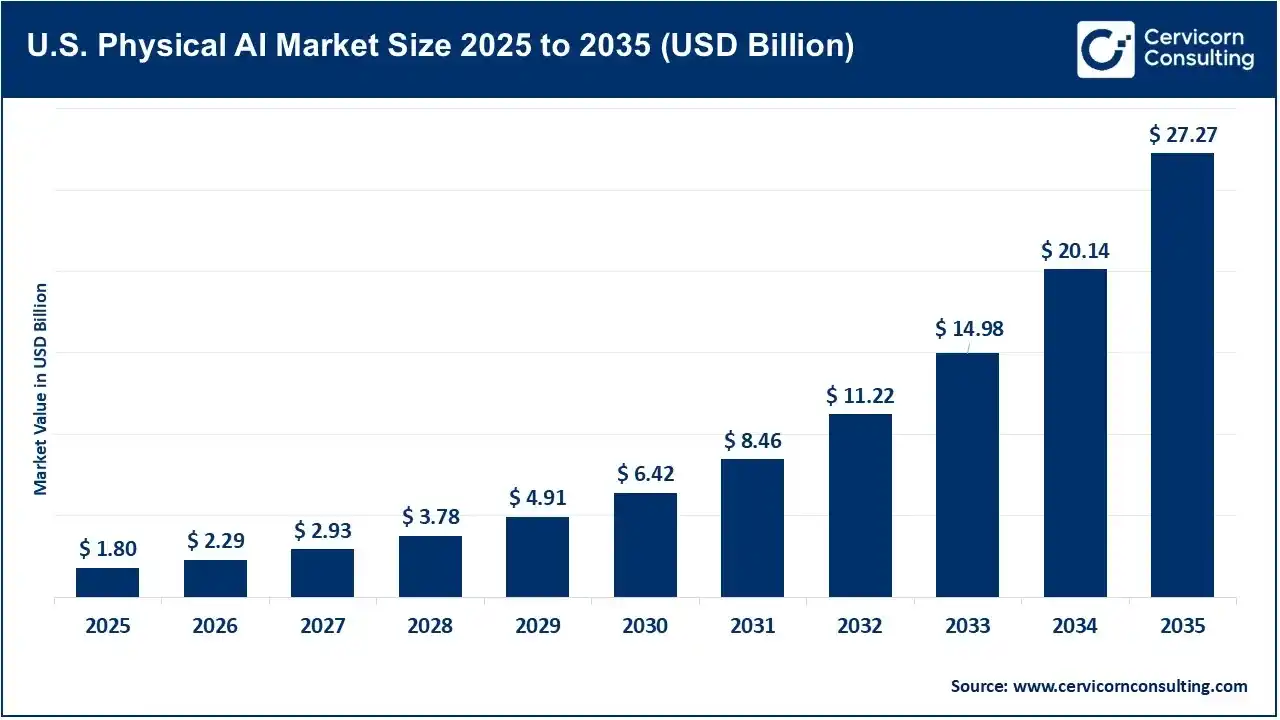
The U.S. physical AI market was valued at approximately USD 1,809 million in 2025 and is projected to reach USD 27,275 million by 2035, expanding at a CAGR of 31.7% during the forecast period.
U.S. Physical AI Market Growth Factors
The U.S. physical AI market is being driven by the convergence of artificial intelligence, robotics, computer vision, edge computing, advanced sensors, autonomous systems, digital twins, and high-performance computing. Increasing demand for intelligent automation across manufacturing, logistics, automotive, healthcare, defense, agriculture, and warehousing is encouraging businesses to move beyond conventional software AI toward systems that can perceive, reason, make decisions, and physically act in real-world environments. The rapid development of multimodal and vision-language-action models is making robots more capable of understanding natural-language instructions, recognizing objects, navigating complex environments, and performing multi-step tasks.
At the same time, labor shortages, rising operating costs, requirements for greater workplace safety, and the need for faster production and fulfillment are strengthening the economic case for autonomous machines. Investments in AI infrastructure and semiconductor manufacturing are also expanding the technological foundation required for physical AI. The United States benefits from a strong ecosystem of AI companies, robotics startups, semiconductor manufacturers, cloud providers, universities, venture capital firms, defense contractors, and technology research laboratories, creating favorable conditions for commercialization.
NVIDIA’s robotics platforms, Tesla’s humanoid robotics and autonomous-driving programs, Google’s Gemini Robotics models, Microsoft’s physical-world AI research, and Amazon’s large-scale deployment of warehouse robots demonstrate how rapidly the technology is moving from research environments into commercial operations. Government initiatives supporting domestic semiconductor production, AI infrastructure, advanced manufacturing, robotics, and national security further reinforce the country’s position in the emerging physical AI economy.
Get a Free Sample: https://www.cervicornconsulting.com/sample/3002
What Is the U.S. Physical AI Market?
Physical AI refers to artificial intelligence systems capable of interacting with and operating within the physical world. Unlike conventional AI applications that primarily process information on computers or in the cloud, physical AI combines intelligence with a physical body or autonomous machine.
A physical AI system typically integrates several technologies, including sensors, cameras, machine-learning models, computer vision, robotics, motion control, edge processors, actuators, simulation platforms, and AI foundation models. These technologies allow a machine to perceive its environment, understand what is happening, make decisions, and perform physical actions.
Examples include autonomous vehicles, humanoid robots, warehouse robots, industrial robotic arms, drones, autonomous delivery systems, intelligent agricultural machinery, robotic healthcare systems, and AI-enabled manufacturing equipment.
The U.S. physical AI market therefore encompasses a broad ecosystem rather than a single product category. It includes AI chips and computing platforms, robotics hardware, software, foundation models, simulation technologies, autonomous systems, cloud robotics, sensors, and services used to build and deploy intelligent physical machines.
Market estimates differ significantly because research companies use different definitions and include different categories of robotics and autonomous systems. One recent estimate places the U.S. physical AI market at approximately USD 1.52 billion in 2025, with the market projected to reach USD 14.13 billion by 2033 at a CAGR of 32.17%. Other research uses a broader definition of physical AI, producing substantially larger market estimates. This variation highlights the fact that physical AI is still an emerging market category rather than a standardized industry classification.
Why Is Physical AI Important?
Physical AI is important because it represents the transition from AI that generates information to AI that can directly influence the physical world.
In manufacturing, intelligent robots can identify defects, manipulate components, perform assembly tasks, and respond to changes in production environments. In logistics, physical AI can coordinate fleets of mobile robots, optimize warehouse movement, and automate repetitive material-handling activities.
The technology is particularly important for industries facing labor shortages or physically demanding working conditions. Robots can take over repetitive, dangerous, or ergonomically challenging tasks while allowing human workers to focus on supervision, maintenance, decision-making, and higher-value activities.
Physical AI also has strategic importance for the United States. Advanced robotics and autonomous systems are increasingly relevant to semiconductor manufacturing, defense, transportation, supply-chain resilience, infrastructure inspection, and space exploration.
The convergence of AI and robotics could ultimately create machines capable of adapting to unfamiliar environments instead of simply following fixed instructions. This adaptability is one of the most important differences between traditional automation and emerging physical AI.
Leading Companies in the U.S. Physical AI Market
| Company | Specialization | Key Focus Areas | Notable Features | 2025 Revenue | Physical AI Market Share |
|---|---|---|---|---|---|
| NVIDIA Corporation | AI computing and robotics platforms | AI chips, simulation, robotics, autonomous systems | Isaac, GR00T, Cosmos, Omniverse, Jetson | USD 130.5 billion | Not publicly disclosed |
| Tesla, Inc. | Autonomous mobility and humanoid robotics | Optimus, autonomous driving, robotaxis, AI hardware | Integrated AI hardware/software and large real-world data ecosystem | USD 94.83 billion | Not publicly disclosed |
| Google DeepMind | AI foundation models and embodied intelligence | Gemini Robotics, embodied reasoning, robot control | Vision-language-action models and multimodal reasoning | USD 402.84 billion* | Not publicly disclosed |
| Microsoft Corporation | Cloud AI and robotics research | Azure AI, robotics foundation models, industrial AI | MAGMA and Azure-based robotics ecosystem | USD 281.7 billion | Not publicly disclosed |
| Amazon Robotics | Warehouse robotics and intelligent logistics | Fulfillment automation, fleet intelligence, robotic manipulation | More than 1 million robots and DeepFleet | USD 716.9 billion | Not publicly disclosed |
NVIDIA Corporation
NVIDIA Corporation is one of the most influential companies in the physical AI ecosystem because it provides the computing infrastructure used to train, simulate, and operate intelligent machines.
NVIDIA’s physical AI strategy covers the entire robotics development pipeline. Its ecosystem includes NVIDIA Isaac for robotics development, Omniverse for simulation and digital twins, Cosmos for world-model development, and Jetson platforms for edge AI inference.
The company’s approach is based on using powerful computing systems to train physical AI models, simulation environments to test them, and specialized processors to run them on robots. NVIDIA describes this as a three-computer approach involving AI training, simulation, and on-robot inference.
NVIDIA also introduced Isaac GR00T models designed for humanoid robots. In 2025, the company expanded its GR00T platform and highlighted adoption by robotics developers including Agility Robotics and Boston Dynamics.
NVIDIA reported USD 130.5 billion in fiscal 2025 revenue, representing 114% year-over-year growth. Its automotive revenue reached approximately USD 1.69 billion, while its broader computing portfolio provides the infrastructure supporting physical AI applications.
Tesla, Inc.
Tesla, Inc. is approaching physical AI primarily through autonomous vehicles, robotics, and AI-enabled manufacturing.
Tesla’s strategy is built around developing machines that can perceive and interact with their surroundings. Its autonomous-driving systems rely on computer vision, neural networks, onboard computing, and continuous data collection from vehicles operating in real-world environments.
The company’s Optimus humanoid robot represents another major physical AI initiative. Optimus is intended to perform repetitive and physically demanding tasks and potentially operate in manufacturing environments before expanding into broader applications.
Tesla’s vertically integrated approach is particularly significant because the company designs vehicles, develops AI software, produces specialized computing hardware, operates manufacturing facilities, and collects data from deployed systems.
Tesla generated USD 94.83 billion in total revenue in 2025, including USD 69.53 billion from automotive revenues, USD 12.77 billion from energy generation and storage, and USD 12.53 billion from services and other activities.
Google DeepMind
Google DeepMind is contributing to physical AI primarily through foundation models that provide robots with advanced perception, reasoning, and action capabilities.
In March 2025, Google DeepMind introduced Gemini Robotics and Gemini Robotics-ER. Gemini Robotics is a vision-language-action model designed to translate visual information and instructions into robotic actions, while Gemini Robotics-ER focuses on embodied reasoning and spatial understanding.
Google subsequently introduced Gemini Robotics On-Device, designed to run efficiently directly on robotic devices rather than relying entirely on cloud infrastructure.
The company’s work demonstrates an important market trend: physical AI is moving toward general-purpose foundation models capable of supporting multiple robot embodiments and different tasks.
Because DeepMind is part of Alphabet, it does not disclose standalone revenue. Alphabet reported USD 402.836 billion in 2025 consolidated revenue, up 15% from 2024.
Microsoft Corporation
Microsoft Corporation is building physical AI capabilities through its cloud infrastructure, AI models, research programs, and partnerships with industrial robotics companies.
Microsoft Research introduced MAGMA, a multimodal AI foundation model designed to operate across digital and physical environments. The model is intended to help AI systems interpret physical environments and generate action proposals for robotic systems.
Microsoft is also using Azure AI technologies to support industrial robotics. Its collaboration with KUKA, for example, uses Azure OpenAI and AI Search to help simplify robot programming. Microsoft reported that the approach could make programming up to 80% faster for certain simple tasks.
Microsoft reported USD 281.7 billion in fiscal 2025 revenue, representing 15% year-over-year growth.
Amazon Robotics
Amazon has one of the world’s largest real-world physical AI deployments through Amazon Robotics.
Amazon has progressively expanded robotics across fulfillment centers, using autonomous mobile robots, robotic arms, intelligent sorting systems, and AI-based fleet coordination. In 2025, Amazon announced deployment of its one millionth robot and introduced DeepFleet, an AI foundation model designed to coordinate robotic movement across its fulfillment network.
Amazon said DeepFleet could improve robotic fleet travel efficiency by approximately 10%.
Amazon has also introduced Vulcan, a robot incorporating touch sensing to handle items in difficult-to-reach storage locations. This illustrates the evolution from basic warehouse automation toward systems that combine perception, sensing, decision-making, and physical manipulation.
Amazon reported USD 716.9 billion in net sales in 2025, up 12% from 2024.
Leading Trends in the U.S. Physical AI Market and Their Impact
1. Humanoid Robots
Humanoid robotics is becoming one of the most visible areas of physical AI. Companies are developing robots capable of operating in environments designed for humans, including factories, warehouses, and eventually homes.
Tesla’s Optimus and NVIDIA’s GR00T ecosystem are examples of this trend. Humanoid robots could reduce the need to redesign facilities specifically for automation because they can potentially use existing tools and workspaces.
The major impact will be greater flexibility compared with traditional single-purpose industrial robots.
2. Vision-Language-Action Models
Physical AI is increasingly shifting toward models that combine visual understanding, language comprehension, reasoning, and physical action.
Google DeepMind’s Gemini Robotics illustrates this direction. Rather than programming every individual movement, developers can increasingly provide high-level instructions and allow AI models to determine how a robot should execute them.
This could significantly reduce robot programming costs and make robotics accessible to organizations without large specialized engineering teams.
3. AI-Powered Autonomous Vehicles
Autonomous vehicles represent one of the largest commercial applications of physical AI. Self-driving systems continuously perceive roads, vehicles, pedestrians, traffic signals, and environmental conditions before making driving decisions.
The development of autonomous vehicles is also contributing to advances in computer vision, sensor fusion, edge computing, mapping, and decision-making algorithms that can be transferred to other physical AI applications.
4. Simulation and Digital Twins
Physical AI systems require extensive training and testing, but collecting real-world training data can be expensive and potentially dangerous.
Simulation environments allow developers to create digital versions of factories, warehouses, vehicles, and robots. NVIDIA’s Omniverse and Cosmos ecosystem illustrates how simulation and world models can help developers train and test AI systems before deploying them in real environments.
The growing use of simulation is expected to reduce development cycles and improve safety.
5. Edge AI and On-Device Intelligence
Many physical AI applications cannot depend entirely on cloud connectivity because robots and autonomous vehicles need extremely low-latency decision-making.
Edge AI enables models to process sensor data directly on machines. Google’s Gemini Robotics On-Device is one example of the industry’s movement toward local robotic intelligence.
The trend will increase demand for energy-efficient AI processors, specialized inference hardware, and optimized models.
6. Intelligent Warehousing
Warehousing is among the most commercially mature physical AI applications.
Amazon’s deployment of more than one million robots demonstrates how AI-enabled robotics can operate at massive scale. DeepFleet further illustrates how AI can optimize not only individual machines but entire robot fleets.
This trend is likely to influence third-party logistics providers, retailers, distribution centers, and manufacturing companies.
7. AI-Enabled Manufacturing
Manufacturers are increasingly combining industrial robots with AI-based perception and decision-making.
Traditional robots are highly effective at repetitive tasks but can struggle with unpredictable environments. Physical AI can help robots recognize different objects, adapt to variations, inspect products, and collaborate with workers.
This could accelerate the transition from fixed automation to flexible manufacturing systems.
Successful Examples of the U.S. Physical AI Market Around the World
The U.S. physical AI ecosystem is already influencing applications outside the country.
Amazon’s global robotic fulfillment network is one of the clearest examples. Amazon’s robotics infrastructure extends across hundreds of facilities internationally, demonstrating how U.S.-developed robotics and AI technologies can be deployed across different markets. In 2025, Amazon said its one-millionth robot joined a network spanning more than 300 facilities worldwide.
NVIDIA’s robotics ecosystem is another global example. The company provides computing, simulation, and AI platforms used by robotics developers internationally. Its Isaac ecosystem has been adopted by multiple robot manufacturers and technology companies.
Google DeepMind’s robotics models demonstrate another form of international influence. Gemini Robotics is being developed as a general-purpose model that can potentially support different robotic embodiments and applications. The technology is designed around multimodal perception, reasoning, and action rather than a single robot configuration.
Microsoft’s industrial AI ecosystem is also extending physical AI capabilities into global manufacturing through partnerships such as KUKA. Azure-based AI tools can help industrial companies program and simulate robotic systems more efficiently.
These examples show that U.S. physical AI leadership does not depend solely on manufacturing robots domestically. It also includes the development of chips, AI models, simulation platforms, cloud infrastructure, software, and robotics ecosystems that can be deployed globally.
Government Initiatives and Policies Shaping the U.S. Physical AI Market
Government policy is becoming an important factor in the development of the U.S. physical AI industry because the technology depends on advanced semiconductors, AI infrastructure, manufacturing capabilities, research, and national-security applications.
CHIPS and Science Act
The CHIPS and Science Act is particularly relevant because physical AI systems require high-performance processors, sensors, memory, and advanced semiconductor packaging.
U.S. Department of Commerce programs under the CHIPS Act have supported domestic semiconductor manufacturing and advanced packaging. For example, the Commerce Department announced awards involving semiconductor materials, manufacturing equipment, and advanced packaging capabilities in 2025.
A stronger domestic semiconductor ecosystem can reduce supply-chain vulnerabilities and improve access to components required for robotics and edge AI.
U.S. AI Leadership Policies
In January 2025, the White House issued an executive order focused on removing barriers to American AI innovation and maintaining U.S. leadership in AI. The order called for an AI Action Plan covering innovation, infrastructure, and national security.
This policy direction is relevant to physical AI because robotics depends heavily on AI models, computing infrastructure, data, and advanced hardware.
America’s AI Action Plan
In July 2025, the White House released America’s AI Action Plan, outlining more than 90 federal policy actions across three major pillars: accelerating innovation, building American AI infrastructure, and strengthening international diplomacy and security.
The emphasis on AI infrastructure can indirectly support physical AI by expanding access to computing, data centers, semiconductor technologies, and AI development capabilities.
AI Export Strategy
The U.S. government also introduced policies aimed at promoting the export of American AI technologies. The July 2025 executive order on exporting the American AI technology stack sought to support global deployment of U.S.-origin AI technologies, including hardware, models, software, applications, and standards.
For physical AI, this could create opportunities for American companies to export complete technology ecosystems involving chips, robotics software, simulation tools, cloud services, and AI models.
AI in Manufacturing and Critical Infrastructure
The National Institute of Standards and Technology announced a USD 20 million investment in two centers focused on AI applications in manufacturing and critical infrastructure. The initiative is intended to accelerate AI adoption in American manufacturing and improve industrial competitiveness.
Such programs are particularly relevant to physical AI because manufacturing and critical infrastructure are among the sectors where autonomous systems, intelligent robots, predictive maintenance, and AI-enabled inspection can generate significant economic benefits.
AI and Scientific Discovery
The Genesis Mission, launched in 2025, also highlights the growing connection between AI, high-performance computing, scientific research, and robotic laboratories. The initiative directs the Department of Energy to develop an AI experimentation platform integrating national laboratory supercomputers, scientific data, foundation models, and robotic laboratories.
This approach could support the development of autonomous scientific experimentation, intelligent laboratory systems, and AI-driven physical research.
Future Outlook for the U.S. Physical AI Market
The U.S. physical AI market is entering a period in which research breakthroughs are increasingly being connected to real commercial deployments. The next stage of development is likely to focus less on isolated demonstrations and more on reliability, scalability, safety, cost efficiency, and measurable business outcomes.
Robots will increasingly need to operate for long periods in unpredictable environments, understand natural-language instructions, cooperate with humans, and learn new tasks without extensive reprogramming. This will increase demand for foundation models, synthetic training data, world models, simulation platforms, advanced sensors, edge computing, and efficient robotic hardware.
The competitive landscape is also likely to broaden. Large technology companies such as NVIDIA, Tesla, Google, Microsoft, and Amazon provide significant infrastructure and commercialization capabilities, while specialized robotics companies and startups are developing humanoid robots, autonomous systems, industrial platforms, and new robotic applications.
The U.S. advantage is therefore not limited to the number of robots produced. Its broader strength lies in the combination of AI research, semiconductor technology, cloud computing, venture capital, robotics engineering, software ecosystems, universities, national laboratories, and large commercial technology platforms.
As these components increasingly converge, physical AI is positioned to become a major technology layer across manufacturing, transportation, logistics, healthcare, defense, infrastructure, and consumer applications.
To Get Detailed Overview, Contact Us: https://www.cervicornconsulting.com/contact-us
Read Report: Japan Physical AI Market Revenue, Trends, and Strategic Insights by 2035