Construction Technology Market Revenue, Trends, and Strategic Insights by 2035
Construction Technology Market Size
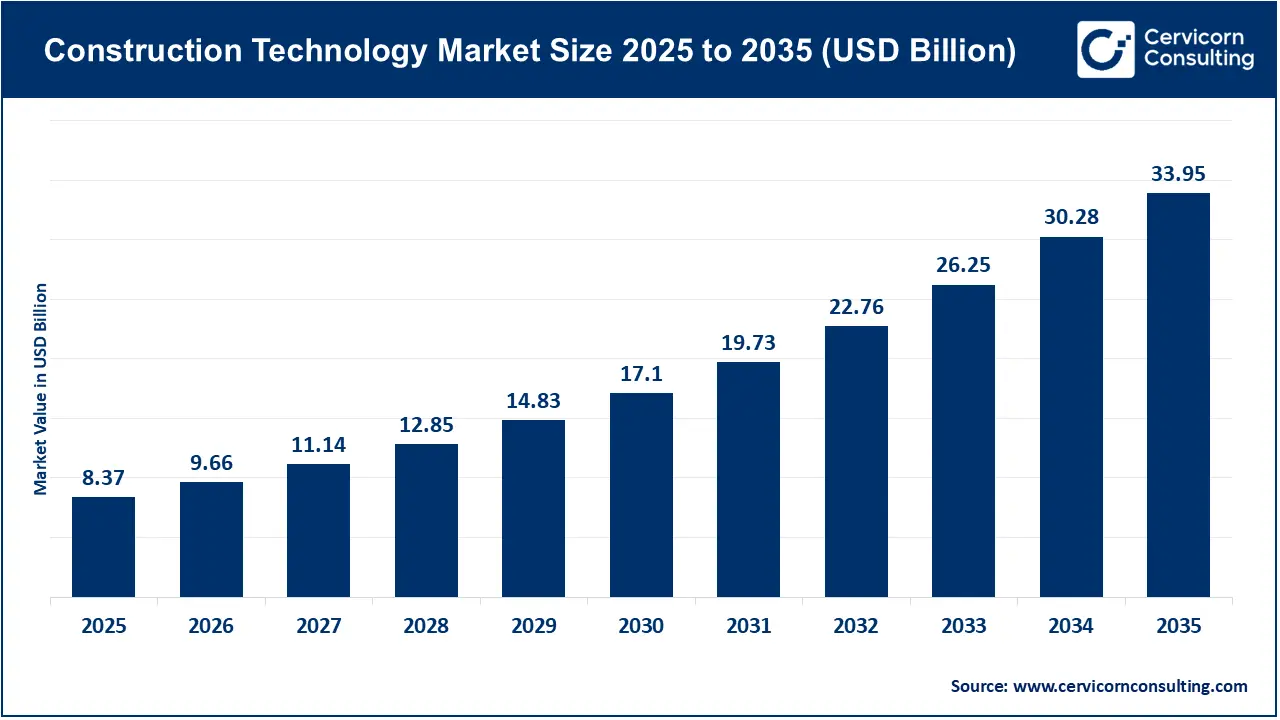
The global construction technology market reached approximately USD 8.37 billion in 2025 and is projected to reach USD 33.95 billion by 2035, expanding at a CAGR of about 15.03% during the forecast period. The market is being supported by growing digitalization, labor shortages, increasing infrastructure investments, sustainability requirements, demand for real-time project visibility, and the adoption of automated construction equipment.
Construction Technology Market Growth Factors
The construction technology market is expanding because construction organizations are under increasing pressure to deliver projects faster, safer, more sustainably, and within tighter budgets, while labor shortages and fragmented project workflows are encouraging investment in automation and digital tools. Building Information Modeling is becoming a foundational technology because it enables architects, engineers, contractors, owners, and facility managers to work from coordinated digital information rather than disconnected drawings and spreadsheets.
At the same time, artificial intelligence is improving design optimization, estimating, scheduling, risk prediction, document analysis, and construction-site monitoring, while IoT sensors and connected equipment provide real-time information about workers, machinery, materials, environmental conditions, and project progress. Cloud platforms are also enabling geographically distributed teams to access the same project information, reducing communication gaps and improving collaboration. Digital twins are extending the value of BIM beyond design and construction into asset operation and predictive maintenance.
In addition, robotics, autonomous equipment, drones, computer vision, 3D printing, and reality capture are helping contractors address productivity and skilled-labor challenges. Government investments in infrastructure and policies promoting BIM, digital permitting, open data standards, and digital project delivery are further accelerating market development. Sustainability is another important catalyst because construction companies increasingly need digital tools to measure materials, carbon emissions, energy performance, waste, and lifecycle impacts.
Get a Free Sample: https://www.cervicornconsulting.com/sample/2715
What Is the Construction Technology Market?
The construction technology market, commonly referred to as ConTech, encompasses technologies, software, hardware, platforms, equipment, and digital services designed to improve construction planning, design, procurement, project execution, inspection, safety, asset management, and facility operations.
Unlike traditional construction practices that depend heavily on paper documents, manual measurements, spreadsheets, disconnected software, and physical inspections, construction technology creates a more integrated digital workflow.
Major technologies included in the market are:
- Building Information Modeling (BIM)
- Construction management software
- Cloud collaboration platforms
- Artificial intelligence and machine learning
- Digital twins
- IoT and connected job sites
- Drones and aerial surveying
- Robotics and autonomous construction equipment
- 3D printing and additive construction
- Augmented and virtual reality
- Computer vision and reality capture
- GPS and geospatial technologies
- Project scheduling and cost-management platforms
- Digital permitting and compliance systems
Why Is the Construction Technology Market Important?
Construction technology is important because the traditional construction industry faces persistent productivity, labor, safety, cost, and coordination challenges. Construction projects involve large numbers of stakeholders, including owners, architects, engineers, general contractors, subcontractors, suppliers, inspectors, regulators, and facility managers. Without integrated information systems, project information can become fragmented across different teams.
Digital construction platforms help create a common information environment where project participants can access current designs, schedules, cost information, documents, field observations, and asset data.
BIM allows teams to identify design conflicts before construction begins. Cloud-based collaboration platforms provide real-time access to project information. Computer vision can monitor progress against planned schedules. Drones can survey large areas more quickly than traditional methods. AI can analyze project documents and identify potential risks. Digital twins can connect physical infrastructure with live operational information.
The importance of construction technology is also increasing because governments are investing heavily in transportation, housing, renewable energy, utilities, smart cities, and other infrastructure. Large and complex projects require sophisticated tools to coordinate information and control costs.
Leading Companies in the Construction Technology Market
| Company | Specialization | Key Focus Areas | Notable Features | 2025 Revenue | Market Share* | Global Presence |
|---|---|---|---|---|---|---|
| Trimble Inc. | Positioning, construction software, geospatial technology | BIM, field management, machine control, surveying, connected construction | GNSS, robotic total stations, Tekla, Trimble Construction Cloud, machine control | USD 3.59B | 22.3% | North America, Europe, Asia-Pacific, Latin America, Middle East and Africa |
| Autodesk Inc. | Design and construction software | BIM, design, estimating, project collaboration, construction management | Revit, AutoCAD, Civil 3D, Forma, Autodesk Construction Cloud | USD 6.13B | 30.2% | North America, Europe, Asia-Pacific and global markets |
| Bentley Systems | Infrastructure engineering software | Digital twins, civil engineering, infrastructure asset management | iTwin, OpenRoads, OpenBuildings, ProjectWise, AI-enabled infrastructure tools | USD 1.50B | 12.0% | Americas, Europe, Middle East, Africa and Asia-Pacific |
| Hilti Group | Construction tools, equipment and digital construction solutions | Productivity, fastening, field workflows, asset management, safety | ON!Track, Fleet Management, connected tools, construction software | CHF 6.3B | N/R | More than 120 countries |
| Oracle Corporation | Enterprise construction and project-management technology | Project controls, construction management, ERP, supply chain, cloud | Primavera, Aconex, Oracle Construction and Engineering | USD 57.4B | 7.8% | Global |
Trimble Inc.
Trimble is one of the most prominent technology providers serving the construction sector, combining positioning technologies, field systems, software, connected equipment, and construction data. Its portfolio spans surveying, machine control, BIM, structural engineering, field management, project collaboration, and construction lifecycle management.
Trimble reported USD 3.587 billion in revenue for fiscal 2025. Its Architecture, Engineering, Construction and Operations ecosystem is supported by technologies such as Tekla, Trimble Connect, field systems, positioning solutions, and construction management applications.
Its major competitive strength is the ability to connect physical construction activities with digital models. GNSS positioning, robotic total stations, machine control, reality capture, and software can work together to improve field productivity and accuracy.
Autodesk Inc.
Autodesk is a major provider of design and construction software and has developed a broad ecosystem spanning architecture, engineering, construction, manufacturing, and media.
Autodesk reported USD 6.131 billion in fiscal 2025 revenue. Its Architecture, Engineering, Construction and Operations product family generated approximately USD 2.937 billion in fiscal 2025. Autodesk’s construction portfolio includes Revit, Civil 3D, AutoCAD, Forma, Autodesk Construction Cloud, BIM Collaborate, Build, Docs, and Takeoff.
Autodesk’s strength lies in connecting design information with construction workflows, allowing BIM models to support estimating, coordination, documentation, scheduling, and project execution.
Bentley Systems
Bentley Systems specializes in infrastructure engineering software and is particularly influential in roads, railways, bridges, utilities, water infrastructure, industrial facilities, and other large infrastructure projects.
Bentley generated approximately USD 1.502 billion in revenue in 2025, with subscription revenue representing the majority of sales.
Its iTwin technology supports digital-twin applications, while ProjectWise supports project collaboration and information management. OpenRoads, OpenBuildings, and other engineering solutions help infrastructure owners and engineering firms manage complex assets throughout their lifecycle.
Hilti Group
Hilti has traditionally been recognized for professional construction tools, fastening systems, drilling equipment, and job-site solutions, but its technology strategy increasingly combines hardware, software, services, and data.
Hilti reported CHF 6.3 billion in sales in 2025, with approximately 34,420 employees globally. Sales grew in local currencies despite challenging market conditions, with particularly strong growth in the Americas and Middle East/Africa.
Digital solutions such as asset tracking, fleet management, connected tools, and productivity software enable contractors to manage equipment and field operations more efficiently. Hilti’s acquisition of 4PS also strengthened its construction business software capabilities.
Oracle Corporation
Oracle is an important enterprise technology provider for large construction companies, infrastructure owners, engineering firms, and contractors. Its construction portfolio is centered on project controls, enterprise resource planning, supply chain management, collaboration, and cloud infrastructure.
Oracle’s Primavera solutions are widely used for planning and scheduling, while Aconex supports project collaboration and document management.
Oracle reported USD 57.4 billion in total fiscal 2025 revenue, although this figure represents the entire company rather than construction technology revenue.
Oracle’s competitive advantage is its ability to integrate construction project management with enterprise finance, procurement, supply chain, and cloud systems.
Leading Trends in Construction Technology and Their Impact
1. Artificial Intelligence and Generative AI
AI is rapidly becoming one of the most important trends in ConTech. Construction companies are using AI to analyze documents, identify project risks, optimize schedules, estimate costs, detect safety issues, and automate repetitive administrative tasks.
Generative AI can also support design exploration by evaluating multiple layouts and construction alternatives. The impact is a shift from reactive project management toward predictive decision-making.
2. Digital Twins
Digital twins are evolving from static 3D representations into dynamic systems connected to real-world data. Sensors, IoT devices, BIM models, GIS information, and operational data can be combined to create a continuously updated digital representation of an asset.
For owners, this can support predictive maintenance, energy management, asset monitoring, and lifecycle optimization.
3. BIM Beyond 3D Modeling
BIM adoption is increasingly moving toward 4D, 5D, 6D, and lifecycle applications. Four-dimensional BIM adds scheduling, while 5D connects models with costs. Higher dimensions can incorporate sustainability, asset management, and operational information.
This makes BIM increasingly valuable throughout the project lifecycle rather than only during design.
4. Connected Construction Sites
IoT sensors and connected equipment are transforming job sites into data-generating environments. Sensors can monitor equipment utilization, worker locations, environmental conditions, material movement, and project progress.
The result is better visibility and faster decision-making.
5. Robotics and Autonomous Equipment
Construction companies are experimenting with autonomous excavators, robotic layout systems, bricklaying robots, robotic demolition equipment, and automated surveying.
Robotics can reduce exposure to dangerous tasks while helping contractors compensate for skilled-labor shortages.
6. Drones and Reality Capture
Drones equipped with cameras, LiDAR, and other sensors can capture detailed information about large construction sites. Reality-capture technology allows project teams to compare actual site conditions with BIM models and planned designs.
This can improve progress tracking, surveying, inspection, and quality assurance.
7. Cloud-Based Construction Platforms
Cloud technology has become a fundamental component of modern construction workflows. Instead of storing documents and project data in isolated systems, cloud platforms allow stakeholders to access shared information remotely.
This is particularly important for projects involving multiple contractors, locations, and supply-chain participants.
8. Sustainable and Low-Carbon Construction Technology
Digital technologies are increasingly being used to measure embodied carbon, optimize materials, reduce construction waste, and monitor energy performance.
As environmental regulations and green-building requirements become stricter, digital documentation of sustainability performance is becoming increasingly important. The European Union, for example, is supporting BIM and digital construction partly because of their potential to improve resource efficiency and sustainability.
Successful Examples of Construction Technology Around the World
Singapore – CORENET X and BIM-Based Approvals
Singapore has become one of the leading examples of government-supported construction digitalization. The Building and Construction Authority has developed CORENET X, a digital platform designed to simplify regulatory approvals through coordinated digital submissions.
Under the system, projects above specified thresholds submit coordinated BIM information, allowing regulators and project teams to work from common digital models. Singapore estimates that BIM-based submissions can reduce approval times by approximately 20% to 25%. CORENET X became mandatory for new projects with gross floor area of at least 30,000 square meters from October 2025, with broader implementation scheduled thereafter.
Japan – i-Construction and BIM/CIM
Japan is using BIM/CIM and i-Construction to improve productivity and automation in infrastructure development. The Ministry of Land, Infrastructure, Transport and Tourism has established BIM/CIM standards and guidelines covering digital models across surveying, design, construction, and maintenance.
Japan’s i-Construction 2.0 program targets at least 30% reduction in labor requirements at construction sites and a 1.5-times improvement in productivity by 2040.
Japan’s approach demonstrates how government policy can connect BIM, automation, digital data, and infrastructure productivity.
United States – Advanced Digital Construction Management Systems
In the United States, the Federal Highway Administration has promoted digital project delivery, BIM, 3D models, digital as-builts, and other technologies.
The Advanced Digital Construction Management Systems program, supported by the Bipartisan Infrastructure Law, provides federal funding to encourage states to adopt digital construction technologies. In 2023, FHWA announced USD 34 million in grants for 10 projects across 10 states, within an overall five-year USD 85 million program.
FHWA’s Integrated Digital Project Delivery initiative is also promoting shared digital models, cloud platforms, open data formats, and digital information that can move from planning through construction and asset management.
United Kingdom – BIM and Digital Built Britain
The UK has been an early leader in government-led BIM adoption. The UK Government Construction Strategy established collaborative BIM as a minimum requirement for centrally procured government projects by 2016.
The government’s Transforming Infrastructure Performance roadmap describes BIM as an important component of digital transformation and information management across the built environment.
The UK’s Digital Built Britain initiative further expanded the concept toward smart infrastructure, connected information, sensors, and whole-life asset management.
Dubai – BIM-Based Building Permits
Dubai provides another example of construction technology being integrated directly into regulatory processes. Dubai Municipality has introduced BIM-based requirements for certain large, specialized, and government projects.
The municipality’s digital permitting environment integrates BIM with automated design auditing and compliance processes. In 2025, Dubai Municipality reported that integrating BIM into automated audits improved submission quality and reduced errors and duplication.
Global Regional Analysis and Government Initiatives
North America
North America remains one of the most mature construction technology markets because of strong software adoption, established construction technology vendors, venture investment, infrastructure spending, and demand for productivity improvements.
The United States is particularly important for construction management software, BIM, cloud collaboration, AI, robotics, drones, and connected equipment. Canada is also investing in digital construction, BIM, infrastructure modernization, and sustainability.
Government infrastructure programs are creating additional demand. The U.S. FHWA’s ADCMS program is supporting digital construction technologies including computer modeling, 3D design, IoT, mobile systems, and lifecycle asset management.
The region is also benefiting from labor shortages. Contractors increasingly view automation, computer vision, machine control, and connected equipment as ways to improve productivity without relying solely on additional labor.
Europe
Europe is characterized by strong emphasis on BIM standards, sustainability, energy efficiency, carbon reduction, and digital public procurement.
The European Commission supports BIM adoption through the BIM and Public Procurement Community, which aims to encourage broader use of BIM in public construction projects across EU Member States.
BIM maturity varies considerably across Europe. Denmark has had mandatory BIM requirements for public construction since 2007, while countries including Italy and Lithuania have introduced mandates for certain public projects. Germany has also developed strategies for BIM implementation in federal buildings.
European construction technology growth is therefore strongly connected to public procurement, standardized digital information, sustainability regulations, and lifecycle asset management.
Asia-Pacific
Asia-Pacific is one of the fastest-growing regions for construction technology. According to Mordor Intelligence, Asia-Pacific represented approximately 33.25% of construction technology market revenue in 2025 and is projected to record a CAGR of about 14.31% through 2031.
China, Japan, India, South Korea, Singapore, and Australia are major markets.
China’s massive infrastructure development and smart-city programs are creating demand for BIM, digital twins, robotics, prefabrication, and construction automation. Japan is emphasizing productivity improvement through i-Construction and BIM/CIM. Singapore is advancing BIM-based regulatory submissions and Integrated Digital Delivery.
India represents another major opportunity because of infrastructure development, urbanization, transportation projects, industrial development, housing, and smart-city initiatives. India’s Economic Survey has highlighted that construction remains relatively less digitalized while noting growing use of technology across infrastructure planning and asset management.
The National Infrastructure Pipeline has also created a large project ecosystem across roads, railways, energy, urban infrastructure, and other sectors, supporting long-term demand for digital project-management and construction technologies.
Latin America
Latin America is an emerging construction technology market where adoption is being driven by infrastructure modernization, urban development, renewable energy projects, mining infrastructure, and the need to improve productivity.
Brazil, Mexico, Chile, Colombia, and Argentina represent important markets. Adoption is generally stronger among large infrastructure contractors and multinational engineering companies, while smaller contractors face challenges related to technology costs, skills, and fragmented workflows.
Cloud-based platforms, mobile field management, drones, BIM, and digital surveying are particularly attractive because they can improve project visibility without requiring organizations to establish extensive physical IT infrastructure.
Middle East and Africa
The Middle East is becoming an important market for construction technology because of large-scale urban development, tourism projects, transportation infrastructure, smart cities, and national diversification programs.
The UAE, Saudi Arabia, Qatar, and other Gulf markets are investing heavily in digital construction. Dubai’s BIM-based permitting and automated design-checking initiatives demonstrate how construction technology can become integrated into government workflows.
Saudi Arabia is also developing digital-twin capabilities. The Saudi Digital Government Authority describes digital twins as representations of physical assets and processes that can integrate IoT, AI, big-data analytics, and cloud technologies.
Africa is at an earlier stage of adoption but offers long-term opportunities through infrastructure development, urbanization, renewable-energy projects, transportation networks, and housing requirements. Mobile-first construction management platforms and cloud solutions may be particularly relevant because they can overcome some limitations associated with traditional IT infrastructure.
Government Initiatives and Policies Shaping the Construction Technology Market
Government policies are becoming one of the most important structural drivers of construction technology adoption because public authorities increasingly use digital requirements in procurement, permitting, infrastructure delivery, and asset management.
United Kingdom: The UK BIM mandate established a foundation for collaborative BIM in government construction and subsequently evolved toward broader information-management standards and digital infrastructure strategies.
Singapore: CORENET X is transforming regulatory submissions by using coordinated BIM information. Mandatory adoption is being phased in based on project size and lifecycle requirements.
Japan: i-Construction 2.0 combines BIM/CIM, digital data, automation, and productivity improvement, with a target of reducing construction-site labor requirements by at least 30% by 2040.
United States: The Bipartisan Infrastructure Law supports the Advanced Digital Construction Management Systems program, providing funding for digital construction and project-delivery technologies.
European Union: The EU BIM and Public Procurement initiative encourages Member States to increase BIM adoption in public construction while promoting interoperability, standardization, sustainability, and transparency.
India: Infrastructure programs such as the National Infrastructure Pipeline and digital infrastructure initiatives are encouraging greater use of technology in planning, monitoring, and management of large infrastructure projects. India’s Economic Survey has specifically identified digitalization as an opportunity to address inefficiencies in the construction and infrastructure sector.
UAE: Dubai Municipality has integrated BIM into building-permit workflows for specified categories of major projects, with automated auditing and digital submission capabilities supporting faster and more coordinated approvals.
These policies demonstrate an important evolution in the construction technology market: governments are moving beyond simply encouraging digitalization and are increasingly embedding digital requirements directly into procurement, permitting, infrastructure delivery, and asset-management processes. This creates a stronger and more predictable market for BIM software, digital twins, cloud collaboration platforms, reality capture, AI, IoT, and construction automation.
To Get Detailed Overview, Contact Us: https://www.cervicornconsulting.com/contact-us
Read Report: U.S. Long Term Care Market Revenue, Trends, and Strategic Insights by 2035