Specialty Fertilizer Market Revenue, Trends, and Strategic Insights by 2035
Specialty Fertilizer Market Overview
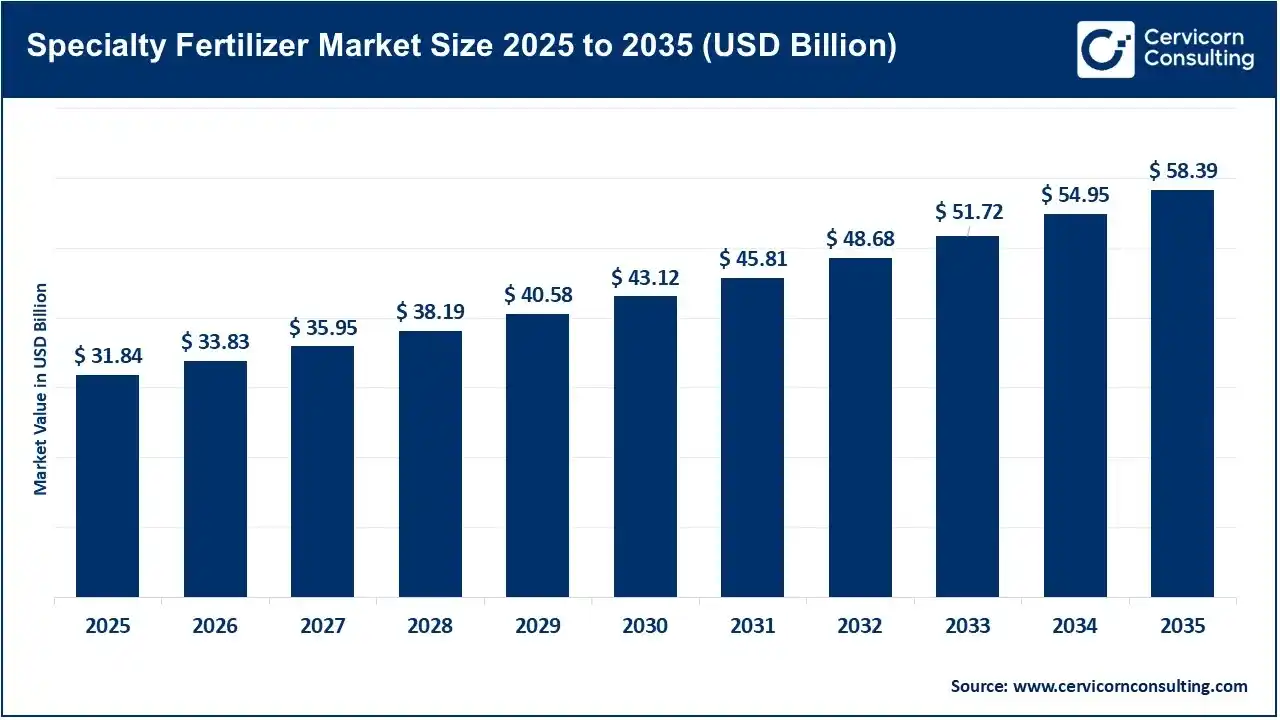
The global specialty fertilizers market was valued at approximately USD 31.84 billion in 2025 and is projected to reach around USD 58.39 billion by 2035, expanding at a CAGR of approximately 6.25% during the forecast period.
Unlike commodity fertilizers that primarily focus on supplying nitrogen, phosphorus, and potassium in bulk, specialty fertilizers are increasingly associated with precision nutrient delivery. Their value proposition is based on applying the right nutrient, at the right concentration, at the right time, and through the most appropriate application method. This makes the segment closely connected with precision agriculture, fertigation, protected cultivation, high-value crops, and sustainable farming.
Specialty Fertilizer Market Growth Factors
The specialty fertilizer market is growing because of increasing global food demand, shrinking availability of arable land, nutrient deficiencies in agricultural soils, rising adoption of precision agriculture, expansion of greenhouse and protected cultivation, growing demand for fruits and vegetables, increasing water scarcity, and the need to improve nutrient-use efficiency. Farmers are increasingly shifting from simply maximizing fertilizer volume toward maximizing nutrient productivity, creating opportunities for controlled-release, water-soluble, micronutrient, customized, foliar, and fertigation fertilizers.
Government programs promoting balanced nutrient management are also supporting demand, while concerns about fertilizer runoff, groundwater contamination, greenhouse-gas emissions, and soil degradation are encouraging more efficient nutrient application. The integration of soil testing, GPS, sensors, farm-management software, and crop-specific nutrient recommendations is further improving the commercial case for specialty fertilizers because growers can match fertilizer formulations with crop requirements and field conditions.
At the same time, high-value crops such as berries, grapes, vegetables, fruits, flowers, and plantation crops generate stronger returns per hectare, allowing farmers to justify the higher cost of specialty products. Expansion of hydroponics, vertical farming, and controlled-environment agriculture is another growth catalyst because these systems require precise water-soluble nutrient formulations and carefully managed nutrient concentrations.
In emerging markets, rising agricultural commercialization and improved access to modern farm inputs are expanding the addressable customer base, while product innovation in nano fertilizers, biostimulant-enhanced fertilizers, enhanced-efficiency fertilizers, and customized NPK formulations is creating new premium product categories. Government incentives that encourage reduced chemical fertilizer consumption and more balanced nutrient application are also changing purchasing behavior in major agricultural economies such as India.
Get a Free Sample: https://www.cervicornconsulting.com/sample/3004
What Is the Specialty Fertilizer Market?
The specialty fertilizer market refers to the production, distribution, and consumption of fertilizers that are formulated to provide targeted, efficient, or crop-specific nutrient delivery. These products can contain primary nutrients such as nitrogen, phosphorus, and potassium, as well as secondary nutrients and micronutrients including calcium, magnesium, sulfur, zinc, iron, manganese, copper, and boron.
Specialty fertilizers can be differentiated according to their formulation and delivery mechanism. Controlled-release fertilizers gradually release nutrients over a defined period, reducing nutrient losses and the need for repeated applications. Water-soluble fertilizers dissolve rapidly in water and are widely used in fertigation and foliar applications. Micronutrient fertilizers address specific nutrient deficiencies, while customized fertilizers can be formulated according to crop, soil, climate, and regional requirements.
The market also includes products designed for high-value horticulture, greenhouse cultivation, turf and ornamentals, hydroponics, and other intensive farming systems. The increasing use of drip irrigation is particularly important because fertigation allows soluble nutrients to be delivered directly to the root zone.
Why Is the Specialty Fertilizer Market Important?
Specialty fertilizers are important because conventional fertilizer application can result in nutrient losses when nutrients are applied in excessive quantities or at inappropriate times. Specialty products seek to improve nutrient-use efficiency by matching nutrient availability with crop demand.
This has economic and environmental implications. Improved nutrient efficiency can potentially reduce the amount of fertilizer required per unit of crop output, while targeted application can minimize nutrient losses to water bodies and the atmosphere. The U.S. Department of Agriculture’s Natural Resources Conservation Service promotes the 4R nutrient-management approach—right source, right rate, right time, and right place—to improve productivity while reducing environmental impacts.
The importance of specialty fertilizers is also increasing as agriculture becomes more technology-driven. Soil sensors, satellite imagery, drones, farm-management software, and precision application equipment are helping growers identify nutrient requirements more accurately. Specialty fertilizers provide the product platform needed to translate these recommendations into targeted nutrient applications.
Leading Companies in the Specialty Fertilizer Market
| Company | Specialization | Key Focus Areas | Notable Features | 2025 Revenue* | Market Share | Global Presence |
|---|---|---|---|---|---|---|
| Agrium Inc. / Nutrien Ltd. | Crop nutrients, enhanced-efficiency fertilizers, specialty products | Potash, nitrogen, proprietary crop nutrients, retail agriculture | Agrium was combined with PotashCorp to form Nutrien in 2018; strong retail and upstream integration | USD 26.89B sales | Not separately disclosed | North America and international markets |
| Coromandel International Limited | Fertilizers, specialty nutrients, customized and nano fertilizers | Phosphatic fertilizers, NPK, micronutrients, nano fertilizers, crop nutrition | Strong Indian distribution network and expanding specialty/nano portfolio | INR 24,444 crore total income, FY25 | Not separately disclosed | India with growing international activities |
| EuroChem Group | Nitrogen, phosphate, potash and specialty nutrient products | NPK, nitrogen fertilizers, phosphate products, customized solutions | Vertically integrated fertilizer producer with international distribution | Not publicly disclosed for 2025 | Not separately disclosed | Europe, Asia, Africa, Americas and other markets |
| Haifa Chemicals Limited / Haifa Group | Specialty plant nutrition, potassium nitrate, water-soluble and controlled-release fertilizers | Fertigation, horticulture, controlled-release nutrition, specialty nutrients | Private company; products available in more than 100 countries | Not publicly disclosed for 2025 | Not separately disclosed | 100+ countries |
| ICL Fertilizers / ICL Group | Specialty agriculture, water-soluble fertilizers and controlled-release nutrition | Specialty agriculture, micronutrients, fertigation, high-value crops | Strong global specialty agriculture portfolio and growing solutions segment | USD 2.063B Growing Solutions sales | Not separately disclosed | Brazil, Israel, Europe, Asia, North America and other markets |
*Revenue figures represent company-wide or relevant reported business-segment revenue where specialty fertilizer revenue is not separately reported. They should not be interpreted as specialty-fertilizer-only revenue. Market shares for these companies are generally not disclosed on a directly comparable 2025 specialty-fertilizer basis.
Agrium Inc. requires a specific clarification: Agrium is no longer an independent operating company. It merged with Potash Corporation of Saskatchewan in 2018 to form Nutrien. Therefore, current financial information is reported under Nutrien. Nutrien recorded approximately USD 26.885 billion in 2025 sales, with strong performance across retail, potash, nitrogen, and phosphate businesses.
Coromandel reported FY2025 consolidated total income of approximately INR 24,444 crore, compared with INR 24,085 crore of revenue shown in its investor presentation, while the company continues to expand across fertilizers, specialty nutrients, organic fertilizers, crop protection, and agri-retail.
Haifa Group, formerly known as Haifa Chemicals, is a private multinational specialty fertilizer company. It operates through 19 subsidiaries, has production facilities in Israel, France, and Canada, proprietary blending facilities in Brazil and South Africa, and supplies products to growers in more than 100 countries.
ICL provides one of the clearest examples of specialty agriculture’s growing importance within a diversified fertilizer company. Its Growing Solutions segment generated approximately USD 2.063 billion in 2025 sales, representing about 29% of ICL’s total sales. The company markets specialty fertilizers globally, particularly in Brazil, Israel, Europe, Asia, and North America.
Leading Trends and Their Impact on the Specialty Fertilizer Market
1. Precision Agriculture and Site-Specific Nutrition
Precision agriculture is transforming fertilizer application from generalized field treatment toward site-specific nutrient management. Soil sensors, satellite data, GPS-guided equipment, drones, and farm-management platforms allow growers to understand variations in soil fertility and crop requirements.
This trend increases demand for customized fertilizers because growers can apply different nutrient blends to different areas of a field. The result is a shift from volume-based fertilizer consumption toward value-based nutrient management.
2. Rapid Expansion of Fertigation
Fertigation—the application of dissolved fertilizer through irrigation systems—is one of the strongest growth areas for specialty fertilizers. Drip irrigation and other precision irrigation technologies allow nutrients to be delivered directly to the plant root zone.
Water-soluble fertilizers are particularly suitable for fertigation, making them increasingly important in greenhouse vegetables, fruits, berries, floriculture, plantations, and commercial horticulture.
3. Growth of Controlled-Release Fertilizers
Controlled-release fertilizers are gaining attention because they can release nutrients progressively according to product formulation and environmental conditions. Their use can reduce the frequency of fertilizer applications and help synchronize nutrient availability with crop demand.
This is particularly attractive in turf management, ornamental plants, horticulture, nurseries, and intensive agricultural systems where nutrient precision is important.
4. Nano Fertilizers and Advanced Nutrient Delivery
Nano fertilizers are emerging as an innovative category in several agricultural markets. India, in particular, has actively promoted nano fertilizers as part of efforts to improve nutrient efficiency and reduce dependence on conventional fertilizer consumption.
India’s government reported that more than 11.85 crore bottles of Nano Urea and 3.53 crore bottles of Nano DAP had been sold by December 31, 2025.
The development of nano fertilizers could create new opportunities for manufacturers, although product performance, farmer education, application protocols, cost-effectiveness, and long-term environmental assessment will remain important factors.
5. Sustainable and Enhanced-Efficiency Fertilizers
Environmental regulations and sustainability targets are encouraging the development of products that reduce nutrient losses. Enhanced-efficiency fertilizers, stabilized nitrogen products, controlled-release formulations, and products combining nutrients with biological or biochemical technologies are gaining attention.
The impact is particularly strong in markets where regulators are placing greater emphasis on nutrient runoff, water quality, greenhouse-gas emissions, and soil health.
6. Customized NPK Formulations
Customized fertilizers are becoming more important as farms become increasingly specialized. A single fertilizer formulation may not be appropriate for different crops, soil types, climates, or production systems.
Customized NPK formulations allow producers to address specific nutrient deficiencies and crop requirements. This supports premium pricing and strengthens relationships between fertilizer suppliers and agricultural customers.
7. Expansion of Controlled-Environment Agriculture
Greenhouses, vertical farms, hydroponics, and other controlled-environment agriculture systems require highly soluble and accurately balanced nutrient solutions. As these systems expand, demand for specialty fertilizers is likely to increase.
The trend is particularly important in regions facing limited arable land, water scarcity, or strong demand for year-round fresh produce.
Successful Examples of Specialty Fertilizer Market Around the World
India: Nano Fertilizers and Balanced Nutrient Management
India provides one of the most visible examples of government-supported innovation in specialty fertilizers. The government is promoting balanced fertilizer use through the Soil Health Card Scheme, Nutrient-Based Subsidy, customized and fortified fertilizers, neem-coated urea, and nano fertilizers. PM-PRANAM also provides incentives to states and Union Territories that reduce chemical fertilizer consumption relative to their previous three-year average.
Companies such as Coromandel are participating in this transition through nano fertilizer manufacturing and product development. Coromandel launched a nano fertilizer facility at Kakinada with annual capacity of approximately 10 million bottles, supporting products such as Gromor Nano DAP and Gromor Nano Urea.
Israel: Advanced Fertigation and Specialty Plant Nutrition
Israel has developed strong expertise in irrigation and precision crop nutrition, creating a favorable environment for specialty fertilizers. Haifa Group is a prominent example, supplying water-soluble fertilizers, potassium nitrate, controlled-release products, and other specialty nutrients to growers worldwide.
Its global network of subsidiaries, manufacturing operations, blending facilities, and distribution systems demonstrates how specialty fertilizer companies can build international businesses around crop-specific nutrient solutions rather than commodity fertilizer alone.
Europe: Efficiency and Environmental Compliance
European agriculture is increasingly focused on nutrient efficiency, environmental protection, and sustainable production. This environment creates opportunities for controlled-release fertilizers, micronutrients, stabilized nitrogen products, and precision nutrient management.
European fertilizer markets have also experienced supply-chain pressures because of energy costs and geopolitical disruptions. These conditions have increased interest in supply diversification, efficient fertilizer use, and technologies that can deliver more crop output from each unit of nutrient input.
Brazil: Specialty Nutrition for High-Value and Large-Scale Crops
Brazil represents a major opportunity because of its enormous agricultural sector and large production of soybeans, corn, sugarcane, coffee, fruits, and other crops. Specialty fertilizers can support nutrient management in large-scale farming while also addressing the specific requirements of high-value crops.
The country’s dependence on imported fertilizer also makes supply security and localized fertilizer production strategically important. Brazil has been exploring ways to reduce foreign dependence and expand domestic fertilizer production.
Global Regional Analysis Including Government Initiatives and Policies
Asia Pacific
Asia Pacific is the largest regional specialty fertilizer market, generating approximately USD 12.98 billion in 2025 and representing 45.03% of the global market. Its leadership is supported by large agricultural economies such as China, India, Thailand, Indonesia, and other Southeast Asian countries.
India is a particularly important growth market because of its large farming population, expanding horticulture sector, government-supported fertilizer programs, and increasing interest in nutrient-use efficiency. PM-PRANAM is designed to encourage states to reduce chemical fertilizer consumption, while government programs are also promoting soil testing, customized fertilizers, nano fertilizers, and integrated nutrient management.
China’s large agricultural base and emphasis on agricultural productivity also create opportunities for specialty nutrient products, although market development is influenced by domestic fertilizer policies, environmental controls, and agricultural modernization.
North America
North America is characterized by advanced agricultural mechanization, precision farming, commercial-scale farms, and strong adoption of data-driven nutrient management. The United States and Canada therefore represent attractive markets for enhanced-efficiency fertilizers, controlled-release fertilizers, micronutrients, liquid fertilizers, and customized nutrient programs.
In the United States, USDA’s 4R nutrient-management framework promotes the right nutrient source, rate, timing, and placement. Such principles directly support the value proposition of specialty fertilizers because these products are designed to improve nutrient delivery and efficiency.
Nutrien is an important participant in the North American crop-nutrition ecosystem. Its 2025 results showed strong fertilizer performance, including 11.86 million tonnes of crop-nutrient sales through its retail business and substantial upstream potash, nitrogen, and phosphate operations.
Europe
Europe represents a mature but technologically sophisticated specialty fertilizer market. Demand is being influenced by environmental regulations, sustainability requirements, nutrient-use efficiency, and efforts to reduce agricultural pollution.
The region’s fertilizer industry has also faced major challenges from high natural-gas prices and geopolitical disruption. At one point following the Ukraine conflict, a substantial portion of European ammonia production capacity was shut down or idled because of high energy costs.
These pressures can encourage adoption of more efficient fertilizer products because growers and regulators have greater incentives to improve nutrient productivity. Controlled-release fertilizers, precision application, stabilized nitrogen, water-soluble fertilizers, and micronutrients are consequently positioned for continued development.
Latin America
Latin America is one of the world’s most strategically important agricultural regions, with Brazil playing a central role in soybean, corn, sugarcane, coffee, and other crop production. Specialty fertilizers have significant potential because of the region’s commercial agriculture base, nutrient requirements, and increasing interest in productivity-enhancing technologies.
Brazil also illustrates the importance of fertilizer supply security. The country imported roughly one-third of its fertilizer requirements from Russia in 2024, highlighting the region’s exposure to geopolitical supply disruptions. Brazilian authorities have been seeking to increase domestic production and reduce reliance on imports.
For specialty fertilizer producers, this environment creates opportunities in local blending, customized formulations, micronutrients, fertigation products, and crop-specific nutrition programs.
Middle East & Africa
The Middle East and Africa represent emerging opportunities for specialty fertilizers. Agricultural modernization, irrigation development, greenhouse farming, horticulture, and food-security initiatives are encouraging demand for efficient nutrient products.
Countries with limited water resources have particular incentives to combine irrigation with precise nutrient delivery. Fertigation can therefore become an important route for specialty fertilizer adoption.
The Middle East also remains strategically important because of its role in fertilizer production and global supply chains. African countries, meanwhile, are increasingly focused on improving domestic agricultural productivity and reducing dependence on food imports. Government-supported fertilizer procurement programs and agricultural modernization initiatives can accelerate adoption when distribution networks and farmer education improve.
Government Initiatives and Policies Shaping the Market
Government policy is becoming one of the most important structural influences on specialty fertilizers. Policies are increasingly moving beyond simply increasing fertilizer availability and toward improving nutrient balance and reducing environmental losses.
In India, PM-PRANAM incentivizes states and Union Territories to reduce chemical fertilizer consumption, with incentives linked to fertilizer subsidy savings. The government is also promoting balanced nutrient application, soil-health management, customized fertilizers, fortified fertilizers, and nano fertilizers.
In the United States, nutrient-management programs based on the 4R framework encourage farmers to select appropriate nutrient sources, application rates, timing, and placement. These practices support adoption of precision and enhanced-efficiency fertilizer technologies.
In Europe, sustainability-oriented agricultural policies and environmental requirements are creating greater pressure to minimize nutrient losses and improve resource efficiency. This favors technologies that can provide more precise nutrient delivery while meeting regulatory expectations.
In Brazil and other Latin American markets, fertilizer-security policies are increasingly focused on reducing import dependence and strengthening domestic production. These initiatives can support local specialty fertilizer manufacturing, blending, distribution, and technology partnerships.
Across emerging markets in Africa, agricultural development programs increasingly emphasize improved access to fertilizer, irrigation, soil management, and productivity-enhancing technologies. As these markets move from basic fertilizer access toward more sophisticated crop-management systems, specialty fertilizers are likely to become an increasingly important component of agricultural modernization.
The overall direction of policy is therefore shifting toward nutrient efficiency, balanced fertilization, soil health, sustainability, precision application, and food-security resilience. This policy environment provides a structural foundation for specialty fertilizer adoption and is likely to influence product development, pricing, distribution strategies, and investment decisions throughout the market.
To Get Detailed Overview, Contact Us: https://www.cervicornconsulting.com/contact-us
Read Report: U.S. Physical AI Market Revenue, Trends, and Strategic Insights by 2035