Pharma 5.0 Market Revenue, Trends, and Strategic Insights by 2035
Table of Contents
TogglePharma 5.0 Market Size
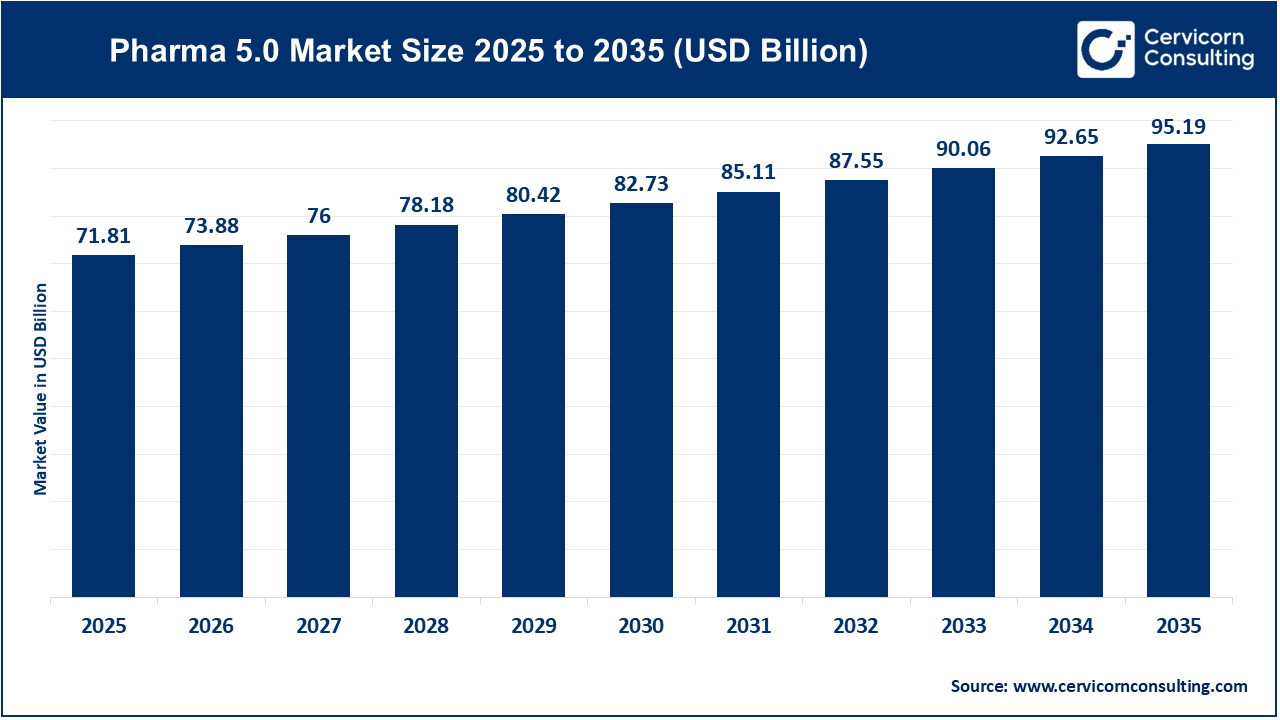
The global pharma 5.0 market was valued at approximately USD 71.81 billion in 2025 and is projected to reach nearly USD 95.19 billion by 2035, expanding at a compound annual growth rate (CAGR) of about 2.86% between 2026 and 2035.
What is the Pharma 5.0 Market?
The Pharma 5.0 market represents the next evolutionary stage of the pharmaceutical industry, integrating advanced digital technologies with human-centric manufacturing and healthcare delivery systems. Building upon the foundations of Industry 4.0, Pharma 5.0 combines artificial intelligence (AI), machine learning (ML), industrial Internet of Things (IIoT), digital twins, robotics, cloud computing, blockchain, advanced analytics, and human-machine collaboration to create more efficient, sustainable, personalized, and resilient pharmaceutical ecosystems.
Pharma 5.0 extends beyond automation by emphasizing collaboration between intelligent machines and skilled professionals. The approach focuses on patient-centric drug development, personalized medicine, sustainable manufacturing practices, predictive maintenance, real-time quality control, and agile supply chain management. Pharmaceutical companies are increasingly leveraging Pharma 5.0 technologies to accelerate drug discovery, optimize clinical trials, enhance manufacturing productivity, and improve patient outcomes.
The market encompasses software platforms, smart manufacturing systems, digital healthcare technologies, advanced robotics, AI-powered research tools, connected devices, and integrated data management solutions used across pharmaceutical research, development, production, distribution, and patient care.
Pharma 5.0 Market Growth Factors
The growth of the Pharma 5.0 market is driven by increasing demand for personalized medicine, rapid adoption of artificial intelligence and machine learning technologies, growing investments in digital transformation initiatives, rising need for operational efficiency in pharmaceutical manufacturing, expansion of smart factories, increasing prevalence of chronic diseases, greater emphasis on quality assurance and regulatory compliance, advancements in cloud computing and big data analytics, growing implementation of industrial IoT systems, rising demand for real-time production monitoring, increased focus on sustainable manufacturing practices, expansion of precision medicine programs, accelerated drug discovery processes through AI-enabled platforms.
Growing adoption of digital twins and predictive analytics, increasing healthcare digitization worldwide, and government support for advanced pharmaceutical manufacturing technologies. Additionally, the need for resilient supply chains, faster vaccine development capabilities, and enhanced patient engagement solutions continues to accelerate the adoption of Pharma 5.0 technologies across global pharmaceutical organizations.
Get a Free Sample: https://www.cervicornconsulting.com/sample/2663
Why is Pharma 5.0 Important?
Enhanced Drug Development
Pharma 5.0 technologies significantly reduce drug discovery timelines by utilizing AI algorithms to identify potential drug candidates, predict molecular interactions, and optimize clinical trial designs. This accelerates the journey from laboratory research to commercial availability.
Personalized Healthcare
The integration of genomic data, AI analytics, and digital health platforms enables pharmaceutical companies to develop personalized treatment plans tailored to individual patient characteristics, improving therapeutic outcomes.
Improved Manufacturing Efficiency
Smart factories equipped with autonomous systems, robotics, and predictive maintenance capabilities minimize production downtime, reduce waste, and enhance manufacturing productivity.
Better Quality Control
Real-time monitoring systems and advanced analytics help identify quality deviations immediately, ensuring compliance with stringent pharmaceutical regulations and reducing product recalls.
Sustainable Operations
Pharma 5.0 promotes energy-efficient manufacturing, optimized resource utilization, and environmentally responsible production practices, supporting global sustainability objectives.
Supply Chain Resilience
Digital supply chain technologies provide end-to-end visibility, predictive forecasting, and risk management capabilities, enabling pharmaceutical companies to respond effectively to disruptions.
Enhanced Patient Outcomes
Connected healthcare ecosystems facilitate continuous patient monitoring, improved treatment adherence, and data-driven healthcare interventions, ultimately leading to better health outcomes.
Major Companies Driving the Pharma 5.0 Market
| Company | Specialization | Key Focus Areas | Notable Features | 2025 Revenue (Approx.) | Market Share* | Global Presence |
|---|---|---|---|---|---|---|
| Pfizer | Biopharmaceuticals | AI-driven drug discovery, digital manufacturing, precision medicine | Advanced analytics platforms, smart manufacturing facilities | USD 65-70 Billion | Significant global pharmaceutical share | Operations in over 125 countries |
| Novartis | Innovative Medicines | Digital transformation, data science, AI-powered R&D | AI-enabled clinical development and manufacturing systems | USD 50-55 Billion | Major global pharmaceutical participant | Presence in more than 140 countries |
| Roche | Pharmaceuticals & Diagnostics | Personalized healthcare, digital diagnostics, data analytics | Strong diagnostics integration and AI-driven healthcare solutions | USD 70-75 Billion | Leading diagnostics and pharma position | Active in over 100 countries |
| AstraZeneca | Biopharmaceutical Innovation | Digital therapeutics, AI research, smart manufacturing | Advanced digital clinical trial technologies | USD 50-55 Billion | Strong oncology and specialty care presence | Operations across 100+ countries |
| Sanofi | Healthcare & Vaccines | Digital health, connected manufacturing, AI innovation | Significant investments in digital transformation initiatives | USD 45-50 Billion | Major pharmaceutical market contributor | Presence in more than 170 countries |
Leading Trends in the Pharma 5.0 Market and Their Impact
1. Artificial Intelligence-Driven Drug Discovery
AI is revolutionizing pharmaceutical research by analyzing vast biological datasets, predicting drug efficacy, and identifying promising molecular targets.
Impact
- Reduced research and development costs
- Faster drug candidate identification
- Improved success rates in clinical development
- Accelerated treatment innovation
2. Digital Twin Technology
Digital twins create virtual replicas of manufacturing facilities, production processes, and pharmaceutical products.
Impact
- Real-time process optimization
- Reduced manufacturing risks
- Enhanced predictive maintenance
- Improved product quality consistency
3. Smart Pharmaceutical Manufacturing
Manufacturers are increasingly implementing automated production systems, robotics, and connected equipment.
Impact
- Increased productivity
- Lower operational expenses
- Reduced human error
- Greater manufacturing flexibility
4. Personalized and Precision Medicine
Advances in genomics and data analytics are enabling highly individualized treatment approaches.
Impact
- Better patient outcomes
- Improved treatment effectiveness
- Reduced adverse drug reactions
- Increased patient satisfaction
5. Blockchain for Pharmaceutical Supply Chains
Blockchain technology is being utilized to improve transparency and traceability throughout pharmaceutical supply networks.
Impact
- Enhanced counterfeit prevention
- Improved regulatory compliance
- Greater supply chain transparency
- Increased stakeholder trust
6. Internet of Medical Things (IoMT)
Connected medical devices and healthcare systems are becoming increasingly important components of Pharma 5.0 ecosystems.
Impact
- Continuous patient monitoring
- Improved treatment adherence
- Enhanced clinical data collection
- Better healthcare decision-making
7. Advanced Robotics and Collaborative Automation
Collaborative robots are working alongside human operators in pharmaceutical production environments.
Impact
- Higher operational efficiency
- Improved workplace safety
- Enhanced production precision
- Greater scalability
8. Sustainable Pharmaceutical Manufacturing
Environmental sustainability has become a strategic priority across the pharmaceutical industry.
Impact
- Reduced carbon emissions
- Lower energy consumption
- Improved resource efficiency
- Compliance with environmental regulations
Successful Examples of Pharma 5.0 Around the World
Pfizer’s AI-Enabled Drug Development Programs
Pfizer has extensively incorporated artificial intelligence and advanced analytics into its drug discovery and clinical development processes. The company’s digital transformation initiatives helped accelerate vaccine development timelines and optimize manufacturing operations through predictive analytics and real-time monitoring systems.
Results
- Faster clinical research execution
- Enhanced manufacturing scalability
- Improved supply chain visibility
Novartis Digital Manufacturing Network
Novartis has developed highly connected manufacturing facilities that leverage AI, IoT sensors, and advanced analytics for real-time production optimization.
Results
- Increased manufacturing productivity
- Reduced operational disruptions
- Enhanced quality management capabilities
Roche Personalized Healthcare Ecosystem
Roche combines pharmaceutical innovation with diagnostic technologies and digital health solutions to support precision medicine initiatives.
Results
- Improved patient stratification
- Better treatment selection
- Enhanced healthcare outcomes
AstraZeneca’s AI-Powered Research Platforms
AstraZeneca utilizes machine learning and advanced computational tools to identify novel therapeutic targets and optimize drug development pipelines.
Results
- Accelerated research timelines
- Increased innovation efficiency
- Enhanced clinical trial success rates
Sanofi’s Smart Factory Initiatives
Sanofi has invested heavily in digital manufacturing technologies, automation systems, and data-driven operational frameworks.
Results
- Greater production efficiency
- Improved product quality
- Enhanced operational resilience
Germany’s Pharmaceutical Smart Manufacturing Ecosystem
Germany has emerged as a leader in Pharma 5.0 adoption through advanced manufacturing technologies, Industry 4.0 integration, and strong collaboration between pharmaceutical companies and technology providers.
Results
- High manufacturing efficiency
- Strong innovation ecosystem
- Advanced digital infrastructure
Singapore’s Digital Pharmaceutical Hub
Singapore has established itself as a global pharmaceutical innovation center through investments in smart manufacturing, AI research, and biotechnology development.
Results
- Increased foreign investment
- Rapid technology adoption
- Enhanced pharmaceutical competitiveness
Global Regional Analysis of the Pharma 5.0 Market
North America
North America remains the largest Pharma 5.0 market due to extensive pharmaceutical R&D investments, strong digital infrastructure, and widespread adoption of advanced manufacturing technologies.
Key Drivers
- Presence of major pharmaceutical companies
- Significant AI and biotechnology investments
- Advanced healthcare infrastructure
- Strong regulatory support for innovation
Government Initiatives and Policies
The United States government supports advanced pharmaceutical manufacturing through initiatives focused on domestic drug production, AI research funding, biotechnology innovation, and digital healthcare transformation. Federal agencies encourage adoption of advanced manufacturing technologies to strengthen supply chain resilience and improve pharmaceutical competitiveness.
Canada supports pharmaceutical innovation through digital health programs, biotechnology research grants, and initiatives promoting smart manufacturing adoption across healthcare and life sciences industries.
Europe
Europe represents a significant Pharma 5.0 market characterized by strong regulatory frameworks, sustainability initiatives, and advanced pharmaceutical manufacturing capabilities.
Key Drivers
- Growing precision medicine programs
- Strong pharmaceutical industry presence
- Increasing investment in digital health technologies
- Sustainability-focused manufacturing strategies
Government Initiatives and Policies
The European Union promotes digital transformation through programs supporting AI adoption, advanced manufacturing, and healthcare innovation. The EU Pharmaceutical Strategy encourages modernization of pharmaceutical production and supply chains.
Germany supports smart manufacturing initiatives through industrial digitalization programs, while France and the United Kingdom continue investing in AI research, biotechnology development, and healthcare digitization.
Asia-Pacific
Asia-Pacific is expected to experience the fastest growth in the Pharma 5.0 market due to rapid industrialization, increasing healthcare investments, and expanding pharmaceutical manufacturing capacity.
Key Drivers
- Growing pharmaceutical production capabilities
- Rising adoption of AI and automation
- Expanding biotechnology sector
- Increasing government support
Government Initiatives and Policies
China
China’s strategic initiatives emphasize artificial intelligence, smart manufacturing, biotechnology innovation, and pharmaceutical modernization. Government programs encourage adoption of advanced digital technologies throughout the pharmaceutical value chain.
India
India promotes pharmaceutical innovation through digital health missions, biotechnology development programs, and manufacturing modernization initiatives. Government support for automation, AI adoption, and pharmaceutical research continues to strengthen the country’s Pharma 5.0 ecosystem.
Japan
Japan invests heavily in robotics, precision medicine, healthcare digitization, and pharmaceutical innovation. Government policies encourage the integration of advanced technologies into healthcare and manufacturing sectors.
South Korea
South Korea supports smart factory development, biotechnology research, and digital healthcare innovation through comprehensive national technology programs.
Latin America
Latin America is gradually adopting Pharma 5.0 technologies as pharmaceutical companies modernize manufacturing facilities and invest in digital transformation initiatives.
Key Drivers
- Expanding healthcare infrastructure
- Increasing pharmaceutical investments
- Growing adoption of automation technologies
- Rising focus on quality compliance
Government Initiatives and Policies
Countries such as Brazil and Mexico are promoting healthcare digitization, biotechnology development, and pharmaceutical manufacturing modernization through investment incentives and innovation programs.
Middle East and Africa
The Middle East and Africa region is witnessing growing adoption of Pharma 5.0 technologies driven by healthcare modernization efforts and increasing pharmaceutical investments.
Key Drivers
- Expanding healthcare infrastructure
- Government-led digital transformation programs
- Growing pharmaceutical manufacturing capabilities
- Rising healthcare expenditures
Government Initiatives and Policies
United Arab Emirates
The UAE promotes artificial intelligence adoption, smart healthcare development, and advanced manufacturing through national innovation strategies and digital transformation programs.
Saudi Arabia
Saudi Arabia’s economic diversification initiatives support pharmaceutical manufacturing, biotechnology innovation, and healthcare technology adoption, creating opportunities for Pharma 5.0 implementation.
South Africa
South Africa continues investing in healthcare modernization, biotechnology research, and pharmaceutical production capabilities to strengthen its healthcare ecosystem.
Future Outlook of the Pharma 5.0 Market
The Pharma 5.0 market is expected to witness substantial expansion as pharmaceutical companies increasingly embrace intelligent automation, AI-powered research, digital manufacturing platforms, and personalized healthcare solutions. The convergence of biotechnology, advanced analytics, cloud computing, robotics, and connected healthcare systems will continue reshaping pharmaceutical operations worldwide. Emerging technologies such as generative AI, quantum computing, digital therapeutics, and autonomous laboratories are likely to further accelerate innovation, improve operational efficiency, and enhance patient outcomes across the global pharmaceutical landscape.
To Get Detailed Overview, Contact Us: https://www.cervicornconsulting.com/contact-us
Read Report: Respiratory Care Devices Market Revenue, Trends, and Strategic Insights by 2035