On-Demand Healthcare Market Revenue, Trends, and Strategic Insights by 2035
On-Demand Healthcare Market Size
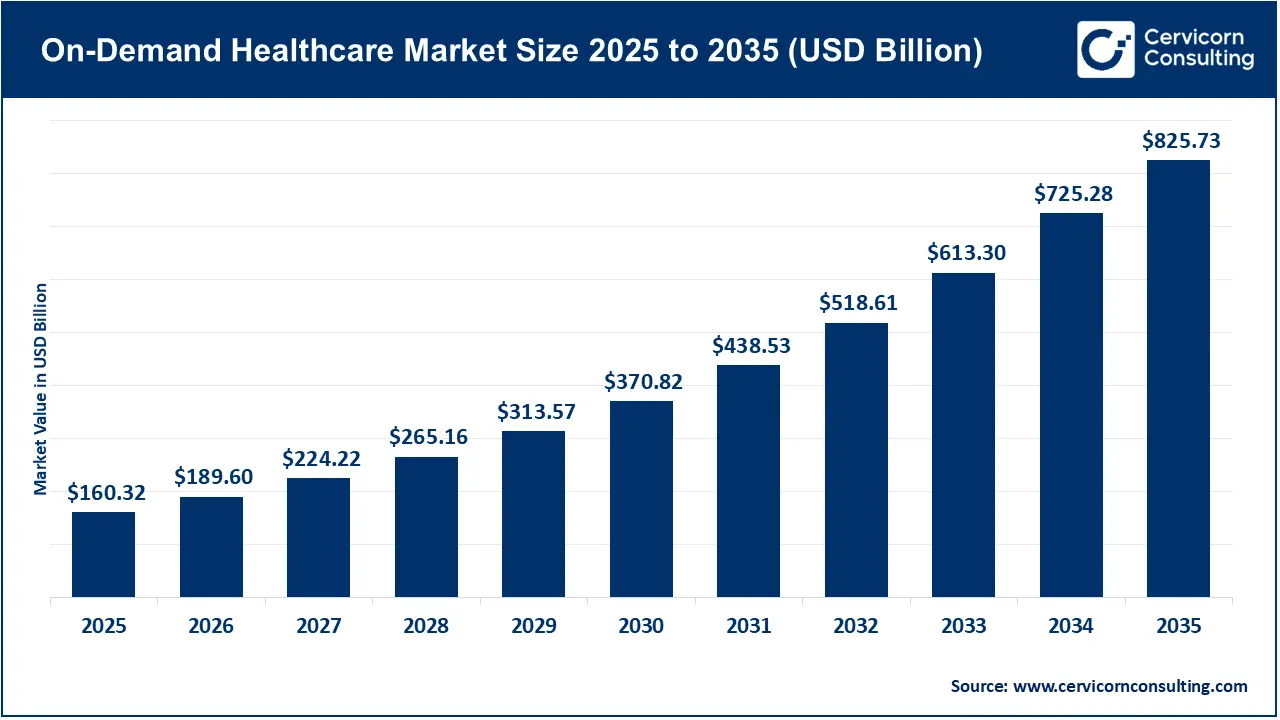
The global on-demand healthcare market was valued at approximately USD 160.32 billion in 2025 and is projected to reach USD 825.73 billion by 2035, expanding at a CAGR of 17.81% during the forecast period.
On-Demand Healthcare Market Growth Factors
The on-demand healthcare market is experiencing rapid expansion due to increasing adoption of telemedicine, widespread smartphone and internet penetration, rising demand for convenient healthcare access, growing prevalence of chronic diseases, aging populations, and advancements in artificial intelligence (AI), cloud computing, and remote patient monitoring technologies. Governments across the globe are investing in digital health infrastructure and introducing supportive telehealth regulations, while healthcare providers are embracing virtual consultations to reduce operational costs and improve patient outcomes. The COVID-19 pandemic permanently accelerated digital healthcare adoption, making virtual care a mainstream healthcare delivery model.
Additionally, increasing healthcare expenditure, shortages of healthcare professionals in rural regions, growing health awareness, integration of wearable devices, and expansion of digital payment ecosystems continue to create significant growth opportunities for the global on-demand healthcare market.
Get a Free Sample: https://www.cervicornconsulting.com/sample/2716
What is the On-Demand Healthcare Market?
The on-demand healthcare market refers to the digital healthcare ecosystem that enables patients to access medical services whenever and wherever they need them through internet-enabled platforms. These services include virtual consultations, online diagnosis, digital prescriptions, mental health counseling, chronic disease management, remote patient monitoring, online pharmacy services, laboratory test booking, AI-powered symptom checking, and home healthcare services.
Unlike traditional healthcare systems that often require scheduled appointments and physical hospital visits, on-demand healthcare platforms connect patients with licensed healthcare professionals through smartphones, tablets, or computers in real time. This patient-centric approach improves accessibility, minimizes waiting times, reduces healthcare costs, and enables continuous monitoring of patients regardless of geographical location.
The market includes healthcare providers, technology companies, insurance organizations, cloud service providers, AI developers, wearable device manufacturers, and pharmaceutical companies working together to deliver personalized digital healthcare experiences.
Today, on-demand healthcare is evolving from simple video consultations into comprehensive virtual healthcare ecosystems that integrate diagnostics, medical imaging, electronic health records (EHRs), prescription management, digital therapeutics, wearable sensors, and predictive analytics.
Why is the On-Demand Healthcare Market Important?
The importance of on-demand healthcare extends beyond convenience. It fundamentally changes how healthcare is delivered, making quality medical services accessible to millions of people who previously faced barriers such as long travel distances, physician shortages, or mobility limitations.
Healthcare systems worldwide are struggling with increasing patient populations, rising healthcare costs, and shortages of skilled medical professionals. On-demand healthcare helps address these challenges by improving healthcare efficiency and optimizing physician productivity.
Virtual healthcare platforms also enable early disease detection through continuous monitoring, reducing emergency hospital admissions and improving long-term disease management. Patients with diabetes, hypertension, cardiovascular diseases, respiratory disorders, and mental health conditions benefit significantly from remote monitoring technologies.
Employers increasingly integrate digital healthcare into employee wellness programs to reduce absenteeism and improve workforce productivity. Insurance providers are also encouraging virtual consultations because they reduce unnecessary emergency department visits and lower overall treatment costs.
Furthermore, on-demand healthcare plays a vital role during public health emergencies by minimizing disease transmission through contactless medical consultations while ensuring uninterrupted patient care.
As healthcare becomes increasingly personalized and data-driven, on-demand healthcare platforms are becoming essential components of future healthcare systems worldwide.
Major Companies Driving the On-Demand Healthcare Market
| Company | Specialization | Key Focus Areas | Notable Features | Estimated 2025 Revenue | Estimated Market Share | Global Presence |
|---|---|---|---|---|---|---|
| Teladoc Health, Inc. | Virtual Healthcare & Telemedicine | Primary care, chronic care, mental health, specialty care | AI-powered virtual care platform, Livongo integration, remote monitoring | Approximately USD 2.7 Billion | 18–20% | North America, Europe, Latin America, Asia-Pacific |
| Amwell (American Well Corporation) | Telehealth Infrastructure | Hospitals, health systems, insurers, virtual specialty care | Enterprise telehealth platform, cloud-based healthcare ecosystem | Approximately USD 1.2 Billion | 10–12% | North America, Europe, Middle East |
| MDLIVE, Inc. | Virtual Physician Services | Primary care, behavioral health, dermatology, urgent care | 24/7 physician access, insurance integration | Approximately USD 850 Million | 7–9% | Primarily North America |
| Doctor on Demand, Inc. | Virtual Medical Consultations | Behavioral health, preventive care, chronic disease management | Personalized virtual healthcare, employer partnerships | Approximately USD 700 Million | 6–8% | North America |
| HealthTap, Inc. | AI-Assisted Telehealth | Primary care, online physician consultations, AI symptom assessment | AI-assisted diagnosis, subscription healthcare model | Approximately USD 350 Million | 3–5% | North America with expanding international services |
Leading Trends Transforming the On-Demand Healthcare Market
Artificial Intelligence is Revolutionizing Virtual Healthcare
Artificial intelligence is becoming one of the most influential technologies in digital healthcare. AI-powered chatbots assist patients before consultations by analyzing symptoms, recommending appropriate specialists, and prioritizing urgent cases.
Machine learning algorithms also assist physicians by identifying disease patterns, predicting patient deterioration, and supporting clinical decision-making.
AI significantly reduces physician workload while improving diagnostic accuracy and patient satisfaction.
Remote Patient Monitoring is Becoming Mainstream
Healthcare providers increasingly use wearable medical devices and connected sensors to continuously monitor patients outside hospitals.
Patients with chronic diseases can share real-time health information, including blood pressure, blood glucose, oxygen saturation, ECG readings, sleep quality, and physical activity levels.
Continuous monitoring allows physicians to intervene early before medical conditions become severe, reducing hospital admissions and healthcare costs.
Mental Health Services are Experiencing Rapid Growth
Demand for virtual behavioral healthcare continues to increase worldwide.
Patients increasingly prefer online counseling due to greater privacy, convenience, reduced stigma, and improved accessibility.
Healthcare platforms now offer virtual psychotherapy, psychiatric consultations, stress management programs, cognitive behavioral therapy (CBT), and digital mental wellness applications.
Employers also invest heavily in virtual mental health programs to improve employee well-being.
Integration of Electronic Health Records Improves Care Coordination
Modern on-demand healthcare platforms integrate directly with hospital information systems and electronic health records.
Physicians can instantly access patient histories, laboratory reports, medications, allergies, imaging studies, and treatment plans during virtual consultations.
Integrated healthcare records improve continuity of care while reducing duplicate testing and medical errors.
Home Healthcare is Expanding Rapidly
Healthcare providers increasingly combine virtual consultations with home healthcare services.
Patients can schedule home laboratory testing, nursing visits, physiotherapy, vaccination, medication delivery, and diagnostic imaging through digital platforms.
This hybrid care model significantly enhances patient convenience while reducing pressure on hospitals.
Personalized Healthcare Powered by Big Data
Healthcare platforms analyze millions of patient records to develop individualized treatment recommendations.
Predictive analytics help identify patients at risk of chronic diseases before symptoms become severe.
Personalized treatment improves clinical outcomes while reducing healthcare expenditures.
Digital Therapeutics are Gaining Momentum
Digital therapeutics combine software applications with evidence-based medical interventions.
Patients receive personalized treatment programs for diabetes, obesity, insomnia, depression, hypertension, and cardiovascular diseases through smartphone applications integrated with healthcare providers.
Digital therapeutics complement traditional medical treatments and improve patient adherence.
Successful Examples of the On-Demand Healthcare Market Around the World
Teladoc Health (United States)
Teladoc has become one of the world’s largest virtual healthcare providers, serving millions of patients through telemedicine, chronic disease management, mental health services, and remote monitoring. Its acquisition of Livongo strengthened its digital chronic care capabilities and demonstrated how virtual healthcare can effectively manage long-term conditions.
Babylon Health (United Kingdom)
Babylon Health pioneered AI-assisted healthcare consultations and symptom assessment tools. Although the company underwent significant restructuring, its innovations influenced the broader adoption of AI-powered virtual healthcare and demonstrated the potential of digital-first primary care models.
Ping An Good Doctor (China)
Ping An Good Doctor developed one of the world’s largest online healthcare ecosystems, combining AI consultation, physician services, appointment scheduling, online pharmacy, medical imaging, and health management.
Millions of users rely on the platform for daily healthcare services across China.
Practo (India)
Practo transformed healthcare accessibility by connecting patients with physicians, diagnostic centers, pharmacies, and hospitals through one integrated platform.
The company continues expanding teleconsultation, digital prescriptions, appointment booking, and electronic medical record solutions across Asia.
Kry (Europe)
Sweden-based Kry (known as Livi in several countries) operates across multiple European nations, providing digital consultations through licensed physicians.
The platform has significantly improved healthcare accessibility in remote regions while reducing pressure on public healthcare systems.
Halodoc (Indonesia)
Halodoc successfully integrates telemedicine, medicine delivery, laboratory testing, insurance services, and healthcare education.
Its comprehensive digital ecosystem has improved healthcare accessibility throughout Indonesia’s geographically dispersed population.
Global Regional Analysis Including Government Initiatives and Policies Shaping the Market
North America
North America remains the largest on-demand healthcare market due to advanced healthcare infrastructure, high internet penetration, strong insurance coverage, and rapid adoption of digital health technologies.
The United States leads global innovation through investments in AI healthcare, remote monitoring, cloud-based healthcare platforms, and digital therapeutics.
Government Initiatives
- Expansion of Medicare reimbursement for telehealth services.
- Increased funding for rural telehealth infrastructure.
- Promotion of interoperability standards for electronic health records.
- Investments in cybersecurity for digital healthcare systems.
- Support for remote patient monitoring reimbursement.
Canada continues expanding virtual healthcare through provincial telemedicine networks while improving healthcare access in remote communities.
Europe
Europe represents one of the fastest-growing digital healthcare regions, supported by universal healthcare systems and strong government investment.
Countries including Germany, France, the United Kingdom, Sweden, Denmark, and the Netherlands actively integrate telemedicine into national healthcare delivery.
Government Initiatives
- European Health Data Space (EHDS) framework for secure health data sharing.
- National reimbursement programs for virtual consultations.
- Cross-border digital health initiatives across European Union member states.
- AI regulatory frameworks supporting responsible healthcare innovation.
- Digital health funding under various EU innovation programs.
European governments increasingly encourage healthcare providers to adopt digital-first care models while protecting patient privacy under strict data regulations.
Asia-Pacific
Asia-Pacific is expected to record the fastest market growth due to large populations, smartphone adoption, expanding healthcare infrastructure, and increasing government investments.
China, India, Japan, South Korea, Singapore, and Australia are leading regional digital healthcare transformation.
Government Initiatives
China
- Healthy China 2030 initiative promoting digital healthcare.
- AI healthcare development strategies.
- Expansion of internet hospitals.
- Digital health insurance reimbursement policies.
India
- Ayushman Bharat Digital Mission creating national digital health infrastructure.
- Digital Health ID implementation.
- Telemedicine Practice Guidelines encouraging virtual consultations.
- Government investment in healthcare digitization.
Japan
- Expanded reimbursement for telemedicine.
- Aging population initiatives promoting remote monitoring.
- AI healthcare innovation funding.
Australia
- Medicare telehealth reimbursement.
- National Digital Health Strategy.
- My Health Record expansion.
Asia-Pacific continues attracting major investments from technology companies developing AI-powered healthcare platforms.
Latin America
Latin America is witnessing significant growth as governments expand digital healthcare services to improve access in rural and underserved communities.
Brazil, Mexico, Argentina, Chile, and Colombia are emerging as important telehealth markets.
Government Initiatives
- National digital health modernization programs.
- Expansion of electronic medical records.
- Telemedicine regulations introduced after the COVID-19 pandemic.
- Public-private healthcare technology partnerships.
- Rural healthcare connectivity projects.
Growing smartphone usage and internet accessibility continue supporting market expansion.
Middle East and Africa
Healthcare digitization is accelerating across the Middle East and Africa due to smart city initiatives, healthcare modernization, and increasing investments in AI.
The United Arab Emirates, Saudi Arabia, Qatar, Israel, and South Africa are leading regional adoption.
Government Initiatives
Saudi Arabia
- Vision 2030 healthcare transformation.
- National digital health strategy.
- AI healthcare investment initiatives.
- Smart hospital development.
United Arab Emirates
- Dubai Health Strategy.
- AI-enabled healthcare programs.
- National telemedicine expansion.
- Smart healthcare infrastructure investment.
South Africa
- National Digital Health Strategy.
- Expansion of electronic health information systems.
- Rural telemedicine initiatives.
African countries increasingly utilize mobile healthcare platforms to overcome physician shortages and improve healthcare accessibility across remote populations.
Future Opportunities Creating Long-Term Market Growth
Several emerging opportunities are expected to accelerate the next phase of on-demand healthcare expansion.
AI-powered clinical decision support systems will improve physician productivity while reducing diagnostic errors. Integration of wearable biosensors with virtual healthcare platforms will enable continuous monitoring of patients with chronic diseases. Advances in 5G connectivity will improve high-quality video consultations, remote diagnostics, and real-time transmission of medical imaging.
Blockchain technology will strengthen healthcare data security and facilitate secure sharing of electronic medical records across healthcare organizations. Digital therapeutics and personalized medicine will further enhance treatment effectiveness by tailoring interventions to individual patient needs.
Expansion into rural and underserved populations, employer-sponsored virtual healthcare programs, value-based care models, and cross-border telemedicine services will create new revenue opportunities for healthcare providers and technology companies.
As healthcare systems increasingly prioritize accessibility, affordability, efficiency, and patient-centered care, the global on-demand healthcare market is expected to remain one of the fastest-growing segments within the digital health industry.
To Get Detailed Overview, Contact Us: https://www.cervicornconsulting.com/contact-us
Read Report: 360-Degree Camera Market Revenue, Trends, and Strategic Insights by 2035