Obesity Clinical Trials Market Revenue, Trends, and Strategic Insights by 2035
Obesity Clinical Trials Market Size
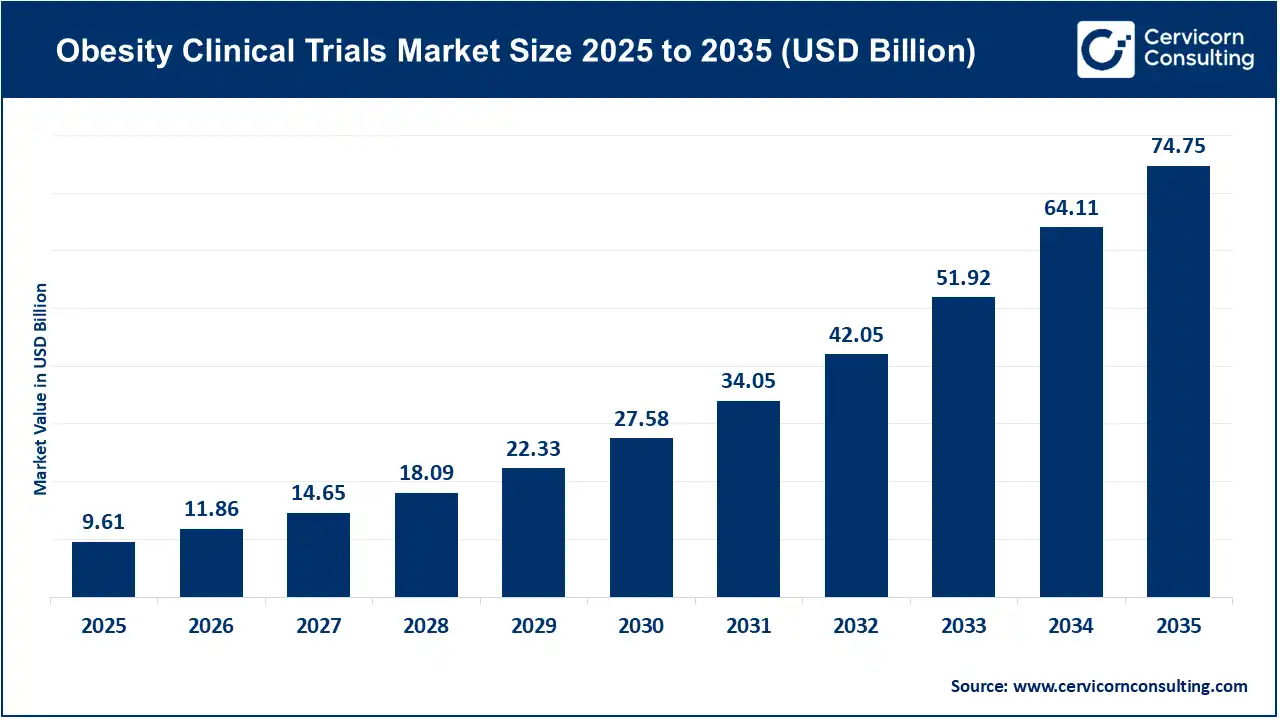
The global obesity clinical trials market was valued at approximately USD 9.61 billion in 2025 and is projected to reach USD 74.75 billion by 2035, expanding at a CAGR of 22.77% during the forecast period.
Obesity Clinical Trials Market Growth Factors
The obesity clinical trials market is experiencing strong growth due to the rapidly increasing global prevalence of obesity, rising healthcare expenditure on obesity-related chronic diseases, growing demand for innovative weight-loss medications, increasing investments by pharmaceutical and biotechnology companies, expanding clinical research infrastructure, favorable regulatory support for metabolic disease therapies, greater adoption of precision medicine, advancements in biomarker discovery, wider implementation of artificial intelligence in clinical trial management, increasing use of decentralized and virtual trial models.
Rising prevalence of diabetes and cardiovascular disorders, growing awareness regarding obesity as a chronic medical condition, improved patient recruitment technologies, expansion of global CRO services, increasing partnerships between academic institutions and pharmaceutical companies, continuous innovation in GLP-1, GIP, amylin, and combination therapies, stronger government support for obesity research, and the growing need to develop safer long-term obesity treatments with improved efficacy and fewer side effects.
Get a Free Sample: https://www.cervicornconsulting.com/sample/2714
What is the Obesity Clinical Trials Market?
The obesity clinical trials market refers to the global ecosystem responsible for designing, conducting, managing, and evaluating clinical studies focused on developing obesity prevention and treatment therapies. These trials investigate new pharmaceutical drugs, biologics, combination therapies, medical devices, digital therapeutics, behavioral interventions, nutritional therapies, and surgical innovations.
Clinical trials generally progress through multiple stages:
- Phase I: Safety evaluation in healthy volunteers.
- Phase II: Dose optimization and early efficacy studies.
- Phase III: Large-scale comparative trials evaluating safety and effectiveness.
- Phase IV: Post-marketing surveillance and long-term safety monitoring.
The market involves numerous stakeholders, including pharmaceutical companies, biotechnology firms, contract research organizations, hospitals, research institutes, regulatory agencies, patient advocacy organizations, and healthcare providers.
Modern obesity clinical trials increasingly incorporate digital monitoring tools, remote patient engagement, wearable sensors, genomic profiling, AI-driven analytics, and real-world evidence to improve study outcomes and patient retention.
Why is the Obesity Clinical Trials Market Important?
Obesity affects hundreds of millions of individuals worldwide and significantly increases the risk of type 2 diabetes, cardiovascular disease, hypertension, fatty liver disease, kidney disorders, sleep apnea, arthritis, and certain cancers. As healthcare systems struggle with rising obesity-related costs, clinical trials play a crucial role in identifying therapies that provide sustainable weight management while improving overall metabolic health.
The market is important because it:
- Accelerates development of breakthrough obesity medications.
- Reduces healthcare costs associated with chronic diseases.
- Supports personalized obesity treatment approaches.
- Generates scientific evidence for regulatory approvals.
- Improves long-term patient outcomes.
- Encourages innovation in metabolic disease management.
- Expands treatment options beyond bariatric surgery.
- Supports global public health initiatives.
- Enables better understanding of obesity biology.
- Improves quality of life for millions of patients.
The growing success of incretin-based therapies has fundamentally changed obesity treatment expectations, creating significant opportunities for next-generation therapeutics.
Major Companies Driving the Obesity Clinical Trials Market
| Company | Specialization | Key Focus Areas | Notable Features | Estimated 2025 Revenue | Estimated Market Share | Global Presence |
|---|---|---|---|---|---|---|
| Novo Nordisk A/S | Diabetes & Obesity Therapeutics | GLP-1 receptor agonists, next-generation obesity drugs | Global leader in obesity drug development with extensive clinical pipeline | Approximately USD 46–48 Billion | Largest obesity therapeutics clinical pipeline | Operates in over 170 countries |
| Eli Lilly and Company | Metabolic Diseases | GLP-1/GIP dual agonists, precision obesity medicine | Strong pipeline with high-efficacy weight-loss therapies | Approximately USD 58–60 Billion | Major global competitor | More than 120 countries |
| Pfizer Inc. | Pharmaceuticals | Oral obesity drugs, metabolic disease research | Expanding oral obesity treatment portfolio | Approximately USD 63–65 Billion | Growing market participant | More than 150 countries |
| Amgen Inc. | Biotechnology | Novel obesity biologics and combination therapies | Focus on long-duration weight-loss therapies | Approximately USD 35–37 Billion | Emerging obesity innovator | More than 100 countries |
| Altimmune, Inc. | Clinical-stage Biotechnology | GLP-1/glucagon dual receptor agonists | Innovative liver disease and obesity clinical programs | Approximately USD 0.05–0.1 Billion | Early-stage clinical innovator | Clinical collaborations across North America and Europe |
Leading Trends Transforming the Obesity Clinical Trials Market
Expansion of GLP-1 and Next-Generation Incretin Therapies
GLP-1 receptor agonists have revolutionized obesity treatment. Companies are now investigating triple agonists, dual agonists, oral formulations, and longer-acting injectable therapies capable of producing greater weight reduction with improved patient convenience.
Impact
- Increased investment in late-stage clinical trials
- Higher success rates
- Greater pharmaceutical competition
- Improved patient outcomes
Personalized Medicine is Reshaping Clinical Research
Researchers increasingly recognize that obesity has multiple biological causes. Clinical trials now include genetic biomarkers, metabolic profiling, microbiome analysis, and precision medicine approaches to identify patient populations that respond best to specific therapies.
Impact
- Better treatment response
- Lower adverse events
- Higher clinical success
- More efficient drug development
Artificial Intelligence Accelerates Trial Efficiency
AI technologies assist researchers in identifying eligible patients, predicting recruitment success, optimizing trial design, analyzing imaging data, and detecting safety signals earlier.
Impact
- Faster recruitment
- Reduced costs
- Improved protocol optimization
- Better data quality
Decentralized Clinical Trials Continue Expanding
Remote patient monitoring, telemedicine, wearable devices, mobile applications, and electronic consent platforms allow patients to participate from home.
Impact
- Increased patient retention
- Broader participant diversity
- Lower operational costs
- Improved accessibility
Combination Therapies Gain Significant Attention
Researchers increasingly investigate therapies combining GLP-1 agonists with glucagon agonists, amylin analogues, GIP agonists, and other metabolic targets.
Impact
- Greater weight reduction
- Improved metabolic outcomes
- Enhanced cardiovascular benefits
- Longer treatment durability
Digital Biomarkers Improve Clinical Monitoring
Smartwatches, continuous glucose monitoring systems, activity trackers, and remote monitoring technologies provide continuous patient data throughout clinical studies.
Impact
- Higher-quality data
- Improved compliance
- Reduced clinic visits
- Better patient engagement
Successful Examples of Obesity Clinical Trials Around the World
Novo Nordisk STEP Clinical Trial Program
The STEP clinical trial program demonstrated remarkable weight-loss outcomes using semaglutide in adults with obesity. These multinational studies significantly influenced obesity treatment guidelines worldwide and accelerated global regulatory approvals.
Eli Lilly SURMOUNT Clinical Trial Program
The SURMOUNT program evaluating tirzepatide produced unprecedented weight-loss results among obese and overweight adults. The trials highlighted improvements in cardiovascular risk factors, metabolic health, and diabetes prevention.
Pfizer Oral GLP-1 Development Programs
Pfizer continues investing in oral obesity therapies aimed at providing patients with convenient alternatives to injectable medications. Clinical trials focus on efficacy, safety, and long-term weight maintenance.
Amgen MariTide Clinical Research
Amgen’s obesity clinical trials investigate long-duration biologic therapies requiring less frequent dosing while maintaining significant weight reduction and metabolic improvements.
Altimmune Pemvidutide Clinical Development
Altimmune is conducting innovative studies evaluating dual GLP-1/glucagon receptor agonists targeting obesity and metabolic dysfunction-associated steatotic liver disease (MASLD), representing an integrated metabolic disease treatment strategy.
Global Regional Analysis
North America
North America represents the largest obesity clinical trials market owing to advanced pharmaceutical research infrastructure, significant R&D investments, high obesity prevalence, favorable reimbursement systems, experienced contract research organizations, and strong regulatory support.
Government Initiatives and Policies
- NIH funding for obesity and metabolic disease research
- FDA Fast Track designation for promising therapies
- Accelerated approval pathways for innovative medicines
- Increased federal investment in precision medicine
- Support for decentralized clinical research
- Expanded digital health regulations
The United States remains the world’s leading hub for obesity clinical trials due to the presence of major pharmaceutical companies and world-class research institutions.
Europe
Europe maintains a strong position supported by collaborative research programs, experienced academic medical centers, favorable regulatory harmonization, and growing public awareness regarding obesity management.
Countries including Germany, France, Denmark, the United Kingdom, Switzerland, Spain, Italy, and the Netherlands actively participate in multinational obesity clinical studies.
Government Initiatives and Policies
- European Medicines Agency support for innovative therapeutics
- Horizon Europe funding programs
- National obesity prevention strategies
- Increased healthcare digitalization
- Cross-border clinical trial collaboration
- Expansion of real-world evidence programs
European regulators increasingly encourage innovative clinical trial methodologies to accelerate therapeutic development.
Asia-Pacific
Asia-Pacific is projected to experience the fastest growth due to rapidly increasing obesity prevalence, expanding pharmaceutical manufacturing, lower clinical trial costs, improving healthcare infrastructure, and growing patient populations.
China, Japan, South Korea, India, Singapore, and Australia are becoming important destinations for multinational obesity clinical research.
Government Initiatives and Policies
- Increased healthcare R&D investments
- National obesity prevention campaigns
- Expansion of biotechnology innovation hubs
- Faster regulatory review processes
- Support for precision medicine
- Incentives for foreign clinical research investment
Growing contract research organizations are further strengthening regional competitiveness.
Latin America
Latin America is becoming an attractive location for obesity clinical trials due to diverse patient populations, experienced investigators, and increasing healthcare modernization.
Brazil, Mexico, Argentina, Chile, and Colombia are major contributors.
Government Initiatives and Policies
- Public-private research collaborations
- Improved clinical trial regulations
- Expansion of academic medical research
- Increased healthcare funding
- National diabetes and obesity prevention initiatives
The region offers substantial opportunities for multinational Phase III studies.
Middle East and Africa
The Middle East and Africa are gradually emerging as promising clinical trial destinations due to increasing obesity prevalence, healthcare investments, and expanding pharmaceutical collaborations.
Countries including Saudi Arabia, the United Arab Emirates, South Africa, Egypt, and Israel are investing in advanced medical research infrastructure.
Government Initiatives and Policies
- National healthcare transformation programs
- Investments in biotechnology research
- Digital healthcare expansion
- Clinical research partnerships
- Regulatory modernization
- Precision medicine initiatives
Government efforts to diversify healthcare economies are expected to attract additional obesity clinical research over the coming years.
Emerging Opportunities in the Obesity Clinical Trials Market
Several emerging opportunities are expected to reshape the market over the next decade:
- Development of oral GLP-1 receptor agonists
- Triple hormone agonist therapies
- Precision obesity medicine based on genetic biomarkers
- AI-powered adaptive clinical trials
- Digital therapeutics integrated with pharmacological treatment
- Combination obesity and diabetes therapies
- Pediatric obesity clinical research
- Long-term cardiovascular outcome studies
- Obesity treatments targeting fatty liver disease and kidney disorders
- Expanded decentralized clinical trial platforms
These opportunities are expected to attract substantial investment from pharmaceutical companies, biotechnology firms, venture capital investors, and public research organizations, driving continued innovation and accelerating the availability of next-generation obesity treatments worldwide.
To Get Detailed Overview, Contact Us: https://www.cervicornconsulting.com/contact-us
Read Report: Small Molecule Injectable Drugs Market Revenue, Trends, and Strategic Insights by 2035