Medical Robots Market Growth Drivers, Trends, Key Players and Regional Insights by 2035
Medical Robots Market Size
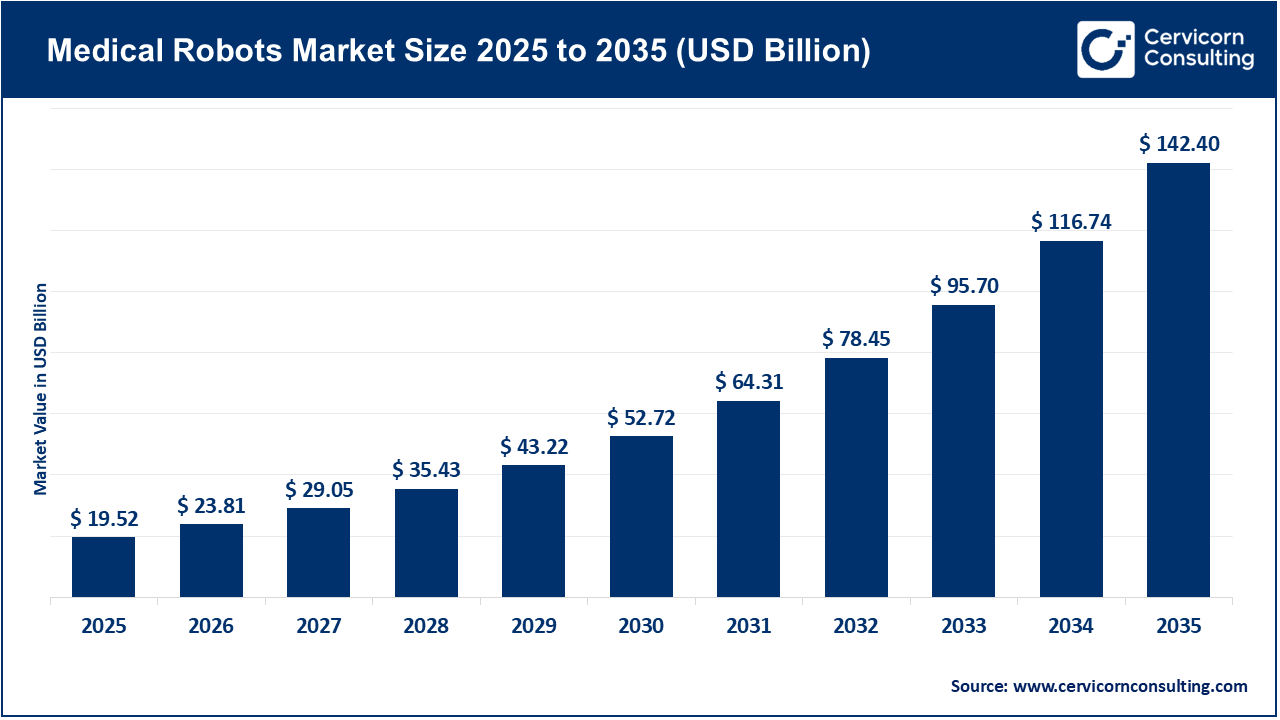
The global medical robots market size was worth USD 19.52 billion in 2025 and is anticipated to expand to around USD 142.40 billion by 2035, registering a compound annual growth rate (CAGR) of 21.98% from 2026 to 2035.
Growth Factors Driving the Medical Robots Market
The global medical robots market is experiencing robust expansion due to a combination of structural healthcare needs and technological advancements. Key growth drivers include the rising prevalence of chronic diseases requiring complex surgical interventions, growing patient demand for minimally invasive procedures, rapid progress in robotics and artificial intelligence (AI), increasing healthcare expenditure, workforce shortages among skilled surgeons and clinicians, and a broader push toward automation within hospitals. Aging populations worldwide are further amplifying demand for robotic-assisted surgeries, rehabilitation systems, and assistive technologies. Additionally, improvements in regulatory approvals, reimbursement policies, and hospital investments in digital infrastructure are accelerating adoption. Together, these forces are reshaping clinical workflows and driving long-term market growth.
What Is the Medical Robots Market?
The medical robots market encompasses robotic technologies designed to assist healthcare professionals across a wide spectrum of clinical applications. Unlike industrial robots, medical robots are engineered for high-precision, safety-critical environments. These systems enhance surgical accuracy, automate repetitive tasks, enable remote procedures, assist rehabilitation, and improve hospital logistics.
Major segments within the market include:
- Surgical Robots – Systems supporting minimally invasive procedures
- Rehabilitation Robots – Devices aiding physical therapy and recovery
- Assistive Robots – Robots supporting elderly and disabled patients
- Telepresence Robots – Platforms enabling remote consultations and procedures
- Hospital & Pharmacy Automation Robots – Systems improving operational efficiency
These technologies collectively aim to improve patient outcomes, increase procedural precision, reduce complications, and optimize healthcare delivery.
Get a Free Sample: https://www.cervicornconsulting.com/sample/2895
Why the Medical Robots Market Is Important
1. Improved Surgical Precision
Medical robots provide sub-millimeter accuracy, reducing human error and enabling complex procedures with enhanced control. This results in fewer complications and better clinical outcomes.
2. Minimally Invasive Care
Robotic systems facilitate smaller incisions, leading to reduced pain, shorter hospital stays, and faster recovery times — major benefits for both patients and providers.
3. Addressing Workforce Shortages
Automation helps compensate for shortages of trained surgeons and clinical staff by improving efficiency and reducing procedural fatigue.
4. Enhanced Patient Safety
Robotic assistance lowers variability in procedures and improves consistency, helping standardize care.
5. Expanded Access to Care
Tele-robotics and remote surgery technologies enable specialists to assist or operate across geographic boundaries, improving access in underserved regions.
6. Operational Efficiency
Robots handling logistics, pharmacy automation, and sterilization reduce administrative burdens and allow clinicians to focus on patient care.
Medical robotics is no longer a niche innovation — it is becoming foundational to modern healthcare systems.
Major Companies Shaping the Medical Robots Market
Intuitive Surgical, Inc.
Specialization:
Intuitive Surgical is the global pioneer in robotic-assisted minimally invasive surgery, best known for the da Vinci Surgical System, one of the most widely adopted surgical robotics platforms worldwide.
Key Focus Areas:
- Robotic-assisted surgery
- Precision instrumentation
- Surgeon training ecosystems
- AI-driven procedural analytics
Notable Features:
- Advanced 3D visualization
- Highly articulated robotic instruments
- Ergonomic surgeon console
- Extensive clinical validation
2024 Revenue:
Intuitive Surgical continues to generate multi-billion-dollar revenues driven by system placements, instruments, and procedure volumes.
Market Share:
Intuitive Surgical maintains a dominant share of the surgical robotics segment globally.
Global Presence:
Strong adoption across North America, Europe, and Asia-Pacific, with expanding penetration in emerging healthcare markets.
Medtronic plc
Specialization:
Medtronic is a diversified medical technology leader with expanding investments in robotic-assisted surgery through the Hugo™ RAS platform.
Key Focus Areas:
- Modular robotic systems
- Cost-efficient robotic solutions
- AI-assisted workflows
- Emerging market expansion
Notable Features:
- Flexible modular architecture
- Competitive pricing strategy
- Multi-specialty surgical applications
- Integrated digital interfaces
2024 Revenue:
Medtronic remains one of the largest global medtech companies, generating tens of billions in annual revenue.
Market Share:
Rapidly growing presence in surgical robotics, particularly as hospitals seek alternatives to established platforms.
Global Presence:
Extensive operations across more than 150 countries.
Stryker Corporation
Specialization:
Stryker is a leader in orthopedic robotic surgery, particularly joint replacement procedures through the MAKO robotic system.
Key Focus Areas:
- Orthopedic robotics
- Joint replacement precision
- Imaging-guided surgery
- Digital surgical planning
Notable Features:
- Patient-specific surgical planning
- High-precision robotic arm guidance
- Integration with imaging technologies
- Proven clinical efficiency
2024 Revenue:
Stryker continues to post strong multi-billion-dollar revenues supported by its robotics and implant portfolios.
Market Share:
Strong leadership in robotic-assisted orthopedic surgery.
Global Presence:
Widely adopted across North America, Europe, and expanding in Asia-Pacific.
Siemens Healthineers AG
Siemens Healthineers integrates robotics within imaging, diagnostics, and interventional solutions rather than focusing on standalone surgical robots.
Key Focus Areas:
- Imaging-guided robotics
- Diagnostic automation
- AI-enhanced clinical systems
- Hybrid operating rooms
Notable Features:
- Advanced imaging integration
- AI-driven analytics
- Strong hospital system connectivity
- Large-scale R&D investment
2024 Revenue:
Siemens Healthineers remains a global healthcare technology powerhouse with substantial annual revenues.
Market Share:
Significant influence through integrated robotics-enabled clinical systems.
Global Presence:
Operations spanning more than 70 countries.
Johnson & Johnson (Ethicon)
Johnson & Johnson is expanding into robotic surgery via its Ethicon division and next-generation platforms.
Key Focus Areas:
- Surgical robotics innovation
- AI-enabled digital surgery
- Multi-procedure robotic platforms
- Minimally invasive technologies
Notable Features:
- Integration with existing surgical ecosystems
- Strong R&D capabilities
- Broad clinical specialization coverage
2024 Revenue:
Johnson & Johnson’s medtech division continues generating tens of billions in revenue annually.
Market Share:
Emerging yet strategically important competitor in surgical robotics.
Global Presence:
Extensive worldwide footprint across developed and emerging markets.
Leading Trends and Their Impact
AI-Powered Robotics
AI integration is enabling smarter surgical assistance, predictive analytics, and real-time decision support, improving accuracy and efficiency.
Minimally Invasive Dominance
Robotic platforms are becoming synonymous with minimally invasive surgery, accelerating adoption across specialties.
Expansion Beyond Surgery
Rehabilitation, eldercare, telepresence, and hospital logistics robotics are gaining momentum.
Cost-Effective Systems
New entrants are introducing modular, lower-cost robotic solutions to broaden accessibility.
Remote & Tele-Robotics
Cross-border robotic procedures are redefining global healthcare delivery.
Personalized & Data-Driven Surgery
Robots increasingly support patient-specific procedural planning.
Successful Global Examples of Medical Robotics
Robotic-Assisted Surgery (Global)
Robotic surgery platforms are now widely used for urology, gynecology, orthopedics, and cardiology procedures.
Orthopedic Robotic Precision
Robotic systems have transformed joint replacement surgeries by enhancing alignment accuracy.
Tele-Robotic Procedures
Remote robotic surgeries demonstrate the potential of robotics in overcoming specialist shortages.
Rehabilitation Robotics
Robots aiding stroke recovery and mobility training are improving therapy outcomes.
Hospital Automation
Logistics and pharmacy robots are enhancing efficiency and reducing errors.
Global Regional Analysis & Government Initiatives
North America
Leads the market due to advanced infrastructure, strong reimbursement support, and high technology adoption.
Government Influence:
- Favorable reimbursement pathways
- Major investments in digital health innovation
- Strong clinical research funding
Europe
Strong adoption supported by public healthcare modernization and innovation incentives.
Government Influence:
- Funding for robotic surgery integration
- Emphasis on patient safety technologies
- Cross-border research collaborations
Asia-Pacific
Fastest-growing region driven by healthcare expansion, medical tourism, and government modernization programs.
Government Influence:
- National AI and robotics strategies
- Investment in smart hospitals
- Rapid regulatory approvals
Countries like China, Japan, South Korea, and India are accelerating robotics adoption.
Latin America
Emerging growth fueled by private hospital investments and healthcare modernization.
Government Influence:
- Digital transformation initiatives
- Gradual expansion of robotic surgery centers
Middle East & Africa
Growth driven by smart hospital initiatives and high-end medical infrastructure projects.
Government Influence:
- National healthcare digitization strategies
- Heavy investment in robotic surgical centers
The Future Outlook of the Medical Robots Market
The medical robots market is positioned for sustained, long-term growth as robotics, AI, imaging, and data analytics converge. As systems become more affordable, compact, and intelligent, adoption will extend beyond large tertiary hospitals into mid-size healthcare facilities globally. Robotics is expected to redefine surgical precision, rehabilitation efficiency, eldercare support, and hospital automation.
To Get Detailed Overview, Contact Us: https://www.cervicornconsulting.com/contact-us
Read Report: Contract Research Organization (CRO) Services Market Revenue, Trends, and Strategic Insights by 2035