Green Chemicals Market Revenue, Trends, and Strategic Insights by 2035
Green Chemicals Market Size
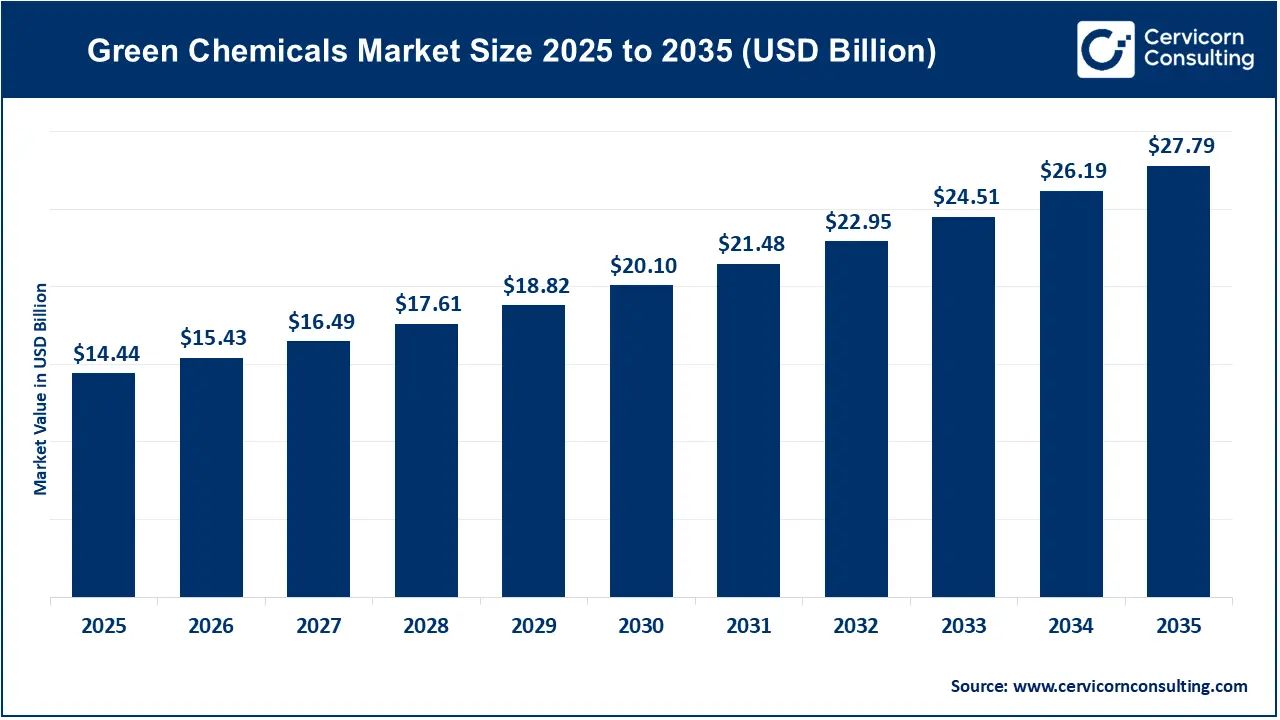
The global green chemicals market was valued at approximately USD 14.44 billion in 2025 and is projected to reach around USD 27.79 billion by 2035, expanding at a CAGR of approximately 6.77% during the forecast period.
Green Chemicals Market Growth Factors
The global green chemicals market is expanding as industries, governments, and consumers increasingly shift away from fossil-based and hazardous chemical production toward renewable, low-carbon, biodegradable, and resource-efficient alternatives. The market is being supported by stricter environmental regulations, corporate net-zero commitments, rising demand for sustainable packaging and materials, advances in biotechnology and fermentation, greater availability of biomass and agricultural feedstocks, and growing investment in circular-economy production.
Green chemicals are also gaining traction because manufacturers are under increasing pressure to reduce greenhouse-gas emissions, water consumption, hazardous waste, and dependence on petroleum-based raw materials. Synthetic biology, metabolic engineering, enzymatic processing, carbon capture and utilization, chemical recycling, and renewable-energy-powered manufacturing are improving the commercial viability of sustainable chemical production.
Get a Free Sample: https://www.cervicornconsulting.com/sample/2735
What Is the Green Chemicals Market?
The green chemicals market comprises chemicals manufactured, processed, or designed using approaches that reduce environmental impact throughout their lifecycle. Unlike conventional chemical production, which has historically relied heavily on petroleum, natural gas, energy-intensive processes, and substances that can generate hazardous waste, green chemistry emphasizes renewable feedstocks, safer formulations, energy efficiency, waste prevention, biodegradability, and lower carbon emissions.
The market includes a broad range of products such as bio-alcohols, bio-organic acids, biopolymers, bio-ketones, bio-solvents, biosurfactants, bio-lubricants, renewable chemical intermediates, and chemicals produced through carbon utilization or recycling. Feedstocks can include sugar and starch crops, agricultural residues, lignocellulosic biomass, algae, industrial waste, captured carbon, and recycled materials.
Technological developments are making it possible to manufacture chemicals through fermentation, enzymatic conversion, metabolic engineering, biocatalysis, and advanced biorefinery processes. These technologies enable companies to produce molecules traditionally derived from fossil resources while reducing their dependence on petroleum-based feedstocks.
The market therefore sits at the intersection of chemical manufacturing, biotechnology, renewable energy, agriculture, waste management, and circular-economy development.
Why Is the Green Chemicals Market Important?
Green chemicals are important because the chemical industry is deeply connected to virtually every major industrial value chain, including packaging, construction, automotive, agriculture, textiles, food and beverages, electronics, pharmaceuticals, cosmetics, and consumer goods. Transforming chemical production can therefore generate environmental benefits across multiple downstream industries.
One of the most important benefits is the potential to reduce dependence on fossil feedstocks. Bio-based chemicals can use renewable carbon from biomass or biological processes instead of relying exclusively on petroleum and natural gas. This can diversify raw-material supply while supporting agricultural and industrial circularity.
Green chemicals can also reduce hazardous substances and pollution. Green chemistry principles encourage manufacturers to prevent waste at source rather than treating waste after it has been generated. Safer solvents, biodegradable materials, renewable feedstocks, and more selective catalytic processes can help reduce environmental and occupational risks.
The market is equally important from an economic perspective. Governments increasingly view sustainable chemistry and biomanufacturing as strategic industries capable of creating new manufacturing capacity, skilled employment, technology development, and export opportunities. India’s BioE3 policy, for example, specifically identifies bio-based chemicals, biopolymers, and enzymes as strategic areas for high-performance biomanufacturing.
Major Companies in the Green Chemicals Market
| Company | Specialization | Key Focus Areas | Notable Features | 2025 Revenue | Market Share* | Global Presence |
|---|---|---|---|---|---|---|
| Dow | Advanced materials, plastics, specialty chemicals | Circular plastics, low-carbon materials, recyclable packaging, sustainable feedstocks | Major global chemical producer with extensive materials portfolio | USD 40.0 billion | Not separately disclosed | Global operations across North America, Europe, Asia Pacific and other regions |
| ADM | Agricultural processing, renewable feedstocks, bio-based ingredients | Biofuels, renewable feedstocks, fermentation, bioproducts | Large-scale agricultural supply chain and processing network | USD 80.3 billion | Not separately disclosed | Global |
| BASF | Chemicals, materials, industrial solutions, specialty chemicals | Sustainable chemistry, circularity, renewable feedstocks, low-carbon production | One of the world’s largest diversified chemical companies | €59.7 billion | Not separately disclosed | Global |
| Cargill, Incorporated | Agricultural commodities, bioindustrial products, food and ingredients | Biofuels, renewable feedstocks, sustainable agriculture, biobased solutions | Extensive agricultural sourcing network | USD 154 billion | Not separately disclosed | 70 countries |
| Corbion | Fermentation, lactic acid, sustainable ingredients and biochemicals | Biochemicals, lactic acid, PLA, natural preservation, fermentation | Strong specialization in bio-based and fermentation technologies | €1.267 billion | Not separately disclosed | Global |
Dow
Dow is one of the largest diversified chemical companies participating in the transition toward more sustainable materials. Its activities span packaging, infrastructure, mobility, consumer applications, coatings, adhesives and advanced materials. Dow reported USD 40.0 billion in net sales for 2025, down from USD 43.0 billion in 2024.
Dow’s green-chemistry focus includes circular plastics, improved recyclability, lower-carbon materials, renewable and recycled feedstocks, and technologies designed to improve the environmental performance of packaging and industrial products. Its global scale gives it an important role in commercializing sustainable materials across established chemical value chains.
ADM
Archer Daniels Midland, commonly known as ADM, provides a particularly important connection between agriculture and green chemical production. Its enormous agricultural processing infrastructure provides renewable feedstocks that can be converted into biofuels, ingredients, specialty products and other bio-based materials.
ADM reported USD 80.269 billion in total revenue in 2025, including USD 61.571 billion from Ag Services and Oilseeds, USD 10.737 billion from Carbohydrate Solutions and USD 7.512 billion from Nutrition.
Its strategic significance for green chemicals comes from its access to corn, oilseeds and other agricultural raw materials, combined with processing, fermentation and biotechnology capabilities.
BASF
BASF is pursuing sustainability through renewable raw materials, circular-economy approaches, lower-carbon production and sustainable product development. BASF generated €59.657 billion in sales in 2025.
Its portfolio spans chemicals, materials, industrial solutions, nutrition and care, agricultural solutions and surface technologies. This broad exposure allows BASF to integrate green-chemistry solutions into applications ranging from automotive and construction materials to agriculture, consumer products and industrial manufacturing.
BASF’s scale also enables sustainability initiatives to be integrated into existing industrial infrastructure rather than being limited to niche applications.
Cargill, Incorporated
Cargill is an important participant in the bio-based economy because of its position in agricultural commodities, renewable feedstocks, biofuels and food and industrial ingredients.
Cargill reported approximately USD 154 billion in annual revenue for fiscal 2025, with operations spanning 70 countries and more than 155,000 employees.
The company’s green-chemistry opportunity is closely associated with agricultural feedstocks, renewable fuels, sustainable supply chains and technologies that turn biological resources into higher-value products. Cargill’s 2025 reporting also highlights investments in renewable biofuels and efforts to create lower-emission agricultural supply chains.
Corbion
Corbion has a particularly strong position in bio-based chemicals because fermentation is central to its business model. The company develops lactic acid and derivatives, sustainable food ingredients, biochemical solutions, and algae-derived products.
Corbion generated €1.2674 billion in sales in 2025, while adjusted EBITDA reached €204.3 million.
Its lactic-acid expertise also connects directly with PLA production, providing a pathway from renewable biological feedstocks to bio-based polymers. Corbion describes sustainability and fermentation expertise as central elements of its strategy.
Leading Trends and Their Impact on the Green Chemicals Market
1. Shift From Fossil Feedstocks to Renewable Carbon
One of the most important market trends is the substitution of petroleum-derived raw materials with renewable carbon sources. Sugar, starch, vegetable oils, agricultural residues, forestry waste, algae and other biological resources are becoming increasingly important feedstocks.
Impact: This trend creates opportunities for agricultural processors, biotechnology companies, chemical manufacturers and biorefineries while reducing dependence on fossil-based carbon.
2. Expansion of Bio-Based Chemicals
Bio-based alcohols, organic acids, polymers and solvents are moving from specialty applications toward larger commercial markets. Bio-alcohols are particularly important because they can be used in solvents, fuels, chemical intermediates and consumer products.
Impact: Greater production scale can reduce unit costs and make renewable alternatives more competitive with conventional chemicals.
3. Synthetic Biology and Fermentation
Synthetic biology is transforming the way chemicals are produced. Microorganisms can be engineered to convert renewable feedstocks into targeted molecules with greater selectivity.
Impact: Companies can potentially produce chemicals with fewer process steps, lower waste generation and reduced energy requirements.
4. Circular Carbon and Chemical Recycling
The market is increasingly moving beyond simply replacing petroleum with biomass. Captured carbon, recycled plastics, industrial waste and other carbon-containing resources are becoming potential raw materials.
Impact: This expands the definition of green chemistry and creates opportunities for carbon-to-chemicals technologies, advanced recycling and closed-loop manufacturing.
5. Sustainable Packaging
Packaging is a major demand center for green chemicals because brand owners face increasing pressure to reduce plastic waste and improve recyclability. Bio-based polymers, biodegradable materials, recyclable additives and renewable coatings are gaining attention.
Impact: Packaging companies increasingly become direct drivers of sustainable chemical innovation through procurement requirements and long-term supply agreements.
6. Low-Carbon Manufacturing
The environmental profile of a chemical increasingly depends not only on its feedstock but also on how it is manufactured. Renewable electricity, electrified processes, green hydrogen and energy-efficient reactors are therefore becoming important components of sustainable chemistry.
Impact: Chemical producers are being pushed to decarbonize existing facilities while developing new production pathways with lower lifecycle emissions.
7. Traceability and Product Carbon Footprints
Customers increasingly want information about feedstock origin, carbon intensity and environmental performance. Digital traceability and lifecycle assessment are therefore becoming more important.
Impact: Companies able to document the sustainability characteristics of products can gain advantages in procurement, regulatory compliance and premium markets.
Successful Examples of the Green Chemicals Market Around the World
Bio-Based Plastics and PLA in Europe and North America
PLA is one of the clearest examples of commercial green chemistry. Lactic acid can be produced through fermentation of renewable carbohydrates and subsequently converted into polylactic acid for packaging, food-service products, fibers and other applications. Companies such as Corbion have developed industrial-scale capabilities around lactic acid and PLA.
This example demonstrates how fermentation can transform agricultural feedstocks into materials capable of replacing certain conventional petroleum-derived plastics.
Renewable Ethanol and Bio-Based Chemicals in the United States
The United States has developed a large biofuel ecosystem based on corn and other renewable feedstocks. Companies such as ADM and Cargill participate in agricultural processing and renewable-fuel value chains.
The wider importance is that established agricultural infrastructure can provide feedstock, logistics and processing capabilities for a broader bio-based chemical industry.
India’s Bio-Based Chemical Development
India is emerging as an important hub for biomanufacturing. Under the BioE3 Policy, the Department of Biotechnology is supporting bio-based chemicals, biopolymers and APIs through research, strain engineering, pilot-scale demonstrations and biomanufacturing infrastructure. The program specifically identifies products such as biosurfactants, pigments, flavor and fragrance chemicals, squalene and itaconic acid.
This approach is significant because it seeks to move technologies from laboratory research toward commercial-scale production while leveraging India’s biotechnology ecosystem.
European Bio-Based Industrial Development
Europe is also attempting to build industrial-scale bio-based capacity. The European Commission identifies bio-based chemicals, bioplastics and polymers, fibers, construction products, fertilizers and plant-protection products as important lead markets. The Commission estimates €1–2 billion in investments for capacity development under its biobased-industry initiatives and has outlined a goal of creating €10 billion in offtake agreements by 2030.
The development of offtake markets is particularly important because many green-chemical technologies face a financing gap between pilot demonstration and commercial-scale manufacturing.
Global Regional Analysis
North America
North America is a major green chemicals market, with Grand View Research estimating that the region accounted for 30.8% of global revenue in 2025.
The region benefits from extensive agricultural feedstock availability, mature chemical infrastructure, strong biotechnology capabilities, and demand from packaging, automotive, construction, food and consumer-goods companies.
The United States has particularly strong capabilities in biotechnology, fermentation, renewable fuels and advanced materials. Agricultural companies such as ADM and Cargill provide access to renewable feedstocks, while major chemical companies such as Dow provide industrial-scale manufacturing and downstream market access.
Government policies supporting clean manufacturing, renewable energy, carbon reduction and domestic biomanufacturing are reinforcing investment. At the same time, corporate sustainability commitments are creating demand for lower-carbon materials.
Europe
Europe is one of the most policy-driven markets for green chemistry. The EU’s chemicals policy has increasingly focused on reducing hazardous substances, promoting circularity and improving industrial sustainability. Bio-based products are also being incorporated into broader circular-economy and industrial strategies.
In July 2025, the European Commission introduced an action plan for a stronger chemical industry that included measures related to decarbonization, affordable energy, innovation and fiscal incentives to stimulate demand for clean chemicals.
Europe’s bioeconomy already represents a major economic base. The European Commission estimates that the bioeconomy generated up to €863 billion in value added and employed approximately 17.1 million people in 2023.
Government initiatives and policies: REACH, the EU Chemicals Strategy for Sustainability, the Circular Economy Action Plan, industrial decarbonization programs, bioeconomy strategies and emerging demand-side measures are shaping investment decisions.
Asia Pacific
Asia Pacific is expected to remain one of the most dynamic areas of the green chemicals market. Rapid industrialization, large manufacturing bases, expanding consumer markets and increasing sustainability requirements are supporting demand.
China has a particularly influential chemical industry and is increasingly emphasizing energy efficiency, pollution reduction, digitalization and green manufacturing. Its 2025–2026 petrochemical and chemical-industry growth plan encourages energy, water and emissions-reduction upgrades, development of green standards and the promotion of non-food bio-based materials.
Japan is pursuing its Green Transformation (GX) strategy to shift its industrial and social structure toward clean energy and lower-carbon production. Japan’s GX framework combines decarbonization, economic growth and energy security, while carbon-pricing and emissions-trading mechanisms are being strengthened.
Government initiatives and policies: China’s green manufacturing programs, Japan’s GX2040 Vision and emissions-trading framework, and sustainability policies across South Korea, India and Southeast Asia are expected to encourage investment in renewable feedstocks, energy-efficient chemical production and bio-based materials.
India
India has significant potential because of its large agricultural economy, expanding biotechnology sector, chemical-manufacturing base and growing emphasis on green growth.
The BioE3 Policy is particularly important. It promotes high-performance biomanufacturing through biofoundries, biomanufacturing hubs and Bio-AI hubs, with bio-based chemicals and enzymes among its six strategic thematic areas.
The Department of Biotechnology has also supported research and scale-up initiatives for bio-based chemicals, biopolymers and APIs, including work on indigenous microbial production strains and pilot-scale biomanufacturing.
India’s broader bioeconomy ambitions further strengthen the opportunity. NITI Aayog’s roadmap projects India’s bioindustrial sector—including biofuels, bio-based chemicals, enzymes, biopolymers and carbon-capture technologies—at USD 180.4 billion by 2030, with further growth projected through 2035 and 2047.
Latin America
Latin America has an important structural advantage in green chemicals because of its agricultural resources, sugarcane production, biofuels industry and availability of biomass.
Brazil is particularly well positioned because of its established sugarcane ethanol industry and large agricultural sector. The combination of renewable feedstocks, agricultural processing infrastructure and chemical manufacturing creates opportunities to expand from biofuels into higher-value biochemical products.
Government policies supporting renewable fuels, circular production and bio-based industrial development can encourage greater investment in biorefineries and renewable chemical intermediates.
Middle East & Africa
The Middle East and Africa represent an emerging opportunity. Gulf economies are investing heavily in industrial diversification, renewable energy, hydrogen and carbon-management technologies. These capabilities could eventually support green chemical production based on low-carbon energy and captured carbon.
Africa offers substantial biomass and agricultural-residue resources, although infrastructure, financing, logistics and technology availability remain important constraints.
In the Middle East, green hydrogen, carbon capture and renewable electricity could enable new pathways for producing low-carbon chemicals and synthetic fuels. Meanwhile, African economies can potentially leverage agricultural residues and bio-waste to develop decentralized biochemical production.
Government Initiatives and Policies Shaping the Green Chemicals Market
Government policy is becoming one of the strongest forces influencing the green chemicals industry. The market is no longer driven solely by consumer preferences; it is increasingly shaped by carbon-pricing systems, environmental standards, renewable-energy policies, public procurement, research grants and industrial investment programs.
In Europe, the European Commission is combining chemical regulation with industrial competitiveness and decarbonization measures. The 2025 chemical-industry action plan emphasizes innovation, energy costs and incentives that can strengthen demand for cleaner chemicals.
In India, BioE3 provides a direct policy mechanism for developing high-performance biomanufacturing, including bio-based chemicals and biopolymers. Its emphasis on shared infrastructure and pilot-scale development is designed to address the gap between laboratory research and commercial manufacturing.
In Japan, the GX framework is linking industrial decarbonization with economic growth. Japan’s government has been developing carbon-pricing and emissions-trading mechanisms while encouraging investment in clean technologies.
In China, industrial policy is encouraging petrochemical and chemical manufacturers to improve energy efficiency, reduce emissions, strengthen green standards and develop non-food bio-based materials.
Across these markets, the common direction is clear: governments are attempting to make low-carbon production more economically viable while reducing the environmental externalities associated with conventional chemical manufacturing.
Market Outlook
The green chemicals market is moving from a sustainability niche toward a broader industrial transformation. Market forecasts vary according to the definition and product coverage used by individual research organizations, but recent estimates consistently indicate strong growth. Grand View Research estimates a USD 120.5 billion market in 2025 and USD 270.1 billion by 2033, while Mordor Intelligence estimates USD 121.56 billion in 2025 and USD 201.17 billion by 2030.
The next stage of growth will depend increasingly on the ability of manufacturers to achieve cost competitiveness, secure reliable renewable feedstocks, scale fermentation and biotechnology platforms, verify lifecycle emissions, and build commercial supply chains.
For chemical producers, agricultural companies, biotechnology firms, packaging manufacturers, automotive suppliers and investors, the greatest opportunities are likely to emerge where renewable feedstocks, advanced biotechnology, circular carbon, low-carbon energy and established chemical infrastructure intersect. As regulations become stricter and customers demand measurable environmental improvements, companies capable of delivering sustainable chemistry at industrial scale are positioned to capture an increasing share of future chemical demand.
To Get Detailed Overview, Contact Us: https://www.cervicornconsulting.com/contact-us
Read Report: Oral Care Market Revenue, Trends, and Strategic Insights by 2035